Sugar Creek Trading Company
Gum Arabic Acacia Gum
Gum Arabic Acacia Gum
Impossible de charger la disponibilité du service de retrait
ACACIA SENEGAL
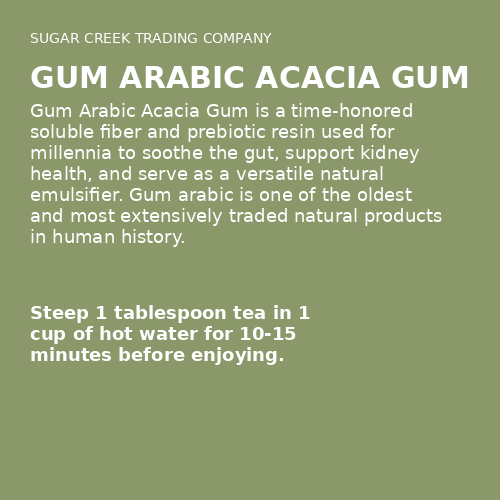
A time-honored soluble fiber and prebiotic resin used for millennia to soothe the gut, support kidney health, and serve as a versatile natural emulsifier.
BOTANICAL IDENTIFICATION
Scientific Name: Acacia senegal (L.) Willd. (syn. Senegalia senegal)
Common Names: Gum arabic, acacia gum, acacia fiber, Kordofan gum, hashab gum, gum acacia
Family: Fabaceae (Legume family), subfamily Mimosoideae
Acacia senegal is a small to medium-sized thorny deciduous tree growing 15 to 30 feet tall, with a characteristically flat-topped, umbrella-shaped crown. The bark is yellowish-brown to grey and fissured, with paired, curved thorns at the base of each leaf. Leaves are bipinnate with numerous tiny leaflets, and the tree produces fragrant, creamy-white to pale yellow spike-like flower clusters. The gum exudes naturally from cracks in the bark or from deliberate incisions, hardening into translucent, amber-colored, rounded nodules or tear-shaped pieces.
Native to the semi-arid Sahel belt of sub-Saharan Africa, Acacia senegal thrives in dry, sandy soils with seasonal rainfall between 100 and 800 millimeters annually. The primary production region is the "gum belt" stretching across Sudan (which produces the majority of the world's supply), Chad, Senegal, Nigeria, Mali, Mauritania, and other West and East African nations. The tree is nitrogen-fixing, playing a vital ecological role in preventing desertification.
CULTURAL AND HISTORICAL USE
Gum arabic is one of the oldest and most extensively traded natural products in human history. Ancient Egyptians used it as early as 2000 BCE as an adhesive in mummification, as a binder in paints and inks, and as a medicinal demulcent for sore throats and digestive complaints. It appears in the Ebers Papyrus (circa 1550 BCE), one of the earliest known medical texts, prescribed for burns, wounds, and intestinal ailments. The gum was so valued that it formed a significant component of trade along caravan routes from sub-Saharan Africa to the Mediterranean world.
In traditional African medicine, gum arabic has been used for centuries to treat diarrhea, dysentery, coughs, and skin inflammation. In Sudanese folk medicine, it is dissolved in water and consumed daily as a general health tonic and kidney-protective agent, a practice that has been validated by modern clinical research. The Hausa and Fulani peoples of West Africa use it both medicinally and as a food stabilizer. In the Arabian Peninsula, gum arabic has long been consumed dissolved in water during Ramadan fasting as a gentle, nourishing preparation that supports digestive and kidney health.
In Western commerce, gum arabic has been indispensable since at least the Middle Ages, used in pharmaceutical preparations, confections, watercolor paints, lithography, and as a stabilizer in beverages. It remains one of the most widely used food-grade hydrocolloids globally, found in soft drinks, candies, baked goods, and countless processed foods as emulsifier E414. Its medicinal applications, however, are increasingly recognized as equally significant.
KEY BIOACTIVE COMPOUNDS & BENEFITS
| Compound/Class | Location in Plant | Human Benefit | Role in Plant |
|---|---|---|---|
| Arabinogalactan polysaccharides | Gum exudate (primary component, ~97%) | Prebiotic fiber, immune modulation, cholesterol binding | Wound sealing, moisture retention, pathogen barrier |
| Glycoproteins (arabinogalactan-protein complex) | Gum exudate | Emulsification, immune stimulation, gut mucosal support | Structural component of the wound-sealing resin |
| Soluble dietary fiber (>85%) | Gum exudate | Prebiotic, satiety, blood sugar regulation, kidney support | N/A (functional classification) |
| Minerals (calcium, magnesium, potassium) | Gum exudate | Electrolyte balance, enzymatic cofactors | Mineral components of the resin matrix |
| Phenolic compounds (minor fraction) | Gum exudate | Antioxidant activity | Antimicrobial defense at wound site |
Gum arabic is unique among dietary fibers for its exceptionally high solubility, low viscosity at high concentrations, and strong prebiotic activity. Unlike many fibers that cause bloating and gas, gum arabic is fermented slowly in the lower colon, producing short-chain fatty acids (especially butyrate) with minimal gas production. Its arabinogalactan-protein complex also provides distinct immune-modulating properties beyond those of simple fiber, making it a multifunctional wellness ingredient.
HOW IT WORKS IN THE BODY
Gum arabic exerts its health benefits primarily through its behavior as a soluble prebiotic fiber and its interactions with the gut microbiome and renal system:
Prebiotic and Gut Microbiome Support:
Gum arabic passes through the stomach and small intestine intact, reaching the colon where it serves as a selective fermentation substrate for beneficial bacteria, particularly Bifidobacteria and Lactobacilli. This fermentation produces short-chain fatty acids (SCFAs), especially butyrate, which nourish colonocytes, strengthen the intestinal barrier, reduce intestinal inflammation, and support healthy immune function throughout the gut-associated lymphoid tissue (GALT).
Kidney and Renal Support:
Clinical studies in patients with chronic kidney disease have demonstrated that gum arabic supplementation significantly reduces blood urea nitrogen (BUN) and creatinine levels. The proposed mechanism involves enhanced fecal nitrogen excretion driven by the shift in gut microbiome composition, effectively creating an alternative route for nitrogenous waste elimination that reduces the burden on compromised kidneys.
Metabolic and Glycemic Regulation:
As a high-molecular-weight soluble fiber, gum arabic slows gastric emptying and the absorption of glucose from the small intestine, contributing to more stable postprandial blood sugar levels. Its fermentation products also improve insulin sensitivity at the cellular level through SCFA-mediated signaling pathways.
Anti-inflammatory and Immune Modulation:
The arabinogalactan-protein fraction stimulates macrophage activity and modulates cytokine production, supporting balanced immune function. The butyrate produced from colonic fermentation further contributes to systemic anti-inflammatory effects by inhibiting NF-kB signaling in intestinal and immune cells.
DOSE GUIDELINES
| Preparation Type | Typical Dose | Purpose |
|---|---|---|
| Gum arabic powder dissolved in water | 5-30 grams daily (start low, increase gradually) | Prebiotic fiber, gut health, kidney support |
| Kidney support protocol | 25-50 grams daily, divided into 2-3 doses | Reduction of BUN and creatinine in CKD (under medical supervision) |
| General wellness and fiber supplementation | 5-15 grams daily in water or beverages | Digestive regularity, blood sugar support, prebiotic |
| Culinary and beverage use | As desired for thickening and emulsification | Food-grade emulsifier, stabilizer, fiber enrichment |
Start with a lower dose (5 grams daily) and increase gradually over 1 to 2 weeks to allow the gut microbiome to adapt, minimizing any initial mild bloating. Gum arabic is one of the best-tolerated fibers available, but gradual introduction is still advisable. It can be taken long-term as a daily supplement.
PREPARATION AND USES
Gum arabic powder dissolves readily in water, forming a clear to slightly opalescent solution with a mild, neutral taste. Simply stir or whisk the desired amount into room-temperature or warm water and drink. It can also be added to juices, smoothies, teas, or other beverages without significantly altering their flavor. For a traditional Sudanese preparation, dissolve gum arabic powder in water with a squeeze of lemon and a touch of honey for a refreshing daily health drink.
Beyond direct consumption, gum arabic is extraordinarily versatile. It serves as a natural emulsifier and stabilizer in homemade salad dressings, beverages, and confections. It can be used as a binder in herbal capsule and tablet formulations. In skincare, it is used as a soothing, film-forming agent in face masks and lotions. For herbal preparations, gum arabic can serve as a carrier or binder for powdered herb blends, improving their consistency and shelf stability.
OPTIMAL CONTEXT FOR USE
This botanical product is especially well-suited for individuals experiencing:
Digestive irregularity, dysbiosis, or a desire to increase prebiotic fiber intake without the bloating and gas common to other fibers
Chronic kidney disease or elevated BUN/creatinine levels, as an adjunct to conventional medical management (under physician supervision)
Blood sugar instability or metabolic syndrome, where soluble fiber can support glycemic control
Inflammatory bowel conditions (IBS, mild colitis) where a gentle, well-tolerated fiber source is needed to support mucosal healing
A need for a clean, food-grade natural emulsifier or binder in herbal preparations, beverages, or homemade foods
Gum arabic combines well with probiotics (providing substrate for their growth), with marshmallow root and slippery elm for comprehensive gut soothing, or with cinnamon and fenugreek for blood sugar support protocols.
SUSTAINABILITY AND ETHICAL HARVESTING
Gum arabic production is a cornerstone of sustainable agroforestry in the African Sahel, where Acacia senegal trees are deliberately cultivated and maintained in "gum gardens" that serve as vital buffers against desertification. The trees fix atmospheric nitrogen, enrich the soil, provide shade for crops and livestock, and offer an important dry-season income source for millions of smallholder farmers across Sudan, Chad, Senegal, and neighboring countries. Gum tapping is a low-impact, renewable harvest that does not kill the tree when practiced correctly.
Purchasing gum arabic directly supports the livelihoods of some of the world's most economically vulnerable farming communities while incentivizing the maintenance and expansion of tree cover in an ecologically fragile region. Ethical sourcing considerations include ensuring fair prices reach tappers and farming families, and supporting cooperative structures that give producers greater bargaining power in the global market.
SAFETY AND CAUTIONS
Gum arabic is classified as GRAS (Generally Recognized as Safe) by the FDA and is one of the safest and most well-tolerated dietary fibers available.
Mild bloating or gas may occur when first introducing gum arabic, particularly at higher doses. This typically resolves within a few days as the gut microbiome adjusts. Start with a lower dose and increase gradually.
Individuals with known allergy to Acacia or legume family plants should exercise caution, though true allergy to gum arabic is rare. Occupational exposure to airborne gum arabic dust has occasionally caused respiratory sensitization in industrial settings.
Gum arabic may reduce the absorption of certain medications (particularly antibiotics like amoxicillin) if taken simultaneously, due to its gel-forming properties in the gut. Separate medication and gum arabic intake by at least 2 hours.
Safe for use during pregnancy and nursing at food-level doses. Higher supplemental doses during pregnancy have not been extensively studied, so moderate use is advisable.
REFERENCES
Ali, B.H., Ziada, A., & Blunden, G. (2009). "Biological effects of gum arabic: A review of some recent research." Food and Chemical Toxicology, 47(1), 1-8.
Calame, W., Weseler, A.R., Viebke, C., Flynn, C., & Siemensma, A.D. (2008). "Gum arabic establishes prebiotic functionality in healthy human volunteers in a dose-dependent manner." British Journal of Nutrition, 100(6), 1269-1275.
Al-Mosawi, A.J. (2002). "The use of acacia gum in end stage renal failure." Journal of Tropical Pediatrics, 48(6), 369-370.
FINAL NOTE
Gum arabic is a quiet powerhouse among botanical products, one that rarely receives the attention of flashier herbs yet delivers profound and well-documented benefits to gut health, kidney function, and metabolic balance. Its 4,000-year track record of safe human use, combined with modern clinical validation of its prebiotic and renal-protective properties, makes it one of the most evidence-supported natural fibers available. It is also a product whose purchase directly supports sustainable forestry and rural livelihoods in some of the world's most challenging landscapes.
Share