Sugar Creek Trading Company
Olive Leaf
Olive Leaf
Impossible de charger la disponibilité du service de retrait
Olea europaea
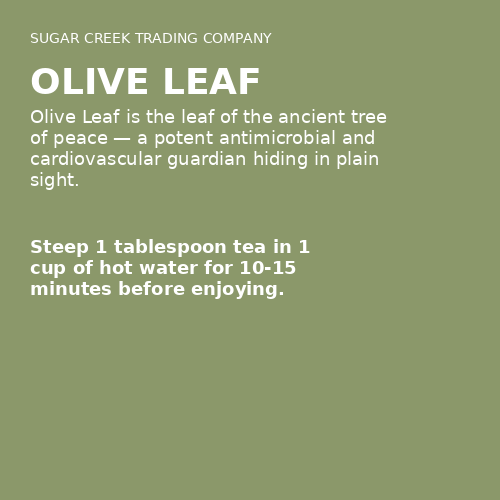
The leaf of the ancient tree of peace — a potent antimicrobial and cardiovascular guardian hiding in plain sight.
Botanical Identification
- Common Name: Olive Leaf
- Latin Name: Olea europaea L.
- Family: Oleaceae (Olive family)
- Parts Used: Dried leaf (whole or cut-and-sifted)
- Native Range: Mediterranean Basin, extending into the Near East and North Africa
- Growth Habit: Long-lived evergreen tree, 8-15 meters tall, with gnarled trunks, silvery-green lanceolate leaves, and small white flowers producing the familiar olive drupe
Cultural and Historical Use
The olive tree is among the most symbolically loaded plants in human civilization — a sign of peace, wisdom, abundance, and endurance across Greek, Roman, Egyptian, and Abrahamic traditions. While the fruit and its oil have dominated commerce and cuisine for millennia, the leaf has its own deep medicinal lineage. Ancient Egyptians used olive leaf preparations in mummification and as a treatment for fevers. Hippocrates prescribed olive leaf tea for a range of ailments. In traditional Mediterranean folk medicine, olive leaf decoctions were standard remedies for malaria, fevers, and infections long before the mechanism was understood. By the mid-19th century, European physicians documented olive leaf's ability to reduce fever in malaria patients, and in the 1960s, researchers at the pharmaceutical company Upjohn isolated oleuropein, identifying the compound responsible for much of the leaf's antimicrobial power. Today, olive leaf occupies a significant position in evidence-based herbal medicine, particularly for cardiovascular and immune support.
Key Bioactive Compounds
| Compound | Class | Primary Action |
|---|---|---|
| Oleuropein | Secoiridoid glycoside | Antimicrobial, antioxidant, anti-inflammatory, antihypertensive; the signature compound of olive leaf |
| Hydroxytyrosol | Phenolic alcohol | One of the most potent natural antioxidants known; cardioprotective, neuroprotective |
| Oleanolic acid | Pentacyclic triterpenoid | Hepatoprotective, anti-inflammatory, antitumor activity in vitro |
| Luteolin | Flavonoid | Anti-inflammatory, antioxidant, neuroprotective |
| Apigenin | Flavonoid | Anxiolytic, anti-inflammatory, supports GABA signaling |
| Verbascoside (acteoside) | Phenylethanoid glycoside | Antioxidant, antimicrobial, immunomodulatory |
How It Works in the Body
Oleuropein is the central actor in olive leaf pharmacology. It exerts broad-spectrum antimicrobial activity by disrupting the cell membranes of bacteria and interfering with viral replication — studies have demonstrated activity against influenza, herpes simplex, and HIV in vitro, though clinical applications require further research. In the cardiovascular system, oleuropein and its metabolite hydroxytyrosol work synergistically: oleuropein inhibits angiotensin-converting enzyme (ACE), reducing blood pressure through a mechanism similar to pharmaceutical ACE inhibitors, while hydroxytyrosol protects LDL cholesterol from oxidation — a key step in atherosclerotic plaque formation. Hydroxytyrosol's antioxidant capacity, measured by oxygen radical absorbance capacity (ORAC), exceeds that of vitamin C, vitamin E, and most other dietary polyphenols. Oleanolic acid contributes hepatoprotective effects, supporting phase I and phase II liver detoxification enzymes. The overall action is one of systemic protection: antimicrobial defense, vascular integrity, antioxidant buffering, and metabolic support.
Dose Guidelines
| Form | Typical Dose | Notes |
|---|---|---|
| Dried leaf tea | 3-5 grams in 8 oz boiling water | Steep 10-15 minutes, covered; flavor is distinctly bitter and astringent |
| Tincture (1:5, 45% alcohol) | 3-5 mL, three times daily | Best for consistent daily use; easier to dose than tea |
| Decoction (stronger preparation) | 5-10 grams simmered 15-20 minutes per quart | Traditional method for acute immune support; more concentrated than infusion |
| Powdered leaf | 1-3 grams daily | Can be encapsulated or mixed into smoothies; slightly less bioavailable than liquid preparations |
Preparation and Uses
- Daily wellness tea: Steep 3-5 grams of dried olive leaf in freshly boiled water for 10-15 minutes. The tea is notably bitter; add lemon and honey to taste. Drink 1-3 cups daily for cardiovascular and immune maintenance.
- Acute immune protocol: At the first sign of cold or flu, prepare a stronger decoction by simmering 10 grams in 2 cups of water for 15 minutes. Drink in divided doses throughout the day for up to one week.
- Blending partners: Olive leaf pairs well with elderberry (immune synergy), hawthorn berry (cardiovascular synergy), and lemon balm (flavor balance and antiviral support).
- Cold infusion: For a milder flavor profile, steep olive leaf in room-temperature water for 4-8 hours. This extracts polyphenols with less bitterness than hot water methods.
Optimal Context for Use
Olive leaf is most valuable as a daily cardiovascular and immune tonic, particularly for individuals with a family history of heart disease, hypertension, or metabolic syndrome. It is also well-suited as a first-line herbal intervention at the onset of respiratory infections. Those who travel frequently, work in high-exposure environments, or experience recurrent infections may find consistent olive leaf use particularly beneficial. The whole dried leaf form is ideal for people who prefer to make their own teas and decoctions and want to work with the full-spectrum chemistry of the plant rather than an isolated extract.
Sustainability and Ethical Harvesting
Olive trees are among the most sustainable cultivated plants on Earth. Individual trees can live for thousands of years, and leaf harvesting — which involves pruning rather than felling — is inherently non-destructive. In fact, regular pruning benefits the tree's productivity and health. The Mediterranean olive-growing regions have deep agricultural traditions around sustainable olive management. Olive leaf is often a byproduct of olive oil production, making it a value-added product that reduces waste. Organic certification ensures the leaves are free from the pesticides sometimes used in conventional olive monocultures.
Safety and Cautions
- Blood pressure medication: Olive leaf has documented hypotensive effects. Those taking ACE inhibitors, ARBs, calcium channel blockers, or other antihypertensives should monitor blood pressure closely and consult their prescriber, as additive effects may occur.
- Blood sugar medications: Some evidence suggests olive leaf may lower blood glucose. Those taking insulin or oral hypoglycemics should monitor levels and adjust under medical supervision.
- Blood thinners: Olive leaf may have mild antiplatelet activity. Use caution alongside warfarin, aspirin, or other anticoagulants.
- Herxheimer-like reactions: Some individuals report transient flu-like symptoms when beginning olive leaf, possibly due to rapid antimicrobial die-off. Start with a low dose and increase gradually.
- Pregnancy: Insufficient safety data for therapeutic doses during pregnancy. Avoid unless directed by a qualified practitioner.
- General tolerability: Well-tolerated by most adults at standard doses. Gastrointestinal upset is the most commonly reported side effect and typically resolves with dose reduction.
References
- Susalit, E., et al. (2011). Olive (Olea europaea) leaf extract effective in patients with stage-1 hypertension. Phytomedicine, 18(4), 251-258.
- Fredrickson, W.R. (2000). Method and composition for antiviral therapy with olive leaves. U.S. Patent 6,117,844.
- Omar, S.H. (2010). Oleuropein in olive and its pharmacological effects. Scientia Pharmaceutica, 78(2), 133-154.
- Visioli, F., Poli, A., & Gall, C. (2002). Antioxidant and other biological activities of phenols from olives and olive oil. Medicinal Research Reviews, 22(1), 65-75.
- European Medicines Agency. (2017). Assessment Report on Olea europaea L., folium. EMA/HMPC.
Final Note
The olive tree has sustained civilizations. Its leaf, often overlooked in favor of the fruit and oil, carries a concentration of protective compounds that the tree evolved over millions of years to defend itself against pathogens, UV radiation, and oxidative stress. When you drink olive leaf tea, you are borrowing that defense. This product is sold as a botanical specimen and herbal supplement. It is not intended to diagnose, treat, cure, or prevent any disease. Consult a qualified healthcare provider before use if you are pregnant, nursing, taking medications, or managing a medical condition.
Share