Sugar Creek Trading Company
Rehmannia Root Cooked
Rehmannia Root Cooked
Impossible de charger la disponibilité du service de retrait
Rehmannia glutinosa (Processed)
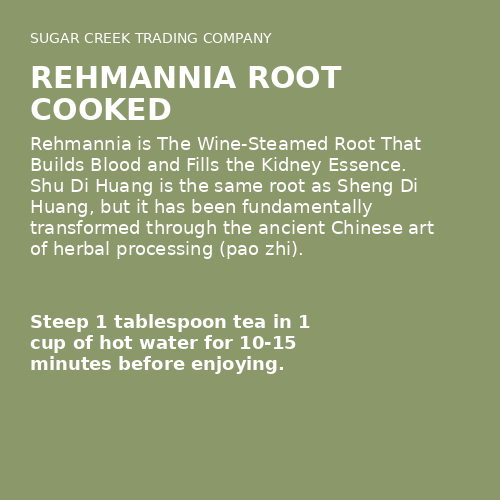
Shu Di Huang — The Wine-Steamed Root That Builds Blood and Fills the Kidney Essence
Botanical Identification
- Species: Rehmannia glutinosa (Gaertn.) DC.
- Family: Orobanchaceae (formerly Scrophulariaceae)
- Common Names: Cooked Rehmannia, Prepared Rehmannia, Shu Di Huang, Processed Chinese Foxglove Root
- Part Used: Tuberous root, wine-steamed and sun-dried (the classical pao zhi or processing method)
- Origin: Same source plant as Sheng Di Huang; cultivated primarily in Henan Province, China. The transformation occurs through processing, not through a different plant.
- Appearance: Jet black, extremely sticky, dense, and glossy; the pieces cling together and leave a dark residue on the hands. The texture is chewy and resinous — dramatically different from the raw form.
- Taste and Energetics: Sweet flavor; slightly warm energy; enters the Liver and Kidney meridians. This is the opposite thermal nature of the raw form — a critical distinction.
Cultural and Historical Use
Shu Di Huang is the same root as Sheng Di Huang, but it has been fundamentally transformed through the ancient Chinese art of herbal processing (pao zhi). The traditional preparation involves repeated cycles of wine-steaming and sun-drying — classically nine cycles, though modern production may use fewer. This process shifts the root's thermal nature from cold to warm, changes its therapeutic direction from clearing heat to building substance, and converts it from a Yin-cooling herb into one of the most powerful blood and essence tonics in the entire Chinese pharmacopeia.
This processing method was codified by the Tang Dynasty (618-907 CE) and refined through the Song and Ming Dynasties. The Bencao Gangmu (Compendium of Materia Medica, 1578) by Li Shizhen documents the nine-steaming, nine-drying method in detail and explains how each cycle deepens the root's nourishing properties. The use of rice wine or yellow wine in the steaming process is not arbitrary — the wine acts as a processing agent that helps drive the herb's properties toward the blood and Kidney meridian while reducing its cold, cloying nature.
Shu Di Huang is the chief herb in Si Wu Tang (Four-Substance Decoction), the foundational blood-building formula in Chinese medicine, and in Liu Wei Di Huang Wan (Six-Ingredient Pill with Rehmannia), the most widely used Kidney Yin tonic formula in the world. It is arguably the single most prescribed herb in TCM for blood deficiency and Kidney essence depletion.
Key Bioactive Compounds
| Compound / Class | Concentration | Documented Activity |
|---|---|---|
| 5-Hydroxymethylfurfural (5-HMF) | Significantly increased by processing | Antioxidant, anti-inflammatory; a Maillard reaction product formed during steaming |
| Melanoidins | High (responsible for black color) | Antioxidant, prebiotic, iron-chelating; formed through browning reactions during processing |
| Rehmanniosides A-D | Partially transformed | Immunomodulatory, anti-inflammatory; profile shifts during steaming |
| Stachyose & oligosaccharides | Reduced from raw (converted to simpler sugars) | The conversion to monosaccharides makes the processed root easier to digest for some individuals |
| Catalpol | Dramatically reduced (often below 0.1%) | Most catalpol degrades during repeated steaming — this is why raw and cooked forms have different effects |
| Gallic acid and galloyl derivatives | Increased by processing | Antioxidant, astringent, supports blood vessel integrity |
Critical Difference from Raw Rehmannia: The wine-steaming process destroys most of the catalpol (the key cooling, anti-inflammatory iridoid), generates new compounds like 5-HMF and melanoidins through Maillard reactions, and converts complex sugars to simpler forms. This chemical transformation is what shifts the herb from cold and heat-clearing to warm and blood-nourishing. The two forms are not interchangeable.
How It Works in the Body
Where raw Rehmannia cools and clears, cooked Rehmannia builds and fills. Shu Di Huang is fundamentally a substance-building herb. In TCM terms, it strongly nourishes Kidney Yin and Kidney Essence (Jing), tonifies the Blood, and supports the marrow — a concept that overlaps with modern understanding of bone marrow function and blood cell production.
The melanoidins formed during processing have demonstrated significant antioxidant capacity, and the 5-HMF generated through steaming has shown protective effects against oxidative stress in both hepatic and renal tissues. The shift from complex oligosaccharides to simpler sugars makes processed Rehmannia somewhat less likely to cause digestive stagnation than the raw form, though it remains a heavy, sticky herb that can still burden weak digestion.
Modern research has explored Shu Di Huang's effects on hematopoiesis (blood cell production), finding that extracts can stimulate erythropoietin production and support red blood cell formation — providing a pharmacological basis for its traditional reputation as a blood tonic. Studies have also shown supportive effects on bone density, hormonal balance in menopausal women, and cognitive function in aging models, consistent with its traditional role in replenishing Kidney Essence.
The wine processing also enhances the root's ability to enter the blood level and circulate through the Liver and Kidney systems, concentrating its effects where they are most needed for deep constitutional rebuilding.
Dose Guidelines
| Preparation | Typical Dose | Frequency |
|---|---|---|
| Decoction (traditional) | 9-30 g simmered in 2-3 cups water for 40-60 minutes | Divided into 2-3 doses daily |
| Powdered root | 3-9 g | 2-3 times daily in warm water or as pills with honey |
| Tincture (1:5, 45% ethanol) | 3-5 mL | 2-3 times daily |
| Patent formula (Liu Wei Di Huang Wan) | 8 pills (concentrated) or per label | 2-3 times daily |
Processing note: This herb is already processed (wine-steamed). It should be used as-is in formulas. Some practitioners add a small piece of fresh ginger or Sha Ren (cardamom) when decocting to help prevent digestive heaviness.
Preparation and Uses
- Decoction: The primary traditional method. Shu Di Huang's extreme stickiness means it should be simmered longer than most herbs and may cling to the pot. Wrapping it in cheesecloth can help with straining. The resulting liquid is dark, thick, and sweet.
- Powder and pills: Commonly ground into powder and formed into honey pills or taken in capsules. Many classical patent formulas use this form.
- Bone broth and soups: Frequently added to nourishing bone broths and medicinal soups in Chinese food therapy, especially postpartum recovery soups and winter tonics.
- Wine infusion: Shu Di Huang is sometimes steeped in rice wine or grain spirits for several months to create a blood-building medicinal wine.
- Combined with companions: Almost always used in formulas rather than alone. Classic pairings include Dang Gui (Angelica sinensis) for blood building, Shan Yao (Chinese yam) for Spleen support, and Shan Zhu Yu (Cornus fruit) for Kidney astringency.
Optimal Context for Use
- Blood deficiency — pale complexion, dizziness, fatigue, thin or scanty menstruation, dry skin and hair, palpitations
- Kidney Yin and Essence depletion — low back pain, weak knees, premature graying, tinnitus, poor memory, diminished fertility
- Postpartum recovery and rebuilding after blood loss
- Menopausal support, especially for women experiencing dryness, hot flashes, and bone density concerns
- Chronic fatigue and constitutional weakness following prolonged illness
- Support for healthy aging — traditionally considered one of the premier longevity herbs
Sustainability and Ethical Harvesting
The sustainability considerations for Shu Di Huang mirror those of the raw form, as they come from the same cultivated plant. Rehmannia glutinosa is not endangered and is produced in large commercial quantities across several Chinese provinces. The additional processing step (wine-steaming and drying) adds labor and time but does not introduce separate sustainability concerns regarding the raw material.
Quality of processed Rehmannia varies considerably. Authentic preparation involves multiple steaming cycles with rice wine or yellow wine, which requires skill and patience. Lower-quality products may undergo fewer cycles, use artificial colorants, or substitute sugar syrups for the natural processing. Sourcing from suppliers who can verify traditional processing methods and provide certificates of analysis for purity and heavy metals is strongly recommended.
Safety and Cautions
- Digestive heaviness: Shu Di Huang is one of the most cloying (greasy, heavy) herbs in the Chinese pharmacopeia. It can cause bloating, loss of appetite, loose stools, or a feeling of fullness in the abdomen. This is why it is almost always combined with digestive-supporting herbs like Chen Pi, Sha Ren, or fresh ginger in formulas.
- Dampness and phlegm: Contraindicated or used with caution in conditions involving excessive dampness, phlegm accumulation, or Spleen Qi deficiency with poor appetite and chronic loose stools.
- Not for acute conditions: Shu Di Huang is a slow, deep tonic — not for acute infections, fevers, or conditions with active inflammation. The raw form (Sheng Di Huang) is more appropriate for heat-clearing.
- Pregnancy: Traditionally used in some pregnancy-support formulas under qualified guidance, but should not be self-prescribed during pregnancy.
- Drug interactions: May interact with anticoagulant medications and blood sugar-lowering drugs. Consult your healthcare provider if taking prescribed medications.
- This product is sold as a botanical specimen and herbal supplement ingredient. These statements have not been evaluated by the FDA. This product is not intended to diagnose, treat, cure, or prevent any disease.
References
- Bensky, D., Clavey, S., & Stoger, E. Chinese Herbal Medicine: Materia Medica, 3rd Edition. Eastland Press, 2004.
- Chinese Pharmacopoeia Commission. Pharmacopoeia of the People's Republic of China, 2020 Edition.
- Liu, C.L., et al. "Changes in the chemical composition and pharmacological activity of Rehmannia glutinosa during processing." Journal of Ethnopharmacology, 2017; 205: 239-252.
- Wang, Y., et al. "5-Hydroxymethylfurfural in processed Rehmannia root: Formation, determination, and biological activities." Frontiers in Pharmacology, 2020; 11: 547.
- Li, S. Bencao Gangmu: Compendium of Materia Medica. Foreign Languages Press, Beijing, 2003 (translation of 1578 original).
Final Note
Shu Di Huang is the anchor of blood-building and essence-replenishing herbalism in the Chinese tradition. Where the raw root cools and clears, this processed form fills what has been emptied and rebuilds what has been depleted. It is not a fast-acting herb — it works slowly, deeply, and cumulatively, often over weeks and months of consistent use within a well-constructed formula. If you struggle with digestive heaviness from this herb, do not push through it; instead, reduce the dose and ensure your formula includes herbs to support the Spleen and move stagnation. The goal is to build without creating blockage. When used wisely and patiently, Shu Di Huang is one of the most profoundly restorative substances in all of herbal medicine.
Share