Sugar Creek Trading Company
Rhubarb Root
Rhubarb Root
Impossible de charger la disponibilité du service de retrait
Rheum palmatum / Rheum officinale
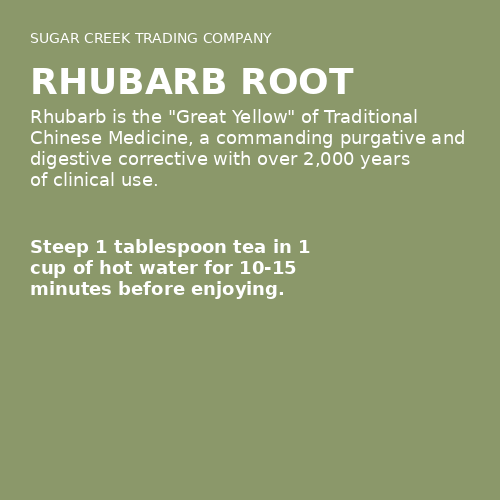
Da Huang — the "Great Yellow" of Traditional Chinese Medicine, a commanding purgative and digestive corrective with over 2,000 years of clinical use.
Botanical Identification
Species: Rheum palmatum L. and Rheum officinale Baill. (Chinese or medicinal rhubarb; not to be confused with culinary rhubarb, R. rhabarbarum)
Family: Polygonaceae (Buckwheat family)
Common names: Chinese Rhubarb, Medicinal Rhubarb, Da Huang (Chinese), Turkey Rhubarb, Indian Rhubarb
Part used: Root and rhizome, harvested from plants at least 3-4 years old, dried and often sliced
Native range: High-altitude regions of western China, Tibet, and the Himalayan foothills, growing at elevations of 2,000-4,000 meters. The plant is a large, dramatic perennial reaching 1.5-3 meters in height with deeply lobed palmate leaves and tall flowering stalks bearing dense clusters of small reddish-green flowers. The root is thick and fleshy, yellow-brown externally and bright orange-yellow internally when fresh.
Cultural and Historical Use
Rhubarb root is one of the most important herbs in the entire Chinese materia medica, first recorded in the Shennong Bencao Jing (Divine Farmer's Classic of Materia Medica) around 200 BCE. Its Chinese name, Da Huang, translates to "Great Yellow," reflecting both the color of the root and the reverence in which it was held. In Traditional Chinese Medicine (TCM), it is classified as a herb that "drains downward" — it purges heat and accumulated stagnation from the interior, clears blood stasis, and resolves toxicity.
Rhubarb root was arguably the most traded medicinal plant on the Silk Road. By the 8th century, it had reached the Arab world, and by the medieval period it was one of the most expensive substances in European apothecaries — at times costing more than opium or saffron. Marco Polo documented its trade in his travels through Central Asia. European physicians used it extensively as a purgative, digestive tonic, and fever remedy. The Russian Empire controlled the rhubarb trade so tightly that a state monopoly existed from the 18th century until the 1860s.
In TCM, Da Huang appears in numerous classical formulas, including Da Cheng Qi Tang (Major Order the Qi Decoction) for severe constipation with abdominal fullness, and Yin Chen Hao Tang for jaundice. It remains one of the most frequently prescribed herbs in modern TCM practice.
Key Bioactive Compounds
| Compound | Classification | Primary Action |
|---|---|---|
| Sennosides A and B | Anthraquinone glycosides | Stimulant laxative; increases colonic peristalsis and fluid secretion |
| Emodin | Free anthraquinone | Anti-inflammatory; antimicrobial; hepatoprotective; antitumor activity |
| Rhein | Free anthraquinone | Anti-inflammatory; nephroprotective; antimicrobial |
| Aloe-emodin | Free anthraquinone | Antimicrobial; laxative; antiviral |
| Chrysophanol | Free anthraquinone | Antifungal; anti-inflammatory |
| Tannins (gallic acid, catechins) | Polyphenols | Astringent at low doses; anti-diarrheal; tissue-toning |
| Stilbene glycosides (rhaponticin) | Stilbenoids | Antioxidant; estrogenic activity |
How It Works in the Body
Rhubarb root's pharmacology demonstrates a fascinating dose-dependent duality. At standard to higher doses, the anthraquinone glycosides (particularly sennosides) dominate. These compounds pass through the stomach and small intestine largely unchanged until colonic bacteria cleave the sugar moiety, releasing the active aglycones. These aglycones stimulate Auerbach's plexus in the intestinal wall, increasing peristaltic contractions and inhibiting the reabsorption of water and electrolytes from the colon. The result is a reliable purgative effect within 6-12 hours of ingestion.
At lower doses, however, rhubarb's tannin content becomes the dominant pharmacological force. Tannins are astringent, meaning they tighten and tone mucous membranes. This gives low-dose rhubarb an anti-diarrheal and digestive-toning effect — the exact opposite of its high-dose purgative action. This dual nature was well understood in TCM, where Da Huang was prescribed at different doses for different clinical presentations.
Beyond its digestive actions, rhubarb's free anthraquinones — emodin, rhein, and aloe-emodin — have demonstrated significant biological activity in modern research. Emodin shows hepatoprotective effects by reducing oxidative stress in liver tissue and modulating inflammatory pathways. Rhein has been studied for nephroprotective effects in chronic kidney disease models, where it appears to slow the progression of renal fibrosis. Both emodin and rhein demonstrate antimicrobial activity against Staphylococcus aureus, Streptococcus species, and various enteric pathogens.
Dose Guidelines
| Form | Amount | Effect |
|---|---|---|
| Decoction (purgative dose) | 3-12 g dried root simmered in 2 cups water for 10-15 minutes | Strong laxative effect within 6-12 hours |
| Decoction (digestive tonic dose) | 0.5-2 g dried root simmered gently | Astringent; digestive toning; mild bitter stimulant |
| Powdered root (capsules) | 500-2,000 mg for purgative; 200-500 mg for tonic | Dose-dependent as above |
| Tincture (1:5) | 1-4 mL (20-80 drops) | Varies by dose |
| TCM formula component | Per practitioner direction, typically 3-15 g in combination | Varies by formula and presentation |
In TCM practice, rhubarb is often added to a decoction near the end of cooking (added later, or hou xia) to preserve its purgative potency. Prolonged cooking reduces the laxative effect as anthraquinone glycosides degrade, leaving the tannin-dominant astringent action. This technique allows practitioners to fine-tune the herb's effect.
Preparation and Uses
- Standard decoction (purgative): Simmer 3-9 g of dried, sliced rhubarb root in 2 cups of water for 10-15 minutes. For maximum purgative effect, add the root in the last 5 minutes of cooking if using in a multi-herb formula. Strain and drink. Expect bowel movement within 6-12 hours.
- Low-dose digestive tonic: Simmer 0.5-1 g in a cup of water for 20-30 minutes (longer cooking degrades anthraquinones, favoring the tannin-astringent action). This produces a bitter, astringent tea that tones the digestive tract.
- Tincture preparation: Chop dried rhubarb root and place in a jar. Cover with 50% alcohol (100-proof vodka) at a 1:5 ratio by weight. Macerate for 4-6 weeks, shaking daily. Strain and bottle. Start with 20-40 drops in water for digestive toning; use 60-80 drops for laxative effect.
- Topical poultice (traditional): Powdered rhubarb root mixed with water or vinegar into a paste has been applied topically for burns, boils, and skin inflammation. Emodin's anti-inflammatory properties support this traditional use.
- In TCM formulas: Rhubarb root is rarely used alone in Chinese medicine. It is combined with other herbs to balance its strong draining action. Classical pairings include Huang Qin (Scutellaria) and Huang Lian (Coptis) for clearing damp-heat, and Dang Gui (Angelica sinensis) and Tao Ren (peach seed) for blood stasis patterns.
Optimal Context for Use
- Acute constipation, particularly with abdominal fullness, bloating, and heat signs
- Digestive stagnation and sluggish bowel function
- Low-dose digestive tonic for chronic loose stools (tannin-dominant effect)
- TCM patterns of excess heat in the Stomach and Intestines
- Blood stasis patterns in TCM (amenorrhea, fixed abdominal pain)
- Supportive use in hepatoprotective protocols (emodin's liver-protective effects)
- Topical application for minor burns and skin inflammation
- Component in traditional cleansing or detoxification formulas
Sustainability and Ethical Harvesting
Medicinal rhubarb (R. palmatum and R. officinale) is extensively cultivated in China, particularly in the provinces of Gansu, Qinghai, Sichuan, and Hubei. It is also grown in European botanical gardens and specialty farms. Because the roots require 3-4 years of growth before harvest, supply chain management is important to ensure consistent quality. Wild harvesting from Tibetan and Himalayan populations has historically been a concern, but the vast majority of commercial rhubarb root now comes from cultivated sources. Buyers should confirm species identity, as culinary rhubarb (R. rhabarbarum) roots are sometimes substituted but contain different and generally lower levels of the key medicinal anthraquinones.
Safety and Cautions
- Not for long-term purgative use: Chronic use of anthraquinone laxatives (more than 1-2 weeks at purgative doses) can cause electrolyte imbalances (particularly potassium depletion), dependency of bowel function on stimulant laxatives, and a condition called melanosis coli (harmless but visible darkening of the colonic mucosa). Use purgative doses only for short-term relief.
- Pregnancy and breastfeeding: Contraindicated. Anthraquinones can stimulate uterine contractions and pass into breast milk.
- Kidney disease: Oxalic acid content in rhubarb can contribute to kidney stone formation in susceptible individuals. Those with a history of calcium oxalate kidney stones should avoid rhubarb root.
- Children: Not recommended for children under 12 without practitioner guidance.
- Drug interactions: Potassium depletion from purgative use can enhance the toxicity of cardiac glycosides (digoxin). May reduce absorption of orally administered medications if taken simultaneously. Separate rhubarb doses from other medications by at least 2 hours.
- Intestinal obstruction: Do not use in cases of suspected bowel obstruction, appendicitis, or acute inflammatory bowel conditions (Crohn's flare, ulcerative colitis flare).
- Color change: Rhubarb root will turn urine yellow-brown or reddish. This is harmless and caused by the anthraquinone pigments being excreted through the kidneys.
References
- Foust, C.M. (1992). Rhubarb: The Wondrous Drug. Princeton University Press.
- Dong, X., et al. (2016). "Emodin: a review of its pharmacology, toxicity and pharmacokinetics." Phytotherapy Research, 30(8), 1207-1218.
- Wang, J., et al. (2015). "Rhein: a review of pharmacological activities." Evidence-Based Complementary and Alternative Medicine, 2015, 578107.
- National Pharmacopoeia Committee. (2020). Pharmacopoeia of the People's Republic of China, Vol. 1. China Medical Science Press.
- Bensky, D., Clavey, S., & Stoger, E. (2004). Chinese Herbal Medicine: Materia Medica, 3rd edition. Eastland Press.
- Huang, Q., et al. (2007). "Anti-inflammatory effects of emodin on lipopolysaccharide-induced inflammation in RAW264.7 cells." International Immunopharmacology, 7(6), 816-823.
Final Note
Rhubarb root is a herb that commands respect. As Da Huang — the "Great Yellow" — it has occupied a place of prominence in Chinese medicine for over two millennia, and its journey along the Silk Road made it one of the most consequential medicinal plants in global trade history. Its dose-dependent duality — purgative at high doses, astringent and toning at low doses — makes it a remarkably versatile tool in the hands of a knowledgeable herbalist. Whether used for acute digestive clearing or as a component in carefully balanced traditional formulas, rhubarb root delivers powerful, predictable results. Respect the dose, understand the mechanism, and this ancient root will serve you well. This product is not intended to diagnose, treat, cure, or prevent any disease. Consult a qualified healthcare practitioner before use if you have any medical conditions or are taking medications.
Share