Sugar Creek Trading Company
Backbone Mountain Herbal Smoking
Backbone Mountain Herbal Smoking
Impossibile caricare la disponibilità di ritiro
BACKBONE MOUNTAIN HERBAL SMOKING BLEND
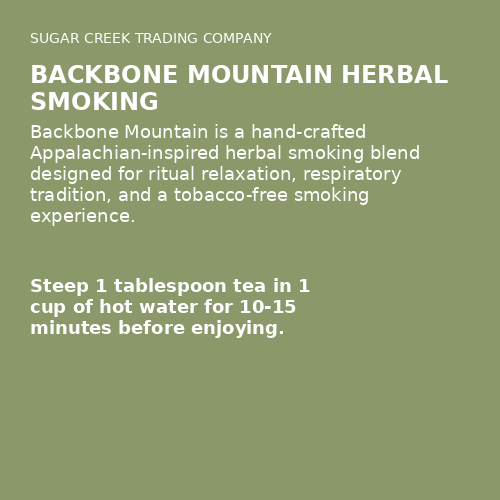
A hand-crafted Appalachian-inspired herbal smoking blend designed for ritual relaxation, respiratory tradition, and a tobacco-free smoking experience.
BOTANICAL IDENTIFICATION
Product Type: Herbal smoking blend (multi-herb formulation)
Common Names: Backbone Mountain Herbal Smoking Blend, Herbal Smoke, Tobacco-Free Smoking Blend
Tradition: Appalachian herbalism and Native American smoking herb traditions
Backbone Mountain Herbal Smoking Blend is a proprietary formulation inspired by the rich botanical heritage of the Appalachian highlands, named after Backbone Mountain, the highest point in Maryland's Allegheny range. Herbal smoking blends draw on centuries of tradition in which specific plants were dried, blended, and smoked for ceremonial, medicinal, and recreational purposes. The blend is designed to provide a smooth, flavorful, and calming smoking experience without tobacco or nicotine.
Traditional herbal smoking blends typically incorporate a base herb for body and burn quality, secondary herbs for flavor and therapeutic action, and aromatic herbs for scent and smoothness. Plants commonly used in Appalachian and broader herbal smoking traditions include mullein, raspberry leaf, mugwort, damiana, coltsfoot, lobelia, skullcap, lavender, and wild lettuce, among others.
CULTURAL AND HISTORICAL USE
The practice of smoking dried herbs is one of the oldest forms of plant medicine, predating written history across nearly every inhabited continent. In North America, Indigenous peoples developed sophisticated smoking traditions using plants such as Nicotiana rustica (ceremonial tobacco), kinnikinnick (a blend often featuring bearberry, Arctostaphylos uva-ursi), red willow bark (Cornus sericea), and mullein (Verbascum thapsus). These practices were deeply ceremonial, used to carry prayers, seal agreements, mark rites of passage, and connect with the spirit world. The sacred pipe ceremony remains a central spiritual practice in many Native American traditions.
In the Appalachian Mountains, settlers from Scotland, Ireland, Germany, and England blended their own European herbal smoking traditions with plant knowledge learned from Cherokee, Shawnee, and other Indigenous nations. Mountain herbalists developed blends using locally abundant plants, including mullein leaf (smoked for respiratory support), rabbit tobacco (Pseudognaphalium obtusifolium, used for colds and ritual), and coltsfoot (Tussilago farfara, a European import used as a lung herb). These blends were smoked in pipes, rolled in corn husks, or burned as smudge for household purification. The tradition of herbal smoking as a tobacco alternative has experienced a significant revival in recent years, driven by interest in nicotine-free alternatives, herbal ritual, and the mindful practice of slowing down.
Backbone Mountain Herbal Smoking Blend honors this lineage by offering a thoughtfully formulated, tobacco-free blend rooted in the botanical traditions of the Appalachian highlands. It is crafted for adults seeking a contemplative, flavorful smoking experience grounded in herbal heritage rather than nicotine dependence.
KEY BIOACTIVE COMPOUNDS & BENEFITS
| Compound/Class | Common Source Herbs | Human Benefit | Role in Blend |
|---|---|---|---|
| Mucilage and saponins | Mullein leaf (Verbascum thapsus) | Soothing to respiratory passages, demulcent action on throat and bronchi | Base herb providing smooth, light smoke with lung-supportive tradition |
| Flavonoids and terpenes (linalool, apigenin) | Lavender, skullcap, chamomile | Calming, anxiolytic, mild sedative effects via GABA modulation | Aromatic and nervine herbs contributing relaxation and flavor |
| Sesquiterpene lactones and thujone compounds | Mugwort (Artemisia vulgaris) | Mildly relaxing, traditionally associated with vivid dreaming and introspection | Aromatic and psychoactive-adjacent herb adding depth and tradition |
| Damianin (terpenoids) and arbutin | Damiana (Turnera diffusa), bearberry (Arctostaphylos uva-ursi) | Mild euphoria, urinary tract support, respiratory smoothness | Flavor herbs contributing sweet, herbal taste and mild mood lift |
| Tannins, volatile oils | Raspberry leaf (Rubus idaeus), mint (Mentha spp.) | Astringent support for throat tissues, cooling sensation | Supporting herbs for burn quality, flavor rounding, and throat comfort |
The blend's value lies in the synergy of its components: a smooth-burning base, calming nervine herbs, flavorful aromatics, and supportive botanicals that together create a satisfying, full-bodied smoke. Because this is a blended product, the specific compound profile reflects the combined contributions of multiple traditional smoking herbs working in concert.
HOW IT WORKS IN THE BODY
When herbs are smoked, their volatile compounds and certain bioactives are rapidly absorbed through the lungs' alveolar membranes, entering the bloodstream within seconds. This provides faster onset of effects compared to oral consumption, though the duration of effect is typically shorter.
Nervous System Relaxation:
Herbs such as skullcap, lavender, and mugwort contain compounds that modulate GABA-ergic signaling in the central nervous system. Linalool (from lavender) and apigenin (from chamomile-type herbs) bind to GABA-A receptors, producing mild anxiolytic and calming effects. When inhaled through smoking, these compounds reach the brain rapidly, producing a noticeable sense of calm within minutes. This is the pharmacological basis for the traditional use of herbal smoking blends as evening relaxation aids.
Respiratory Passage Interaction:
Mullein, the most common base herb in traditional smoking blends, contains mucilaginous compounds and saponins that have a long history of use as a respiratory demulcent. While the act of smoking any substance introduces particulate matter to the lungs, the traditional rationale holds that mullein's saponins, when heated, may help loosen and expel stagnant mucus. This is a traditional perspective and should not be interpreted as a claim that smoking is beneficial to lung health.
Mood and Mindfulness:
The ritual of preparing and smoking an herbal blend, independent of any pharmacological action, activates parasympathetic nervous system responses. The rhythmic breathing pattern of smoking, the sensory engagement of aroma and flavor, and the intentional pause from daily activity all contribute to a measurable reduction in cortisol levels and sympathetic nervous activity. Herbal smoking traditions across cultures have always recognized this ritual dimension as inseparable from the plant's direct effects.
DOSE GUIDELINES
| Preparation Type | Typical Dose | Purpose |
|---|---|---|
| Hand-rolled cigarette or cone | 0.5-1 g of blend per session | Relaxation, ritual, tobacco-free smoking experience |
| Pipe | 1-2 pinches (0.3-0.7 g) per bowl | Traditional herbal pipe smoking for contemplation and calm |
| Dry herb vaporizer | 0.3-0.5 g at 150-200 degrees C (300-390 degrees F) | Lower-temperature inhalation for reduced combustion byproducts |
Herbal smoking blends are best used occasionally and mindfully rather than habitually. Many practitioners use them as part of an evening wind-down ritual, during meditation or journaling, or as a transitional tool for individuals reducing tobacco consumption. If using as a tobacco alternative, be aware that while this blend is nicotine-free, the ritual satisfaction may help manage habitual cravings.
PREPARATION AND USES
The blend can be rolled into cigarettes using standard rolling papers or pre-rolled cones, packed into a pipe, or used in a dry herb vaporizer. For rolling, ensure the blend is evenly distributed and not packed too tightly, which can restrict airflow and create harsh smoke. A medium-loose pack produces the smoothest draw. When using a pipe, a gentle, sipping-style draw is preferable to deep, hard inhalation.
For those who prefer not to inhale smoke, the blend can also be burned as an incense or smudge. Place a small amount in a fire-safe dish or shell, ignite, and allow the smoke to waft through a room for aromatic and atmospheric purposes. Some users also prepare the blend as a strong tea for a non-smoked alternative, though the flavor profile and effects differ from the smoked form. Dry herb vaporization at lower temperatures (around 150-180 degrees C) offers a middle ground, extracting volatile compounds with significantly less combustion byproduct than smoking.
OPTIMAL CONTEXT FOR USE
Backbone Mountain Herbal Smoking Blend is especially well-suited for individuals experiencing:
A desire to reduce or eliminate tobacco and nicotine use, seeking a satisfying herbal alternative that maintains the ritual of smoking
Evening restlessness, mild anxiety, or difficulty transitioning from work mode to rest, where a calming ritual can support relaxation
Interest in traditional Appalachian, Native American, or European herbal smoking practices as part of a mindful, intentional lifestyle
Creative or contemplative practices, including journaling, meditation, music, or fireside reflection, where a tobacco-free smoke enhances the atmosphere
Social smoking situations where a nicotine-free, botanical option is preferred
This blend pairs well with other calming practices such as herbal tea (chamomile, passionflower, or valerian), breathwork, and evening stretching routines.
SUSTAINABILITY AND ETHICAL HARVESTING
The herbs used in traditional smoking blends are, for the most part, abundant and easily cultivated species. Mullein is a prolific biennial weed found throughout North America and Europe. Raspberry leaf is a byproduct of berry cultivation. Lavender, damiana, and mugwort are all widely cultivated. None of the herbs commonly used in blends of this type are endangered or threatened.
Sugar Creek Trading Company formulates its Backbone Mountain blend with attention to sourcing quality: herbs are selected for purity, free from pesticide residues, and sourced from reputable growers and wildcrafters who follow sustainable practices. The Appalachian naming reflects a respect for the region's herbal heritage and the communities that have kept these traditions alive.
SAFETY AND CAUTIONS
While herbal smoking blends are nicotine-free and tobacco-free, it is important to acknowledge that inhaling the combustion products of any plant material carries inherent risks to respiratory health.
Smoking any substance produces tar, carbon monoxide, and particulate matter. Individuals with asthma, COPD, or other respiratory conditions should avoid smoking and consider vaporization or non-inhalation alternatives instead.
This product is intended for adults only. It is not intended for use by minors, pregnant or nursing individuals, or anyone with serious respiratory illness.
Mugwort-containing blends may cause allergic reactions in individuals sensitive to Asteraceae (daisy family) plants, including ragweed. Mugwort should be avoided during pregnancy due to its traditional use as an emmenagogue.
This product is not intended to diagnose, treat, cure, or prevent any disease. It is not a smoking cessation aid, though some individuals find herbal smoking blends helpful as a personal transition tool.
REFERENCES
Crellin, J.K. & Philpott, J. A Reference Guide to Medicinal Plants: Herbal Medicine Past and Present. Duke University Press, 1990.
Moerman, D.E. Native American Ethnobotany. Timber Press, 1998.
Cavender, A. Folk Medicine in Southern Appalachia. University of North Carolina Press, 2003.
Hatfield, G. Encyclopedia of Folk Medicine: Old World and New World Traditions. ABC-CLIO, 2004.
FINAL NOTE
Backbone Mountain Herbal Smoking Blend is an invitation to rediscover the ancient, cross-cultural practice of herbal smoking as something deliberate, plant-centered, and nicotine-free. Named for one of the Appalachian range's defining ridgelines, this blend carries the spirit of mountain herbalism: practical, rooted in place, and respectful of the plants and traditions it draws from. Whether used as a tobacco alternative, a contemplative ritual, or simply a way to slow down at the end of a long day, it connects the smoker to a lineage of herbal practice that stretches back millennia.
Condividere