Sugar Creek Trading Company
Birch Bark
Birch Bark
Impossibile caricare la disponibilità di ritiro
BETULA SPP.
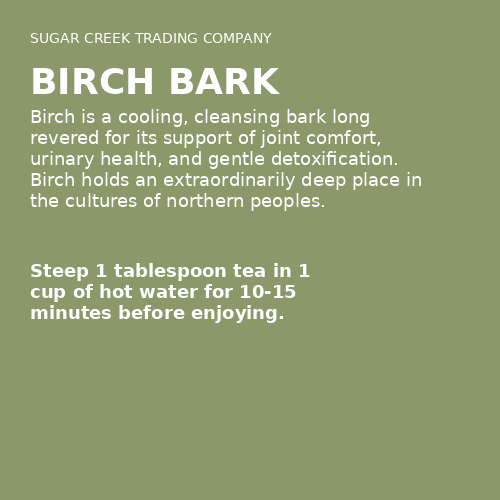
A cooling, cleansing bark long revered for its support of joint comfort, urinary health, and gentle detoxification.
BOTANICAL IDENTIFICATION
Scientific Name: Betula pendula Roth (syn. B. verrucosa), Betula pubescens Ehrh., and related species
Common Names: Birch Bark, White Birch, Silver Birch, European Birch, Paper Birch, Betula Bark, Lady of the Woods
Family: Betulaceae (Birch family)
Birches are graceful, medium-sized deciduous trees typically reaching 15 to 25 meters in height, characterized by their distinctive papery bark that peels in thin, horizontal layers. The bark of silver birch (B. pendula) is smooth, silvery-white with black diamond-shaped lenticels, while paper birch (B. papyrifera) displays a brilliant chalky white. Leaves are alternate, triangular to ovate with doubly serrated margins, and the trees produce pendulous male catkins and smaller, erect female catkins in spring. The crown is open and airy with slender, often drooping branches that give the tree its characteristic elegant silhouette.
Birch species are native to the temperate and boreal regions of the Northern Hemisphere, forming vast forests across Scandinavia, Russia, northern Europe, and North America. They are pioneer trees that colonize disturbed ground rapidly and thrive in full sun on a wide range of soils, though they prefer moist, well-drained, slightly acidic conditions. Birch trees are notably cold-hardy and can grow at higher latitudes and elevations than most other broadleaf trees, making them a defining species of the northern forest biome.
CULTURAL AND HISTORICAL USE
Birch holds an extraordinarily deep place in the cultures of northern peoples. The very word "birch" derives from the Proto-Indo-European root *bhereg, meaning "to shine" or "bright," referencing the luminous white bark that made this tree a symbol of renewal, purification, and new beginnings across cultures from Siberia to Scotland. In Norse mythology, birch was sacred to the goddess Frigga and associated with love and fertility. The birch rune, Berkana, represented new growth and regeneration. In Celtic tradition, birch was the first tree of the Ogham alphabet and marked the beginning of the year, and birch brooms were used to ritually sweep away the old year's energies.
Medicinally, birch bark has been used across the entire circumpolar north for thousands of years. Indigenous peoples of North America, including the Ojibwe, Cree, Mi'kmaq, and numerous other nations, used birch bark preparations extensively for pain relief, fever reduction, wound healing, and urinary complaints. The inner bark was chewed or made into tea for headaches, joint pain, and digestive discomfort. In traditional European herbalism, birch bark and leaf were staple remedies from at least the medieval period, appearing in the writings of Hildegard of Bingen, the herbals of Nicholas Culpeper, and the Eclectic physicians of 19th-century America. Russian and Finnish folk medicine traditions particularly valued birch bark for arthritis, kidney and bladder conditions, and skin diseases.
Modern scientific interest in birch bark accelerated dramatically with the isolation of betulin and betulinic acid, triterpene compounds found in high concentration in the white outer bark. These compounds have become the subject of extensive pharmacological research for their anti-inflammatory, antiviral, and potential anticancer properties. Meanwhile, the traditional uses of birch bark tea for joint comfort and urinary support continue to be validated by European phytotherapy research, and birch bark remains an approved herbal medicine in the German Commission E monographs and the European Medicines Agency.
KEY BIOACTIVE COMPOUNDS & BENEFITS
| Compound/Class | Location in Plant | Human Benefit | Role in Plant |
|---|---|---|---|
| Betulin (up to 30% of outer bark dry weight) | Outer bark (the white papery layer) | Anti-inflammatory; supports healthy cholesterol metabolism; antiviral activity; under investigation for anticancer properties | Structural waterproofing compound; antimicrobial barrier |
| Betulinic acid | Outer bark | Potent anti-inflammatory; selective cytotoxic activity against certain cell lines; immune-modulating | Derived from betulin; defensive compound |
| Salicylates (methyl salicylate, salicin-related compounds) | Inner bark and twigs | Mild analgesic and anti-inflammatory effects; nature's aspirin predecessor; fever-reducing | Herbivore deterrence and wound response |
| Flavonoids (hyperoside, quercetin glycosides) | Inner bark and leaves | Antioxidant; diuretic; supports kidney function and urinary flow | UV protection and antimicrobial defense |
| Tannins (proanthocyanidins, catechins) | Inner and outer bark | Astringent; wound-healing; antimicrobial; supports tissue integrity | Pathogen resistance and structural reinforcement |
Birch bark's therapeutic character is shaped by two distinctive chemical signatures. The outer white bark is exceptionally rich in betulin and betulinic acid, triterpene compounds that are the focus of cutting-edge pharmacological research. The inner bark contributes salicylates, flavonoids, and tannins that provide the traditional analgesic, anti-inflammatory, and diuretic effects that have made birch a cornerstone of northern folk medicine for millennia. Together, these compound classes create a broad-spectrum remedy that addresses pain, inflammation, and elimination simultaneously.
HOW IT WORKS IN THE BODY
Birch bark exerts its effects through several complementary pathways that address pain, inflammation, and waste elimination.
Pain Relief and Anti-inflammatory Action:
The salicylate compounds in birch bark act as natural COX inhibitors, reducing the production of prostaglandins that drive pain signaling and inflammation. This is the same fundamental mechanism as aspirin, though in birch bark the effect is gentler and buffered by the presence of other plant compounds that reduce gastric irritation. Betulin and betulinic acid contribute additional anti-inflammatory activity through inhibition of NF-kB signaling, a master regulator of inflammatory gene expression. This dual pathway gives birch bark a broader anti-inflammatory profile than salicylates alone, addressing both acute pain and chronic inflammatory processes.
Urinary System Support and Detoxification:
The flavonoids in birch bark, particularly hyperoside and quercetin glycosides, promote increased renal blood flow and urine production without depleting electrolytes as aggressively as pharmaceutical diuretics. This gentle aquaretic (water-moving) action supports the flushing of metabolic waste products, uric acid, and inflammatory byproducts through the kidneys. European phytotherapy has long employed this mechanism for supporting individuals with joint discomfort, where increased urinary excretion of uric acid and other irritants can reduce the inflammatory burden on affected joints.
Antimicrobial and Wound-Healing Support:
Betulin has demonstrated broad-spectrum antimicrobial activity in laboratory studies, effective against certain bacteria, fungi, and viruses. The tannins in the bark add further antimicrobial action while providing astringent wound-healing support by precipitating proteins at the tissue surface, forming a protective layer that reduces bleeding, secretion, and microbial entry. This combination of chemistry explains the widespread traditional use of birch bark preparations for wound care, skin infections, and oral health.
Metabolic and Hepatoprotective Effects:
Emerging research suggests that betulin and betulinic acid may influence lipid metabolism by activating AMPK (AMP-activated protein kinase), a cellular energy sensor that promotes fat oxidation and supports healthy cholesterol balance. Animal studies have also demonstrated hepatoprotective effects, with betulin reducing liver fat accumulation and inflammatory markers. While these findings are preliminary and primarily from laboratory and animal models, they align with the traditional use of birch bark as a metabolic cleanser and spring tonic.
DOSE GUIDELINES
| Preparation Type | Typical Dose | Purpose |
|---|---|---|
| Decoction (simmered tea) | 1-2 teaspoons dried bark per cup, simmered 10-15 minutes; 2-3 cups daily | Joint comfort, urinary support, gentle detoxification |
| Tincture (1:5, 50% ethanol) | 2-4 mL, three times daily | Concentrated anti-inflammatory and diuretic support |
| Capsules (powdered bark) | 500-1000 mg, two to three times daily | Convenient daily supplementation for joint and metabolic support |
| Topical wash or compress | Strong decoction applied externally as needed | Wound care, skin conditions, localized pain |
Birch bark can be used both as a short-term remedy for acute discomfort and as a longer-term tonic for chronic joint and urinary concerns. For seasonal cleansing and detoxification, European tradition recommends a 4-to-6-week course in spring. For chronic joint support, it is typically used for extended periods alongside dietary modifications and complementary herbs. Adequate water intake is important when using birch bark for its diuretic effects.
PREPARATION AND USES
Because birch bark is a dense, woody material, it requires a decoction rather than a simple infusion to extract its active compounds effectively. To prepare a decoction, add 1 to 2 teaspoons of dried bark pieces per cup of cold water, bring to a gentle boil, then reduce heat and simmer covered for 10 to 15 minutes. Strain and drink warm. The resulting liquid has a mild, slightly sweet, wintergreen-adjacent flavor with a gentle astringency that most people find pleasant. For a stronger preparation, increase the simmering time to 20 minutes or add a slightly heavier dose of bark.
Birch bark combines well with other herbs depending on the therapeutic goal. For joint comfort formulas, it pairs excellently with willow bark, meadowsweet, devil's claw, and turmeric. For urinary and kidney support blends, combine with dandelion root, nettle leaf, goldenrod, and corn silk. For spring cleansing tonics, birch bark works beautifully alongside dandelion root, burdock root, and cleavers. Externally, a strong decoction of birch bark can be used as a wound wash, a compress for arthritic joints, or a rinse for skin irritations. The bark can also be tinctured in 50% ethanol for a shelf-stable preparation that is convenient for daily use.
OPTIMAL CONTEXT FOR USE
This herb is especially well-suited for individuals experiencing:
Joint stiffness, soreness, or inflammatory joint conditions where gentle, natural anti-inflammatory support is desired
Recurrent urinary tract discomfort or a desire to support healthy kidney and bladder function through increased fluid throughput
Seasonal detoxification needs, particularly in spring, when the body benefits from enhanced elimination of accumulated metabolic waste
Mild to moderate pain from muscle tension, headaches, or overexertion where a gentle, plant-based analgesic is preferred
Skin conditions such as eczema, psoriasis, or minor wounds where topical astringent and antimicrobial support is beneficial
Birch bark is most effective as part of an integrated approach that includes adequate hydration, anti-inflammatory nutrition, appropriate movement, and complementary herbs targeted to individual needs.
SUSTAINABILITY AND ETHICAL HARVESTING
Birch trees are among the most abundant and rapidly regenerating tree species across the entire Northern Hemisphere. They are prolific pioneer species that colonize disturbed ground quickly, and birch forests are expanding in many regions due to changing land use patterns. There are no conservation concerns for any commercially harvested birch species. Bark harvesting, when done properly, does not kill the tree; the outer bark can be carefully peeled from mature trees without damaging the living cambium layer beneath, allowing the tree to regenerate its bark over several years.
Commercial birch bark for the herbal trade is sourced from both wild collection and forestry byproducts across Northern Europe, Russia, and North America. Much of the bark available in commerce comes from trees that are being harvested for timber or firewood, making the bark a sustainable secondary product that would otherwise go to waste. Sugar Creek Trading Company sources birch bark from suppliers committed to ethical harvesting practices that respect both the trees and the forest ecosystems they sustain.
SAFETY AND CAUTIONS
Birch bark has a long history of safe traditional use and is generally well tolerated at recommended doses. However, several important cautions apply.
Salicylate sensitivity: Individuals with known allergies or sensitivities to aspirin (acetylsalicylic acid) or other salicylate compounds should exercise caution with birch bark, as it contains natural salicylates that may trigger similar reactions. Those with aspirin-induced asthma should avoid birch bark entirely.
Anticoagulant and antiplatelet medications: The salicylate content of birch bark may enhance the effects of blood-thinning medications including warfarin, aspirin, and other NSAIDs. Consult a healthcare provider before combining birch bark with any anticoagulant or antiplatelet therapy.
Kidney conditions: While birch bark supports healthy urinary function, its diuretic properties mean it should be used cautiously by individuals with serious kidney disease or those taking prescription diuretics. Adequate water intake is essential when using birch bark for its diuretic effects.
Birch pollen allergy: Individuals with birch pollen allergy may potentially experience cross-reactive allergic responses to birch bark preparations, though this is uncommon. Discontinue use if any allergic symptoms occur.
Pregnancy and nursing: Due to the salicylate content, birch bark is not recommended during pregnancy, particularly in the third trimester, as salicylates may affect fetal circulation and uterine activity. Nursing mothers should consult a healthcare provider before use.
REFERENCES
Rastogi, S., et al. (2015). "Betulinic acid bioactivities: from antiviral to anticancer properties." Mini Reviews in Medicinal Chemistry, 15(6), 467-478.
European Medicines Agency. (2014). "Assessment Report on Betula pendula Roth and/or Betula pubescens Ehrh., cortex." EMA/HMPC/246816/2009.
Blumenthal, M. (Ed.). (1998). The Complete German Commission E Monographs: Therapeutic Guide to Herbal Medicines. American Botanical Council. pp. 68-69.
Tang, J.J., et al. (2011). "Inhibition of SREBP by a small molecule, betulin, improves hyperlipidemia and insulin resistance." Cell Metabolism, 13(1), 44-56.
Moerman, D.E. (1998). Native American Ethnobotany. Timber Press. (Entries on Betula spp.)
FINAL NOTE
Birch bark carries the medicine of the northern forest: clean, cooling, and quietly powerful. For thousands of years, the peoples of the circumpolar north have turned to this luminous tree for relief from pain, for cleansing the body's internal waterways, and for the kind of gentle, sustained anti-inflammatory support that allows stiff joints and overburdened systems to find their ease again. With modern research now illuminating the remarkable pharmacology of betulin and betulinic acid, birch bark stands at the intersection of ancient tradition and contemporary science, offering a remedy that is as relevant today as it was when the first northern healers stripped its bright bark and set it to simmer over the fire.
Condividere