Sugar Creek Trading Company
Pippali Long Pepper
Pippali Long Pepper
Impossibile caricare la disponibilità di ritiro
Piper longum — Pippali Long Pepper
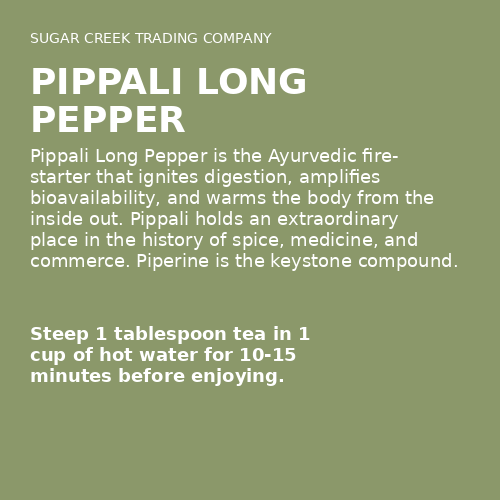
The Ayurvedic fire-starter that ignites digestion, amplifies bioavailability, and warms the body from the inside out.
Botanical Identification
Common Names: Pippali, Long Pepper, Indian Long Pepper, Bi Bo (Chinese), Thippili (Tamil), Pipul (Bengali)
Family: Piperaceae (Pepper family)
Parts Used: Dried unripe fruit spikes (the catkin-like fruiting bodies), occasionally roots (pippalimula)
Appearance: A slender, aromatic, climbing or trailing perennial vine with heart-shaped, dark-green leaves on smooth, jointed stems. The fruiting spikes are cylindrical, 2–5 cm long, composed of tiny, tightly packed fruitlets fused together, giving the spike a bumpy, segmented surface. When dried, the spikes turn grayish-brown to black and become hard and brittle. The flavor is pungent, warming, and more complex than black pepper, with sweet, earthy, and slightly numbing undertones.
Native Range: Indigenous to the Indo-Malayan region, including northeastern India (Assam, Meghalaya, the Western Ghats), Sri Lanka, Nepal, and the Indonesian archipelago. Cultivated throughout tropical South and Southeast Asia.
Harvest Season: Fruits are harvested while still unripe and green, then sun-dried to produce the dried spikes sold commercially. Harvesting occurs during the monsoon and post-monsoon months, typically August through November.
Cultural and Historical Use
Pippali holds an extraordinary place in the history of spice, medicine, and commerce. It was the original "pepper" of the ancient world — the Sanskrit word pippali is the etymological root of the Greek peperi, the Latin piper, and the English "pepper." Long pepper reached Mediterranean markets via overland trade routes centuries before black pepper (Piper nigrum) supplanted it as the dominant pungent spice. In Ayurvedic medicine, pippali is classified as one of the three ingredients in Trikatu ("three pungents," alongside black pepper and ginger), one of the most frequently prescribed formulas in the entire Ayurvedic pharmacopoeia. It is considered a rasayana (rejuvenative) for the respiratory and digestive systems and is specifically indicated for kapha imbalances — conditions characterized by congestion, sluggish metabolism, and excess mucus. The Charaka Samhita, dating to the early centuries of the common era, prescribes pippali in over 200 formulations, making it one of the most referenced herbs in classical Ayurvedic literature. In Traditional Chinese Medicine, it is known as bi bo and is used to warm the middle burner, relieve stomach cold, and treat abdominal pain. The modern rediscovery of piperine’s bioavailability-enhancing effects has brought pippali to the forefront of integrative pharmacology.
Key Bioactive Compounds
| Compound | Class | Primary Activity |
|---|---|---|
| Piperine | Alkaloid (amide) | Bioavailability enhancer (inhibits CYP3A4 and P-glycoprotein), thermogenic, analgesic |
| Piperlongumine (piperlonguminine) | Alkaloid (amide) | Anti-inflammatory, selective cytotoxicity toward stressed cells, NF-kB inhibitor |
| Pipernonaline | Alkaloid (amide) | Antifungal, anti-tubercular activity |
| Retrofractamide A | Amide alkaloid | TRPV1 receptor agonist (warming/pain-modulating sensation) |
| Sesamin | Lignan | Antioxidant, lipid metabolism modulation, hepatoprotective |
| Beta-caryophyllene | Sesquiterpene | Anti-inflammatory via CB2 cannabinoid receptor agonism |
| Essential oil (1–2.5%) | Volatile terpenes | Carminative, antimicrobial, aromatic |
Piperine content in dried Piper longum fruit typically ranges from 1–3%, compared to 5–9% in black pepper. However, long pepper contains a broader spectrum of bioactive amide alkaloids, including piperlongumine, which is present in only trace amounts in P. nigrum. This alkaloid diversity gives pippali a pharmacological profile distinct from and in many respects richer than black pepper.
How It Works in the Body
Piperine is the keystone compound. It dramatically enhances the bioavailability of co-ingested substances by inhibiting cytochrome P450 3A4 (CYP3A4) and intestinal P-glycoprotein efflux transporters. In practical terms, this means that nutrients and herbal compounds taken alongside pippali spend more time in the bloodstream and less time being metabolized or expelled before they can exert their effects. Curcumin bioavailability, for example, increases by approximately 2,000% when co-administered with piperine. This mechanism validates the ancient Ayurvedic practice of including pippali in multi-herb formulas to "carry the medicine deeper." Beyond bioavailability enhancement, piperine activates TRPV1 vanilloid receptors on sensory neurons, producing the characteristic warming sensation and stimulating digestive secretions — hydrochloric acid, pancreatic enzymes, and bile flow all increase, improving the breakdown and absorption of food. Piperlongumine has attracted significant research attention for its selective action on cells experiencing elevated oxidative stress, operating through a mechanism that raises reactive oxygen species in already-stressed cells while leaving healthy cells largely unaffected. The overall effect of pippali is thermogenic, digestive, expectorant, and synergistic — it makes everything it accompanies work better.
Dose Guidelines
| Preparation | Typical Dose | Notes |
|---|---|---|
| Whole dried fruit (culinary) | 1–3 spikes, crushed or ground, added to food | Use as you would black pepper; excellent in soups, curries, chai, and honey |
| Powdered fruit (churna) | 250–500 mg, 1–3 times daily | Traditional Ayurvedic dose; take with warm water, honey, or ghee |
| Trikatu formula | 500–1000 mg of the blend (equal parts pippali, black pepper, ginger), 1–2 times daily before meals | The classic Ayurvedic digestive and bioavailability formula |
| Honey paste (pippali rasayana) | 1/4–1/2 tsp powdered pippali mixed into 1 tsp raw honey, taken before meals | Traditional rejuvenative preparation, especially for respiratory support |
| Milk decoction (pippali ksheerapaka) | 1–2 g powder simmered in 1 cup milk until reduced by half | Classical preparation for building strength and respiratory health |
Ayurvedic tradition often uses pippali in a graduated dosing protocol called Vardhamana Pippali, starting with a small dose that increases daily over a set period, then tapers back down. This should be undertaken with guidance from a qualified Ayurvedic practitioner.
Preparation and Uses
- Trikatu digestive fire blend: Combine equal parts ground pippali, ground black pepper, and ground dried ginger. Take 1/4–1/2 teaspoon in warm water or honey 15–30 minutes before meals to kindle digestive capacity.
- Pippali honey for respiratory support: Mix 1/4 teaspoon ground pippali into a spoonful of raw honey. Take twice daily during cold season or when experiencing chest congestion.
- Bioavailability booster: Add a small pinch of ground pippali to turmeric golden milk, ashwagandha preparations, or any herbal formula where you want enhanced absorption.
- Culinary spice: Grind whole dried spikes and use in place of or alongside black pepper. Exceptional in slow-cooked stews, North African tagines, Southeast Asian curries, and spiced desserts.
- Chai enhancement: Add 1–2 crushed pippali spikes to your chai pot along with ginger, cardamom, and cinnamon for deeper warmth and complexity.
- Medicated ghee: Simmer pippali powder in ghee on low heat for 15–20 minutes, strain, and use as a vehicle for other herbs or as a digestive condiment.
Optimal Context for Use
- Sluggish digestion, low appetite, bloating, and gas (especially in cold or kapha constitutions)
- Enhancing the absorption and efficacy of other herbs and supplements (especially curcumin, ashwagandha, boswellia)
- Respiratory congestion, chronic cough, and excess mucus production
- Cold hands and feet, poor peripheral circulation, and metabolic sluggishness
- As a component of Trikatu and other classical Ayurvedic formulations
- Culinary use as a premium, historically significant pungent spice
Sustainability and Ethical Harvesting
Piper longum is widely cultivated across tropical South and Southeast Asia, particularly in the Indian states of Assam, Meghalaya, Kerala, and Karnataka, as well as in Sri Lanka, Indonesia, and Thailand. It is not a threatened species, and commercial cultivation has largely replaced wild harvesting. Ethical sourcing should prioritize fair-trade practices that ensure equitable compensation for smallholder farmers, many of whom tend pippali as an understory crop in shaded agroforestry systems. These cultivation methods — growing the vine beneath tree canopy — are inherently sustainable and ecologically beneficial, supporting biodiversity while producing a high-value spice crop.
Safety and Cautions
- Drug interactions (important): Piperine significantly alters the pharmacokinetics of many pharmaceuticals by inhibiting CYP3A4 and P-glycoprotein. This can increase blood levels of prescription medications including phenytoin, propranolol, theophylline, cyclosporine, and many others. If you take prescription medications, consult your healthcare provider before using pippali regularly.
- Pregnancy and lactation: Traditionally used in small culinary amounts during pregnancy in Ayurvedic culture, but therapeutic doses should be avoided without professional guidance. The thermogenic and uterine-stimulating potential warrants caution.
- Gastric sensitivity: The pungent alkaloids can aggravate acid reflux, gastritis, or peptic ulcers in sensitive individuals. Avoid high doses if you have active inflammatory GI conditions.
- Pitta constitutions (Ayurvedic): Individuals with strong pitta (heat-dominant) constitutions may find pippali overly heating. Use in smaller amounts and balance with cooling herbs.
- Children: Small culinary amounts are generally considered safe. Therapeutic doses are not recommended for children under 12 without practitioner guidance.
References
- Shoba, G., et al. (1998). Influence of piperine on the pharmacokinetics of curcumin in animals and human volunteers. Planta Medica, 64(4), 353–356.
- Atal, C. K., et al. (1985). Scientific evidence on the role of Ayurvedic herbals on bioavailability of drugs. Journal of Ethnopharmacology, 14(2–3), 229–239.
- Raj, L., et al. (2011). Selective killing of cancer cells by a small molecule targeting the stress response to ROS. Nature, 475(7355), 231–234. [Piperlongumine study]
- Sharma, P. V. (Ed.). (2001). Charaka Samhita (English translation, Vol. I–IV). Chaukhambha Orientalia.
- Srinivasan, K. (2007). Black pepper and its pungent principle — piperine: A review of diverse physiological effects. Critical Reviews in Food Science and Nutrition, 47(8), 735–748.
- Dalby, A. (2000). Dangerous Tastes: The Story of Spices. University of California Press.
Final Note
Pippali is one of those rare herbs that improves everything around it. Its role as a bioavailability enhancer means it doesn’t just work on its own — it makes your entire herbal and nutritional protocol more effective. This pharmacological generosity, combined with thousands of years of Ayurvedic clinical refinement and a flavor profile that belongs in any serious spice collection, makes long pepper an essential staple. Whether you approach it as a medicine, a culinary spice, or both, pippali rewards attention and consistent, respectful use. This product is sold as a raw botanical for educational and research purposes. It is not intended to diagnose, treat, cure, or prevent any disease. Consult a qualified healthcare practitioner before use.
Condividere