Sugar Creek Trading Company
Rehmannia Glutinosa Root
Rehmannia Glutinosa Root
Impossibile caricare la disponibilità di ritiro
Rehmannia glutinosa
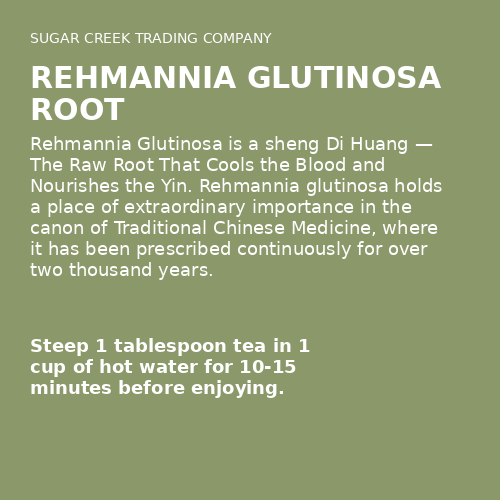
Sheng Di Huang — The Raw Root That Cools the Blood and Nourishes the Yin
Botanical Identification
- Species: Rehmannia glutinosa (Gaertn.) DC.
- Family: Orobanchaceae (formerly Scrophulariaceae)
- Common Names: Chinese Foxglove Root, Sheng Di Huang (raw/dried form), Di Huang, Rehmannia Root
- Part Used: Tuberous root (raw/dried, unprocessed)
- Origin: Native to northern and central China; cultivated extensively in Henan Province, particularly the Jiaozuo region historically known as Huaiqing Prefecture
- Appearance: Dark yellowish-brown to blackish exterior with a soft, sticky, moist interior when fresh-dried; the cut surface is oily and slightly glossy
- Taste and Energetics: Sweet and bitter flavor; cold energy; enters the Heart, Liver, and Kidney meridians in Traditional Chinese Medicine
Cultural and Historical Use
Rehmannia glutinosa holds a place of extraordinary importance in the canon of Traditional Chinese Medicine, where it has been prescribed continuously for over two thousand years. First documented in the Shennong Bencao Jing (Divine Farmer's Classic of Materia Medica), compiled between approximately 200 BCE and 200 CE, the raw root — Sheng Di Huang — was classified as a superior-grade herb, meaning it was considered safe enough for long-term use and capable of nurturing fundamental vitality.
In TCM theory, the distinction between raw (Sheng Di Huang) and cooked (Shu Di Huang) forms of Rehmannia is critically important. The raw, dried root is valued for its cooling properties and its ability to clear heat from the blood, generate fluids, and nourish Yin. It appears in foundational classical formulas such as Liu Wei Di Huang Wan (Six-Ingredient Pill with Rehmannia) and Si Wu Tang (Four-Substance Decoction), cornerstones of Chinese herbal medicine that remain in widespread clinical use today.
The herb earned its place as one of the "Four Huai Medicines" — a group of four herbs native to the Huaiqing region of Henan Province considered to produce the finest medicinal quality. Korean and Japanese traditional medicine systems also adopted Rehmannia extensively, integrating it into their own pharmacopeias under the names ji-hwang and jio, respectively.
Key Bioactive Compounds
| Compound / Class | Concentration | Documented Activity |
|---|---|---|
| Catalpol (iridoid glycoside) | Up to 3-5% in raw root | Neuroprotective, anti-inflammatory, hypoglycemic; supports kidney function |
| Rehmanniosides A-D | Variable | Immunomodulatory, anti-inflammatory, adrenal-supportive |
| Acteoside (verbascoside) | 0.5-2% | Potent antioxidant, hepatoprotective, anti-inflammatory |
| Stachyose & other oligosaccharides | Up to 40-50% total sugars | Prebiotic activity; contribute to moistening and fluid-generating properties |
| Leonuride (ajugoside) | Trace to moderate | Cardioprotective, mild sedative properties |
| Aucubin (iridoid glycoside) | Trace amounts | Anti-inflammatory, antimicrobial, hepatoprotective |
Note: The raw/dried form (Sheng Di Huang) retains significantly higher levels of catalpol compared to the wine-steamed cooked form. Catalpol is heat-sensitive and degrades during the steaming process, which is why the two preparations have distinct therapeutic profiles.
How It Works in the Body
Sheng Di Huang's cooling nature makes it a primary herb for conditions involving excess heat in the blood. Its iridoid glycosides, particularly catalpol, have demonstrated the ability to reduce inflammatory cytokine expression and modulate immune responses in both animal and in-vitro studies. The high catalpol content in the raw form supports neuroprotective pathways, including upregulation of brain-derived neurotrophic factor (BDNF) and reduction of oxidative stress markers in neuronal tissue.
The root's abundant oligosaccharides contribute a deeply moistening quality, helping to restore fluids in conditions marked by dryness — dry mouth, dry cough, or constipation arising from fluid deficiency. These sugars also serve as prebiotics, supporting beneficial gut flora and potentially improving nutrient absorption.
From a modern pharmacological perspective, raw Rehmannia has shown promise in supporting adrenal function, moderating blood glucose levels, and protecting hepatic and renal tissues from oxidative damage. Its immunomodulatory activity is nuanced — it can upregulate suppressed immune function while simultaneously calming overactive inflammatory responses, making it a balancing rather than purely stimulating or suppressing agent.
Dose Guidelines
| Preparation | Typical Dose | Frequency |
|---|---|---|
| Decoction (traditional) | 9-30 g dried root simmered in 2-3 cups water for 30-45 minutes | Divided into 2-3 doses daily |
| Powdered root | 3-6 g | 2-3 times daily, mixed into warm water or honey |
| Tincture (1:5, 40% ethanol) | 3-5 mL | 2-3 times daily |
| As part of a formula | Typically 10-20% of total formula weight | Per formula instructions |
Preparation and Uses
- Decoction: The most traditional method. Simmer the sliced or broken root pieces in water for 30-45 minutes. The resulting tea is dark, slightly sweet, and viscous. Often combined with other herbs in multi-herb formulas.
- Powder: Ground root can be encapsulated or stirred into warm water. Useful for those who find the taste of the decoction too strong.
- Honey pills: Traditionally, powdered Rehmannia was mixed with honey to form small pills — a classic delivery method that combines the herb's properties with honey's own moistening and harmonizing nature.
- Congee: In Chinese food therapy, sliced raw Rehmannia is sometimes simmered into rice congee to create a nourishing medicinal porridge for recovery from illness or to support Yin deficiency.
- Topical: Occasionally used in poultices or washes for burns, sores, and skin conditions associated with blood heat.
Optimal Context for Use
- Conditions of Yin deficiency with heat signs — night sweats, afternoon fevers, a sensation of heat in the palms and soles, dry mouth at night
- Blood heat patterns — nosebleeds, blood in the urine, heavy menstrual bleeding, skin eruptions with redness and heat
- Thirst and fluid depletion following febrile illness
- Support for adrenal and kidney health in cases of chronic stress or overwork
- Complementary support for blood sugar regulation alongside conventional care
- Recovery periods where the body needs deep nourishment and cooling restoration
Sustainability and Ethical Harvesting
Rehmannia glutinosa is extensively cultivated in China, particularly in Henan, Shandong, Hebei, and Shanxi provinces, and is not considered threatened in the wild. The plant is a perennial that produces tuberous roots typically harvested after one to two growing seasons. Sustainable farming practices include crop rotation, as Rehmannia can deplete soil nutrients significantly — traditional farmers in the Jiaozuo region historically rotated Rehmannia with other crops on eight-year cycles to maintain soil health.
When sourcing, look for root that has been tested for heavy metals and pesticide residues, as herbs cultivated in intensive agricultural zones may carry contamination. Supporting suppliers who work with small-scale Chinese farmers practicing traditional cultivation methods helps preserve both agricultural knowledge and fair labor practices.
Safety and Cautions
- Digestive sensitivity: Raw Rehmannia is cold in nature and rich in sticky oligosaccharides. It may cause loose stools, bloating, or digestive discomfort in individuals with weak digestion (Spleen Qi deficiency in TCM terms). It is often combined with ginger or Chen Pi (tangerine peel) to offset this tendency.
- Cold constitutions: Not ideal as a standalone herb for individuals who run cold, experience chronic diarrhea, or have a pale, swollen tongue — the cooked form (Shu Di Huang) is generally preferred in such cases.
- Pregnancy: Use during pregnancy should be guided by a qualified practitioner.
- Drug interactions: May interact with blood sugar-lowering medications and anticoagulant/antiplatelet drugs. Consult a healthcare provider if you are taking prescribed medications.
- This product is sold as a botanical specimen and herbal supplement ingredient. These statements have not been evaluated by the FDA. This product is not intended to diagnose, treat, cure, or prevent any disease.
References
- Chinese Pharmacopoeia Commission. Pharmacopoeia of the People's Republic of China, 2020 Edition.
- Bensky, D., Clavey, S., & Stoger, E. Chinese Herbal Medicine: Materia Medica, 3rd Edition. Eastland Press, 2004.
- Zhang, R.X., et al. "Catalpol: A naturally occurring bioactive compound with therapeutic potential." Molecular Medicine Reports, 2019; 20(2): 1151-1160.
- Liu, C., et al. "Rehmannia glutinosa polysaccharides: A review of extraction, purification, structure, and bioactivities." International Journal of Biological Macromolecules, 2021; 184: 1-13.
- Huang, Y., et al. "Neuroprotective effects of catalpol on Alzheimer's disease." Brain Research, 2016; 1636: 130-141.
Final Note
Sheng Di Huang is one of the great cooling, nourishing roots in all of herbal medicine. Its ability to clear heat from the blood while simultaneously replenishing depleted fluids and Yin makes it nearly irreplaceable in classical TCM formulation. If you are new to this herb, begin with small doses in tea or as part of a balanced formula, and pay attention to how your digestion responds. For deep, chronic Yin deficiency or blood heat conditions, raw Rehmannia is a foundational ally — patient, steady, and profoundly restorative.
Condividere