Sugar Creek Trading Company
Shepherd's Purse
Shepherd's Purse
Impossibile caricare la disponibilità di ritiro
Capsella bursa-pastoris
Shepherd's Purse — The Battlefield Herb That Stanches the Flow
Botanical Identification
- Common Names: Shepherd's Purse, Shepherd's Bag, Lady's Purse, Witches' Pouches, Mother's Heart, Pickpocket, Casewort
- Latin Name: Capsella bursa-pastoris
- Family: Brassicaceae (mustard family)
- Part Used: Aerial parts (leaves, stems, flowers, and the distinctive heart-shaped seed pods)
- Form: Dried cut herb
- Origin: Native to Eastern Europe and Asia Minor; now cosmopolitan — found on every continent except Antarctica
- Harvest: Collected during flowering, typically spring through autumn; best used fresh or recently dried for maximum hemostatic potency
Cultural and Historical Use
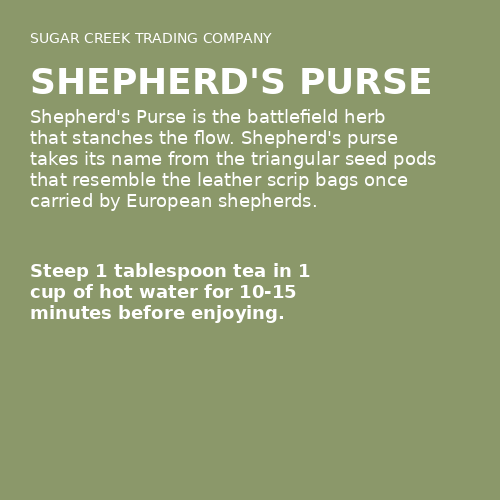
Shepherd's purse takes its name from the triangular seed pods that resemble the leather scrip bags once carried by European shepherds. Despite its humble weedy appearance, this plant has been one of the most important hemostatic herbs in Western herbal medicine for centuries. Dioscorides referenced a plant believed to be shepherd's purse in the 1st century CE for stanching blood flow. By the Middle Ages, European herbalists relied on it for nosebleeds, wound hemorrhage, and heavy menstrual bleeding.
During World War I, when supplies of conventional hemostatic agents ran short, German and Allied field medics turned to shepherd's purse and yarrow as emergency styptics. The British Pharmaceutical Codex of 1923 officially recognized Capsella preparations for uterine hemorrhage. In Traditional Chinese Medicine, the plant is known as ji cai and has been used to cool blood heat and stop bleeding, particularly from the eyes and uterus. Across the Appalachian folk tradition, shepherd's purse tea was a midwife's standby for postpartum hemorrhage — brewed strong and administered warm to contract the uterus and slow bleeding.
The plant is also edible. In Korea and parts of China, young shepherd's purse greens (naengi) are a prized spring vegetable, added to soups, dumplings, and rice dishes.
Key Bioactive Compounds
| Compound | Concentration (approx.) | Primary Activity |
|---|---|---|
| Bursic acid (diosmin-related flavonoids) | Variable | Hemostatic — promotes vasoconstriction and platelet aggregation |
| Tyramine and related amines | Trace to moderate | Sympathomimetic vasoconstriction, uterine contraction stimulation |
| Acetylcholine | Trace (fresh herb) | Smooth muscle stimulation, blood pressure modulation |
| Flavonoids (rutin, quercetin, luteolin) | 1–3% total flavonoids | Capillary strengthening, anti-inflammatory, antioxidant |
| Fumaric acid | Variable | Anti-inflammatory, metabolic intermediate |
| Sulforaphane precursors (glucosinolates) | Present (Brassicaceae family) | Antimicrobial, phase II detoxification enzyme induction |
| Vitamin K | Significant levels in fresh plant | Essential cofactor for blood clotting cascade |
| Tannins | Low to moderate | Astringent — tightens tissues, reduces fluid loss |
How It Works in the Body
Shepherd's purse exerts its hemostatic action through a multi-pronged mechanism. The tyramine content triggers localized vasoconstriction, narrowing blood vessels at the site of hemorrhage to reduce blood flow. Simultaneously, the flavonoid complex — particularly rutin and its metabolites — strengthens fragile capillary walls, reducing their permeability and tendency to leak. The vitamin K present in the plant supports the hepatic synthesis of clotting factors II, VII, IX, and X, reinforcing the coagulation cascade at a systemic level.
On smooth muscle, shepherd's purse acts as a uterine tonic. The combination of acetylcholine (in fresh preparations) and tyramine stimulates myometrial contraction, which compresses uterine blood vessels and is the body's primary mechanism for controlling postpartum and menstrual hemorrhage. This oxytocic-like action is why midwives and herbalists have relied on it for centuries during and after childbirth.
Beyond hemostasis, the flavonoids provide anti-inflammatory and antioxidant support, while the glucosinolate content places shepherd's purse within the cancer-protective Brassicaceae family of plants. The astringent tannins contribute a tissue-tightening effect that supports the herb's use in diarrhea and as a topical wound wash.
Dose Guidelines
| Use | Amount | Frequency | Notes |
|---|---|---|---|
| Tea (infusion) for heavy menses | 1–2 teaspoons dried herb per 8 oz boiling water, steep 10–15 min | 3 times daily during heavy flow days | Begin 1–2 days before expected heavy flow if cycle is predictable |
| Tincture (1:5, 45% ethanol) | 2–4 mL (40–80 drops) | 3 times daily | Fresh plant tincture is considered more potent than dried |
| Acute hemorrhage support | Strong tea (2 tbsp per cup) or 5 mL tincture | Every 15–30 min as needed | Seek immediate medical care for serious bleeding — this is supportive, not a substitute |
| Topical compress (nosebleed, wound) | Strong decoction applied on cloth | Apply with direct pressure | Fresh crushed leaf can also be applied directly to minor cuts |
Preparation and Uses
- Hot infusion: Pour 8 ounces of boiling water over 1 to 2 teaspoons of dried shepherd's purse herb. Cover and steep for 10 to 15 minutes. Strain and drink warm. The taste is mild and slightly peppery, typical of the mustard family.
- Tincture: Best prepared from fresh flowering herb at a 1:2 ratio in 60% alcohol. Dried herb tincture at 1:5 in 45% alcohol is also effective. Tinctures preserve the volatile hemostatic constituents better than long-dried bulk herb.
- Combination formulas: Often blended with yarrow (Achillea millefolium), lady's mantle (Alchemilla vulgaris), and nettle leaf for comprehensive menstrual support. Pairs well with cramp bark for painful, heavy periods.
- Sitz bath: Brew a strong pot of shepherd's purse tea and add to a warm sitz bath for postpartum perineal healing and hemorrhoid support.
- Nasal packing: Soak a cotton ball in strong cooled tea and gently insert into the nostril for persistent nosebleeds.
Optimal Context for Use
- Heavy menstrual bleeding (menorrhagia) — one of the most traditional and well-supported uses
- Postpartum hemorrhage support (alongside medical care, not as replacement)
- Nosebleeds (epistaxis), especially recurrent or frequent episodes
- Minor wound bleeding and abrasions as a topical styptic
- Hematuria (blood in urine) — traditional use, requires medical evaluation for underlying cause
- Mild urinary tract support — gentle astringent and diuretic action
- Diarrhea — astringent tannins help tone intestinal mucosa
Sustainability and Ethical Harvesting
Shepherd's purse is one of the most abundant weeds on Earth. It thrives in disturbed soils, garden edges, sidewalk cracks, agricultural fields, and roadsides across every temperate and subtropical region. It is not endangered, threatened, or at risk from wild harvesting in any known jurisdiction. The plant self-seeds prolifically, producing thousands of seeds per plant that can remain viable in soil for decades. For wildcrafters, the primary concern is not overharvesting but rather ensuring the collection site is free from pesticides, herbicides, heavy metals, and road runoff contamination. Harvest from clean garden edges, organic farms, or known unsprayed meadows. Leave some plants to complete their seed cycle for next year's growth.
Safety and Cautions
- Pregnancy: Shepherd's purse is a uterine stimulant and must be strictly avoided during pregnancy except under direct supervision of a qualified midwife or practitioner during labor and delivery. It can provoke uterine contractions.
- Blood-thinning medications: The vitamin K content and hemostatic action may interfere with warfarin, heparin, and other anticoagulants. Consult your prescriber before use.
- Thyroid conditions: As a member of the Brassicaceae family, shepherd's purse contains goitrogenic glucosinolates. Those with hypothyroidism should use cautiously, though the amounts in typical tea doses are generally considered insignificant.
- Blood pressure: Tyramine content may interact with MAO inhibitor medications. Avoid concurrent use.
- Kidney stones: Contains oxalates. Those with a history of calcium oxalate stones should use in moderation.
- Serious hemorrhage: This herb is a supportive aid, not a replacement for emergency medical care. Any significant or unexplained bleeding requires professional evaluation.
- Freshness matters: Hemostatic potency decreases with age. Use recently dried herb (within 6–12 months of harvest) for best results.
References
- Al-Snafi, A.E. (2015). The chemical constituents and pharmacological effects of Capsella bursa-pastoris — A review. International Journal of Pharmacology and Toxicology, 5(2), 76–81.
- Newall, C.A., Anderson, L.A., & Phillipson, J.D. (1996). Herbal Medicines: A Guide for Health-Care Professionals. Pharmaceutical Press.
- Kuroda, K. & Takagi, K. (1969). Physiologically active substance in Capsella bursa-pastoris. Nature, 220(5168), 707–708.
- British Herbal Pharmacopoeia (1983). British Herbal Medicine Association. Entry for Capsella bursa-pastoris.
- Hoffmann, D. (2003). Medical Herbalism: The Science and Practice of Herbal Medicine. Healing Arts Press.
Final Note
Shepherd's purse is an unassuming wayside plant with extraordinary clinical relevance. For centuries it has been the herbalist's first reach for heavy bleeding — a reputation backed by its unique combination of vasoconstrictive amines, capillary-strengthening flavonoids, and clotting-supportive vitamin K. Keep it in your herbal first-aid kit and your menstrual support formulas. Respect its power during pregnancy, and always seek professional medical care for serious or unexplained hemorrhage. This product is sold as a botanical specimen and herbal tea ingredient. It is not intended to diagnose, treat, cure, or prevent any disease.
Condividere