Sugar Creek Trading Company
Alfalfa Leaf
Alfalfa Leaf
Impossible de charger la disponibilité du service de retrait
MEDICAGO SATIVA
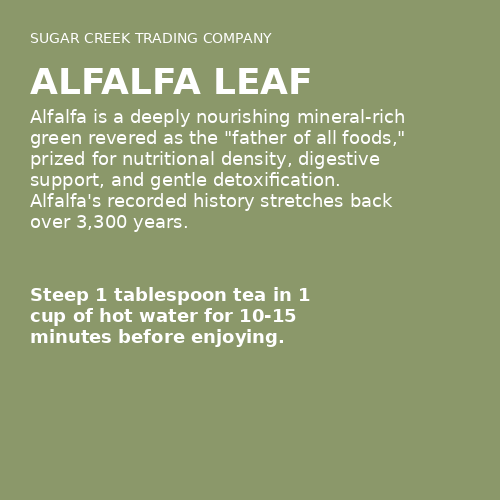
A deeply nourishing mineral-rich green revered as the "father of all foods," prized for nutritional density, digestive support, and gentle detoxification.
BOTANICAL IDENTIFICATION
Scientific Name: Medicago sativa L.
Common Names: Alfalfa, Lucerne, Purple Medic, Buffalo Herb, Chilean Clover, Father of All Foods
Family: Fabaceae (Legume / Pea family)
Alfalfa is a deep-rooted, erect perennial legume growing 30 to 90 cm tall with trifoliate leaves composed of three small, oblong leaflets with finely serrated tips. The stems are smooth to slightly hairy and branch freely, giving the plant a bushy appearance. In summer, it produces dense clusters of small, violet to blue-purple flowers typical of the pea family, which develop into characteristic spirally coiled seed pods containing kidney-shaped seeds.
Native to south-central Asia and first cultivated in ancient Persia, alfalfa is now grown on every inhabited continent and is one of the most widely cultivated forage crops in the world. It thrives in deep, well-drained soils with a neutral to slightly alkaline pH and prefers full sun. Its extraordinary taproot system can penetrate 6 meters or more into the earth, accessing minerals and water far beyond the reach of most plants.
CULTURAL AND HISTORICAL USE
Alfalfa's recorded history stretches back over 3,300 years. It was first cultivated in ancient Persia (modern-day Iran) around 1300 BCE as a premium feed for cavalry horses, and its Arabic name, al-fac-facah, meaning "father of all foods," reflects the high esteem in which early agrarian cultures held this plant. Persian, Greek, and Roman writers including Pliny and Columella documented its use as the finest available animal forage. The plant traveled the Silk Road to China, was carried across North Africa by Arab expansion, reached Spain by the eighth century, and arrived in the Americas with Spanish colonizers in the 1500s.
In traditional medicine, alfalfa leaf has been used across multiple systems. In Ayurvedic practice, it has been valued as a nutritive tonic and digestive aid, particularly for conditions associated with nutritional depletion. Traditional Chinese Medicine recognized it for cooling heat conditions and promoting urination. Native American peoples, including the Cherokee and Costanoan, used alfalfa medicinally after its introduction to the continent, employing it for arthritis, digestive complaints, and as a blood-building tonic. Early American Eclectic physicians of the 19th century prescribed alfalfa preparations for poor appetite, nutritional deficiency, and convalescence.
By the early 20th century, alfalfa leaf tea and tablets had become a staple of the emerging American health food movement. Naturopathic physicians praised it as a mineral supplement and alkalizing agent. Today, it remains one of the most popular nutritive herbs in Western herbalism, valued for its exceptional nutrient density and gentle, food-like safety profile.
KEY BIOACTIVE COMPOUNDS & BENEFITS
| Compound/Class | Location in Plant | Human Benefit | Role in Plant |
|---|---|---|---|
| Vitamins (A, C, E, K, B-complex) | Leaves (concentrated) | Broad nutritional support; vitamin K supports healthy blood clotting and bone metabolism; antioxidant protection | Photosynthetic and metabolic cofactors |
| Minerals (calcium, magnesium, potassium, iron, zinc, phosphorus, silica) | Leaves and stems (drawn from deep soil via taproot) | Supports bone density, electrolyte balance, oxygen transport, and enzyme function | Structural and enzymatic roles in plant physiology |
| Saponins (soyasaponins, medicagenic acid glycosides) | Leaves, roots, seeds | May support healthy cholesterol metabolism by binding bile acids; immune-modulating activity | Antifungal and insect-deterrent defense compounds |
| Flavonoids and isoflavones (genistein, daidzein, coumestrol) | Leaves and sprouts | Antioxidant activity; phytoestrogenic effects may support menopausal comfort | UV screening, nitrogen-fixing bacterial signaling |
| Chlorophyll | Leaves (abundant) | Internal deodorizing; supports detoxification pathways; provides magnesium | Primary photosynthetic pigment |
Alfalfa's therapeutic identity is rooted in density rather than potency. Unlike herbs that work through concentrated bioactive compounds, alfalfa operates primarily as a whole-food nutritive, delivering a broad spectrum of vitamins, minerals, chlorophyll, and plant proteins in a highly bioavailable form. The saponins and isoflavones add a modest pharmacological dimension, supporting cholesterol metabolism and providing gentle hormonal balancing, but the plant's core value lies in its ability to deeply nourish depleted systems from the ground up.
HOW IT WORKS IN THE BODY
Alfalfa exerts its effects primarily through nutritional replenishment and gentle physiological support across multiple organ systems.
Nutritional Replenishment and Mineralization:
Because its taproot reaches deep into subsoil mineral layers inaccessible to shallow-rooted plants, alfalfa concentrates an unusually broad range of trace minerals in its leaf tissue. When consumed as tea or food, these minerals are delivered in naturally chelated, plant-matrix forms that are well absorbed by the human digestive system. This makes alfalfa leaf particularly valuable for individuals recovering from illness, nutritional deficiency, or prolonged stress that has depleted mineral reserves. The high vitamin K content specifically supports calcium metabolism and healthy coagulation.
Digestive Support and Appetite Stimulation:
Alfalfa leaf contains mild bitter principles and saponins that stimulate digestive secretions, including stomach acid, bile, and pancreatic enzymes. This gentle stimulation can improve appetite and nutrient absorption, particularly in individuals with weak or sluggish digestion. The plant's fiber and chlorophyll content further support healthy intestinal motility and may help balance gut microflora.
Cholesterol and Lipid Metabolism:
Alfalfa saponins have been shown in animal and in vitro studies to bind to cholesterol and bile acids in the intestine, reducing their reabsorption and promoting fecal excretion. This mechanism may contribute to modest improvements in blood lipid profiles when alfalfa is consumed regularly as part of a balanced diet. Human clinical evidence is limited but supportive.
Gentle Detoxification and Alkalizing Action:
The abundant chlorophyll in alfalfa leaves is traditionally associated with internal cleansing, supporting liver function, and neutralizing acidic metabolic byproducts. While the body tightly regulates blood pH through its own buffering systems, the mineral-rich alkaline ash produced by alfalfa metabolism may support kidney function and reduce the body's compensatory mineral depletion from bone stores.
DOSE GUIDELINES
| Preparation Type | Typical Dose | Purpose |
|---|---|---|
| Hot infusion (tea) | 1-2 tablespoons dried leaf per cup, steeped 15-20 minutes; 2-3 cups daily | Nutritive tonic, mineral supplementation, digestive support |
| Tincture (1:5, 25% ethanol) | 3-5 mL, three times daily | Convenient liquid form for appetite stimulation and nutritive support |
| Capsules / tablets (powdered leaf) | 500-1000 mg, two to three times daily | Concentrated nutritive supplementation |
| Food use (sprouts or leaf) | Freely, as part of regular diet | Daily nutrition, salads, smoothies, soups |
Alfalfa is best used as a long-term nutritive tonic rather than a short-term acute remedy. Many herbalists recommend daily use over periods of weeks to months, particularly during recovery from illness, seasonal transitions, or periods of high physical demand. Because it is fundamentally a food herb, it can be integrated into the daily diet with the same ease as any green vegetable.
PREPARATION AND USES
Alfalfa leaf makes an excellent daily nourishing infusion. For maximum mineral extraction, use 1 to 2 tablespoons of dried leaf per cup of boiling water, cover, and steep for 15 to 20 minutes or longer. Some herbalists recommend the "long infusion" method: place a full ounce (approximately 30 grams) of dried alfalfa leaf in a quart jar, fill with boiling water, cap tightly, and steep for 4 to 8 hours or overnight. Strain and drink throughout the day. This extended steeping extracts substantially more minerals and produces a rich, deeply green, pleasantly grassy liquid.
Alfalfa leaf blends beautifully with other nutritive herbs such as nettle leaf, oat straw, and red clover for comprehensive mineral infusions. It also pairs well with peppermint or lemongrass for a more flavorful daily tea. The dried leaf can be powdered and added to smoothies, sprinkled on salads, or mixed into soups and broths as a nutrient booster. Alfalfa sprouts are a popular culinary use, offering a fresh, crunchy addition to sandwiches and salads with a concentrated enzyme and vitamin content. For those preferring convenience, the powdered leaf is widely available in capsule and tablet form.
OPTIMAL CONTEXT FOR USE
This herb is especially well-suited for individuals experiencing:
Nutritional depletion, mineral deficiency, or recovery from prolonged illness, surgery, or physical exhaustion
Poor appetite, sluggish digestion, or difficulty absorbing nutrients from food
Menopausal discomfort, where gentle phytoestrogenic support and mineral replenishment may be beneficial
Elevated cholesterol or a desire to support healthy lipid metabolism through dietary means
A need for a safe, food-grade daily green supplement to complement an otherwise nutrient-poor diet
Alfalfa works best as a foundational nutritive within a broader wellness approach that includes whole foods, adequate hydration, and other supportive herbs matched to individual needs.
SUSTAINABILITY AND ETHICAL HARVESTING
Alfalfa is one of the most extensively cultivated crops on Earth, with approximately 30 million hectares planted worldwide. It is not wild-harvested in any significant commercial quantity, and there are no conservation concerns whatsoever. As a nitrogen-fixing legume, alfalfa actually improves soil health by converting atmospheric nitrogen into plant-available forms through its symbiotic relationship with Rhizobium bacteria, making it a valuable rotation crop that reduces the need for synthetic fertilizers.
Commercial alfalfa leaf for the herbal market is typically sourced from dedicated herb farms that harvest the aerial portions during early to mid-bloom, when nutrient content peaks. Organically grown alfalfa is widely available and recommended to avoid pesticide residues. Sugar Creek Trading Company sources quality alfalfa leaf from reputable suppliers committed to sustainable agricultural practices.
SAFETY AND CAUTIONS
Alfalfa leaf is generally recognized as safe (GRAS) and has a long history of food use worldwide. However, several important cautions apply.
Vitamin K and anticoagulant medications: Alfalfa leaf is high in vitamin K, which plays a central role in blood clotting. Individuals taking warfarin (Coumadin) or other vitamin K-sensitive anticoagulants should avoid large or fluctuating doses of alfalfa, as it may interfere with medication efficacy. Consult a healthcare provider before use.
Autoimmune conditions: Alfalfa seeds and sprouts contain the amino acid L-canavanine, which has been associated with reactivation of lupus (systemic lupus erythematosus) symptoms in susceptible individuals. While the leaf contains significantly less L-canavanine than the seed, individuals with SLE or other autoimmune conditions should avoid alfalfa or use only under professional guidance.
Pregnancy and nursing: The phytoestrogenic isoflavones in alfalfa suggest caution during pregnancy. While moderate dietary use of alfalfa leaf tea is generally considered safe, concentrated supplements should be avoided during pregnancy and lactation unless recommended by a qualified practitioner.
Sprout safety: Raw alfalfa sprouts have been implicated in foodborne illness outbreaks (Salmonella, E. coli) due to the warm, moist sprouting conditions. Immunocompromised individuals, the elderly, pregnant women, and young children should avoid raw sprouts or ensure they are sourced from reputable producers with rigorous safety testing.
REFERENCES
Duke, J.A. (2002). Handbook of Medicinal Herbs (2nd ed.). CRC Press. pp. 12-14.
Hoffmann, D. (2003). Medical Herbalism: The Science and Practice of Herbal Medicine. Healing Arts Press. pp. 524-525.
Molgaard, J., et al. (1987). "Alfalfa seeds lower low density lipoprotein cholesterol and apolipoprotein B concentrations in patients with type II hyperlipoproteinemia." Atherosclerosis, 65(1-2), 173-179.
Natural Medicines Comprehensive Database. (2023). "Alfalfa." Therapeutic Research Center.
Bora, K.S. & Sharma, A. (2011). "Phytochemical and pharmacological potential of Medicago sativa: A review." Pharmaceutical Biology, 49(2), 211-220.
FINAL NOTE
Alfalfa is the herbalist's reminder that sometimes the most powerful medicine is simply deep nutrition. Its extraordinary root system draws up a mineral wealth that few other plants can match, delivering it in a gentle, food-grade form that even the most sensitive systems can typically tolerate. Whether taken as a daily nourishing infusion, blended into smoothies, or simply enjoyed as a mild and pleasant green tea, alfalfa leaf is a cornerstone nutritive that belongs in every herbalist's pantry and every wellness-seeker's daily routine.
Share