Sugar Creek Trading Company
Allspice
Allspice
Impossible de charger la disponibilité du service de retrait
PIMENTA DIOICA
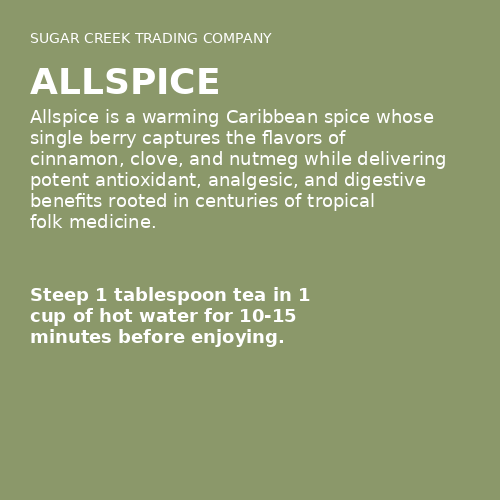
A warming Caribbean spice whose single berry captures the flavors of cinnamon, clove, and nutmeg while delivering potent antioxidant, analgesic, and digestive benefits rooted in centuries of tropical folk medicine.
BOTANICAL IDENTIFICATION
Scientific Name: Pimenta dioica (L.) Merr.
Common Names: Allspice, Jamaica Pepper, Pimento, Myrtle Pepper, Newspice, Pimenta
Family: Myrtaceae (Myrtle family)
Allspice is an aromatic evergreen tree that can reach 10 to 18 meters in height, with smooth, grey bark that peels in thin sheets and glossy, leathery, elliptical leaves that release a rich, spicy fragrance when crushed. The tree produces small, white, four-petaled flowers in dense panicles during mid-summer, followed by clusters of small, round berries approximately 6 mm in diameter. The berries are harvested while still green and unripe, then sun-dried until they turn a dark reddish-brown, at which point they resemble large, rough peppercorns.
Native to the Greater Antilles, southern Mexico, and Central America, allspice thrives in tropical lowland forests with warm temperatures, high humidity, and well-drained limestone or volcanic soils. Jamaica remains the world's primary producer and exporter of allspice, where the tree grows semi-wild in the rugged hill country of the island's interior. The species has been introduced to other tropical regions but rarely produces fruit of comparable quality outside its native range.
CULTURAL AND HISTORICAL USE
The indigenous Taino and Arawak peoples of the Caribbean were the first known users of allspice, employing the dried berries and leaves to season and preserve meats, prepare warming medicinal teas, and embalm their dead. When Spanish explorers encountered the spice in Jamaica in the early 16th century, they named it pimienta (pepper) due to the berries' resemblance to peppercorns. The English later coined the name "allspice" because its complex aroma seemed to combine cinnamon, clove, and nutmeg in a single berry.
Throughout the Caribbean, allspice became central to both cuisine and folk medicine. In Jamaica, allspice is a foundational ingredient in jerk seasoning, a tradition that dates back to the Maroons, escaped enslaved Africans who developed the slow-smoking technique using allspice wood and berries to preserve and flavor wild game. Allspice tea, known locally as "pimento dram," has been used for centuries to relieve stomachaches, menstrual cramps, colds, and muscle pain. In Central American curanderismo, allspice poultices were applied to aching joints and bruises.
European herbalists of the 17th and 18th centuries adopted allspice as a carminative (gas-relieving) spice and warming digestive stimulant. It appeared in pharmacopoeias as an ingredient in digestive cordials and was used to flavor medicines with unpleasant tastes. In Ayurvedic-influenced practice, allspice is considered a warming spice that kindles agni (digestive fire) and is useful for cold, damp, Kapha-type constitutions.
KEY BIOACTIVE COMPOUNDS & BENEFITS
| Compound/Class | Location in Plant | Human Benefit | Role in Plant |
|---|---|---|---|
| Eugenol (60-80% of essential oil) | Berries and leaves | Analgesic; anti-inflammatory; antimicrobial; dental pain relief | Antifungal and antibacterial defense; herbivore deterrent |
| Methyleugenol and chavicol | Berries | Contribute to antispasmodic and carminative effects | Aromatic defense compounds |
| Ericifolin and gallic acid tannins | Berries and leaves | Potent antioxidants; anti-tumor activity in preliminary research | UV protection; antimicrobial defense |
| 1,8-Cineole (eucalyptol) | Leaves | Respiratory decongestant; mild expectorant | Insect deterrent |
| Beta-caryophyllene | Berries | Anti-inflammatory (CB2 receptor agonist); gastroprotective | Attracts beneficial predatory insects |
Eugenol is the dominant compound and the primary driver of allspice's therapeutic effects. This phenylpropanoid is the same compound responsible for the analgesic properties of clove oil, and it occurs in allspice at similarly high concentrations. The synergy between eugenol, beta-caryophyllene, and the plant's tannin fraction creates a broad-spectrum anti-inflammatory and antioxidant profile that exceeds what any single isolated compound could achieve.
HOW IT WORKS IN THE BODY
Allspice acts as a warming stimulant that enhances circulation, relieves pain, calms digestive spasm, and provides robust antioxidant protection.
Pain Relief and Anti-Inflammatory Action:
Eugenol inhibits cyclooxygenase-2 (COX-2) and lipoxygenase enzymes, reducing the production of pro-inflammatory prostaglandins and leukotrienes. It also blocks voltage-gated sodium channels in pain-sensing neurons, producing a local anesthetic effect. This dual mechanism explains allspice's long-standing use for dental pain, joint aches, and muscle soreness. Beta-caryophyllene contributes additional anti-inflammatory action through selective activation of cannabinoid receptor type 2 (CB2), which modulates immune cell activity without psychoactive effects.
Digestive Support and Carminative Action:
Allspice stimulates the secretion of digestive enzymes and gastric acid, improving the breakdown and absorption of food. Its essential oil relaxes smooth muscle in the gastrointestinal tract, relieving bloating, gas, and intestinal cramping. The warming, circulatory-stimulating properties increase blood flow to the digestive organs, enhancing overall digestive efficiency. These properties make allspice a classic post-meal digestive aid.
Antimicrobial and Preservative Properties:
Eugenol and related phenolic compounds disrupt microbial cell membranes and inhibit the growth of a wide range of bacteria and fungi, including Staphylococcus aureus, Escherichia coli, Candida albicans, and various food-spoilage organisms. This antimicrobial potency is the basis for allspice's centuries-old use in food preservation and explains its prominence in tropical cuisines where meat spoilage is a constant concern.
Antioxidant Protection:
Allspice consistently ranks among the highest-antioxidant spices in ORAC (Oxygen Radical Absorbance Capacity) assays. Its combination of eugenol, gallic acid derivatives, and ericifolin provides potent scavenging of free radicals, protecting lipids, proteins, and DNA from oxidative damage. Preliminary in vitro research suggests that ericifolin may have specific anti-proliferative effects on certain cancer cell lines, though clinical evidence in humans is not yet established.
DOSE GUIDELINES
| Preparation Type | Typical Dose | Purpose |
|---|---|---|
| Ground spice (culinary) | 1/4 to 1/2 teaspoon per serving, as desired | Digestive support; antioxidant intake; culinary flavoring |
| Whole berry tea (infusion/decoction) | 1 teaspoon crushed berries per cup, steeped 10-15 minutes | Digestive carminative; warming tonic for colds |
| Tincture (1:5, 60% ethanol) | 1-3 mL, 2-3 times daily | Concentrated digestive and anti-inflammatory support |
| Essential oil (topical, diluted) | 1-2 drops in 1 tablespoon carrier oil | Topical pain relief for sore muscles and joints |
Allspice is best used in moderate, regular culinary quantities or as a short-term remedy for acute digestive or pain complaints. It is a warming spice and may be too stimulating in large amounts for individuals with heat-type constitutions or inflammatory digestive conditions like active gastritis.
PREPARATION AND USES
Whole allspice berries retain their essential oil and flavor much longer than pre-ground spice. For tea, lightly crush 1 teaspoon of whole berries with a mortar and pestle, place in a cup, pour boiling water over them, and steep covered for 10 to 15 minutes. Strain and drink after meals for digestive comfort, or add honey and lemon for a warming cold-weather tonic. For a richer extraction, gently simmer the crushed berries for 5 to 10 minutes as a decoction.
In the kitchen, allspice is indispensable in Caribbean jerk marinades, Middle Eastern baharat spice blends, Scandinavian pickled herring, and British fruitcakes and mincemeat. It pairs beautifully with cinnamon, ginger, black pepper, and clove. For topical use, allspice essential oil should always be diluted in a carrier oil (such as sweet almond or coconut oil) before application to the skin, as undiluted eugenol-rich oils can cause irritation or chemical burns.
OPTIMAL CONTEXT FOR USE
Allspice is especially well-suited for individuals experiencing:
Digestive discomfort, bloating, gas, or sluggish digestion, particularly after heavy or rich meals
Muscle or joint pain and soreness, where a warming, anti-inflammatory topical application is desired
Dental pain or mouth discomfort, where eugenol's local anesthetic effect can provide temporary relief
Cold and damp conditions, chills, or early-stage colds, where a warming circulatory stimulant is appropriate
A desire to increase dietary antioxidant intake through flavorful culinary use rather than isolated supplements
Allspice combines well with ginger for enhanced digestive warming, with turmeric for synergistic anti-inflammatory effects, and with cinnamon for blood sugar support in warming spice blends.
SUSTAINABILITY AND ETHICAL HARVESTING
Jamaica's allspice production is largely based on semi-wild and traditionally managed stands of Pimenta dioica trees, a system that has sustained production for centuries with minimal environmental disruption. The trees grow in diverse, mixed-species forests and hillside plantations that preserve habitat and soil integrity. Because allspice trees are long-lived and productive for decades, the cultivation model is inherently sustainable.
However, Jamaican allspice production has faced challenges from climate events, aging tree populations, and competition from cheaper synthetic flavoring. Supporting authentic, origin-verified allspice helps sustain the livelihoods of Jamaican farming communities and preserves the genetic diversity of this ecologically important tropical tree. Allspice is not considered threatened, but quality and sustainability vary by source, and Jamaican-origin berries remain the gold standard.
SAFETY AND CAUTIONS
Allspice is generally recognized as safe (GRAS) when used in normal culinary quantities. The following cautions apply to concentrated or therapeutic use:
Eugenol sensitivity: The high eugenol content can cause skin or mucous membrane irritation in sensitive individuals, especially when using essential oil or concentrated preparations. Always dilute essential oil before topical application and perform a patch test.
Anticoagulant interaction: Eugenol has mild antiplatelet activity. Individuals taking blood-thinning medications (warfarin, aspirin, clopidogrel) should use concentrated allspice preparations with caution and inform their healthcare provider.
Pregnancy: Culinary amounts are considered safe during pregnancy. However, concentrated allspice preparations, essential oil, and high-dose supplementation should be avoided during pregnancy, as eugenol may stimulate uterine contractions at high doses.
Gastritis and reflux: Allspice's warming, stimulatory nature may aggravate active gastritis, acid reflux, or peptic ulcers in some individuals.
REFERENCES
Kikuzaki, H., et al. (1999). "Antioxidant effects of some ginger constituents." Journal of Food Science, 64(2), 294-299. [Note: Includes comparative ORAC data for allspice.]
Rompelberg, C.J., et al. (1996). "Antimutagenicity of eugenol in the rodent bone marrow micronucleus test." Mutation Research, 346(2), 69-75.
Marzouk, M.S.A., et al. (2007). "An acylated flavan-3-ol glycoside from Pimenta dioica." Phytochemistry, 68(9), 1324-1331.
FINAL NOTE
Allspice is a remarkable testament to the complexity that a single plant can achieve. In one small, unassuming berry, it offers the aromatic warmth of cinnamon, the pungent depth of clove, and the subtle sweetness of nutmeg, all unified by a phytochemical profile that is as therapeutically potent as it is culinarily versatile. From the jerk pits of Jamaica to the spice drawers of kitchens worldwide, allspice reminds us that the most effective medicines are often the ones we reach for simply because they taste extraordinary.
Share