Sugar Creek Trading Company
Aloe Vera
Aloe Vera
Impossible de charger la disponibilité du service de retrait
ALOE VERA
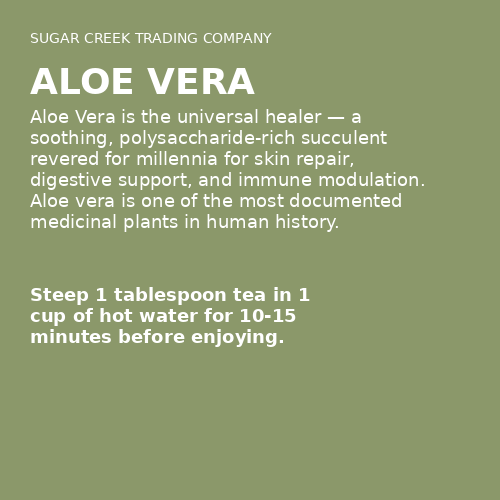
The universal healer — a soothing, polysaccharide-rich succulent revered for millennia for skin repair, digestive support, and immune modulation.
BOTANICAL IDENTIFICATION
Scientific Name: Aloe vera (L.) Burm.f. (syn. Aloe barbadensis Mill.)
Common Names: Aloe vera, Barbados Aloe, True Aloe, Burn Plant, First Aid Plant
Family: Asphodelaceae (formerly Liliaceae)
Aloe vera is a stemless or short-stemmed succulent perennial growing 60 to 100 cm (24 to 39 inches) tall. Its thick, fleshy, lance-shaped leaves are gray-green to green, with serrated margins and occasional white flecks on younger surfaces. The plant produces a tall spike of tubular yellow flowers from the center of the rosette, typically in summer.
Believed to originate from the Arabian Peninsula, Aloe vera has been cultivated so extensively across tropical and subtropical regions worldwide that its precise native range is uncertain. It thrives in warm, arid climates with well-drained sandy or loamy soil and full sun, and is now commercially cultivated on large scale in Mexico, the Dominican Republic, India, China, and the southern United States.
CULTURAL AND HISTORICAL USE
Aloe vera is one of the most documented medicinal plants in human history. The Ebers Papyrus (c. 1550 BCE) records Egyptian physicians using aloe preparations for skin infections, burns, and parasites. Cleopatra and Nefertiti reportedly incorporated aloe gel into their beauty rituals. In ancient Greece, Dioscorides described aloe in his De Materia Medica as a treatment for wounds, hemorrhoids, and mouth sores. Alexander the Great is said to have conquered the island of Socotra specifically to secure aloe supplies for his soldiers' wounds.
In Ayurvedic medicine, Aloe vera is known as kumari ("young maiden") and ghrita-kumari, valued as a rejuvenating tonic (rasayana) for the skin, liver, and female reproductive system. It is classified as bitter and cooling, pacifying Pitta and Kapha doshas. In Traditional Chinese Medicine, the dried latex (known as lu hui) is used to clear liver heat, purge fire toxins, and treat constipation.
Modern commercial interest in Aloe vera exploded in the 1950s and 1960s when researchers began documenting its wound-healing properties scientifically. Today it is among the most widely used botanical ingredients globally, appearing in skincare, beverages, dietary supplements, and functional foods. This 100:1 extract represents a highly concentrated form, where 100 kilograms of raw aloe leaf material are reduced to 1 kilogram of extract, concentrating the active polysaccharides and phytochemicals.
KEY BIOACTIVE COMPOUNDS & BENEFITS
| Compound/Class | Location in Plant | Human Benefit | Role in Plant |
|---|---|---|---|
| Acemannan (acetylated mannan) | Inner leaf gel parenchyma | Immune stimulation; wound healing; prebiotic; antiviral activity | Water storage and structural polysaccharide |
| Aloin A & B (anthraquinone glycosides) | Yellow latex layer | Stimulant laxative (minimal in decolorized extracts) | Bitter herbivory deterrent |
| Aloe-emodin | Latex and leaf rind | Antimicrobial; anti-inflammatory; antitumor activity in vitro | Pathogen defense |
| Glucomannans and other polysaccharides | Inner gel matrix | Moisturizing; anti-inflammatory; blood sugar modulation | Water retention and cell wall structure |
| Vitamins (A, C, E, B12, folic acid) and enzymes | Throughout gel | Antioxidant protection; enzymatic anti-inflammatory effects | Metabolic functions and UV defense |
In a 100:1 extract, the polysaccharide and phenolic fractions are significantly concentrated compared to raw gel. This means the immune-modulating acemannan content and antioxidant phenolics are delivered in much smaller serving sizes, making this extract form ideal for encapsulation and precise dosing. The concentration process typically removes or substantially reduces the aloin (laxative) content, yielding a product focused on the gel's therapeutic polysaccharides rather than the latex's purgative effects.
HOW IT WORKS IN THE BODY
Aloe vera's concentrated extract delivers its benefits through several interconnected physiological pathways.
Immune Modulation and Cellular Defense:
Acemannan activates macrophages via toll-like receptor pathways, increasing phagocytosis and the release of immune-signaling cytokines such as interleukin-1 (IL-1) and tumor necrosis factor-alpha (TNF-alpha). This primes the innate immune system for faster response to pathogens. At the same time, acemannan exhibits prebiotic properties, feeding beneficial Bifidobacterium and Lactobacillus species in the colon and supporting mucosal immune integrity.
Wound Healing and Tissue Repair:
Aloe polysaccharides stimulate fibroblast growth factor and increase collagen synthesis, accelerating the proliferative phase of wound healing. The gel's mucilaginous matrix also provides a hydrating, protective barrier when applied topically. Enzymes such as bradykinase help reduce excessive inflammation at wound sites, while salicylic acid derivatives contribute mild analgesic effects.
Digestive and Gastrointestinal Support:
The polysaccharides in Aloe vera gel coat and soothe the gastrointestinal mucosa, providing a demulcent effect beneficial for conditions involving irritation or inflammation of the stomach and intestinal lining. Studies have shown improvements in symptoms of gastroesophageal reflux and irritable bowel syndrome with regular aloe gel consumption.
Blood Sugar Regulation:
Several clinical trials have demonstrated that Aloe vera gel and its polysaccharides can modestly reduce fasting blood glucose and HbA1c levels, likely through improved insulin sensitivity and slowed intestinal glucose absorption mediated by the gel's viscous polysaccharide matrix.
DOSE GUIDELINES
| Preparation Type | Typical Dose | Purpose |
|---|---|---|
| 100:1 Extract powder | 100–300 mg, 1–2x daily | Immune support; general wellness tonic |
| 100:1 Extract in capsules | 200–500 mg daily | Digestive soothing; blood sugar support |
| Reconstituted topical paste | Mix powder with water; apply as needed | Skin repair; burns; irritation |
Because this is a 100:1 concentrated extract, doses are substantially smaller than those used for raw aloe gel or juice. A 200 mg serving of 100:1 extract represents the concentrated actives from approximately 20 grams of fresh leaf material. This extract is well-suited for daily long-term use as a tonic supplement.
PREPARATION AND USES
Aloe vera 100:1 extract powder can be encapsulated for convenient daily supplementation or stirred into water, juice, or smoothies. Due to its concentration, only small amounts are needed. For topical use, the powder can be mixed with a small amount of water or a carrier oil (such as coconut or jojoba oil) to create a concentrated aloe paste for application to burns, sunburn, minor cuts, dry skin, or irritated areas.
For digestive support, the extract can be taken 15 to 30 minutes before meals with a full glass of water. It mixes well with other herbal powders in custom formulations — combining Aloe vera extract with turmeric, slippery elm, or marshmallow root creates a comprehensive gut-soothing blend. The neutral-to-slightly-bitter flavor of the concentrated extract blends easily into beverages without strongly altering taste.
OPTIMAL CONTEXT FOR USE
This extract is especially well-suited for individuals experiencing:
Digestive discomfort, acid reflux, or mild gastrointestinal inflammation
Frequent minor skin injuries, sunburn, or dry and irritated skin
A desire for convenient, high-potency immune support in capsule or powder form
Metabolic concerns including borderline or mildly elevated blood sugar
Interest in a concentrated botanical supplement that delivers whole-plant benefits in small doses
Aloe vera extract pairs effectively with probiotics for gut health, with vitamin C and zinc for immune support, and with hyaluronic acid or collagen peptides for skin and connective tissue wellness.
SUSTAINABILITY AND ETHICAL HARVESTING
Aloe vera is one of the most widely cultivated medicinal plants in the world, with major production in Mexico, India, China, Thailand, and the Dominican Republic. Because it is commercially farmed rather than wild-harvested, pressure on wild populations is minimal. The plant is drought-tolerant and can be grown on marginal agricultural land with minimal irrigation, making it an ecologically favorable crop in arid regions.
Sustainable Aloe vera farming practices include organic cultivation without synthetic pesticides, hand-harvesting of mature outer leaves (allowing the plant to continue producing), and water-efficient drip irrigation. Buyers should look for certifications such as the International Aloe Science Council (IASC) seal, which verifies quality and sustainable production standards.
SAFETY AND CAUTIONS
Aloe vera inner gel and gel-derived extracts (including this 100:1 extract) are generally recognized as safe (GRAS) for oral and topical use.
Allergic reactions: Rare but possible, especially in individuals allergic to plants in the Asphodelaceae or Liliaceae families. Discontinue use if rash, itching, or swelling occurs.
Drug interactions: Aloe vera may enhance the effects of blood sugar-lowering medications (insulin, metformin) and anticoagulants. Monitor blood glucose closely if combining with diabetes medication.
Pregnancy and nursing: While the inner gel is generally considered safe, concentrated extracts should be used with caution during pregnancy. Consult a healthcare provider before use.
Aloin content: High-quality 100:1 extracts are typically decolorized (aloin-reduced). Verify that the product has been processed to remove or minimize anthraquinone laxative compounds if long-term internal use is intended.
REFERENCES
Surjushe, A., Vasani, R., & Saple, D.G. "Aloe vera: a short review." Indian Journal of Dermatology, 53(4), 2008, 163–166.
Radha, M.H., & Laxmipriya, N.P. "Evaluation of biological properties and clinical effectiveness of Aloe vera: a systematic review." Journal of Traditional and Complementary Medicine, 5(1), 2015, 21–26.
Reynolds, T., & Dweck, A.C. "Aloe vera leaf gel: a review update." Journal of Ethnopharmacology, 68(1-3), 1999, 3–37.
Hamman, J.H. "Composition and applications of Aloe vera leaf gel." Molecules, 13(8), 2008, 1599–1616.
International Aloe Science Council (IASC). Certification standards and quality specifications. www.iasc.org.
FINAL NOTE
Aloe vera needs little introduction — it is perhaps the single most recognized medicinal plant on Earth, and for good reason. This 100:1 extract distills the healing essence of the inner gel into a potent, convenient form, delivering concentrated polysaccharides and phytonutrients without the bulk of raw juice. Whether taken internally for digestive calm and immune resilience or applied topically for skin that needs repair, concentrated Aloe vera extract is a foundational botanical that belongs in every herbal toolkit.
Share