Sugar Creek Trading Company
Anantamul Root
Anantamul Root
Impossible de charger la disponibilité du service de retrait
HEMIDESMUS INDICUS
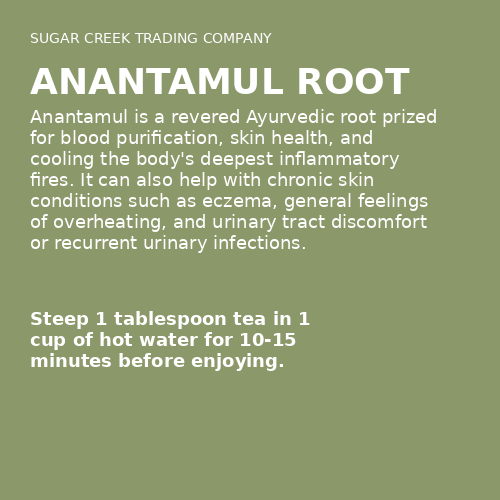
A revered Ayurvedic root prized for blood purification, skin health, and cooling the body's deepest inflammatory fires.
BOTANICAL IDENTIFICATION
Scientific Name: Hemidesmus indicus (L.) R.Br.
Common Names: Anantamul, Indian Sarsaparilla, Nannari, Sugandhi, Sariva, Eternal Root
Family: Apocynaceae (formerly Asclepiadaceae)
Anantamul is a slender, twining, semi-erect shrub that typically grows to 1-3 meters in length. Its leaves are opposite, elliptic-lanceolate, and dark green with prominent whitish veins on the upper surface. The small, greenish-purple flowers are borne in axillary cymes, and the plant produces slender, cylindrical follicle fruits. The root, the primary medicinal part, is woody, tortuous, and brownish externally with a characteristic pleasant vanilla-like fragrance when dried.
Native to the Indian subcontinent, Anantamul thrives in tropical and subtropical climates across India, Sri Lanka, and parts of Southeast Asia. It grows wild in sandy and rocky soils, in open scrublands, hedgerows, and the margins of deciduous forests, from sea level up to approximately 600 meters elevation.
CULTURAL AND HISTORICAL USE
Anantamul holds a position of deep reverence in Ayurvedic medicine, where its Sanskrit name translates to "the eternal root" (ananta = endless, mul = root), reflecting both the plant's spreading root system and its perceived inexhaustible healing virtues. Classified in Ayurveda as a premier raktashodhaka (blood purifier), it has been prescribed for thousands of years to treat skin diseases, fevers, urinary disorders, and chronic inflammatory conditions. The Charaka Samhita and Sushruta Samhita, foundational Ayurvedic texts dating to roughly 600 BCE, both list Sariva among the most important cooling and detoxifying herbs, placing it in the Sarivadi Gana group of medicinal plants.
In South Indian folk medicine, the root is widely used to prepare "nannari sherbet," a fragrant, rose-tinted cooling drink traditionally consumed during hot summer months to prevent heat stroke and urinary tract infections. Sri Lankan traditional medicine (Deshiya Chikitsa) employs the root similarly for fevers, venereal diseases, and as a general tonic. The Siddha medical system of Tamil Nadu considers Anantamul a key herb for treating chronic skin conditions like psoriasis and eczema, as well as rheumatic complaints.
European colonial botanists encountered the root in the 18th century and initially confused it with New World sarsaparilla (Smilax species), leading to its English common name "Indian Sarsaparilla." While botanically unrelated to true sarsaparilla, Anantamul shares some functional overlap in traditional use as a blood-cleansing, alterative tonic. It was included in the British Pharmacopoeia as a substitute for sarsaparilla and was exported to Europe as a treatment for syphilis and chronic skin diseases throughout the 19th century.
KEY BIOACTIVE COMPOUNDS & BENEFITS
| Compound/Class | Location in Plant | Human Benefit | Role in Plant |
|---|---|---|---|
| 2-Hydroxy-4-methoxybenzaldehyde | Root bark | Anti-inflammatory, hepatoprotective, antimicrobial activity | Aromatic defense compound; contributes to the root's characteristic vanilla-like scent |
| Hemidesminine & related alkaloids | Root | Anti-venom properties, immune modulation, analgesic effects | Nitrogen-based chemical defense against herbivores |
| Coumarino-lignoids (hemidesmin I & II) | Root | Potent antioxidant activity, protection against lipid peroxidation | UV protection and structural defense compounds |
| Saponins (sarsapogenin derivatives) | Root | Blood purification, anti-hyperlipidemic effects, diuretic action | Membrane-disrupting defense against pathogens and herbivores |
| Tannins & flavonoids | Root and leaves | Astringent, wound-healing, antidiarrheal, and antioxidant properties | Protection against UV radiation and microbial attack |
Together, these compounds create a broad-spectrum alterative profile. The aromatic aldehyde (2-hydroxy-4-methoxybenzaldehyde) is considered the root's signature active compound, responsible for much of its anti-inflammatory and antimicrobial potency. Combined with the saponins and coumarino-lignoids, Anantamul root delivers a cooling, detoxifying, and tissue-protective action that modern pharmacology is beginning to validate through in vitro and animal studies.
HOW IT WORKS IN THE BODY
Anantamul acts primarily as a systemic alterative and anti-inflammatory agent, working through several interconnected physiological pathways.
Blood Purification and Detoxification:
The saponins and phenolic compounds in Anantamul support hepatic and renal detoxification pathways. They promote diuresis and enhance the clearance of metabolic waste products from the blood. Studies suggest the root extract upregulates liver antioxidant enzymes (superoxide dismutase, catalase, glutathione peroxidase), helping to neutralize circulating free radicals and reduce oxidative burden on the blood and tissues.
Anti-Inflammatory and Immune Modulation:
2-Hydroxy-4-methoxybenzaldehyde has been shown to inhibit pro-inflammatory cytokines and reduce edema in experimental models. The root extract modulates NF-kB signaling, a master switch for inflammatory gene expression, which helps explain its traditional use in chronic inflammatory skin conditions and joint pain. The alkaloid hemidesminine demonstrates immunomodulatory effects, enhancing phagocytic activity while dampening excessive inflammatory responses.
Skin and Tissue Repair:
Anantamul's combined antioxidant, anti-inflammatory, and antimicrobial actions converge on skin health. By reducing systemic inflammation and oxidative stress while combating skin-colonizing pathogens, the root creates conditions favorable for tissue repair. Its astringent tannins support wound closure and reduce weeping in eczematous conditions.
Cooling and Thermoregulatory Support:
In Ayurvedic terms, Anantamul is deeply cooling (sheeta virya), which translates physiologically into its ability to reduce heat-associated inflammation, support healthy perspiration, and promote urinary cooling. This makes it especially valued in tropical climates for managing heat-related complaints.
DOSE GUIDELINES
| Preparation Type | Typical Dose | Purpose |
|---|---|---|
| Decoction (root) | 3-6 g dried root simmered in 2 cups water for 15-20 min; drink 1-2 cups daily | Blood purification, skin conditions, general cooling tonic |
| Cold infusion | 5-10 g root soaked overnight in 2 cups water; strain and drink in morning | Urinary support, gentle detox, summer cooling drink |
| Powder (churna) | 1-3 g powder twice daily with warm water or milk | Chronic skin conditions, digestive support, systemic alterative |
| Tincture (1:5, 45% ethanol) | 2-4 mL, 2-3 times daily | Concentrated extract for chronic inflammatory conditions |
Anantamul is traditionally used as a long-term tonic rather than an acute remedy. Ayurvedic practitioners typically recommend courses of 4-12 weeks for chronic skin conditions and blood purification protocols, often combined with complementary herbs in classical formulations like Sarivadyasava (a fermented preparation) or Sarivadi Vati.
PREPARATION AND USES
The most traditional preparation is a simple decoction: simmer 3-6 grams of dried, chopped Anantamul root in two cups of water for 15-20 minutes, strain, and drink warm or at room temperature. For a milder preparation particularly suited to hot weather, prepare a cold infusion by soaking the root overnight in room-temperature water. This cold-water extraction preserves the delicate aromatic compounds and yields a pleasantly fragrant drink that can be sweetened with raw sugar or honey. In South India, this cold infusion forms the basis of the beloved nannari sherbet, often enhanced with lime juice and served over ice.
The powdered root can be taken directly with water or milk, or encapsulated for convenience. For topical applications, a paste made from the powdered root mixed with water, coconut oil, or ghee can be applied to inflammatory skin conditions, minor wounds, or insect bites. Anantamul also combines well in formulas with other alterative herbs such as neem, manjistha, and turmeric for comprehensive skin and blood support. The root can be tinctured in 45% alcohol for a more concentrated and shelf-stable preparation.
OPTIMAL CONTEXT FOR USE
This herb is especially well-suited for individuals experiencing:
Chronic skin conditions such as eczema, psoriasis, acne, or persistent rashes that suggest underlying systemic inflammation or toxicity
General feelings of overheating, excess pitta in Ayurvedic terms, including inflammatory conditions aggravated by heat
Urinary tract discomfort or recurrent urinary infections, where a gentle diuretic and antimicrobial tonic is desired
Desire for a long-term blood-cleansing and detoxification protocol, particularly during seasonal transitions or after periods of dietary excess
Joint inflammation or rheumatic complaints accompanied by heat and swelling
For best results, Anantamul is often combined with dietary adjustments (reducing fried foods, alcohol, and excessive spice) and complementary cooling herbs like coriander, fennel, or licorice root as part of a holistic wellness approach.
SUSTAINABILITY AND ETHICAL HARVESTING
Anantamul grows abundantly across the Indian subcontinent and is not currently listed as endangered or threatened. However, increasing commercial demand for the root has led to overharvesting in some wild populations, particularly in regions of central and southern India. The plant is increasingly cultivated on small farms and in agroforestry systems, which helps reduce pressure on wild stands. Sustainable harvesting practices involve taking only a portion of the root system from mature plants, allowing regrowth, and rotating collection sites.
When sourcing Anantamul, look for suppliers who work directly with cultivated sources or who practice responsible wildcrafting under established guidelines. Supporting fair-trade supply chains helps ensure that the rural Indian communities who harvest this root receive equitable compensation for their labor and traditional knowledge.
SAFETY AND CAUTIONS
Anantamul is considered very safe and is classified as a food-grade herb in India, where it has been consumed as a beverage ingredient for centuries. Nonetheless, some precautions apply:
Individuals with known allergies to plants in the Apocynaceae family should exercise caution and start with a small test dose.
Due to its diuretic properties, those on prescription diuretics or blood pressure medications should consult a healthcare provider before use to avoid additive effects.
While traditionally used during pregnancy in some Ayurvedic formulations, pregnant and nursing women should consult a qualified practitioner before using Anantamul, as rigorous modern safety data for these populations is limited.
Anantamul may potentiate the effects of anti-diabetic medications due to reported hypoglycemic activity; diabetic patients should monitor blood sugar levels if using this herb regularly.
REFERENCES
Satheesh Naik, K., et al. "Pharmacological review on Hemidesmus indicus." International Journal of Research in Phytochemistry and Pharmacology, 4(4), 2014, pp. 156-163.
Kotnis, M.S., et al. "Anti-inflammatory and analgesic activity of Hemidesmus indicus root extract." Journal of Ethnopharmacology, 96(1-2), 2005, pp. 159-163.
Ravishankara, M.N., et al. "Antioxidant activity of Hemidesmus indicus root." Phytomedicine, 9(2), 2002, pp. 153-160.
Williamson, E.M. Major Herbs of Ayurveda. Churchill Livingstone/Elsevier, 2002.
Khare, C.P. Indian Medicinal Plants: An Illustrated Dictionary. Springer-Verlag, 2007.
FINAL NOTE
Anantamul is one of Ayurveda's great quiet healers -- a root that works patiently beneath the surface, clearing heat, purifying blood, and restoring the skin's integrity over weeks and months of consistent use. Its gentle potency and pleasant flavor make it one of the rare medicinal herbs that people genuinely enjoy taking. For anyone dealing with stubborn inflammatory skin conditions or seeking a reliable, time-tested cooling tonic, Anantamul root is an exceptional ally drawn from one of the world's oldest living medical traditions.
Share