Sugar Creek Trading Company
Asafoetida With Acacia Gum
Asafoetida With Acacia Gum
Impossible de charger la disponibilité du service de retrait
FERULA ASSA-FOETIDA
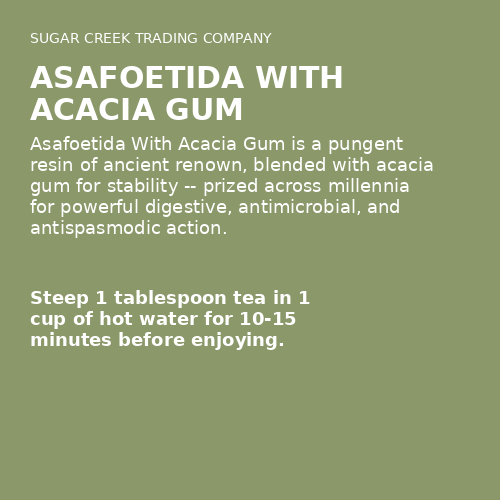
A pungent resin of ancient renown, blended with acacia gum for stability -- prized across millennia for powerful digestive, antimicrobial, and antispasmodic action.
BOTANICAL IDENTIFICATION
Scientific Name: Ferula assa-foetida L. (resin), blended with Acacia senegal (L.) Willd. (gum arabic)
Common Names: Asafoetida, Hing, Devil's Dung, Stinking Gum, Food of the Gods, Giant Fennel Resin
Family: Apiaceae (Carrot/Parsley family) for asafoetida; Fabaceae (Legume family) for acacia gum
Ferula assa-foetida is a large, herbaceous perennial that can reach 2 to 3 meters in height. It has a thick, fleshy taproot, hollow stems, and finely divided compound leaves. The plant produces large umbels of pale yellow flowers. The medicinally and culinarily valuable part is the oleo-gum-resin that exudes from incisions made in the living root crown and upper root. Fresh, the resin is soft and pungent; dried, it hardens into yellowish-brown to reddish-brown lumps with an intensely sulfurous odor.
Asafoetida is native to the arid regions of Iran, Afghanistan, Turkmenistan, and parts of Pakistan. It grows in dry, rocky, mountainous terrain at elevations between 600 and 1,500 meters. The plant requires several years of growth before resin harvesting can begin, and individual plants are typically harvested destructively, making sustainable management essential.
ABOUT THIS BLEND: ASAFOETIDA WITH ACACIA GUM
Raw asafoetida resin is extremely potent, sticky, and difficult to handle in its pure form. In this preparation, the resin is blended with acacia gum (gum arabic), a natural, food-grade stabilizer derived from the Acacia senegal tree. The acacia gum serves as a carrier that makes the asafoetida easier to measure, store, and incorporate into recipes and preparations. It also moderates the intensity of the flavor, making it more approachable for culinary use. This is the most traditional and widely used commercial form of asafoetida, commonly known as "compounded hing" or "hing powder" in Indian grocery traditions.
CULTURAL AND HISTORICAL USE
Asafoetida holds an extraordinarily prominent place in the culinary and medicinal traditions of India, Persia, and the broader Middle East. In Ayurvedic medicine, it is classified as one of the most potent carminatives (gas-relieving agents) and is prescribed for vata disorders, flatulence, colic, intestinal parasites, and hysteria. It is called "hing" in Hindi and is considered indispensable in the vegetarian kitchens of Brahmin, Jain, and Buddhist communities, where it serves as a flavor substitute for onion and garlic, which are avoided for religious reasons.
In Persian and Unani medicine, asafoetida has been used for centuries to treat epilepsy, respiratory infections, intestinal worms, and menstrual irregularities. The Greek physician Dioscorides documented its use in the first century CE, and it was a prized commodity on the ancient spice routes. Roman cooks used it liberally as a seasoning, storing it in jars with pine nuts to diffuse the flavor. Medieval European herbalists prescribed it for "hysterical" conditions, earning it the name "Devil's Dung" for its overpowering smell -- a name that coexisted with its Persian title "Food of the Gods."
In traditional African and Middle Eastern folk medicine, asafoetida has been used as an amulet to ward off illness, hung around the necks of children during epidemics, and burned as a fumigant to purify sick rooms. In early American folk medicine, particularly in Appalachian and African American traditions, small bags of asafoetida were worn around the neck to prevent colds and flu -- a practice that persisted into the mid-20th century.
KEY BIOACTIVE COMPOUNDS & BENEFITS
| Compound/Class | Location in Plant | Human Benefit | Role in Plant |
|---|---|---|---|
| Organosulfur compounds (diallyl disulfide, dimethyl trisulfide) | Oleo-gum-resin | Antimicrobial, antispasmodic, carminative, antihypertensive | Chemical defense against herbivores and pathogens |
| Ferulic acid and ferulaic esters | Resin fraction | Anti-inflammatory, antioxidant, neuroprotective | Structural support and UV defense in plant tissues |
| Coumarin derivatives (umbelliprenin, farnesiferol) | Resin and gum fractions | Antispasmodic, vasodilatory, cancer-preventive activity | Defense compounds and allelopathic agents |
| Volatile terpenoids (alpha- and beta-pinene) | Essential oil fraction | Expectorant, bronchodilatory, antimicrobial | Aromatic defense against insect herbivory |
| Polysaccharides (from gum fraction + added acacia gum) | Gum resin and acacia carrier | Prebiotic fiber, demulcent soothing of GI tract | Wound-sealing response and energy storage |
The pharmacological profile of asafoetida is dominated by its sulfur-containing volatile compounds, which are responsible for both its characteristic odor and its potent biological effects. These organosulfur compounds share structural similarities with those found in garlic and onion, conferring overlapping antimicrobial and cardiovascular benefits. The coumarins add antispasmodic and smooth-muscle-relaxing properties, while ferulic acid provides systemic antioxidant and anti-inflammatory support. The acacia gum carrier contributes its own gentle prebiotic and demulcent qualities.
HOW IT WORKS IN THE BODY
Asafoetida operates through several well-characterized physiological pathways, with its effects concentrated in the digestive, respiratory, and nervous systems.
Digestive and Carminative Action:
The organosulfur compounds and coumarins relax smooth muscle in the intestinal wall, relieving spasms that cause gas, bloating, and colic. Simultaneously, asafoetida stimulates the secretion of digestive enzymes from the pancreas and bile from the gallbladder, improving the overall breakdown of food -- particularly fats and legumes. Its antimicrobial volatile oils also help control the overgrowth of gas-producing bacteria in the small intestine, making it especially useful for SIBO-related symptoms.
Antimicrobial and Antiparasitic Activity:
The sulfur compounds demonstrate broad-spectrum antimicrobial action against gram-positive and gram-negative bacteria, fungi, and intestinal parasites. Research has shown activity against H. pylori, Candida species, and several common intestinal helminths. This traditional antiparasitic use is well-supported by in vitro and animal studies.
Respiratory Support:
As an expectorant and bronchial antispasmodic, asafoetida helps loosen mucus in the airways and reduces bronchial spasm. The volatile terpenoids are partially excreted through the lungs, delivering antimicrobial action directly to respiratory tissues. Traditional Unani and Ayurvedic practitioners have long used it for asthma, bronchitis, and whooping cough.
Nervous System and Antispasmodic Effects:
Coumarin derivatives, particularly umbelliprenin and farnesiferol, have demonstrated anxiolytic and anticonvulsant activity in animal models. Traditional use for "nervous" conditions, hysteria, and epilepsy may be partially explained by GABAergic modulation and calcium-channel effects in neural tissue.
DOSE GUIDELINES
| Preparation Type | Typical Dose | Purpose |
|---|---|---|
| Compounded powder (with acacia gum) | 200-500 mg (a pinch to 1/4 teaspoon), added to food or warm water, 1-3 times daily | Digestive support, gas, bloating |
| Warm water infusion | A pinch (100-300 mg) dissolved in 1 cup warm water | Acute gas, colic, stomach cramps |
| Tincture (1:5, 60% ethanol) | 0.5-2 mL, up to 3 times daily | Antispasmodic, respiratory support |
| Culinary use | A pinch per dish, tempered in hot oil or ghee | Preventive digestive support with meals |
Asafoetida is most effective when used in small, regular doses rather than large single doses. In culinary contexts, it is traditionally "bloomed" in hot oil or ghee for a few seconds before other ingredients are added -- this transforms the raw sulfurous smell into a mellow, savory, onion-like flavor. For medicinal purposes, dissolving a small amount in warm water and drinking before meals is the most direct approach. Because this preparation is blended with acacia gum, the flavor is more moderate than pure resin.
PREPARATION AND USES
The most common and traditional method of using compounded asafoetida is in cooking. Add a pinch to hot oil or ghee at the beginning of cooking -- this is the foundation of Indian "tadka" or "tempering." The heat volatilizes the harsh sulfur compounds and develops a rich, umami-like depth that enhances dal, vegetable curries, pickles, and rice dishes. It is particularly valued when cooking beans and lentils, as it both flavors the dish and reduces the gas-producing potential of legumes.
For medicinal use, dissolve a pinch (200-300 mg) in a cup of warm water and drink 15-30 minutes before meals for digestive complaints. For acute gas or colic, a slightly larger dose dissolved in warm water with a pinch of ginger can provide rapid relief. Asafoetida can also be prepared as a tincture by macerating the compounded powder in 60% ethanol for 4-6 weeks. Topically, a paste of asafoetida mixed with water has been traditionally applied to the abdomen for colic and gas in both adults and children, though this use is less common today.
OPTIMAL CONTEXT FOR USE
Asafoetida with acacia gum is especially well-suited for individuals experiencing:
Chronic flatulence, bloating, and digestive discomfort, particularly related to legume and cruciferous vegetable consumption
Intestinal cramping, colic, or IBS-like symptoms where smooth muscle spasm is a major component
Small intestinal bacterial overgrowth (SIBO) symptoms, where antimicrobial and carminative action is desired
Respiratory congestion, productive cough, or bronchial spasm in the context of colds or chronic bronchitis
Vegetarian or vegan cooks seeking a savory, umami-rich substitute for onion and garlic
Asafoetida combines well with ginger, cumin, and fennel for comprehensive digestive support. For respiratory applications, it can be paired with thyme, elecampane, or mullein.
SUSTAINABILITY AND ETHICAL HARVESTING
Asafoetida presents genuine sustainability concerns. The resin is harvested by making incisions in the root crown of mature plants (typically 4-5 years old), and the process often kills the plant. Wild populations in Iran and Afghanistan have faced significant harvesting pressure, and cultivation efforts are still in relatively early stages, primarily in India's Himachal Pradesh and Uttarakhand regions. Iran remains the dominant global producer, and wild-harvest management varies considerably by region.
The acacia gum (gum arabic) used as a carrier in this product is sustainably harvested from Acacia senegal trees in sub-Saharan Africa, primarily Sudan, Chad, and Senegal. The gum is collected by making small incisions in the bark, and the trees are not killed in the process. Responsible sourcing of both components is important. Sugar Creek Trading Company is committed to working with suppliers who support sustainable harvesting practices and emerging cultivation programs for Ferula species.
SAFETY AND CAUTIONS
Asafoetida is generally safe when used in culinary quantities and moderate medicinal doses. However, the following cautions apply:
Pregnancy: Asafoetida has traditionally been considered an emmenagogue (menstrual stimulant) and is contraindicated during pregnancy due to potential uterine stimulant effects. Avoid medicinal doses during pregnancy.
Bleeding disorders and surgery: The organosulfur compounds may have mild anticoagulant effects. Discontinue use at least two weeks before scheduled surgery, and use with caution if taking blood-thinning medications.
Infants and young children: Medicinal doses are not recommended for infants under 12 months. External abdominal application should also be used with caution in very young children.
Gastrointestinal sensitivity: In large doses, asafoetida can cause nausea, diarrhea, or burning sensations in the GI tract. Start with small amounts and increase gradually.
Blood pressure medications: Asafoetida may lower blood pressure; use with caution if taking antihypertensive drugs.
REFERENCES
Iranshahy, M., and Iranshahi, M. "Traditional uses, phytochemistry, and pharmacology of asafoetida (Ferula assa-foetida oleo-gum-resin) -- a review." Journal of Ethnopharmacology, 134(1), 1-10, 2011.
Mahendra, P., and Bisht, S. "Ferula asafoetida: Traditional uses and pharmacological activity." Pharmacognosy Reviews, 6(12), 141-146, 2012.
Bagheri, S.M., et al. "Antispasmodic effect of Ferula assa-foetida L. extract on rat ileum." Research in Pharmaceutical Sciences, 9(5), 363-367, 2014.
Amalraj, A., and Gopi, S. "Biological activities and medicinal properties of asafoetida: A review." Journal of Traditional and Complementary Medicine, 7(3), 347-359, 2017.
Fatehi, M., et al. "The pharmacology of Ferula species." Iranian Journal of Basic Medical Sciences, 7(3), 159-167, 2004.
FINAL NOTE
Asafoetida with acacia gum represents one of the oldest and most practical forms of this extraordinary resin. From the kitchens of ancient Rome to the Ayurvedic pharmacies of modern India, asafoetida has earned its place as a first-line remedy for digestive distress and a culinary treasure for those who understand its transformative power when heated in oil. The acacia gum carrier makes this preparation easy to use, store, and dose -- putting millennia of digestive wisdom into a simple pinch. Its pungent chemistry, rich in sulfur compounds that mirror those in garlic and onion, offers antimicrobial, antispasmodic, and carminative benefits that few single botanicals can match.
Share