Sugar Creek Trading Company
Asafoetida with Fenugreek
Asafoetida with Fenugreek
Impossible de charger la disponibilité du service de retrait
FERULA ASSA-FOETIDA & TRIGONELLA FOENUM-GRAECUM
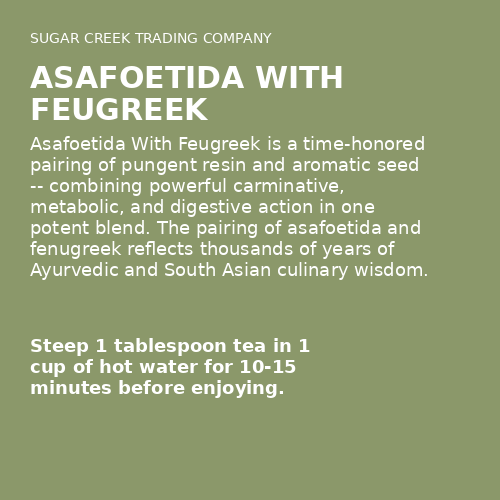
A time-honored pairing of pungent resin and aromatic seed -- combining powerful carminative, metabolic, and digestive action in one potent blend.
BOTANICAL IDENTIFICATION
Scientific Name: Ferula assa-foetida L. (asafoetida resin) blended with Trigonella foenum-graecum L. (fenugreek seed powder)
Common Names: Asafoetida: Hing, Devil's Dung, Stinking Gum, Food of the Gods | Fenugreek: Methi, Bird's Foot, Greek Hay, Hilbeh
Family: Apiaceae (Carrot/Parsley family) for asafoetida; Fabaceae (Legume family) for fenugreek
Ferula assa-foetida is a large herbaceous perennial reaching 2-3 meters in height with a thick taproot, hollow stems, and compound leaves. The valued oleo-gum-resin is harvested by incising the root crown. Trigonella foenum-graecum is an upright annual legume growing 30-60 cm tall, with trifoliate leaves, small white or yellowish flowers, and slender curved pods containing 10-20 hard, angular, yellowish-brown seeds with a distinctive maple-like aroma.
Asafoetida is native to the arid mountains of Iran, Afghanistan, and Central Asia. Fenugreek originates from the eastern Mediterranean and western Asia but is now cultivated extensively throughout India, Egypt, Ethiopia, Morocco, and many other regions. Both plants have thrived in hot, semi-arid climates for millennia.
ABOUT THIS BLEND
This preparation combines asafoetida resin with ground fenugreek seed as a carrier and synergistic partner. Fenugreek serves a dual role: it absorbs and stabilizes the sticky asafoetida resin for ease of handling and measurement, and it contributes its own substantial medicinal properties to the blend. This combination is deeply rooted in Indian culinary and Ayurvedic tradition, where hing and methi frequently appear together in spice blends, pickles, and medicinal formulas targeting digestive and metabolic health. The result is a product that delivers more than either ingredient alone.
CULTURAL AND HISTORICAL USE
The pairing of asafoetida and fenugreek reflects thousands of years of Ayurvedic and South Asian culinary wisdom. In Ayurveda, both are classified as deepana (appetite-stimulating) and pachana (digestion-promoting) herbs. Asafoetida is considered one of the supreme carminatives for vata imbalances -- gas, bloating, constipation, and nervous digestion -- while fenugreek is valued for its ability to warm the body, stimulate milk production in nursing mothers, support blood sugar balance, and strengthen digestion through its bitter and mucilaginous properties.
In Indian cooking, asafoetida and fenugreek are foundational to many regional spice blends. South Indian sambar powder, various pickle masalas, and Gujarati dal preparations frequently feature both. The combination appears in Ayurvedic churnas (herbal powders) prescribed for chronic digestive weakness, metabolic sluggishness, and joint stiffness. Unani physicians likewise combined the two for stomach ailments and to expel intestinal worms.
Fenugreek on its own has a rich history beyond South Asia. Ancient Egyptian papyri document its use in embalming and medicine. Greek and Roman physicians prescribed it for respiratory complaints and as a poultice for inflammation. In traditional Chinese medicine, fenugreek seed (hu lu ba) is used to warm the kidneys, dispel cold, and alleviate pain. The convergence of these two botanicals in a single preparation represents a union of Central Asian and South Asian herbal intelligence.
KEY BIOACTIVE COMPOUNDS & BENEFITS
| Compound/Class | Source | Human Benefit | Role in Plant |
|---|---|---|---|
| Organosulfur compounds (diallyl disulfide, dimethyl trisulfide) | Asafoetida resin | Antimicrobial, antispasmodic, carminative | Chemical defense against herbivores |
| Ferulic acid and coumarin derivatives | Asafoetida resin | Anti-inflammatory, antioxidant, vasodilatory | Structural defense and UV protection |
| Steroidal saponins (diosgenin, yamogenin) | Fenugreek seed | Cholesterol reduction, hormone modulation, anti-inflammatory | Antifungal defense and membrane stabilization |
| Galactomannan fiber (soluble) | Fenugreek seed | Blood sugar regulation, cholesterol binding, prebiotic activity | Seed energy reserve and hydration management |
| 4-Hydroxyisoleucine | Fenugreek seed | Insulin sensitizer, promotes glucose uptake in muscle tissue | Amino acid storage compound |
| Trigonelline (alkaloid) | Fenugreek seed | Neuroprotective, blood sugar lowering, liver protective | Nitrogen storage and defense compound |
This blend brings together two complementary pharmacological profiles. Asafoetida contributes potent sulfur-based antimicrobial and antispasmodic chemistry, while fenugreek delivers steroidal saponins and unique amino acids that modulate metabolism, insulin signaling, and cholesterol handling. The combination addresses digestive, metabolic, and inflammatory pathways simultaneously -- a hallmark of well-designed traditional formulas.
HOW IT WORKS IN THE BODY
This blend acts through multiple systems, with each ingredient reinforcing and expanding the other's effects.
Digestive and Carminative Action:
Asafoetida's organosulfur compounds relax intestinal smooth muscle, relieve gas and bloating, and stimulate enzyme secretion. Fenugreek's galactomannan fiber acts as a bulk-forming agent that regulates bowel transit time, while its bitter principles stimulate appetite and bile flow. Together, they address the full spectrum of digestive complaints -- from upper GI fullness to lower GI gas and irregular motility.
Blood Sugar and Metabolic Regulation:
Fenugreek is one of the most clinically studied herbs for blood sugar management. Its 4-hydroxyisoleucine directly stimulates insulin secretion from pancreatic beta cells in a glucose-dependent manner (meaning it acts only when blood sugar is elevated, reducing the risk of hypoglycemia). The galactomannan fiber slows carbohydrate absorption, and diosgenin improves insulin receptor sensitivity. Asafoetida complements this by supporting healthy pancreatic enzyme function and reducing inflammatory mediators that contribute to insulin resistance.
Cholesterol and Lipid Management:
Fenugreek saponins bind to bile acids in the intestine, increasing their excretion and forcing the liver to draw down cholesterol stores to produce replacement bile. Asafoetida's ferulic acid provides antioxidant protection to LDL particles, reducing their susceptibility to the oxidation that drives atherosclerosis. Clinical trials with fenugreek have shown reductions in total cholesterol, LDL, and triglycerides.
Anti-inflammatory and Antimicrobial Support:
Both ingredients contribute anti-inflammatory compounds through different mechanisms. Asafoetida's coumarins and ferulic acid inhibit COX and lipoxygenase pathways, while fenugreek's diosgenin suppresses NF-kB-mediated inflammatory gene expression. The broad-spectrum antimicrobial activity of asafoetida's sulfur compounds helps maintain healthy gut microbial balance.
DOSE GUIDELINES
| Preparation Type | Typical Dose | Purpose |
|---|---|---|
| Blended powder (culinary) | 1/4 to 1/2 teaspoon, added to cooking oil or food | Digestive support with meals, flavor enhancement |
| Warm water preparation | 1/4 to 1/2 teaspoon stirred into warm water, 1-2 times daily before meals | Digestive complaints, blood sugar support |
| Capsules (filled from powder) | 500-1,000 mg, 2-3 times daily with meals | Metabolic support, cholesterol management |
| Spice blend component | 1-2 teaspoons per batch of dal, curry, or pickle masala | Preventive digestive and metabolic support |
For digestive purposes, this blend works best when taken with or immediately before meals. For blood sugar and cholesterol goals, consistent daily use over 8-12 weeks is recommended. In cooking, add the powder to hot oil or ghee briefly before adding other ingredients -- this activates the asafoetida's volatile compounds and develops a savory, umami depth. The fenugreek component contributes a slightly nutty, maple-like warmth.
PREPARATION AND USES
The most traditional way to use this blend is in the Indian tadka (tempering) technique: heat a tablespoon of ghee or oil in a small pan, add a pinch to 1/4 teaspoon of the powder, let it sizzle for just a few seconds until fragrant, then pour over dal, vegetables, or rice. This brief contact with hot fat transforms the raw pungency into a deeply savory, complex flavor. The blend is essential in sambar, rasam, many South Indian chutneys, and Gujarati-style preparations.
For medicinal use without cooking, stir 1/4 to 1/2 teaspoon into a cup of warm water and drink before meals. Some practitioners recommend mixing with a small amount of ghee or honey to improve palatability and absorption. The powder can also be filled into capsules for those who prefer to avoid the taste entirely. As a component of larger herbal formulas, this blend pairs well with cumin, ajwain (carom seeds), black pepper, and ginger in traditional digestive churnas.
OPTIMAL CONTEXT FOR USE
This asafoetida-fenugreek blend is especially well-suited for individuals experiencing:
Chronic flatulence and bloating, particularly from legume-heavy or high-fiber diets
Blood sugar dysregulation, insulin resistance, or prediabetic patterns where dietary support is desired
Elevated cholesterol or triglycerides in individuals seeking evidence-based herbal adjuncts to diet and exercise
Sluggish appetite or weak digestive fire (what Ayurveda calls low agni), with symptoms of heaviness after eating
Cooks seeking an authentic Indian spice blend that doubles as a functional food for digestive and metabolic wellness
This blend combines well with turmeric and black pepper for a comprehensive anti-inflammatory and metabolic formula, or with ginger and cumin for targeted digestive support.
SUSTAINABILITY AND ETHICAL HARVESTING
Asafoetida faces sustainability challenges due to its destructive harvesting method -- plants are typically killed during resin extraction, and wild populations in Iran and Afghanistan have experienced overharvesting pressure. Cultivation programs are expanding in India, but supply still depends significantly on wild harvest. Fenugreek, in contrast, is a widely cultivated annual crop grown extensively across India, Egypt, and the Mediterranean with no conservation concerns. It is often used as a nitrogen-fixing cover crop, making it a net positive for soil health.
Sugar Creek Trading Company is committed to sourcing from suppliers who support responsible harvest practices for asafoetida and prioritize emerging cultivation efforts. The fenugreek component is sourced from established agricultural supply chains with robust quality standards.
SAFETY AND CAUTIONS
Both ingredients in this blend have long histories of safe use in food and medicine. However, the following cautions apply:
Pregnancy: Both asafoetida and fenugreek have traditional reputations as uterine stimulants. Asafoetida is contraindicated during pregnancy in medicinal doses. Fenugreek in large doses may also stimulate uterine contractions. Small culinary amounts are generally considered safe, but medicinal dosing should be avoided during pregnancy.
Blood sugar medications: Fenugreek can lower blood sugar. If you take insulin or oral hypoglycemic agents, monitor blood sugar closely and consult your healthcare provider, as dose adjustments may be needed.
Blood-thinning medications: Both asafoetida and fenugreek may have mild anticoagulant properties. Discontinue use at least two weeks before scheduled surgery.
Allergies: Individuals allergic to peanuts or chickpeas may cross-react with fenugreek, as all are in the Fabaceae family. Asafoetida allergy is rare but possible in individuals sensitive to Apiaceae plants (celery, carrots, parsley).
Maple syrup odor: Fenugreek contains sotolon, which can cause body fluids (sweat, urine) to develop a maple-syrup-like odor. This is harmless but can be mistaken for maple syrup urine disease in medical contexts.
REFERENCES
Iranshahy, M., and Iranshahi, M. "Traditional uses, phytochemistry, and pharmacology of asafoetida (Ferula assa-foetida oleo-gum-resin) -- a review." Journal of Ethnopharmacology, 134(1), 1-10, 2011.
Neelakantan, N., et al. "Effect of fenugreek (Trigonella foenum-graecum L.) intake on glycemia: A meta-analysis of clinical trials." Nutrition Journal, 13, 7, 2014.
Basch, E., et al. "Therapeutic applications of fenugreek." Alternative Medicine Review, 8(1), 20-27, 2003.
Amalraj, A., and Gopi, S. "Biological activities and medicinal properties of asafoetida: A review." Journal of Traditional and Complementary Medicine, 7(3), 347-359, 2017.
Yadav, U.C., and Baquer, N.Z. "Pharmacological effects of Trigonella foenum-graecum L. in health and disease." Pharmaceutical Biology, 52(2), 243-254, 2014.
FINAL NOTE
This blend of asafoetida and fenugreek is far more than the sum of its parts. It represents a meeting of Central Asian resin craft and South Asian seed wisdom -- two traditions converging on the same truth: that digestion is the foundation of health, and that the right spices are medicine. The sulfurous fire of asafoetida and the warm, bitter depth of fenugreek work in concert to stimulate appetite, tame gas, support insulin sensitivity, and promote healthy cholesterol levels. Whether used as a functional cooking spice or taken as a supplement, this is a preparation rooted in millennia of lived experience and increasingly validated by modern research.
Share