Sugar Creek Trading Company
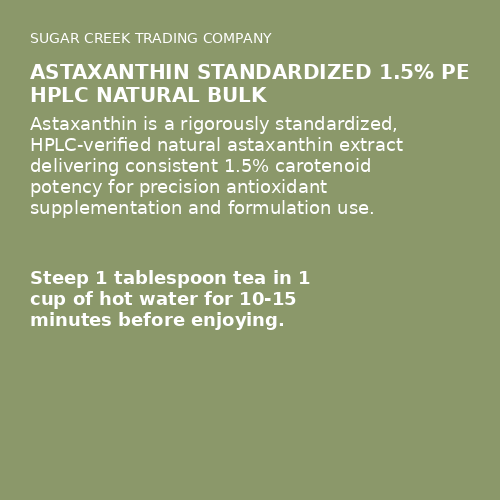
Astaxanthin Standardized 1.5% Pe Hplc Natural Bulk
Astaxanthin Standardized 1.5% Pe Hplc Natural Bulk
Impossible de charger la disponibilité du service de retrait
HAEMATOCOCCUS PLUVIALIS
A rigorously standardized, HPLC-verified natural astaxanthin extract delivering consistent 1.5% carotenoid potency for precision antioxidant supplementation and formulation use.
BOTANICAL IDENTIFICATION
Scientific Name: Haematococcus pluvialis Flotow
Common Names: Haematococcus Algae, Blood Rain Algae, Red Microalgae
Family: Haematococcaceae (Green microalgae, class Chlorophyceae)
Haematococcus pluvialis is a single-celled freshwater green microalga approximately 20 to 50 micrometers in diameter. During favorable growth conditions, the cells are green, motile, and biflagellated. Under environmental stress, including high UV radiation, nutrient starvation, or temperature extremes, the organism transitions into a dormant aplanospore stage, accumulating astaxanthin in lipid droplets to concentrations as high as 4 to 5% of cell dry weight. This red, thick-walled cyst form is the stage harvested for commercial astaxanthin production.
The species occurs naturally in freshwater environments across temperate and subtropical regions worldwide. For commercial purposes, H. pluvialis is cultivated under carefully controlled conditions in closed tubular photobioreactors or covered raceway ponds, primarily in Hawaii, Israel, India, China, and Sweden. The standardized designation of this product indicates that the extract has been processed and verified to deliver a precise, batch-to-batch consistent concentration of astaxanthin.
CULTURAL AND HISTORICAL USE
Astaxanthin is a modern nutraceutical discovery rather than a traditional herbal remedy, yet its biological role is ancient. For over a billion years, microalgae like Haematococcus have produced astaxanthin as a molecular survival shield against the most destructive force in biology: uncontrolled oxidation. The pigment's journey into human nutrition began when scientists traced the remarkable endurance of wild Pacific salmon back through the food chain to the zooplankton and algae that concentrate this compound.
The first commercial production of natural astaxanthin from H. pluvialis began in the mid-1990s in Kona, Hawaii, where year-round sunlight and clean water provided ideal growing conditions. Early clinical studies quickly distinguished natural astaxanthin from its synthetic counterpart (produced from petrochemical precursors for aquaculture feed), demonstrating superior bioavailability, antioxidant potency, and safety. By the early 2000s, natural astaxanthin had received GRAS (Generally Recognized as Safe) status from the U.S. FDA and had entered the mainstream supplement market.
The standardized form of astaxanthin reflects the evolution of the natural products industry toward pharmaceutical-grade precision. Standardization via HPLC (High Performance Liquid Chromatography) ensures that every batch meets a guaranteed minimum potency, allowing formulators, practitioners, and consumers to calculate exact doses with confidence. This is particularly important for astaxanthin, where clinical efficacy thresholds are well defined by published research.
KEY BIOACTIVE COMPOUNDS & BENEFITS
| Compound/Class | Location in Plant | Human Benefit | Role in Plant |
|---|---|---|---|
| Astaxanthin (free and esterified forms, standardized to 1.5%) | Encysted aplanospore lipid bodies | Elite antioxidant protection of cell membranes, mitochondria, retina, skin, and vasculature | Photoprotective shield against UV and oxidative destruction during dormancy |
| Astaxanthin monoesters and diesters | Lipid droplets within cyst cells | Highly stable, bioavailable transport forms readily absorbed by human intestinal cells | Long-term carotenoid storage for extended dormancy periods |
| Lutein and zeaxanthin (trace co-occurring carotenoids) | Cell membranes and plastids | Synergistic eye protection; specifically concentrate in the macular pigment | Photosynthetic accessory pigments and light-harvesting molecules |
| Beta-carotene (trace) | Vegetative and transitional cells | Provitamin A activity; additional antioxidant and immune support | Primary photosynthetic pigment and precursor to astaxanthin biosynthesis |
| Algal phospholipids and fatty acids | Cell membrane and lipid matrix | Enhance carotenoid bioavailability; support cell membrane integrity | Structural membrane components and energy reserves |
The standardized designation means this product has been analytically verified to contain no less than 1.5% astaxanthin by HPLC, providing a guaranteed minimum of 15 mg of astaxanthin per gram of powder. The natural algal matrix delivers astaxanthin predominantly in its 3S,3'S stereoisomer configuration, the form produced exclusively by biological synthesis and shown in research to be the most biologically active. This distinguishes it from synthetic astaxanthin, which is a racemic mixture of three geometric isomers with lower demonstrated efficacy.
HOW IT WORKS IN THE BODY
Astaxanthin's mechanisms of action are rooted in its unique molecular geometry: a long, rigid polyene chain with terminal hydroxyl and keto groups that allow it to embed across the full thickness of phospholipid bilayers, protecting both the interior and surface of cell membranes simultaneously.
Membrane-Spanning Antioxidant Defense:
Unlike most antioxidants, which are either water-soluble (vitamin C, glutathione) or lipid-soluble but confined to one layer of the membrane (vitamin E, beta-carotene), astaxanthin spans the entire bilayer. This transmembrane positioning allows it to intercept free radicals generated anywhere within or at the surface of the membrane. Crucially, astaxanthin neutralizes reactive oxygen species through physical quenching and electron donation without itself becoming a damaging radical, a property that sets it apart from many other antioxidants that can become pro-oxidant at high concentrations.
Mitochondrial Protection and Energy Metabolism:
The mitochondria are the primary site of cellular energy production and, consequently, the greatest source of endogenous free radical generation. Astaxanthin accumulates in mitochondrial membranes, where it protects the electron transport chain from oxidative damage, preserves membrane potential, and supports efficient ATP production. This mechanism underlies its documented benefits for exercise endurance, muscle recovery, and anti-fatigue effects.
Ocular and Retinal Protection:
Astaxanthin crosses the blood-retinal barrier, a selective membrane that excludes most compounds from reaching the delicate neural tissue of the retina. Once in the retina, it protects photoreceptor cells and the retinal pigment epithelium from photo-oxidative damage. Randomized controlled trials have demonstrated improvements in accommodative function (ability to focus at varying distances), visual acuity depth, and reduced symptoms of eye fatigue in astaxanthin-supplemented subjects.
Anti-Inflammatory Signaling:
Astaxanthin downregulates the NF-kB inflammatory pathway and suppresses the production of pro-inflammatory cytokines including TNF-alpha, IL-1beta, and IL-6. It also inhibits cyclooxygenase-2 (COX-2) expression, providing a natural anti-inflammatory effect without the gastrointestinal side effects associated with pharmaceutical COX inhibitors.
Dermal Protection and Skin Aging:
Oral astaxanthin supplementation has been shown in clinical trials to improve skin moisture content, elasticity, and wrinkle depth while reducing UV-induced DNA damage in dermal fibroblasts. The mechanism involves direct quenching of UV-generated singlet oxygen in skin tissue, combined with inhibition of matrix metalloproteinases (MMPs) that break down collagen and elastin.
DOSE GUIDELINES
| Preparation Type | Typical Dose | Purpose |
|---|---|---|
| Standardized bulk powder (1.5% astaxanthin) | 270-530 mg powder daily (provides 4-8 mg astaxanthin) | General antioxidant, eye, and skin support |
| Higher dose protocol | 530-800 mg powder daily (provides 8-12 mg astaxanthin) | Athletic performance, cardiovascular support, intensive antioxidant protection |
| Encapsulated | 1-2 capsules of 300-400 mg, taken with a fat-containing meal | Convenient daily supplementation with precise dosing |
The standardized potency of this product enables precise dosing calculations. At 1.5% (15 mg astaxanthin per gram), a 400 mg capsule delivers 6 mg of astaxanthin, squarely within the clinically effective range. Absorption is fat-dependent; always take with a meal containing dietary fat (eggs, avocado, olive oil, nuts, fish). Benefits are cumulative, with measurable antioxidant markers improving over 4 to 8 weeks of daily use and maximal skin and eye benefits typically reached by 12 weeks.
PREPARATION AND USES
This standardized bulk powder is designed primarily for encapsulation and formulation use. For personal supplementation, fill size 0 or 00 vegetable capsules with the powder using an inexpensive capsule-filling machine or manual tray. Each capsule should be taken with the largest fat-containing meal of the day for optimal absorption. The standardized potency allows formulators to calculate exact astaxanthin delivery per capsule with confidence, making this product suitable for both personal use and small-batch supplement production.
The powder can also be incorporated directly into fat-based preparations: blend into smoothies made with coconut milk or nut butter, stir into yogurt, or mix into salad dressings with olive oil. For topical formulation, the powder can be dissolved in carrier oils such as jojoba, rosehip seed, or squalane oil to create antioxidant facial serums. Note that astaxanthin is a potent pigment and will impart a red-orange color to all preparations. Store in airtight, opaque containers away from heat and light to maintain potency and prevent carotenoid degradation.
OPTIMAL CONTEXT FOR USE
This standardized astaxanthin extract is especially well-suited for individuals experiencing:
Sustained digital screen exposure and associated eye strain, dry eyes, or difficulty focusing, where retinal antioxidant support can measurably improve visual comfort and performance
Visible signs of skin aging including fine lines, reduced elasticity, and sun damage, where internal photoprotection complements topical skincare routines
Cardiovascular risk management, particularly elevated oxidized LDL, chronic inflammation, or arterial stiffness, where astaxanthin's lipid-protective effects are well documented
Endurance training, competitive athletics, or high-intensity physical work, where mitochondrial protection and reduced exercise-induced oxidative damage accelerate recovery
Formulation needs for supplement manufacturing, custom blending, or practitioner-directed protocols requiring verified, standardized potency for precise dosing
Astaxanthin works synergistically with omega-3 fatty acids (EPA and DHA) for cardiovascular and anti-inflammatory benefit, with lutein and zeaxanthin for comprehensive macular protection, and with CoQ10 for enhanced mitochondrial support.
SUSTAINABILITY AND ETHICAL HARVESTING
Microalgae cultivation for astaxanthin production is among the most sustainable methods of producing a nutritional supplement. H. pluvialis is grown in controlled systems that require no arable farmland, use minimal freshwater (with most facilities recycling water), and employ no pesticides, herbicides, or synthetic fertilizers. During photosynthesis, the algae actively absorb atmospheric carbon dioxide, giving the production process a favorable carbon footprint.
Natural astaxanthin from H. pluvialis is a direct and sustainable alternative to synthetic astaxanthin, which is manufactured from petroleum-derived starting materials and is primarily used in industrial aquaculture. By choosing natural, algae-sourced astaxanthin, consumers support a production model that is ecologically regenerative rather than extractive. Leading production facilities in Hawaii, Israel, and India operate under stringent environmental and quality standards, including organic certification where applicable.
SAFETY AND CAUTIONS
Natural astaxanthin from H. pluvialis has an exceptional safety profile supported by extensive toxicological testing and clinical trial data. It holds GRAS status from the U.S. FDA and Novel Food approval from the European Food Safety Authority (EFSA). The following considerations apply:
No significant adverse effects have been observed in human clinical trials using doses up to 40 mg of astaxanthin per day for 12 weeks, or 12 mg per day for extended periods. Standard supplementation doses of 4-12 mg daily carry a wide safety margin.
Astaxanthin may modestly lower blood pressure. Individuals taking antihypertensive medications should monitor blood pressure and adjust medications under medical guidance if needed.
A mild antiplatelet effect has been observed at higher doses. Individuals taking anticoagulant or antiplatelet medications (warfarin, aspirin, clopidogrel) should consult their healthcare provider before beginning astaxanthin supplementation.
While true allergy to purified H. pluvialis astaxanthin is extremely rare, individuals with known allergies to algae or marine organisms should proceed with caution and may wish to start with a lower dose.
Safety data during pregnancy and lactation is limited. Pregnant and nursing women should consult a healthcare provider before use.
REFERENCES
Ambati, R.R., Phang, S.M., Ravi, S., & Aswathanarayana, R.G. (2014). "Astaxanthin: Sources, extraction, stability, biological activities and its commercial applications." Marine Drugs, 12(1), 128-152.
Naguib, Y.M. (2000). "Antioxidant activities of astaxanthin and related carotenoids." Journal of Agricultural and Food Chemistry, 48(4), 1150-1154.
Tominaga, K., Hongo, N., Karato, M., & Yamashita, E. (2012). "Cosmetic benefits of astaxanthin on humans subjects." Acta Biochimica Polonica, 59(1), 43-47.
FINAL NOTE
This standardized astaxanthin extract represents the highest tier of quality control in natural carotenoid supplementation. With every batch verified to 1.5% astaxanthin by HPLC, it provides the precision that informed consumers and professional formulators require. Natural astaxanthin from Haematococcus pluvialis is not merely an antioxidant; it is a survival molecule refined by over a billion years of algal evolution, now available in a form that delivers consistent, measurable protection to the cells, tissues, and organs that need it most.
Share