Sugar Creek Trading Company
Bacopa Monnieri
Bacopa Monnieri
Impossible de charger la disponibilité du service de retrait
BACOPA MONNIERI
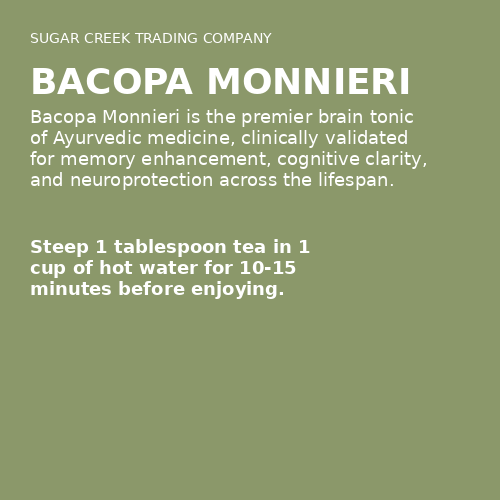
The premier brain tonic of Ayurvedic medicine, clinically validated for memory enhancement, cognitive clarity, and neuroprotection across the lifespan.
BOTANICAL IDENTIFICATION
Scientific Name: Bacopa monnieri (L.) Wettst.
Common Names: Bacopa, Brahmi, Water Hyssop, Herb of Grace, Jalanimba, Nira-Brahmi, Thyme-leaved Gratiola
Family: Plantaginaceae (Plantain family; formerly Scrophulariaceae)
Bacopa monnieri is a small, creeping, succulent perennial herb that grows 10 to 30 cm in length, forming dense mats along the margins of wetlands, ponds, and marshy areas. The stems are soft and fleshy, bearing opposite, oblong, sessile leaves that are 4 to 6 mm thick with entire margins. Small, five-petaled flowers ranging from white to pale blue or violet emerge from the leaf axils, blooming throughout the warm months. The entire plant, particularly the aerial portions (leaves and stems), is used medicinally.
Native to the wetlands of South and Southeast Asia, Australia, and parts of Africa, Bacopa thrives in tropical and subtropical freshwater habitats, including marshes, riverbanks, pond edges, and flooded rice paddies. It tolerates both submerged and emergent growing conditions and is increasingly cultivated commercially in India, Thailand, and the United States for the herbal supplement market.
CULTURAL AND HISTORICAL USE
Bacopa monnieri occupies a singular position in Ayurvedic medicine as the foremost medhya rasayana, a rejuvenative specifically for the mind and intellect. Its Sanskrit name "Brahmi" derives from Brahma, the Hindu creator god, reflecting the reverence with which ancient Indian physicians regarded this plant's ability to enhance the highest cognitive functions. The Charaka Samhita (circa 6th century BCE) and the Sushruta Samhita both describe Brahmi as a promoter of intellect, memory, and longevity, prescribing it for conditions ranging from anxiety and mental fatigue to epilepsy and voice disorders.
In traditional Ayurvedic practice, Bacopa was administered to scholars, students, and children to sharpen memory and improve the capacity for learning, particularly before periods of intensive study or recitation of sacred texts. It was typically prepared as a fresh juice mixed with ghee (clarified butter) or as a dried powder in milk, formulations designed to enhance the bioavailability of its active compounds. The Bhavaprakasha Nighantu, a 16th-century Ayurvedic text, classifies Brahmi as bitter and cooling, balancing all three doshas but with particular affinity for Pitta and Vata, the doshas most associated with mental inflammation and nervous system agitation.
Bacopa's reputation has extended well beyond South Asia. In Thai traditional medicine, it is known as Phrom Mi and used for similar cognitive and anxiolytic purposes. In the 20th and 21st centuries, Bacopa has become one of the most rigorously studied nootropic herbs in the world, with dozens of randomized controlled trials (RCTs) evaluating its effects on memory, attention, and cognitive processing speed. This convergence of ancient tradition and modern neuroscience has made Bacopa one of the most credible and widely recommended cognitive-support botanicals available.
KEY BIOACTIVE COMPOUNDS & BENEFITS
| Compound/Class | Location in Plant | Human Benefit | Role in Plant |
|---|---|---|---|
| Bacosides A and B (triterpenoid saponins) | Leaves and stems (aerial parts) | Primary nootropic compounds: enhance synaptic transmission, promote nerve impulse repair, improve memory consolidation | Chemical defense against herbivores; bitter taste deterrent |
| Bacopasides I-XII | Leaves and stems | Neuroprotective, antioxidant activity in brain tissue, support for BDNF expression | Specialized saponin variants with antifungal and antibacterial roles |
| Bacosterols and bacosine (steroidal saponins and alkaloids) | Whole aerial plant | Anxiolytic effects, smooth muscle relaxation, adaptogenic support | Secondary metabolites involved in stress and defense signaling |
| Apigenin and luteolin (flavonoids) | Leaves | Anti-inflammatory, antioxidant, neuroprotective via reduction of neuroinflammation | UV protection and oxidative stress management in sun-exposed wetland habitat |
| Hersaponin | Leaves | Mild sedative and cardiotonic activity | Bitter compound serving as insect feeding deterrent |
The bacosides are the pharmacological engine of Bacopa monnieri. Standardized extracts are typically calibrated to contain 40-55% bacosides, the concentration range used in most clinical trials. These dammarane-type triterpenoid saponins are structurally unique to Bacopa and are responsible for the majority of its documented cognitive and neuroprotective effects. The supporting flavonoids and alkaloids contribute anti-inflammatory and anxiolytic dimensions that round out Bacopa's profile as a comprehensive brain tonic.
HOW IT WORKS IN THE BODY
Bacopa monnieri operates through several well-characterized neurobiological mechanisms, making it one of the most mechanistically understood nootropic herbs.
Memory Formation and Synaptic Plasticity:
Bacosides enhance synaptic communication in the hippocampus, the brain's primary memory-processing center. They upregulate the expression of brain-derived neurotrophic factor (BDNF), a protein essential for the growth, maintenance, and survival of neurons. Increased BDNF supports long-term potentiation (LTP), the cellular mechanism underlying memory consolidation. Clinical trials have consistently shown improvements in delayed recall, working memory, and information processing speed after 8 to 12 weeks of daily Bacopa supplementation.
Cholinergic System Modulation:
Bacopa modulates the acetylcholine system, the primary neurotransmitter system involved in learning and memory. Bacosides have been shown to inhibit acetylcholinesterase (AChE), the enzyme that breaks down acetylcholine, thereby increasing acetylcholine availability at synapses. This mechanism parallels the action of pharmaceutical cognitive enhancers like donepezil, though Bacopa's effect is gentler and accompanied by a broader neuroprotective profile.
Neuroprotection and Antioxidant Defense:
The brain is highly susceptible to oxidative damage due to its high oxygen consumption and lipid-rich composition. Bacopa's bacosides and flavonoids significantly reduce lipid peroxidation, increase superoxide dismutase (SOD) and glutathione peroxidase (GPx) activity in brain tissue, and scavenge reactive oxygen species. This antioxidant neuroprotection is particularly relevant for age-related cognitive decline, where cumulative oxidative damage is a primary driver.
Anxiolytic and Stress-Adaptive Effects:
Bacopa modulates serotonergic and GABAergic neurotransmission, producing measurable anxiolytic effects without the sedation associated with benzodiazepines. Studies have shown reductions in cortisol levels and improvements in stress-adaptation scores in participants taking standardized Bacopa extracts. This dual action, enhancing cognitive performance while reducing anxiety, distinguishes Bacopa from stimulant-type nootropics that often increase anxiety as a side effect.
DOSE GUIDELINES
| Preparation Type | Typical Dose | Purpose |
|---|---|---|
| Dried herb powder | 3-6 g daily, mixed with warm milk, ghee, or water | Traditional Ayurvedic nootropic dose for memory and intellect |
| Standardized extract (40-55% bacosides) | 300-450 mg daily | Clinically studied dose for cognitive enhancement (based on RCT protocols) |
| Tincture (1:5, 45% ethanol) | 3-6 mL daily | Liquid extract for daily cognitive and anxiolytic support |
| Infusion (dried herb) | 3-5 g steeped in hot water for 10-15 minutes | Gentle daily tea for cognitive maintenance and stress resilience |
Bacopa is a slow-acting herb whose benefits build over time. Clinical trials consistently report that significant cognitive improvements emerge after 8 to 12 weeks of daily use. For best results, Bacopa should be taken consistently rather than sporadically. Taking it with a fat source (ghee, coconut oil, or a meal containing fats) enhances the absorption of its lipophilic bacoside compounds. Traditional Ayurvedic timing suggests morning consumption for cognitive clarity throughout the day.
PREPARATION AND USES
The dried herb can be prepared as a simple infusion by steeping in hot water for 10 to 15 minutes. The taste is distinctly bitter, which is characteristic of its saponin content. In Ayurvedic tradition, the bitterness is tempered by mixing the powdered herb with ghee and honey, or simmering it in milk (Brahmi Ghrita or Brahmi Ksheerapaka), preparations that simultaneously enhance the bioavailability of the fat-soluble bacosides. Modern practitioners often encapsulate the powder or use standardized extracts for convenience and dose precision.
Bacopa powder can be added to smoothies, blended with adaptogenic herbs like ashwagandha and gotu kola for a comprehensive brain-support formula, or mixed into warm golden milk with turmeric and black pepper. For topical use, Brahmi oil (Bacopa-infused sesame or coconut oil) is a traditional Ayurvedic preparation massaged into the scalp to promote hair health and calm the mind, as it is believed in Ayurveda that scalp massage with medicated oils directly benefits the nervous system.
OPTIMAL CONTEXT FOR USE
Bacopa monnieri is especially well-suited for individuals experiencing:
Memory concerns, brain fog, or difficulty with focus and information retention, whether age-related or due to stress and overwork
Academic or professional demands requiring sustained cognitive performance, complex learning, or long periods of concentration
Anxiety accompanied by cognitive impairment, where both calm and clarity are needed simultaneously
Age-related cognitive decline, as a neuroprotective strategy supported by clinical evidence for older adults
Recovery from neurological stress, including post-concussion support and periods of intense mental or emotional demand
Bacopa is frequently combined with other nootropic and adaptogenic herbs for synergistic effect. Classic Ayurvedic pairings include gotu kola (Centella asiatica, often also called Brahmi in some traditions), ashwagandha (Withania somnifera) for combined cognitive and stress support, and shankhpushpi (Convolvulus pluricaulis) for enhanced memory and sleep quality.
SUSTAINABILITY AND ETHICAL HARVESTING
Bacopa monnieri is an adaptable, fast-growing wetland plant that is widely cultivated for the herbal supplement market, significantly reducing pressure on wild populations. Major cultivation centers are located in India (particularly in Kerala, Tamil Nadu, and Maharashtra), where the plant is grown in paddy-field-like conditions or along the margins of irrigation channels. Its semi-aquatic nature means it can be cultivated on marginal wetlands that are unsuitable for most other crops, making it an economically valuable and ecologically compatible crop for rural farming communities.
Wild Bacopa remains common throughout its native range, thriving in disturbed wetlands, ditches, and pond margins. It is not currently listed as threatened or endangered by any international conservation body. Sugar Creek Trading Company sources Bacopa from suppliers who maintain quality standards including testing for heavy metals, a particular concern for wetland-grown plants that may accumulate contaminants from waterways.
SAFETY AND CAUTIONS
Bacopa monnieri has been extensively studied for safety in both short-term and long-term clinical trials and is generally well-tolerated at recommended doses.
The most commonly reported side effects are mild gastrointestinal symptoms, including nausea, stomach cramps, bloating, and diarrhea, particularly when taken on an empty stomach. Taking Bacopa with food significantly reduces these effects.
Bacopa may have mild thyroid-stimulating effects. Individuals with thyroid disorders, particularly hyperthyroidism, should consult a healthcare provider before use and monitor thyroid function.
Due to its cholinergic activity, Bacopa may theoretically interact with cholinesterase inhibitors (donepezil, rivastigmine) and anticholinergic medications. Consult a healthcare provider if taking such medications.
Pregnant and nursing individuals should consult a qualified healthcare practitioner before use. While Bacopa has a long history of traditional use, specific clinical safety data during pregnancy is limited.
Bacopa may have mild sedative effects in some individuals, particularly at higher doses. Exercise caution when combining with other sedative herbs or medications, and assess individual response before driving or operating machinery.
REFERENCES
Kongkeaw, C., Dilokthornsakul, P., Thanarangsarit, P., et al. "Meta-analysis of Randomized Controlled Trials on Cognitive Effects of Bacopa monnieri Extract." Journal of Ethnopharmacology, 2014; 151(1): 528-535.
Stough, C., Lloyd, J., Clarke, J., et al. "The Chronic Effects of an Extract of Bacopa monniera (Brahmi) on Cognitive Function in Healthy Human Subjects." Psychopharmacology, 2001; 156(4): 481-484.
Aguiar, S. & Borowski, T. "Neuropharmacological Review of the Nootropic Herb Bacopa monnieri." Rejuvenation Research, 2013; 16(4): 313-326.
Russo, A. & Borrelli, F. "Bacopa monniera, a Reputed Nootropic Plant: An Overview." Phytomedicine, 2005; 12(4): 305-317.
Sharma, P.V. Charaka Samhita: Text with English Translation. Chaukhambha Orientalia, 2001.
FINAL NOTE
Bacopa monnieri stands at the rare intersection of ancient wisdom and modern scientific validation. What Ayurvedic sages prescribed thousands of years ago for sharpening the intellect, contemporary neuroscience has confirmed through randomized controlled trials: this unassuming wetland herb genuinely enhances memory, protects neurons, and calms the anxious mind. For students, professionals, aging adults, or anyone seeking to support the long-term health and performance of their most vital organ, Bacopa is among the most evidence-backed and time-tested allies the plant world has to offer.
Share