Sugar Creek Trading Company
Bilberry Leaf
Bilberry Leaf
Impossible de charger la disponibilité du service de retrait
VACCINIUM MYRTILLUS
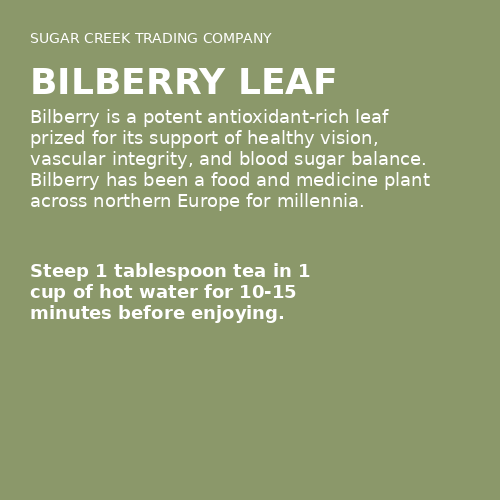
A potent antioxidant-rich leaf prized for its support of healthy vision, vascular integrity, and blood sugar balance.
BOTANICAL IDENTIFICATION
Scientific Name: Vaccinium myrtillus L.
Common Names: Bilberry Leaf, European Blueberry Leaf, Whortleberry Leaf, Huckleberry Leaf, Myrtilli Folium, Blaeberry Leaf
Family: Ericaceae (Heath family)
Bilberry is a low-growing, deciduous shrub reaching 15 to 60 cm tall with angular, green, finely branching stems. The leaves are ovate to elliptical, 1 to 3 cm long, with finely serrated margins and a bright green color that turns reddish in autumn. Small, greenish-pink, urn-shaped flowers appear in spring, developing into the characteristic dark blue-black berries with a distinctive purple-staining flesh that distinguishes true bilberry from its American blueberry cousins.
Native to the moorlands, heathlands, and acidic woodland floors of northern and central Europe, bilberry thrives in poor, acidic soils at elevations ranging from lowland bogs to subalpine meadows. It is found abundantly across Scandinavia, the British Isles, and mountainous regions of continental Europe, and extends into parts of northern Asia. The plant prefers partial shade and cool, humid conditions with well-drained, peaty or sandy soils.
CULTURAL AND HISTORICAL USE
Bilberry has been a food and medicine plant across northern Europe for millennia. Wild bilberries were a critical seasonal food source for prehistoric European peoples, and the leaves and fruits appear in folk medicine traditions from Ireland to Russia. In medieval European herbalism, bilberry leaf was used primarily as an astringent remedy for diarrhea, mouth sores, and urinary complaints. The 12th-century German abbess and herbalist Hildegard of Bingen referenced bilberry in her medical writings, and the plant was included in numerous European pharmacopoeias from the 16th century onward.
The most famous chapter in bilberry's history came during World War II, when Royal Air Force pilots reportedly consumed bilberry jam before nighttime bombing missions, believing it improved their night vision and visual acuity. While the exact details of these accounts have been debated, the story catalyzed significant scientific interest in bilberry's effects on vision and vascular health that continues to this day. The leaf, in particular, gained attention in mid-20th-century European phytotherapy for its hypoglycemic properties after Italian researchers documented its traditional use by diabetic patients in rural communities.
In traditional European folk medicine, bilberry leaf tea was a household remedy for managing blood sugar, treating urinary tract infections, and soothing inflamed gums and sore throats. Scandinavian and Baltic peoples used the leaves as a substitute for expensive imported tea, and in parts of Scotland and Ireland, bilberry leaf was among the most commonly gathered wild medicinal herbs well into the 20th century. Today, bilberry leaf remains an important herb in European phytotherapy, particularly in Germany, France, and the Nordic countries, where it is prescribed by physicians and herbalists for circulatory and metabolic support.
KEY BIOACTIVE COMPOUNDS & BENEFITS
| Compound/Class | Location in Plant | Human Benefit | Role in Plant |
|---|---|---|---|
| Chlorogenic acid and other phenolic acids | Leaves (concentrated) | Antioxidant protection; supports healthy blood sugar metabolism by inhibiting glucose-6-phosphatase; anti-inflammatory | UV screening and pathogen defense |
| Quercetin and other flavonol glycosides | Leaves | Strengthens capillary walls; reduces vascular permeability; anti-inflammatory and antihistamine activity | UV protection and pollinator signaling |
| Proanthocyanidins (condensed tannins) | Leaves and stems | Powerful astringent action; supports vascular integrity; antioxidant; may improve microcirculation | Herbivore deterrence and wound sealing |
| Arbutin and hydroquinone glycosides | Leaves | Urinary antiseptic properties; supports urinary tract health | Antifungal defense compound |
| Chromium (trace mineral) | Leaves (bioaccumulated from acidic soils) | Supports insulin sensitivity and glucose metabolism | Incidental uptake from soil minerals |
Bilberry leaf's therapeutic profile is defined by its exceptional concentration of phenolic compounds, particularly chlorogenic acid and flavonol glycosides, which together exert a synergistic effect on vascular health and glucose metabolism. Unlike the berry, which is famous for its anthocyanin content, the leaf delivers its benefits primarily through tannins, phenolic acids, and flavonoids that target blood vessel integrity, microcirculation, and metabolic regulation. This makes bilberry leaf a distinct and complementary medicine to the fruit, with its own well-established therapeutic identity in European herbal practice.
HOW IT WORKS IN THE BODY
Bilberry leaf exerts its effects through multiple interconnected pathways, primarily centered on vascular protection, glucose metabolism, and antioxidant defense.
Blood Sugar Regulation:
Chlorogenic acid and related phenolic compounds in bilberry leaf have been shown to inhibit glucose-6-phosphatase, an enzyme involved in the release of stored glucose from the liver into the bloodstream. This mechanism helps moderate postprandial blood sugar spikes and supports more stable glucose levels throughout the day. Additionally, the chromium content and overall phenolic profile may enhance insulin receptor sensitivity, improving the body's ability to utilize glucose efficiently at the cellular level. Traditional European use for blood sugar management is supported by both animal studies and limited clinical observation.
Vascular Integrity and Microcirculation:
The flavonoids and proanthocyanidins in bilberry leaf strengthen capillary walls by cross-linking collagen fibers in the vascular endothelium, reducing permeability and fragility. This action is particularly relevant for the delicate microvascular beds of the eyes, kidneys, and extremities. By reducing capillary leakage and improving blood flow through small vessels, bilberry leaf supports tissue oxygenation and nutrient delivery to areas that depend heavily on intact microcirculation.
Antioxidant and Anti-inflammatory Protection:
The concentrated phenolic compounds in bilberry leaf scavenge reactive oxygen species and inhibit lipid peroxidation, protecting cell membranes and vascular tissues from oxidative damage. Quercetin and related flavonoids additionally modulate inflammatory pathways by inhibiting the release of histamine and reducing the production of pro-inflammatory cytokines. This dual antioxidant-anti-inflammatory action is particularly relevant for conditions involving chronic low-grade inflammation and oxidative stress.
Urinary Tract Support:
The arbutin content of bilberry leaf is converted to hydroquinone in alkaline urine, where it exerts mild antimicrobial activity against common urinary pathogens. Combined with the diuretic effect of the flavonoid glycosides, this provides gentle support for urinary tract health, a use well documented in Scandinavian and Germanic folk medicine traditions.
DOSE GUIDELINES
| Preparation Type | Typical Dose | Purpose |
|---|---|---|
| Hot infusion (tea) | 1-2 teaspoons dried leaf per cup, steeped 10-15 minutes; 2-3 cups daily | General vascular and metabolic support, blood sugar regulation |
| Tincture (1:5, 45% ethanol) | 2-4 mL, three times daily | Concentrated extract for circulatory and glycemic support |
| Capsules (powdered leaf) | 500-1000 mg, two to three times daily | Convenient daily supplementation |
Bilberry leaf is most effective when used as a consistent daily tonic over periods of several weeks to months. For blood sugar support, many European herbalists recommend combining it with other glycemic herbs and using it alongside dietary and lifestyle modifications. Short-term use as an astringent for diarrhea or sore throat is also well established.
PREPARATION AND USES
Bilberry leaf makes a pleasant, mildly astringent tea with a slightly tannic, green flavor reminiscent of green tea. For a standard infusion, use 1 to 2 teaspoons of dried leaf per cup of boiling water, cover, and steep for 10 to 15 minutes. The longer steeping time is important to fully extract the phenolic compounds and tannins that drive the leaf's therapeutic activity. Strain and drink warm or at room temperature. For a stronger preparation targeting blood sugar or vascular support, some practitioners recommend a light decoction: simmer the leaves gently for 5 minutes before steeping for an additional 10 minutes.
Bilberry leaf blends well with other supportive herbs. For blood sugar formulas, it pairs effectively with cinnamon bark, fenugreek seed, and gymnema leaf. For vascular and circulatory support, it combines beautifully with ginkgo leaf, hawthorn berry, and gotu kola. As a pleasant daily drinking tea, it can be mixed with peppermint, lemon balm, or hibiscus. The dried leaf can also be powdered and encapsulated for those who prefer pill form, or prepared as a tincture using 45% ethanol for a shelf-stable liquid extract.
OPTIMAL CONTEXT FOR USE
This herb is especially well-suited for individuals experiencing:
Blood sugar imbalances or a desire to support healthy glucose metabolism alongside dietary changes
Poor peripheral circulation, cold extremities, or concerns about microvascular health
Eye strain, visual fatigue, or a family history of age-related vision concerns where vascular support to the retina is desired
Capillary fragility, easy bruising, or spider veins suggesting weakened vascular integrity
Recurrent mild urinary tract discomfort where gentle antiseptic and diuretic support is appropriate
Bilberry leaf works best as part of a comprehensive approach that includes whole-food nutrition, regular movement, adequate hydration, and other herbs selected to match individual constitutional needs.
SUSTAINABILITY AND ETHICAL HARVESTING
Bilberry is an abundant wild plant across its native range in northern and central Europe, and wild populations are generally considered stable and not at risk. The leaves are typically harvested sustainably by hand from wild-growing shrubs during the summer months, following the same gathering traditions that have been practiced for centuries. In Scandinavia and Eastern Europe, bilberry harvesting (both leaf and fruit) is protected by traditional right-of-access laws that allow foraging on public and private land alike.
Commercial bilberry leaf for the herbal trade is sourced primarily from wild collection in Eastern Europe, particularly Bulgaria, Romania, Albania, and the Baltic states, where organized harvesting provides supplemental income to rural communities. Some cultivated production exists, though the plant's preference for wild, acidic, nutrient-poor soils makes large-scale cultivation less economical than responsible wild collection. Sugar Creek Trading Company sources bilberry leaf from reputable suppliers who adhere to sustainable harvesting practices that protect wild stands for future generations.
SAFETY AND CAUTIONS
Bilberry leaf is generally well tolerated and has a long history of safe use as a food and medicine in Europe. However, several precautions should be noted.
Blood sugar medications: Because bilberry leaf may lower blood glucose levels, individuals taking insulin or oral hypoglycemic medications should use this herb with caution and under healthcare supervision to avoid additive hypoglycemic effects. Blood sugar monitoring is recommended when combining bilberry leaf with diabetes medications.
Long-term high-dose use: Some older sources have raised theoretical concerns about chronic high-dose use of bilberry leaf due to its hydroquinone content (from arbutin). While typical tea consumption is well within safe limits, extremely high or prolonged intake of concentrated preparations should be avoided without professional guidance.
Anticoagulant and antiplatelet medications: The flavonoids in bilberry leaf may have mild blood-thinning effects. Individuals taking warfarin, aspirin, or other anticoagulant/antiplatelet drugs should consult a healthcare provider before using bilberry leaf regularly.
Pregnancy and nursing: While moderate consumption of bilberry leaf tea is not known to be harmful, concentrated supplements have not been adequately studied during pregnancy and lactation. Pregnant and nursing women should consult a qualified practitioner before use beyond occasional tea consumption.
REFERENCES
Hoffmann, D. (2003). Medical Herbalism: The Science and Practice of Herbal Medicine. Healing Arts Press. pp. 564-565.
European Medicines Agency. (2015). "Assessment Report on Vaccinium myrtillus L., folium." EMA/HMPC/159076/2013.
Wichtl, M. (Ed.). (2004). Herbal Drugs and Phytopharmaceuticals (3rd ed.). Medpharm Scientific Publishers. pp. 401-403.
Cignarella, A., et al. (1996). "Novel lipid-lowering properties of Vaccinium myrtillus L. leaves, a traditional antidiabetic treatment, in several models of rat dyslipidaemia." Thrombosis Research, 84(5), 311-322.
Riihinen, K., et al. (2008). "Organ-specific distribution of phenolic compounds in bilberry (Vaccinium myrtillus) and 'northblue' blueberry (Vaccinium corymbosum x V. angustifolium)." Food Chemistry, 110(1), 156-160.
FINAL NOTE
Bilberry leaf is one of European herbalism's most trusted allies for the blood vessels and the metabolic system. Where the famous bilberry fruit delivers its deep purple anthocyanins, the leaf offers its own distinct gift: a concentrated matrix of phenolic acids, flavonoids, and tannins that quietly strengthen the body's smallest blood vessels and help steady the rhythms of glucose metabolism. It is a gentle, reliable, everyday herb that rewards consistent use, making it an ideal foundation for anyone seeking long-term circulatory and metabolic support through the wisdom of traditional European plant medicine.
Share