Sugar Creek Trading Company
Black Cohosh Root
Black Cohosh Root
Impossible de charger la disponibilité du service de retrait
ACTAEA RACEMOSA
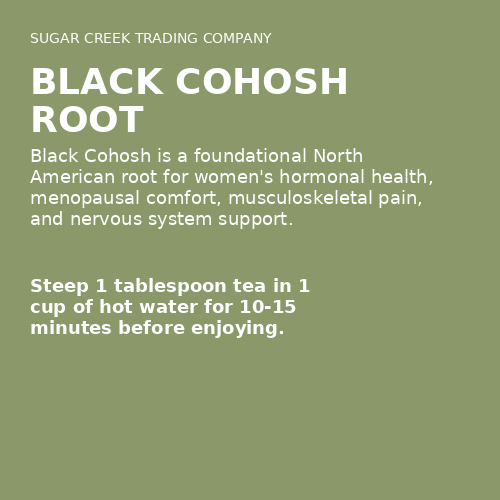
A foundational North American root for women's hormonal health, menopausal comfort, musculoskeletal pain, and nervous system support.
BOTANICAL IDENTIFICATION
Scientific Name: Actaea racemosa L. (syn. Cimicifuga racemosa (L.) Nutt.)
Common Names: Black Cohosh, Black Bugbane, Black Snakeroot, Fairy Candles, Rattleweed, Squawroot, Macrotys
Family: Ranunculaceae (Buttercup family)
Black Cohosh is a stately herbaceous perennial that grows 1-2.5 meters tall from a thick, knotted, dark-colored rhizome and root system. The compound leaves are large and divided, with sharply toothed leaflets. In late spring to midsummer, the plant sends up dramatic tall racemes (up to 60 cm long) of small, fluffy white flowers with a distinctive, somewhat unpleasant odor that repels insects -- hence the name "bugbane." The dried root and rhizome are dark brown to black externally, with a bitter, acrid taste.
Black Cohosh is native to the rich, moist deciduous forests of eastern North America, ranging from southern Ontario through the Appalachian Mountains to Georgia. It thrives in partial to full shade, in deep, humus-rich forest soils, often found alongside other woodland medicinals such as Goldenseal, Ginseng, and Blue Cohosh.
CULTURAL AND HISTORICAL USE
Black Cohosh is one of the most important medicinal plants native to North America, with a continuous tradition of use spanning at least several centuries. Indigenous peoples of the eastern woodlands, including the Cherokee, Iroquois, Delaware, and Algonquin nations, used the root extensively for rheumatic conditions, gynecological complaints, snakebite, and as a general tonic. The Cherokee specifically employed it for conditions related to women's reproductive health, including painful or irregular menstruation and difficulties in childbirth.
European settlers rapidly adopted Black Cohosh into their own practice. By the early 19th century, it became one of the most popular herbs in the Eclectic medical movement, a school of American physicians who favored botanical medicines. The Eclectics prescribed it under the name "Macrotys" for neuralgia, rheumatism, chorea (involuntary movement disorders), and a wide range of women's complaints including dysmenorrhea, amenorrhea, and menopausal symptoms. It was a key ingredient in Lydia Pinkham's Vegetable Compound, perhaps the most famous patent medicine of the Victorian era, marketed for "female complaints."
In the 20th and 21st centuries, Black Cohosh became the subject of extensive clinical research, particularly in Germany, where it was developed into standardized extracts (most notably Remifemin) for menopausal symptom management. It is now one of the most widely used and clinically studied herbal remedies for hot flashes, night sweats, and other menopausal discomforts, with monographs in the German Commission E, the European Medicines Agency, and the World Health Organization.
KEY BIOACTIVE COMPOUNDS & BENEFITS
| Compound/Class | Location in Plant | Human Benefit | Role in Plant |
|---|---|---|---|
| Triterpene glycosides (actein, 23-epi-26-deoxyactein, cimicifugoside) | Rhizome, roots | Central mechanism for menopausal symptom relief; modulate serotonin, dopamine, and opioid receptors | Chemical defense against herbivores and pathogens |
| Phenolic acids (caffeic acid, ferulic acid, isoferulic acid, fukinolic acid) | Rhizome, roots | Anti-inflammatory, antioxidant, and antispasmodic effects; support vascular tone | UV protection and antimicrobial defense |
| Cimicifugic acids (A, B, E, F) | Rhizome, roots | Unique compounds with anti-inflammatory and vasomotor-modulating activity | Specialized phenylpropanoid defense metabolites |
| N-methylserotonin | Rhizome, roots | Direct serotonergic activity; may contribute to mood support and hot flash reduction | Nitrogen-containing alkaloid for pest deterrence |
| Formononetin (isoflavone, trace amounts) | Rhizome | Mild estrogenic activity contributing to overall hormonal modulation | Phytoalexin defense compound |
Black Cohosh root's therapeutic action is not primarily estrogenic, as was long assumed. Modern research has revealed that its triterpene glycosides and phenolic compounds work primarily through serotonergic, dopaminergic, and opioid receptor modulation in the central nervous system. This explains its broad efficacy across vasomotor symptoms (hot flashes), mood disturbances, sleep disruption, and pain -- all of which involve these neurotransmitter pathways.
HOW IT WORKS IN THE BODY
Black Cohosh root acts through multiple neuroendocrine and anti-inflammatory pathways, with its primary effects centered on the central nervous system rather than direct hormonal manipulation.
Vasomotor Symptom Relief (Hot Flashes and Night Sweats):
The triterpene glycosides, particularly actein, modulate serotonin receptors (5-HT1A, 5-HT1D, and 5-HT7) in the hypothalamus, the brain's thermoregulatory center. Declining estrogen during menopause narrows the thermoneutral zone, causing the body to initiate cooling responses (hot flashes) in response to small temperature fluctuations. By stabilizing serotonergic signaling in this region, Black Cohosh helps widen the thermoneutral zone and reduce the frequency and intensity of vasomotor episodes.
Mood, Sleep, and Nervous System Support:
N-methylserotonin and the triterpene glycosides bind to serotonin and dopamine receptors, supporting neurotransmitter balance that is often disrupted during hormonal transitions. Additionally, some compounds interact with mu-opioid receptors, which may contribute to the root's traditional use for pain relief and its calming, mildly anxiolytic effects. This multi-receptor activity supports mood stability, reduces anxiety, and improves sleep quality.
Musculoskeletal and Anti-Inflammatory Action:
The phenolic acids and cimicifugic acids inhibit NF-kB-mediated inflammatory cascades, reducing the production of inflammatory prostaglandins and cytokines. This anti-inflammatory activity, combined with the antispasmodic effects of ferulic acid on smooth and skeletal muscle, underpins the Eclectic tradition of using Black Cohosh for rheumatic pain, muscle spasms, and neuralgia.
Reproductive and Uterine Effects:
Black Cohosh has a mild regulatory effect on the hypothalamic-pituitary-ovarian axis, helping to normalize luteinizing hormone (LH) pulsatility during menopause. It also has a relaxing effect on uterine smooth muscle, which supports its traditional use for menstrual cramps and as a partus preparator (birth preparation aid) in the final weeks of pregnancy under midwifery guidance.
DOSE GUIDELINES
| Preparation Type | Typical Dose | Purpose |
|---|---|---|
| Dried root decoction | 1-2 teaspoons of dried root simmered in water for 15-20 minutes; 1-3 cups daily | Menopausal symptoms, musculoskeletal pain, nervous tension |
| Tincture (1:5, 60% alcohol) | 1-2 mL, 2-3 times daily | Concentrated hormonal and nervous system support |
| Powdered root capsule | 300-600 mg, 1-2 times daily | Standardized menopausal support |
| Standardized extract (2.5% triterpene glycosides) | 20-40 mg, twice daily | Clinically studied dose for hot flashes and menopausal discomfort |
Clinical trials have typically used standardized extracts for 8-12 weeks to assess efficacy for menopausal symptoms. Benefits often begin within 2-4 weeks and increase over time. Black Cohosh can be used long-term, though some practitioners recommend periodic breaks (e.g., 6 months on, 1 month off). It is most effective when taken consistently rather than on an as-needed basis.
PREPARATION AND USES
Black Cohosh root is a hard, woody rhizome that requires decoction (simmering) rather than simple infusion to extract its compounds effectively. Place 1-2 teaspoons of the dried, cut root in a small saucepan with 2 cups of water, bring to a boil, then reduce to a gentle simmer for 15-20 minutes. Strain and drink warm. The taste is bitter and somewhat acrid, which is characteristic and indicative of quality. Honey or lemon may be added. The decoction can be made in larger batches and refrigerated for up to 3 days.
Tincture is the most common professional preparation, as the alcohol efficiently extracts the triterpene glycosides and makes dosing precise and convenient. For home use, the dried root can also be ground and encapsulated. Black Cohosh is frequently combined with other herbs in menopause support formulas, pairing well with Dong Quai, Vitex (Chaste Tree Berry), Red Clover, and St. John's Wort. For musculoskeletal formulas, it combines effectively with Kava, Valerian, and Cramp Bark.
OPTIMAL CONTEXT FOR USE
This herb is especially well-suited for individuals experiencing:
Menopausal vasomotor symptoms including hot flashes, night sweats, and temperature dysregulation
Perimenopausal mood changes, irritability, anxiety, or depressive symptoms related to hormonal transition
Menstrual discomfort including cramping, irregularity, or premenstrual syndrome (PMS)
Musculoskeletal pain, particularly rheumatic conditions, myalgia, neck and back tension, or neuralgia
Sleep disturbance related to hormonal changes, particularly when accompanied by night sweats or restlessness
Black Cohosh is particularly valuable for women who cannot or choose not to use hormone replacement therapy (HRT), and it can be used alongside HRT under practitioner guidance. It also has applications for men experiencing musculoskeletal pain and nervous tension.
SUSTAINABILITY AND ETHICAL HARVESTING
Black Cohosh is a slow-growing woodland perennial that faces significant sustainability challenges. The vast majority of commercial Black Cohosh is still wild-harvested from Appalachian forests, where decades of collection pressure, combined with habitat loss from logging and development, have led to population declines in many areas. The species is listed on the United Plant Savers "At-Risk" list and is monitored under CITES Appendix II for international trade.
Ethical sourcing of Black Cohosh should prioritize cultivated or forest-farmed material wherever possible. Woodland cultivation (also called "forest farming") is increasingly practiced in Appalachia, where the root is grown under the natural forest canopy. When wild-harvested, responsible harvesters take only a portion of any given population, leave smaller plants to mature, and scatter seeds from mature specimens. Consumers can support sustainability by asking suppliers about their sourcing practices and favoring brands that invest in cultivation programs.
SAFETY AND CAUTIONS
Black Cohosh root is generally well tolerated in recommended doses. Clinical trials involving thousands of participants have established a good safety profile. However, the following precautions apply:
Liver health: Rare case reports have associated Black Cohosh with hepatotoxicity (liver injury), though causality has not been definitively established, and contamination or adulteration with other species (notably Asian Actaea species) may account for some reports. Individuals with liver disease should consult their healthcare provider. Discontinue use and seek medical attention if symptoms of liver dysfunction (jaundice, dark urine, abdominal pain) occur.
Estrogen-sensitive conditions: Although modern research indicates Black Cohosh is not directly estrogenic, some practitioners advise caution in individuals with estrogen receptor-positive breast cancer, endometriosis, or uterine fibroids until more definitive data are available. The American Herbal Products Association considers it safe in this context, but individual consultation is recommended.
Pregnancy: Black Cohosh should not be used during the first or second trimester of pregnancy due to potential uterine-stimulating effects. Some midwives use it in late pregnancy (final 2-4 weeks) for birth preparation, but this should only be done under qualified practitioner supervision.
Gastrointestinal effects: Mild stomach upset, nausea, or heaviness may occur, particularly at higher doses or on an empty stomach. Taking with food can minimize this.
REFERENCES
Borrelli, F. & Ernst, E. (2008). Black cohosh (Cimicifuga racemosa): a systematic review of adverse events. American Journal of Obstetrics and Gynecology, 199(5), 455-466.
Wuttke, W., Seidlova-Wuttke, D., & Gorkow, C. (2003). The Cimicifuga preparation BNO 1055 vs. conjugated estrogens in a double-blind placebo-controlled study. Maturitas, 44(Suppl 1), S67-S77.
Fabricant, D.S., Nikolic, D., Lankin, D.C., et al. (2005). Cimicifuga racemosa constituent analysis. Journal of Natural Products, 68(8), 1266-1270.
FINAL NOTE
Black Cohosh is one of the great gifts of the Appalachian forest pharmacy -- a root that bridges Indigenous knowledge, Eclectic medical tradition, and modern clinical science. Its ability to ease the menopausal transition without direct hormonal manipulation makes it a uniquely valuable botanical for women navigating one of life's most significant physiological changes. With mindful sourcing from cultivated or sustainably managed populations, this remarkable root can continue to serve future generations as it has for centuries past.
Share