Sugar Creek Trading Company
Bloodroot
Bloodroot
Impossible de charger la disponibilité du service de retrait
SANGUINARIA CANADENSIS
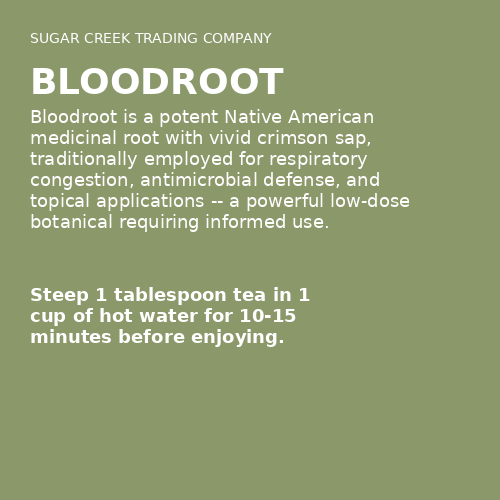
A potent Native American medicinal root with vivid crimson sap, traditionally employed for respiratory congestion, antimicrobial defense, and topical applications -- a powerful low-dose botanical requiring informed use.
BOTANICAL IDENTIFICATION
Scientific Name: Sanguinaria canadensis L.
Common Names: Bloodroot, Blood Root, Red Puccoon, Indian Paint, Tetterwort, Sweet Slumber, Sanguinaria, Pauson
Family: Papaveraceae (Poppy family)
Bloodroot is a low-growing, herbaceous perennial that emerges in early spring from a thick, fleshy rhizome. A single large, palmately lobed leaf with 5 to 9 deep lobes wraps around the developing flower bud as it pushes through the forest floor. The solitary flower is strikingly elegant -- pure white with 8 to 12 petals encircling a cluster of golden stamens -- and blooms briefly in March through May before the leaf reaches full size. The plant's defining characteristic is the vivid blood-red to orange-red latex that bleeds from the rhizome when cut or broken, a feature so dramatic that it gave rise to both the common name and the Latin genus (sanguinaria from sanguis, meaning "blood").
Native to the rich deciduous woodlands of eastern North America, bloodroot ranges from Nova Scotia south to Florida and west to the Great Plains. It favors moist, humus-rich soils in dappled shade on wooded slopes, ravines, and river terraces, often growing alongside trillium, wild ginger, and other spring woodland ephemerals. The entire plant retreats underground by midsummer, surviving as a dormant rhizome until the following spring.
CULTURAL AND HISTORICAL USE
Few North American plants carry as rich a cultural legacy as bloodroot. For centuries before European contact, Indigenous peoples across the eastern woodlands relied on this plant for medicine, ceremony, and art. The Algonquin, Ojibwe, Iroquois, Cherokee, Delaware, Micmac, Rappahannock, and many other nations used the crimson sap as a sacred body paint and textile dye -- the Algonquian word "puccoon" refers specifically to plants yielding red pigment. Medicinally, the root was prepared as treatments for respiratory ailments, sore throats, skin growths, and rheumatic pain. Several nations employed it as a ritual emetic for spiritual cleansing. The root was also applied directly to warts and abnormal skin growths, a practice that would later deeply influence Western medical approaches.
Colonial physicians and botanical explorers quickly recognized bloodroot's medicinal value. It became one of the cornerstone remedies of American herbal practice by the late 1700s, listed in the United States Pharmacopoeia from its first edition in 1820 and remaining official until 1926, with continued presence in the National Formulary until 1965. The Eclectic physicians -- the great American school of plant-based medicine -- considered sanguinaria among their most important remedies. Scudder, Felter, and Lloyd wrote extensively about its use as a respiratory stimulant and expectorant, emphasizing its value in small, repeated doses for bronchitis, croup, and laryngitis. Dr. J.W. Fell of London developed a topical bloodroot preparation in the 1850s for the treatment of breast tumors, establishing a line of escharotic use that has continued in folk medicine to the present day.
In the modern era, sanguinarine attracted pharmaceutical attention for its potent antibacterial properties. It was incorporated into commercially available toothpastes and mouthwashes marketed for plaque and gingivitis reduction throughout the 1980s and 1990s. Bloodroot alkaloids continue to be actively researched in pharmacology, with particular interest in sanguinarine's anti-proliferative mechanisms and its potential applications in oncology, infectious disease, and inflammatory conditions.
KEY BIOACTIVE COMPOUNDS & BENEFITS
| Compound/Class | Location in Plant | Human Benefit | Role in Plant |
|---|---|---|---|
| Sanguinarine (benzophenanthridine alkaloid) | Rhizome (highest concentration), red latex | Potent antimicrobial, anti-inflammatory, anti-plaque, expectorant, anti-proliferative activity | Primary chemical defense; red pigment |
| Chelerythrine | Rhizome, latex | Antimicrobial, anti-inflammatory, protein kinase C inhibitor studied for anti-cancer potential | Secondary defense alkaloid |
| Berberine | Rhizome | Broad-spectrum antimicrobial, metabolic support, anti-inflammatory | Antimicrobial defense; yellow pigment component |
| Protopine and allocryptopine | Rhizome | Smooth muscle relaxant, antispasmodic, mild sedative action on respiratory passages | Chemical defense alkaloids |
| Sanguirubine and sanguilutine | Rhizome, latex | Contribute to the broad antimicrobial and cytotoxic spectrum of the whole root | Minor alkaloids enhancing overall chemical defense |
Bloodroot's therapeutic power resides in its dense concentration of isoquinoline alkaloids, with sanguinarine as the dominant compound. Sanguinarine is a quaternary benzophenanthridine alkaloid with a remarkable range of biological activities -- it intercalates DNA, disrupts cell membranes, inhibits key inflammatory enzymes, and induces apoptosis in rapidly dividing cells. The full complex of alkaloids, including chelerythrine, berberine, and protopine, functions as a synergistic pharmacological unit that has made bloodroot one of the most intensively studied medicinal plants native to North America.
HOW IT WORKS IN THE BODY
Bloodroot alkaloids act through multiple potent mechanisms across respiratory, immune, and cellular systems. Understanding these actions helps explain both the therapeutic value and the need for careful dosing.
Respiratory and Expectorant Action:
Sanguinarine stimulates bronchial gland secretion through a reflex mechanism initiated in the stomach, increasing the volume and fluidity of respiratory mucus to facilitate its expulsion. This reflex expectorant action is the foundation of bloodroot's centuries-long use for congested, productive coughs and bronchitis. Protopine and allocryptopine contribute antispasmodic effects that relax bronchial smooth muscle, reducing the intensity of spasmodic and paroxysmal coughing. The combined effect is both loosening of phlegm and calming of the irritated airways.
Antimicrobial Activity:
Sanguinarine exhibits broad-spectrum antimicrobial action through disruption of bacterial cell membrane integrity, inhibition of bacterial DNA replication and protein synthesis, and interference with biofilm formation. It is active against gram-positive bacteria (including Staphylococcus aureus and methicillin-resistant strains), several gram-negative species, oral pathogens responsible for plaque and gum disease, and Candida species. This antimicrobial breadth, combined with its anti-biofilm activity, accounts for its effectiveness in oral health applications.
Anti-Proliferative and Apoptotic Mechanisms:
Sanguinarine and chelerythrine have been the subject of extensive research for their ability to selectively induce apoptosis in rapidly proliferating cells. The mechanisms include DNA intercalation, inhibition of the NF-kB inflammatory signaling pathway, disruption of mitochondrial membrane potential, activation of caspase cascades, and inhibition of topoisomerase enzymes. These actions explain the traditional topical use of bloodroot for skin abnormalities and are driving ongoing investigation into potential oncological applications. Importantly, the cytotoxic action is not selective enough for safe self-treatment -- this remains a domain for professional application.
Anti-Inflammatory Pathways:
Sanguinarine suppresses NF-kB-mediated transcription of pro-inflammatory genes, reduces COX-2 expression and prostaglandin E2 production, and inhibits TNF-alpha release from activated macrophages. These anti-inflammatory effects complement the antimicrobial and expectorant actions, making bloodroot particularly useful in conditions where infection and inflammation coexist, such as bronchitis and oral disease.
DOSE GUIDELINES
| Preparation Type | Typical Dose | Purpose |
|---|---|---|
| Tincture (1:5, 60% alcohol) | 0.5-1 mL (10-20 drops), 1-3 times daily -- always start at the low end | Expectorant for bronchitis, coughs, respiratory congestion |
| Dried root (decoction) | 60-500 mg simmered in water; use cautiously in small amounts | Traditional respiratory and antimicrobial support |
| Topical preparations | Only dilute, professionally prepared formulations; never apply raw root paste without expert supervision | Skin conditions -- strictly under practitioner guidance |
Bloodroot is a LOW-DOSE plant with a narrow therapeutic window. The difference between an effective expectorant dose and a dose that causes nausea is small. The Eclectic physicians specifically cautioned that bloodroot should be given in "small doses frequently repeated" rather than large single doses, and that it worked best as a component of formulas rather than alone. Never exceed recommended doses, and always begin at the lowest suggested amount to assess individual tolerance.
PREPARATION AND USES
Tincture is the preferred preparation for bloodroot because it allows precise, drop-by-drop dosing -- an important advantage with a plant of this potency. Prepare in 60 percent alcohol at a 1:5 ratio for efficient alkaloid extraction. For respiratory support, take 10 to 20 drops in a small amount of warm water, two to three times daily during acute bronchial congestion. Bloodroot tincture is most commonly used as one component of a multi-herb respiratory formula, combined with wild cherry bark, elecampane root, mullein leaf, horehound, or lobelia for a balanced and buffered expectorant blend.
A decoction can be prepared by simmering a very small quantity of dried root (roughly one-quarter teaspoon or less) in one cup of water for 10 to 15 minutes, then straining thoroughly. The resulting liquid is acrid and bitter. Dilute gargle preparations were traditionally used for sore throats and gum infections. Bloodroot was a key ingredient in many 19th-century compound cough syrups and lozenges, where its expectorant power was tempered by demulcent and antispasmodic herbs. Topical use of bloodroot -- including the preparation known as "black salve" -- has a long history but carries real risk of tissue destruction and scarring; such use should be undertaken only with the guidance of a practitioner experienced in escharotic protocols.
OPTIMAL CONTEXT FOR USE
Bloodroot is especially well-suited for individuals experiencing:
Acute or chronic bronchitis with thick, stubborn mucus that is difficult to expectorate -- where bloodroot's reflex expectorant action can effectively loosen and mobilize respiratory secretions
Spasmodic coughs, croup-like symptoms, or laryngitis where both expectorant and antispasmodic action are needed to calm and clear the airways
Oral health challenges including persistent plaque, gingivitis, or periodontal inflammation -- where dilute bloodroot preparations may serve as an adjunct to professional dental care
Situations where a qualified herbalist or practitioner has specifically recommended bloodroot as part of a supervised topical or internal protocol
Bloodroot is best used in combination with complementary herbs. For respiratory formulas, it pairs effectively with wild cherry bark, elecampane, horehound, mullein, and licorice root. For oral care, it combines well with myrrh resin, sage leaf, and propolis in herbal mouthwash formulations.
SUSTAINABILITY AND ETHICAL HARVESTING
Bloodroot is a slow-growing perennial of mature deciduous forests, and it faces meaningful conservation pressure across portions of its native range. Habitat destruction from logging and development, deer overbrowse, and commercial wild-harvesting have all contributed to population declines. United Plant Savers lists Sanguinaria canadensis on its "At-Risk" list, and it is classified as exploitably vulnerable, rare, or of special concern in several states and Canadian provinces.
Responsible sourcing is essential. Purchase bloodroot from suppliers who can verify cultivated origin or sustainable wild-harvesting practices. Bloodroot can be cultivated in woodland shade gardens that mimic its native habitat, though it requires patience -- rhizomes grow slowly and may take several years to reach a useful size. When wild-harvesting, never take more than 10 percent of any population, avoid the smallest and largest specimens, replant rhizome sections, and scatter ripe seed to promote regeneration. Supporting nursery propagation from seed, rather than wild-dug plants, is one of the most impactful steps consumers and herbalists can take to ensure this irreplaceable plant remains available for future generations.
SAFETY AND CAUTIONS
Bloodroot is a powerful, low-dose botanical that demands informed and cautious use. It is not appropriate for casual consumption or unsupervised experimentation.
Overdose causes severe nausea, vomiting, diarrhea, burning of the mouth and throat, visual disturbances, and potentially dangerous cardiovascular depression. The emetic dose is not far above the medicinal dose. Always measure carefully and start at the lowest recommended amount.
Concentrated topical bloodroot preparations (including "black salve" and similar escharotic pastes) can cause deep, uncontrolled tissue destruction, severe burns, disfiguring scars, and serious complications. Self-treatment of suspected skin cancers or other skin lesions with bloodroot paste is strongly discouraged and does not replace professional medical evaluation. Topical use should only occur under qualified professional supervision.
Bloodroot is strictly contraindicated during pregnancy and breastfeeding. Sanguinarine has demonstrated uterotonic effects and potential developmental toxicity. Do not use in children without professional guidance.
Sanguinarine can interact with medications processed by cytochrome P450 liver enzymes. Those taking prescription drugs -- especially those with narrow therapeutic windows such as warfarin, digoxin, or certain anti-seizure medications -- should consult a healthcare provider before using bloodroot.
Chronic exposure to sanguinarine in oral products has been associated with the development of oral leukoplakia in some individuals. Internal and oral use should be periodic rather than continuous.
REFERENCES
Ahmad, N., et al. "Differential antiproliferative and apoptotic response of sanguinarine for cancer cells versus normal cells." Clinical Cancer Research, 6(4): 1524-1528, 2000.
Godowski, K.C. "Antimicrobial action of sanguinarine." Journal of Clinical Dentistry, 1(4): 96-101, 1989.
Lenfeld, J., et al. "Antiinflammatory activity of quaternary benzophenanthridine alkaloids from Chelidonium majus." Planta Medica, 47(2): 111-113, 1981.
Moerman, D.E. Native American Ethnobotany. Timber Press, 1998. (Comprehensive documentation of Indigenous uses of Sanguinaria canadensis.)
Felter, H.W. and Lloyd, J.U. King's American Dispensatory. 18th ed., 1898. (Eclectic medical uses and dosing guidelines for Sanguinaria.)
FINAL NOTE
Bloodroot stands as a testament to the concentrated medicinal intelligence that a single woodland plant can hold within its roots. Its blood-red sap -- once sacred paint, now a subject of modern pharmacological research -- carries alkaloids powerful enough to dissolve mucus from congested lungs, disrupt bacterial biofilms, and trigger apoptosis in abnormal cells. This is not a gentle daily tea herb; it is a specialist's tool, refined by centuries of Indigenous and Eclectic medical knowledge into one of the most precisely employed botanicals in the North American tradition. Used wisely and with respect for both its power and its ecological vulnerability, bloodroot remains an extraordinary resource from the forest floor.
Share