Sugar Creek Trading Company
Cascara Sagrada Bark
Cascara Sagrada Bark
Impossible de charger la disponibilité du service de retrait
FRANGULA PURSHIANA
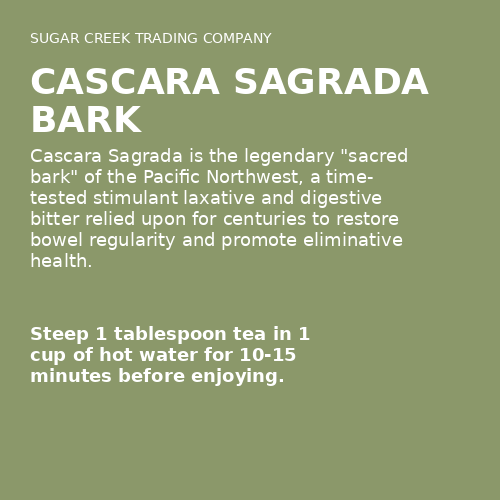
The legendary "sacred bark" of the Pacific Northwest, a time-tested stimulant laxative and digestive bitter relied upon for centuries to restore bowel regularity and promote eliminative health.
BOTANICAL IDENTIFICATION
Scientific Name: Frangula purshiana (DC.) A. Gray ex J.G. Cooper (syn. Rhamnus purshiana DC.)
Common Names: Cascara Sagrada, Sacred Bark, Chittem Bark, Bearberry Bark, Cascara Buckthorn
Family: Rhamnaceae (Buckthorn family)
Cascara sagrada is a deciduous tree or large shrub growing 5 to 15 meters tall with thin, smooth to slightly furrowed bark that presents reddish-brown to gray on the exterior and a distinctive bright yellow on the freshly exposed inner surface. Its leaves are broadly elliptical, 5 to 15 cm long, with prominent parallel venation and finely serrated edges. Small, inconspicuous greenish-yellow flowers bloom in axillary clusters, producing dark purple-black drupes consumed by birds and bears, which disperse the seeds.
Native to the moist coniferous and mixed forests of the Pacific Northwest, cascara sagrada ranges from southern British Columbia through Washington, Oregon, and northern California, extending eastward into Idaho and Montana. It occupies shaded understory habitats with rich, moist soils at elevations from sea level to about 1,500 meters. This cut bark form preserves the traditional preparation: strips of aged bark ready for decoction, infusion, or grinding.
CULTURAL AND HISTORICAL USE
Cascara sagrada occupies a central place in the ethnobotanical heritage of western North America. Indigenous peoples of the Pacific Northwest, including the Coast Salish, Chinook, Skagit, Nlaka'pamux, and numerous other First Nations, recognized this bark as a powerful and reliable medicine for constipation and digestive stagnation. Traditional practice universally required aging the harvested bark for at least one year before use, as fresh bark contains an excess of free anthraquinones that cause severe griping, nausea, and vomiting. The aging process allows enzymatic conversion of these harsh compounds into milder glycoside forms.
When Spanish missionaries and explorers encountered the bark through trade with Indigenous communities in the 17th and 18th centuries, they were so impressed by its efficacy that they named it "cascara sagrada"--"sacred bark." By the mid-1800s, word of the bark had reached eastern American physicians and European pharmacists, and by 1890 cascara sagrada had been admitted to the United States Pharmacopeia (USP), where it remained for over a century. Through much of the 20th century, it was the single most widely used laxative ingredient in over-the-counter products sold in the United States.
Eclectic physicians of the 19th and early 20th centuries valued cascara not merely as a laxative but as a comprehensive digestive tonic. Harvey Wickes Felter and John Uri Lloyd documented its use for chronic constipation, hepatic torpor, gallbladder insufficiency, and dyspepsia in King's American Dispensatory. They emphasized that cascara, unlike many purgatives, was believed to gradually restore the bowel's own peristaltic tone when used judiciously. Although the FDA reclassified cascara sagrada in 2002, removing it from approved OTC laxative drug ingredients due to insufficient modern clinical data, it remains one of the most widely used and deeply respected herbal laxatives in traditional practice around the world.
KEY BIOACTIVE COMPOUNDS & BENEFITS
| Compound/Class | Location in Plant | Human Benefit | Role in Plant |
|---|---|---|---|
| Cascarosides A, B, C, D (anthraquinone glycosides) | Inner bark | Primary stimulant laxative compounds; promote colonic peristalsis and fluid secretion | Chemical defense against herbivores and microbial pathogens |
| Emodin | Bark | Antimicrobial, anti-inflammatory, mild laxative, and emerging hepatoprotective research | Antifungal and antibacterial defense |
| Aloe-emodin | Bark | Enhances intestinal peristalsis; subject of anticancer research | Defensive secondary metabolite |
| Chrysophanol | Bark | Anti-inflammatory, hepatoprotective, antimicrobial activity | Secondary defense compound |
| Bitter principles and tannins | Bark | Stimulate bile flow, gastric acid, and pancreatic secretions; astringent toning of intestinal mucosa | Antiherbivory deterrents |
Cascara sagrada's therapeutic power resides in its cascarosides, a group of hydroxyanthracene glycosides unique to this species that are among the mildest of the stimulant anthraquinone laxatives when the bark has been properly aged. Working in concert with free anthraquinones, bitter principles, and tannins, these compounds deliver a well-rounded action that addresses both the mechanical (peristalsis) and secretory (bile, fluid) aspects of healthy elimination. The cut bark form retains the full matrix of these compounds in their natural proportions.
HOW IT WORKS IN THE BODY
Cascara sagrada bark acts primarily on the large intestine, with important secondary effects on the hepatobiliary system and upper digestive tract.
Stimulant Laxative Action (Colon):
The cascarosides survive stomach acid and small intestinal digestion intact. Upon reaching the colon, they are hydrolyzed by bacterial beta-glucosidases, releasing active aglycones (emodin, aloe-emodin, chrysophanol) directly at the target site. These active metabolites stimulate the myenteric (Auerbach's) nerve plexus in the colonic wall, triggering increased peristaltic contractions that propel intestinal contents toward the rectum. Simultaneously, the aglycones inhibit the Na+/K+-ATPase pumps on colonocytes, blocking water and electrolyte reabsorption and actively promoting chloride and water secretion into the intestinal lumen. This dual mechanism--enhanced motility plus increased luminal fluid--produces a soft, formed stool typically within 6 to 12 hours of ingestion.
Cholagogue and Bitter Tonic Action:
The intensely bitter taste of cascara bark activates T2R bitter taste receptors on the tongue and in the gut, triggering a reflex cascade that increases gastric acid production, stimulates pancreatic enzyme output, and promotes the release of bile from the gallbladder (cholagogue effect). This bile-stimulating property supports fat digestion, cholesterol metabolism, and the liver's detoxification and waste-elimination pathways.
Intestinal Toning:
Traditional herbalists have long maintained that cascara sagrada, when used in short courses, helps "retrain" a sluggish bowel by restoring more normal peristaltic rhythm. The astringent tannins in the bark may contribute to this by toning lax intestinal tissue. While clinical evidence for long-term bowel retraining is limited, the Eclectic tradition specifically distinguished cascara from harsher cathartics on this basis.
DOSE GUIDELINES
| Preparation Type | Typical Dose | Purpose |
|---|---|---|
| Decoction (cut bark) | 1 to 2 teaspoons of bark simmered in 1 cup water for 10-15 minutes, strained, taken at bedtime | Traditional laxative; bowel movement in 6-12 hours |
| Cold infusion | 1 to 2 teaspoons of bark soaked in 1 cup cold water for 12 hours, strained, taken at bedtime | Gentler preparation that extracts fewer harsh free anthraquinones |
| Tincture (1:5, 25-45% alcohol) | 1-2 mL at bedtime | Convenient measured liquid dose |
Cascara sagrada bark is strictly for short-term, occasional use--typically no more than 7 to 10 consecutive days. Always begin with the lowest effective dose and take at bedtime for a morning bowel movement. Drink adequate water throughout the day when using this herb. If constipation persists beyond one week of use, discontinue and consult a healthcare provider to investigate underlying causes.
PREPARATION AND USES
The traditional and most common preparation of cascara sagrada cut bark is a decoction: place 1 to 2 teaspoons of the bark pieces in a small saucepan with one cup of water, bring to a gentle simmer, cover, and maintain a low simmer for 10 to 15 minutes. Strain and drink at bedtime. The taste is profoundly bitter, and most people benefit from adding honey, a slice of ginger, or a few leaves of peppermint to improve palatability. A cold infusion (12-hour soak in cold water) is sometimes preferred as it extracts a gentler proportion of the active compounds.
Cascara bark can also be ground at home using a coffee grinder and filled into capsules for those who cannot tolerate the bitter taste. In professional herbalism, cascara sagrada is frequently combined with carminative herbs such as ginger, fennel seed, or peppermint to reduce the likelihood of abdominal cramping. Classic formulas pair cascara with berberine-containing barks like Oregon grape root or barberry to address constipation associated with biliary insufficiency and liver stagnation. The cut bark format is preferred by herbalists who prepare decoctions, tinctures, or custom blends and want full control over the extraction process.
OPTIMAL CONTEXT FOR USE
Cascara sagrada bark is especially well-suited for individuals experiencing:
Occasional constipation triggered by travel, dietary disruption, medication side effects, stress, or temporary changes in routine
Chronic sluggish bowel function that has not responded to increased dietary fiber, adequate hydration, exercise, and other first-line interventions
Poor appetite, sluggish digestion, or suspected biliary insufficiency, where the combined laxative and bitter cholagogue actions may provide more comprehensive relief
Short-term digestive cleansing protocols or bowel preparation as part of a structured herbal program guided by a qualified practitioner
This herb works best as part of a broader approach to digestive health that prioritizes adequate fiber intake, daily hydration, regular physical movement, stress management, and attention to the body's natural eliminative rhythms.
SUSTAINABILITY AND ETHICAL HARVESTING
Cascara sagrada has a complex sustainability history. During the peak of commercial demand in the 20th century, vast quantities of bark were stripped from wild trees throughout the Pacific Northwest, substantially depleting populations in many areas. Unlike some trees that recover from bark harvesting, cascara trees often die or suffer severe decline when fully stripped. Oregon and Washington have enacted harvest regulations and permit requirements to protect remaining wild stands on both public and private lands.
Sugar Creek Trading Company is committed to sourcing cascara sagrada bark from suppliers who practice ethical and sustainable harvesting, including selective partial bark stripping that allows trees to survive, harvest from fallen or thinned trees, and cultivation efforts where available. The conservation of this ecologically important understory species depends on responsible sourcing practices throughout the supply chain. Consumers can support sustainability by using cascara sagrada only when truly needed and at the lowest effective dose.
SAFETY AND CAUTIONS
Cascara sagrada is a potent stimulant laxative that requires careful, informed use. It is safe when used appropriately and for short durations but carries significant risks with misuse or prolonged consumption.
Duration of use: Limit use to no more than 7 to 10 consecutive days. Chronic use of anthraquinone-containing laxatives can lead to electrolyte imbalances (particularly potassium depletion), dehydration, melanosis coli (a harmless discoloration of the colon lining), and laxative dependency in which the colon loses its ability to produce normal peristalsis without stimulation.
Pregnancy and nursing: Cascara sagrada is contraindicated during pregnancy due to its potent stimulant action on smooth muscle and potential to cause uterine contractions. It is also contraindicated during breastfeeding, as anthraquinone metabolites can pass into breast milk and may cause diarrhea in nursing infants.
Gastrointestinal contraindications: Do not use if you have abdominal pain of unknown origin, bowel obstruction, appendicitis, inflammatory bowel disease (Crohn's disease or ulcerative colitis), or any acute abdominal condition. Use with caution in individuals with hemorrhoids, as increased peristalsis can aggravate them.
Drug interactions: Cascara-induced potassium loss can potentiate the effects of cardiac glycosides (digoxin) and may interact with thiazide and loop diuretics, corticosteroids, and licorice root, all of which can also lower potassium levels. Accelerated intestinal transit may reduce the absorption time and effectiveness of orally administered medications.
Age restrictions: Not recommended for children under 12 years of age without professional supervision.
REFERENCES
Felter, H.W. & Lloyd, J.U. (1898). King's American Dispensatory. 18th ed. Ohio Valley Company. [Cascara Sagrada monograph.]
European Medicines Agency (EMA). (2015). "Assessment report on Rhamnus purshianus DC., cortex." EMA/HMPC/513578/2012.
Blumenthal, M., et al. (1998). The Complete German Commission E Monographs: Therapeutic Guide to Herbal Medicines. American Botanical Council.
FINAL NOTE
Cascara sagrada bark is a botanical that earned its name honestly. For centuries, this unassuming Pacific Northwest tree bark has been the remedy people reach for when the body's eliminative systems need decisive yet measured support. In its traditional cut bark form, cascara sagrada invites a ritual of preparation--the slow simmer, the bitter sip, the patience to let the medicine work overnight--that connects the user to a lineage of Indigenous knowledge and Eclectic wisdom stretching back generations. Use it wisely, use it briefly, and let it remind you that the body's natural rhythms, once restored, are best maintained through the daily practices of nourishment and movement.
Share