Sugar Creek Trading Company
Chives
Chives
Impossible de charger la disponibilité du service de retrait
ALLIUM SCHOENOPRASUM
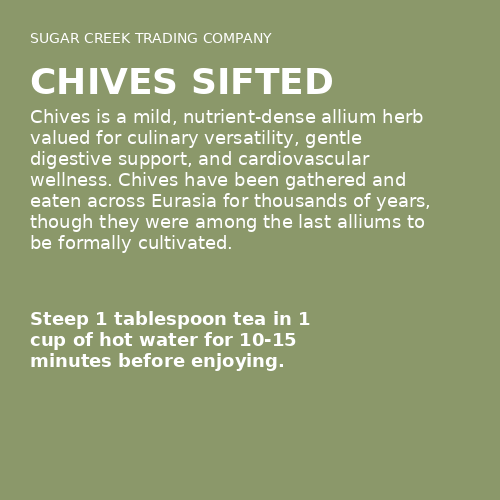
A mild, nutrient-dense allium herb valued for culinary versatility, gentle digestive support, and cardiovascular wellness.
BOTANICAL IDENTIFICATION
Scientific Name: Allium schoenoprasum L.
Common Names: Chives, Common Chives, Garden Chives, Onion Chives, Wild Chives, Ciboulette
Family: Amaryllidaceae (Onion family)
Chives are a hardy, clump-forming perennial growing 20–50 cm tall from small, elongated bulbs. The leaves are hollow, tubular, and bright green, with a fine, grass-like appearance. In late spring to early summer, the plant produces attractive spherical flower heads of pink to purple florets atop slender, upright scapes. Sifted chives are the dried, cut leaf material processed to a uniform size for culinary and herbal use.
Native to Europe, Asia, and North America, chives are one of the most widely distributed wild alliums in the Northern Hemisphere. They thrive in moist, well-drained soils in full sun to partial shade, from lowland meadows to alpine elevations, and are among the easiest herbs to cultivate in gardens and containers.
CULTURAL AND HISTORICAL USE
Chives have been gathered and eaten across Eurasia for thousands of years, though they were among the last alliums to be formally cultivated. Records suggest systematic garden cultivation began in the Middle Ages in Europe, where monasteries grew chives both for the kitchen and the apothecary. In medieval herbalism, chives were used to stimulate appetite, aid digestion, and clear mild respiratory congestion. They were also hung in bundles around the home, following the folk tradition that alliums ward off evil spirits and disease.
In Traditional Chinese Medicine, allium herbs including chives (jiu cai, though this more specifically refers to garlic chives, A. tuberosum) are classified as warming, pungent herbs that move qi and blood, resolve stagnation, and support the kidneys and digestive organs. The gentle warming quality of common chives aligns with this broader allium tradition. In European folk medicine, chive poultices were occasionally applied to insect bites, and chive-infused vinegar was used as a household tonic and cleansing agent.
Culinarily, chives are indispensable across French, Scandinavian, Eastern European, and American cooking traditions. They belong to the classic French fines herbes blend alongside parsley, tarragon, and chervil. Their delicate onion flavor enhances eggs, potatoes, soft cheeses, soups, and salads without overpowering other ingredients, making them one of the most frequently used finishing herbs in the Western kitchen.
KEY BIOACTIVE COMPOUNDS & BENEFITS
| Compound/Class | Location in Plant | Human Benefit | Role in Plant |
|---|---|---|---|
| Organosulfur Compounds (Allicin precursors, Diallyl sulfides) | Leaves and bulbs | Antimicrobial activity, cardiovascular support, antioxidant protection | Chemical defense against herbivores and pathogens |
| Flavonoids (Quercetin, Kaempferol) | Leaves and flowers | Anti-inflammatory, antioxidant, cardiovascular protection | UV protection and pollinator signaling |
| Vitamin K | Leaves | Blood clotting regulation, bone health support | Photosynthesis-related electron transport |
| Vitamin C (Ascorbic Acid) | Leaves | Immune support, collagen synthesis, antioxidant defense | Antioxidant protection in photosynthetic tissue |
| Carotenoids (Beta-carotene, Lutein) | Leaves | Eye health, skin protection, provitamin A activity | Light harvesting and photoprotection |
Chives deliver the signature health benefits of the allium family—sulfur-based antimicrobial and cardiovascular compounds—in a milder, more approachable form than garlic or onion. Their rich flavonoid and vitamin content makes them a nutrient-dense addition to daily meals, and the synergy between their sulfur compounds and antioxidant flavonoids provides broad-spectrum cellular protection in even small culinary quantities.
HOW IT WORKS IN THE BODY
Chives exert their effects through the combined action of organosulfur compounds, flavonoid antioxidants, and concentrated micronutrients.
Cardiovascular and Circulatory Support:
The organosulfur compounds in chives, particularly allicin and its derivatives, promote vasodilation via hydrogen sulfide (H2S) signaling pathways, helping to relax blood vessel walls and support healthy blood pressure. These same compounds inhibit platelet aggregation and support healthy cholesterol metabolism by modulating HMG-CoA reductase activity. Quercetin further contributes by reducing oxidative damage to endothelial cells lining the blood vessels.
Digestive Stimulation:
Chives gently stimulate the secretion of saliva and gastric juices, improving appetite and the efficiency of digestion. The mild sulfur compounds have carminative properties, helping to reduce gas and bloating. Unlike stronger alliums, chives rarely cause digestive irritation, making them suitable for sensitive individuals who still want the benefits of allium chemistry.
Antimicrobial and Immune Support:
Allicin and related sulfur metabolites demonstrate activity against a range of bacteria, fungi, and viruses in laboratory studies. While chives contain lower concentrations of these compounds than garlic, regular dietary intake contributes to the body's baseline antimicrobial defenses. The vitamin C content further supports immune cell function and antioxidant recycling.
Bone and Blood Health:
Chives are an excellent source of vitamin K, critical for proper blood clotting and the activation of osteocalcin, a protein essential for calcium binding in bone tissue. Combined with their folate content, chives support healthy homocysteine metabolism, which is important for both cardiovascular and bone health.
DOSE GUIDELINES
| Preparation Type | Typical Dose | Purpose |
|---|---|---|
| Dried Sifted Chives (culinary) | 1–3 tsp added to food daily | Nutritional supplementation, digestive support, daily allium intake |
| Chive Infusion (tea) | 1–2 tsp dried chives steeped in 8 oz hot water, 10–15 minutes | Mild digestive tonic, gentle respiratory support |
| Chive Vinegar (folk preparation) | 1 tbsp chive-infused vinegar in water | Appetite stimulation, mineral extraction, digestive aid |
Chives are best used as a consistent, daily culinary herb rather than an acute medicinal dose. Their mild potency makes them ideal for long-term incorporation into the diet, where their cumulative nutritional and cardiovascular benefits are most pronounced. There is no established upper limit for culinary use.
PREPARATION AND USES
Dried sifted chives rehydrate quickly and can be added directly to soups, stews, omelets, scrambled eggs, baked potatoes, cream cheese spreads, compound butters, salad dressings, and dips. They are best added near the end of cooking or as a finishing garnish to preserve their delicate flavor and volatile sulfur compounds. For maximum nutritional benefit, sprinkle dried chives over warm (not boiling) dishes just before serving.
To make a simple chive infusion, steep one to two teaspoons of dried sifted chives in hot water for 10–15 minutes; the resulting mild, onion-scented tea can support digestion after meals. Chive vinegar is another traditional preparation: pack a jar loosely with dried chives, cover with raw apple cider vinegar, steep for 2–4 weeks, then strain and use as a salad dressing base or digestive tonic. Dried chives can also be blended into herb salt mixtures, seasoning blends, and bread doughs.
OPTIMAL CONTEXT FOR USE
Chives are especially well-suited for individuals experiencing:
A desire to increase daily allium intake for cardiovascular support without the intensity of raw garlic or onion
Mild digestive sluggishness, low appetite, or occasional bloating
A need for increased vitamin K and micronutrient intake through whole-food sources
Sensitivity to stronger alliums but a wish to retain their health benefits
A culinary goal of adding depth and savory complexity to everyday meals with minimal effort
Chives pair naturally with other gentle digestive and nutritive herbs such as parsley, dill, and thyme, and they complement stronger medicinal alliums like garlic in both the kitchen and the apothecary.
SUSTAINABILITY AND ETHICAL HARVESTING
Chives are among the most sustainable herbs available. They are perennial, cold-hardy, drought-tolerant once established, and spread readily by both division and self-seeding. They require minimal inputs to cultivate, are resistant to most pests (in fact, they are often planted as companion plants to deter aphids and other garden pests), and can be harvested repeatedly throughout the growing season without harming the plant. Wild chive populations are abundant and widespread across the Northern Hemisphere.
Commercial dried chive production is primarily farm-based and raises no conservation concerns. Choosing organically grown chives ensures the absence of synthetic pesticide residues, which is particularly relevant for a leaf herb consumed in its entirety.
SAFETY AND CAUTIONS
Chives are considered very safe for the vast majority of people and are consumed worldwide as a common food ingredient. The following minor cautions apply:
Allium sensitivity: Individuals with known allergies or intolerances to onions, garlic, or other allium species may also react to chives. Symptoms are typically mild (digestive upset, skin irritation) but should be noted.
Blood-thinning medications: Due to their vitamin K content and mild antiplatelet effects, individuals on warfarin or other anticoagulants should maintain consistent (not suddenly increased) chive intake and consult their healthcare provider.
Pregnancy and nursing: Chives are safe in normal culinary amounts during pregnancy and breastfeeding. No restrictions apply at food-level doses.
Pets: Note that all alliums, including chives, are toxic to dogs and cats. Keep dried chives stored away from pets.
REFERENCES
Fritsch, R.M. & Friesen, N. (2002). "Evolution, Domestication and Taxonomy." In: Rabinowitch, H.D. & Currah, L. (eds.), Allium Crop Science: Recent Advances. CABI Publishing, pp. 5–30.
Corzo-Martínez, M., Corzo, N., & Villamiel, M. (2007). "Biological properties of onions and garlic." Trends in Food Science & Technology, 18(12), 609–625.
Mnayer, D., Fabiano-Tixier, A.S., Petitcolas, E., et al. (2014). "Chemical composition, antibacterial and antioxidant activities of six essentials oils from the Alliaceae family." Molecules, 19(12), 20034–20053.
FINAL NOTE
Chives are the gentlest ambassador of the powerful allium family—delivering sulfur chemistry, cardiovascular support, and a wealth of micronutrients in a form so mild and versatile it can grace nearly any dish. Their value lies not in dramatic potency but in quiet, daily consistency: a sprinkle here, a garnish there, steadily contributing to long-term health with every meal. No herb cabinet or kitchen is truly complete without them.
Share