Sugar Creek Trading Company
Chlorella
Chlorella
Impossible de charger la disponibilité du service de retrait
CHLORELLA VULGARIS
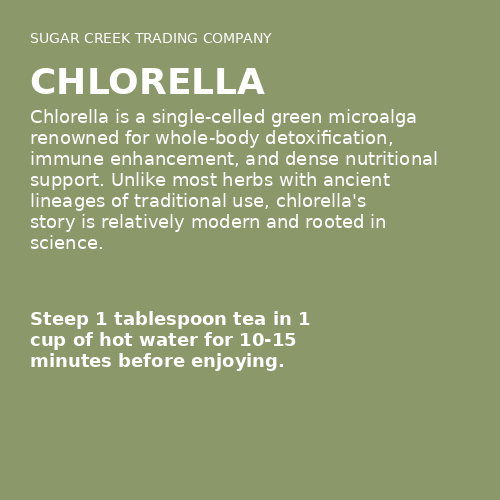
A single-celled green microalga renowned for whole-body detoxification, immune enhancement, and dense nutritional support.
BOTANICAL IDENTIFICATION
Scientific Name: Chlorella vulgaris Beijerinck
Common Names: Chlorella, Green Algae, Sun Chlorella, Chlorella Powder
Family: Chlorellaceae (Green microalgae family)
Chlorella is a spherical, single-celled freshwater green microalga measuring only 2–10 micrometers in diameter. Despite its microscopic size, each cell is a complete photosynthetic organism containing a nucleus, chloroplast, and a remarkably tough cell wall composed of cellulose and sporopollenin. Under optimal conditions, chlorella reproduces rapidly by autosporulation, dividing into four daughter cells every 16–24 hours, which accounts for its extraordinary biomass productivity.
Chlorella is found naturally in freshwater lakes and ponds across temperate and tropical regions worldwide. Commercial production is carried out in controlled environments—outdoor open ponds or enclosed photobioreactors—primarily in Japan, Taiwan, Germany, and the United States, where water quality, light exposure, and nutrient inputs are carefully managed to produce a pure, contaminant-free product.
CULTURAL AND HISTORICAL USE
Unlike most herbs with ancient lineages of traditional use, chlorella's story is relatively modern and rooted in science. The organism was first identified by the Dutch microbiologist Martinus Beijerinck in 1890, and it became a subject of intense research in the mid-20th century. After World War II, chlorella was investigated as a potential solution to global food shortages due to its extraordinary protein content (up to 60% by dry weight) and rapid growth rate. NASA studied it as a potential food and oxygen source for long-duration space missions.
Japan became the epicenter of chlorella culture beginning in the 1960s, when Nihon Chlorella Inc. and other companies began large-scale production. Japanese consumers embraced chlorella as a daily health supplement, and by the 1980s and 1990s, it had become one of the most popular dietary supplements in Japan, used for general wellness, detoxification, and immune support. This Japanese tradition of daily chlorella use continues today and has spread globally.
In integrative and naturopathic medicine, chlorella has earned a central role as a heavy metal chelator and detoxification agent, particularly for mercury, lead, and cadmium. It is frequently recommended as part of amalgam filling removal protocols and environmental toxin clearance programs. Its dense nutritional profile has also made it a staple in plant-based nutrition, green superfood blends, and athletic recovery regimens.
KEY BIOACTIVE COMPOUNDS & BENEFITS
| Compound/Class | Location in Plant | Human Benefit | Role in Plant |
|---|---|---|---|
| Chlorella Growth Factor (CGF) | Nucleus (RNA/DNA complex) | Cellular repair and regeneration, immune activation, tissue healing | Drives the rapid cell division cycle of the organism |
| Chlorophyll (highest known concentration) | Chloroplast | Detoxification, deodorizing, antioxidant, blood-building support | Primary photosynthetic pigment for energy production |
| Sporopollenin (cell wall component) | Cell wall | Binds heavy metals and environmental toxins in the gut for elimination | Structural defense and UV protection of the cell |
| Beta-Glucans | Cell wall | Immune modulation, macrophage and NK cell activation | Structural polysaccharide in the cell wall matrix |
| Complete Protein (all essential amino acids) | Throughout cell | Muscle repair, enzyme production, tissue maintenance | Structural and metabolic building blocks for growth |
Chlorella is unique among green supplements in that its therapeutic identity rests on a combination of factors found in no single plant: the world's highest chlorophyll concentration, a nucleotide-rich growth factor, a toxin-binding cell wall, immune-activating polysaccharides, and a complete protein profile. This convergence makes chlorella a true whole-body nutritive and detoxifying agent rather than a single-purpose remedy.
HOW IT WORKS IN THE BODY
Chlorella operates through multiple simultaneous mechanisms, functioning as both a concentrated food and a detoxification tool.
Heavy Metal and Toxin Binding:
The sporopollenin and cellulose matrix of chlorella's cell wall has a strong affinity for heavy metals (mercury, lead, cadmium, arsenic) and certain organic pollutants (dioxins, PCBs). When consumed, the indigestible cell wall material passes through the gastrointestinal tract, adsorbing these toxins and preventing their reabsorption through enterohepatic circulation. This mechanism is particularly important for mercury detoxification, as chlorella binds both inorganic and methylmercury in the gut lumen.
Immune System Modulation:
The beta-glucans and glycoproteins in chlorella's cell wall activate innate immune responses by stimulating macrophages, natural killer (NK) cells, and dendritic cells through pattern recognition receptors (particularly Dectin-1 and TLR-2). Chlorella Growth Factor (CGF) further supports immune function by providing nucleotides (RNA/DNA) that are essential for the rapid proliferation of immune cells during an active response. Clinical trials have shown increased salivary IgA and enhanced NK cell activity in regular chlorella users.
Nutritional Replenishment and Blood Building:
Chlorella provides bioavailable iron, B12 (unusual for a plant source), folate, and the highest chlorophyll density of any known organism. Chlorophyll is structurally similar to hemoglobin and supports the body's blood-building processes. The complete amino acid profile and high protein content (50–60% by weight) make chlorella a meaningful protein source, particularly for plant-based diets. Its naturally occurring vitamins A, C, E, and K, along with magnesium, zinc, and phosphorus, contribute to comprehensive micronutrient support.
Antioxidant Defense and Cellular Repair:
Chlorophyll, carotenoids (lutein, beta-carotene), and vitamin E in chlorella provide multi-layered antioxidant protection against reactive oxygen species. CGF, with its concentrated nucleic acid content, supports DNA repair mechanisms and cellular regeneration, which is why chlorella is often associated with recovery, tissue healing, and anti-aging protocols.
DOSE GUIDELINES
| Preparation Type | Typical Dose | Purpose |
|---|---|---|
| Chlorella Powder (daily maintenance) | 3–5 grams per day (approx. 1–1.5 tsp) | Nutritional support, gentle ongoing detoxification, immune maintenance |
| Chlorella Powder (active detox protocol) | 5–10 grams per day, divided doses | Heavy metal chelation support, intensive detoxification programs |
| Chlorella Tablets (pressed powder) | 10–20 tablets per day (typically 250–500 mg each) | Convenient alternative to powder for daily use |
Chlorella is best introduced gradually, starting with 1–2 grams per day and increasing over 1–2 weeks to allow the body to adjust. Some individuals experience mild digestive changes (gas, green stools) during the initial period, which typically resolve. For detoxification protocols, work with a qualified practitioner to determine appropriate dosing and duration. Chlorella is most effective as a consistent, long-term daily supplement rather than an occasional addition.
PREPARATION AND USES
Chlorella powder has a deep green color and a distinctive marine-like, slightly grassy flavor. It blends easily into smoothies, green juices, and protein shakes, where fruits like banana, mango, and pineapple help balance its earthy taste. It can also be stirred into water, coconut water, or juice for a quick daily dose. Some people mix chlorella into salad dressings, pesto, energy balls, or raw desserts. For those who find the flavor challenging, tablets offer a tasteless, convenient alternative.
For detoxification purposes, chlorella is often taken 30 minutes before meals to maximize its toxin-binding capacity in the gut before new food enters the digestive tract. It pairs synergistically with cilantro (Coriandrum sativum), which is believed to mobilize heavy metals from tissues into circulation, while chlorella binds and escorts them out through the feces. This cilantro-chlorella combination is a cornerstone of many integrative detoxification protocols.
OPTIMAL CONTEXT FOR USE
Chlorella is especially well-suited for individuals experiencing:
Known or suspected heavy metal exposure (dental amalgams, contaminated water, occupational exposure, fish-heavy diets)
A desire for comprehensive daily nutritional support, particularly on plant-based or restricted diets
Weakened or sluggish immune function, frequent infections, or post-illness recovery
Low energy, fatigue, or anemia where iron and B12 support from whole-food sources is desired
A general interest in daily detoxification and cellular protection in a modern environment
Chlorella works well alongside spirulina for a comprehensive algae-based nutrition protocol, and it complements liver-supporting herbs like milk thistle and dandelion root in broader detox programs.
SUSTAINABILITY AND ETHICAL HARVESTING
Chlorella is among the most sustainable nutritional supplements available. It is cultivated, not wild-harvested, in controlled freshwater systems that can be located on non-arable land. Its photosynthetic efficiency is extraordinary—chlorella converts sunlight into biomass far more efficiently per acre than any conventional crop. It absorbs carbon dioxide during growth, requires no pesticides or herbicides, and the water used in closed photobioreactor systems can be recycled.
Quality and sustainability concerns center on the production method: open-pond systems are more affordable but vulnerable to contamination from environmental pollutants and competing organisms, while closed photobioreactors produce a purer product with greater resource efficiency. Consumers should look for chlorella from producers who test for heavy metals, microbial contaminants, and radiation, and who use cracked-cell-wall processing to ensure digestibility without compromising the cell wall's binding properties.
SAFETY AND CAUTIONS
Chlorella is widely consumed and has a strong safety profile established through decades of use in Japan and elsewhere. The following cautions should be noted:
Initial detox symptoms: Some individuals experience digestive discomfort, gas, nausea, or green discoloration of stool when beginning chlorella, particularly at higher doses. Start low and increase gradually.
Iodine sensitivity: While chlorella contains less iodine than marine seaweeds, individuals with thyroid conditions or iodine sensitivity should monitor intake and consult their healthcare provider.
Autoimmune conditions: Because chlorella stimulates immune activity, individuals with autoimmune diseases (lupus, rheumatoid arthritis, multiple sclerosis) should use caution and consult a practitioner, as immune stimulation may theoretically exacerbate symptoms.
Blood-thinning medications: Chlorella contains vitamin K and may affect anticoagulant therapy (warfarin). Maintain consistent intake and inform your prescribing physician.
Pregnancy and nursing: Chlorella is generally considered safe during pregnancy (and is commonly used in Japan during pregnancy), but high-dose detoxification protocols should be avoided during pregnancy to prevent mobilized toxins from reaching the fetus.
REFERENCES
Merchant, R.E. & Andre, C.A. (2001). "A review of recent clinical trials of the nutritional supplement Chlorella pyrenoidosa in the treatment of fibromyalgia, hypertension, and ulcerative colitis." Alternative Therapies in Health and Medicine, 7(3), 79–91.
Kwak, J.H., Baek, S.H., Woo, Y., et al. (2012). "Beneficial immunostimulatory effect of short-term Chlorella supplementation: Enhancement of natural killer cell activity and early inflammatory response." Nutrition Journal, 11, 53.
Uchikawa, T., Kumamoto, Y., Maruyama, I., et al. (2011). "Enhanced elimination of tissue methylmercury in Parachlorella beijerinckii-fed mice." Journal of Toxicological Sciences, 36(1), 121–126.
FINAL NOTE
Chlorella is nature's most efficient single-celled package of nutrition, detoxification, and immune support. What began as a Cold War-era food science curiosity has become one of the most evidence-backed green supplements available, with a particular genius for binding and removing the heavy metals and pollutants that define modern environmental exposure. Taken daily, chlorella quietly performs the essential housekeeping of the body—feeding cells, clearing toxins, and fortifying defenses—in a form no larger than a grain of dust.
Share