Sugar Creek Trading Company
Comfrey
Comfrey
Impossible de charger la disponibilité du service de retrait
SYMPHYTUM OFFICINALE
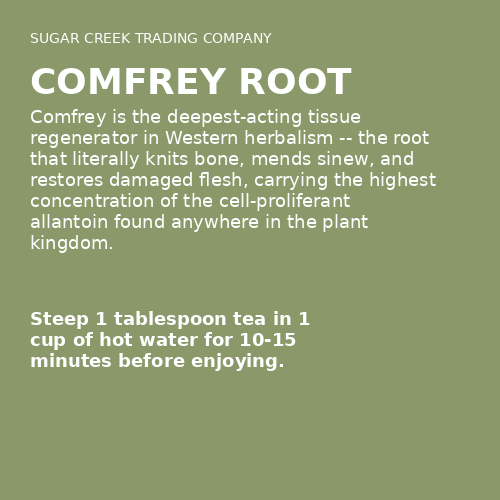
The deepest-acting tissue regenerator in Western herbalism -- the root that literally knits bone, mends sinew, and restores damaged flesh, carrying the highest concentration of the cell-proliferant allantoin found anywhere in the plant kingdom.
BOTANICAL IDENTIFICATION
Scientific Name: Symphytum officinale L.
Common Names: Comfrey Root, Common Comfrey, Knitbone, Boneset, Bruisewort, Consound, Slippery Root, Blackwort, Healing Herb
Family: Boraginaceae (Borage family)
Comfrey is a robust, fast-growing perennial herb that forms dense clumps 60 to 120 cm tall with large, rough, hairy lance-shaped leaves and drooping bell-shaped flowers in purple, pink, or creamy white. The root, which is the primary medicinal part of the plant, is a thick, fleshy, branching taproot with black or dark brown skin and a white, mucilaginous interior. Established roots can reach 180 cm deep into the soil and are remarkably regenerative, with even small fragments capable of producing new plants.
Native to Europe and western Asia, Comfrey thrives in moist, rich soils along riverbanks, ditches, meadows, and waste ground. It has been widely cultivated and naturalized across North America, where it persists tenaciously in gardens, old homesteads, and disturbed fertile ground. The root is typically harvested in autumn or early spring when the plant's energy is concentrated below ground and allantoin content is at its peak.
CULTURAL AND HISTORICAL USE
Comfrey root is the original Knitbone -- the specific plant part that gave rise to the entire Comfrey legend. While the leaves have their own therapeutic value, it is the root that was used in the classical texts and battlefield medicine that built Comfrey's 2,000-year reputation as the supreme bone and wound healer. The genus name Symphytum comes from the Greek "symphyo," meaning "to grow together," and this name was given specifically in reference to the root's ability to unite fractured bone and torn tissue when applied as a poultice.
Dioscorides (first century CE) specifically prescribed the root, pounded and applied as a plaster, for fractures and wounds. Pliny the Elder recorded that Comfrey root was so powerfully binding that pieces of raw meat boiled with it would fuse together. Medieval physicians across Europe used the root extensively: it was a standard in military field kits for treating battle wounds, fractures, and deep lacerations. Gerard wrote in 1597 that the root, "stamped and laid on fresh wounds," would "glew them together with great celeritie." Culpeper confirmed its role as the foremost bone-mending plant in his 1653 Herbal.
In North American folk medicine, Comfrey root was a household staple through the 19th and 20th centuries. Rural families kept Comfrey growing near the house specifically for emergency poultices. The root was grated or pounded, mixed with a small amount of water to form a paste, and applied directly over fractures, bad sprains, and deep bruises. Some traditions included drinking a small amount of root decoction internally for stomach ulcers and lung complaints, though this internal use has been reconsidered in light of modern pyrrolizidine alkaloid research. The root remains the most clinically studied part of the plant, with modern pharmaceutical preparations (such as Traumaplant and Kytta-Salbe in Germany) based specifically on Comfrey root extract.
KEY BIOACTIVE COMPOUNDS & BENEFITS
| Compound/Class | Location in Plant | Human Benefit | Role in Plant |
|---|---|---|---|
| Allantoin (0.6-4.7%, highest in root) | Root cortex and parenchyma (peak concentration) | Stimulates fibroblast proliferation, accelerates cell division in bone, cartilage, connective tissue, and skin; the primary driver of Comfrey's tissue-repair reputation | Growth regulation in the plant's most actively regenerating tissue |
| Mucilage polysaccharides (up to 29%) | Root parenchyma (very high concentration) | Demulcent and emollient action; creates a moist, protective healing matrix over damaged tissue; soothes internal mucous membranes | Water retention, frost protection, and structural hydration in root tissue |
| Rosmarinic acid | Root and leaves | Anti-inflammatory, antioxidant, and mild analgesic activity; reduces swelling and pain at injury sites | Antimicrobial defense compound |
| Tannins (condensed and hydrolyzable) | Root bark and cortex | Astringent action tightens tissue, reduces bleeding, and creates a protective protein layer on wound surfaces | Deterrence of root-feeding organisms and microbial resistance |
| Steroidal saponins and triterpenoids | Root | Anti-inflammatory and immune-supporting activity; may enhance absorption of other active compounds | Chemical defense and membrane integrity |
Comfrey root contains the highest concentration of allantoin found in the plant, typically 2 to 5 times more than the leaves, making it the most potent tissue-regenerating part of the Comfrey plant. The root's exceptional mucilage content (nearly 30%) creates an unmatched soothing, protective matrix, while the rosmarinic acid provides clinically demonstrated anti-inflammatory action. This is why pharmaceutical Comfrey preparations worldwide are based on root extracts rather than leaf: the root delivers the most concentrated therapeutic payload.
HOW IT WORKS IN THE BODY
Comfrey root's therapeutic actions operate through a powerful synergy of tissue regeneration, physical protection, and inflammation control that has been validated in multiple modern clinical trials.
Cell Proliferation and Deep Tissue Regeneration:
Allantoin, present in peak concentrations in the root, is a proven cell-proliferant (mitotic stimulant) that activates fibroblast division and accelerates the production of collagen, granulation tissue, and new epithelial cells. Applied topically over a fracture, sprain, or wound, allantoin measurably speeds the rate at which damaged tissue is replaced by healthy new cells. This is not folk speculation -- clinical trials on Comfrey root ointments have demonstrated faster healing of ankle sprains compared to diclofenac gel, and significant improvements in osteoarthritis pain and mobility compared to placebo.
Mucilaginous Healing Matrix:
The root's exceptionally high mucilage content (up to 29%) creates a thick, gel-like protective layer when applied topically. This mucilage serves as a natural wound dressing: it maintains optimal moisture levels for healing, protects exposed tissue from mechanical irritation and drying, and provides a scaffold-like matrix through which cells can migrate and proliferate. When taken internally (in traditional practice), this mucilage coats and soothes the lining of the digestive tract.
Anti-Inflammatory and Analgesic Action:
Rosmarinic acid and related phenolic compounds in the root inhibit complement cascade activation and suppress the synthesis of pro-inflammatory prostaglandins and leukotrienes. Clinical studies have shown that topical Comfrey root preparations produce statistically significant reductions in pain, swelling, and inflammation in acute ankle sprains, back pain, and knee osteoarthritis. In some trials, Comfrey root ointment matched or exceeded the pain relief provided by conventional NSAID gels.
Astringent Tissue Stabilization:
The tannins concentrated in the root bark provide immediate astringent effects when applied to wounds or inflamed tissue. This tightens the tissue surface, reduces capillary bleeding, and creates a stable, protein-tanned layer that protects the healing zone during the critical early phases of repair.
DOSE GUIDELINES
| Preparation Type | Typical Dose | Purpose |
|---|---|---|
| Poultice (topical) | Grated or powdered root mixed with warm water to form a paste, applied directly to affected area, covered with cloth, 1-3 times daily | Fractures, severe sprains, deep bruises, bone and connective tissue repair |
| Infused oil (topical) | Apply liberally to affected area 2-3 times daily | Joint pain, muscle soreness, scar tissue, chronic musculoskeletal conditions |
| Salve or ointment (topical) | Apply to affected area as needed, up to 3-4 times daily | Convenient daily application for sprains, arthritis, skin repair |
| Decoction (topical wash) | 1-2 tablespoons dried root simmered 15-20 minutes, strained, used as wash or compress | Wound washing, compress for deep bruises and inflammation |
Comfrey root is recommended for topical use only in modern herbal practice due to its higher pyrrolizidine alkaloid (PA) content compared to the leaf. The German Commission E monograph permits topical Comfrey root preparations applied for up to 4 to 6 weeks per year on intact skin. Do not apply to deep puncture wounds or heavily infected wounds, as the rapid cell-proliferating action can close the skin surface before deeper tissue has healed, potentially sealing in infection. For fractures, apply only after the bone has been properly set by a medical professional.
PREPARATION AND USES
The most powerful traditional application of Comfrey root is the fresh or reconstituted root poultice. Dried root pieces or powder are mixed with a small amount of warm water to create a thick, mucilaginous paste that is applied directly over the injury site, covered with a cloth or bandage, and left in place for several hours or overnight. The paste will set to a semi-firm consistency as it dries, creating a natural splint-like dressing that delivers allantoin and mucilage directly into the tissue below. This method was the standard approach for fractures and severe sprains throughout European medical history.
Comfrey root-infused oil is prepared by covering the dried root in olive oil or another carrier oil and steeping for 4 to 6 weeks (cold method) or several hours using gentle heat (double boiler method at 100-110 degrees F). The strained oil is rich, dark, and deeply mucilaginous. It can be used directly as a massage oil for joints and muscles or thickened with beeswax into a healing salve. Comfrey root salve is one of the most popular and effective herbal preparations in Western herbalism, widely used for arthritis, sports injuries, back pain, and general musculoskeletal care. A strong root decoction can also serve as a wound wash or compress base for external injuries.
OPTIMAL CONTEXT FOR USE
Comfrey root is especially well-suited for individuals experiencing:
Bone fractures, stress fractures, or slow-healing bone injuries where maximum cell-regenerative support is desired (applied topically after proper medical setting)
Severe sprains, ligament strains, or torn connective tissue requiring accelerated repair
Osteoarthritis, particularly of the knee, with pain, stiffness, and impaired mobility -- clinical trials support its efficacy for this use
Acute and chronic back pain, muscle strains, or myalgia with inflammation and restricted movement
Post-surgical healing, scar tissue management, or deep bruising requiring intensive topical tissue repair
Comfrey root is the strongest part of the plant for tissue repair and is the preferred choice when maximum allantoin delivery is needed. It works best as part of a comprehensive recovery approach that includes proper medical care, rest, nutrition, and complementary herbs such as Arnica (for bruising), Calendula (for skin), and anti-inflammatory supports like Turmeric or Boswellia taken internally.
SUSTAINABILITY AND ETHICAL HARVESTING
Comfrey is one of the most vigorous and sustainable medicinal plants in cultivation. While root harvest is more intensive than leaf harvest (as the root must be dug rather than cut), Comfrey's extraordinary regenerative capacity means that even partial root harvest leaves behind fragments that quickly regrow into full plants. Commercial Comfrey root is almost entirely cultivated, eliminating wild harvest pressure. The plant requires no pesticides, tolerates poor soils, and actively improves soil structure and mineral content through its deep taprooting action.
In permaculture and sustainable agriculture, Comfrey root systems serve as living mineral pumps, drawing potassium, phosphorus, calcium, and trace elements from deep subsoil and making them available to surface-level plants through leaf decomposition. This ecological role makes Comfrey root harvest a byproduct of a plant that is already earning its place in the garden as a soil builder, compost activator, and dynamic accumulator. Sugar Creek Trading Company sources Comfrey root from cultivated stands managed with attention to quality, clean growing practices, and sustainable harvest rotation.
SAFETY AND CAUTIONS
Comfrey root is the most potent medicinal part of the plant but also contains the highest concentration of pyrrolizidine alkaloids (PAs), requiring careful, informed use.
Comfrey root contains significantly higher levels of pyrrolizidine alkaloids (PAs) than the leaf, approximately 10 times the concentration found in S. officinale leaves. PAs are hepatotoxic when consumed internally in significant amounts or over prolonged periods. For this reason, modern regulatory bodies (German Commission E, EMA, FDA) restrict Comfrey root to topical use only.
Topical use on intact skin is considered safe when limited to 4 to 6 weeks per treatment course, with total annual topical exposure not exceeding 6 weeks (German Commission E guideline). Topical absorption of PAs through intact skin is minimal but not zero.
Do not apply to deep puncture wounds, heavily infected wounds, or large open wounds. Comfrey root's powerful cell-proliferating action can seal the skin surface before deeper layers have healed, trapping infection beneath.
Not recommended for internal use. Not for use during pregnancy or nursing. Individuals with liver disease should avoid Comfrey root preparations entirely.
Do not combine with other PA-containing herbs (Coltsfoot, Borage, Butterbur, certain Senecio species) or hepatotoxic medications, as PA effects may be cumulative.
REFERENCES
Staiger, C. "Comfrey: A Clinical Overview." Phytotherapy Research, 2012; 26(10): 1441-1448.
Grube, B., Grunwald, J., Krug, L., & Staiger, C. "Efficacy of a Comfrey Root Extract Ointment in Comparison to a Diclofenac Gel in the Treatment of Ankle Distortions." Phytomedicine, 2007; 14(1): 2-10.
Predel, H.G., Giannetti, B., Koll, R., Bulitta, M., & Staiger, C. "Efficacy of a Comfrey Root Extract Ointment in the Treatment of Patients with Painful Osteoarthritis of the Knee." Phytomedicine, 2005; 12(10): 707-714.
European Medicines Agency (EMA). "Assessment Report on Symphytum officinale L., radix." Committee on Herbal Medicinal Products (HMPC), 2015.
German Commission E. "Monograph: Symphyti radix (Comfrey Root)." Bundesanzeiger, 1990.
FINAL NOTE
Comfrey root is the concentrated essence of a plant that has defined the concept of herbal tissue repair for two millennia. With the highest allantoin content of any commonly available botanical, the richest mucilage for creating a protective healing matrix, and clinically proven anti-inflammatory action that rivals pharmaceutical gels, Comfrey root is not merely a folk remedy -- it is a validated therapeutic agent for musculoskeletal healing. Applied as a poultice over a fracture or formulated into a salve for arthritic joints, it remains one of the most powerful tools in the herbalist's repertoire for helping the body rebuild what has been broken.
Share