Sugar Creek Trading Company
Common English Ivy Leaf
Common English Ivy Leaf
Impossible de charger la disponibilité du service de retrait
HEDERA HELIX
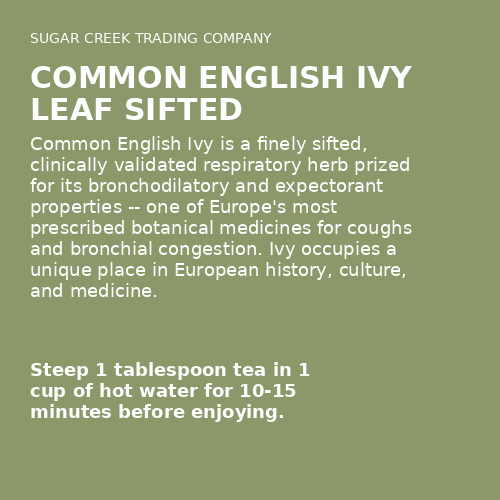
A finely sifted, clinically validated respiratory herb prized for its bronchodilatory and expectorant properties -- one of Europe's most prescribed botanical medicines for coughs and bronchial congestion.
BOTANICAL IDENTIFICATION
Scientific Name: Hedera helix L.
Common Names: Common English Ivy, English Ivy, True Ivy, European Ivy, Bindwood, Lovestone, Winter Ivy
Family: Araliaceae (Ginseng/Ivy family)
English ivy is an evergreen, woody climbing vine capable of reaching 90 feet or more when supported by trees, walls, or structures, or spreading as a dense groundcover. The familiar juvenile leaves are dark green, leathery, and palmately lobed with 3 to 5 points, while adult flowering branches produce unlobed, ovate leaves. Clusters of small greenish-yellow flowers bloom in autumn, producing dark blue-black berries that ripen in late winter.
Native to Europe, western Asia, and northern Africa, English ivy thrives in shaded woodlands and hedgerows with moist, well-drained soils. It has naturalized extensively throughout temperate North America and is one of the most widely recognized climbing plants in the world, growing in USDA hardiness zones 4 through 9.
CULTURAL AND HISTORICAL USE
Ivy occupies a unique place in European history, culture, and medicine. In ancient Greece and Rome, ivy was sacred to Dionysus (Bacchus), god of wine, and wreaths of ivy were worn at festivals as symbols of fidelity, persistence, and eternal life. The belief that ivy could counter the effects of intoxication led to the practice of carving drinking vessels from ivy wood. In Celtic and early Christian traditions, ivy represented endurance through winter and the triumph of life over darkness, making it a centerpiece of solstice and Christmas symbolism.
As a medicine, ivy leaf has been used in European herbalism for centuries to treat respiratory complaints. Folk healers throughout Germany, France, and the British Isles prepared ivy leaf teas and syrups as household remedies for chronic bronchitis, whooping cough, and asthma. Hildegard of Bingen documented ivy's healing properties in the 12th century, and it appeared regularly in European pharmacopoeias throughout the medieval and early modern periods.
Modern clinical interest in ivy leaf was spearheaded by German phytotherapy researchers in the mid-20th century, who investigated its saponin content and discovered a unique bronchodilatory mechanism. This research led to the development of standardized ivy leaf extracts that are now among the top-selling herbal respiratory medicines in Europe. Ivy leaf is officially recognized by the German Commission E, the European Pharmacopoeia, and the European Medicines Agency for the treatment of productive coughs and inflammatory bronchial conditions.
KEY BIOACTIVE COMPOUNDS & BENEFITS
| Compound/Class | Location in Plant | Human Benefit | Role in Plant |
|---|---|---|---|
| Hederacoside C (saponin glycoside) | Leaves | Primary active precursor; converted to alpha-hederin, which relaxes bronchial smooth muscle and increases surfactant production | Antifungal and anti-herbivory defense |
| Alpha-hederin (triterpene saponin) | Leaves | Bronchodilator, mucolytic, anti-inflammatory; reduces cough frequency and improves airflow | Membrane-disrupting antimicrobial defense |
| Flavonoids (rutin, kaempferol, quercetin) | Leaves | Antioxidant and anti-inflammatory; reduce airway inflammation and support vascular health | UV protection and pollinator signaling |
| Phenolic acids (chlorogenic acid, caffeic acid) | Leaves | Antioxidant, mildly antimicrobial, and anti-inflammatory | Defense against oxidative and microbial stress |
Ivy leaf's effectiveness as a respiratory remedy rests on its saponin glycosides, particularly hederacoside C and alpha-hederin. These compounds act through a pharmacologically distinct mechanism -- preventing the internalization of beta-2 adrenergic receptors on bronchial cells -- that simultaneously relaxes airway smooth muscle and stimulates surfactant production. This dual bronchodilatory and mucolytic action is what sets ivy leaf apart from most other herbal expectorants and gives it its strong clinical evidence base.
HOW IT WORKS IN THE BODY
Ivy leaf exerts its therapeutic effects primarily on the respiratory system through a well-characterized, clinically validated pharmacological pathway.
Bronchial Relaxation and Airway Opening:
Alpha-hederin inhibits the endocytic internalization of beta-2 adrenergic receptors on the surface of bronchial smooth muscle cells. By keeping more receptors active on the cell membrane, the body's own adrenaline and noradrenaline signals are amplified, resulting in measurable bronchodilation. This mechanism parallels the action of pharmaceutical beta-2 agonists, though at a gentler, more physiological level.
Mucus Thinning and Expectoration:
The saponins reduce surface tension within bronchial secretions, making mucus thinner and less viscous. Simultaneously, alpha-hederin stimulates alveolar type II epithelial cells to produce more pulmonary surfactant, which further aids mucus clearance by the lungs' natural ciliary transport system. The result is more productive, easier coughing with faster clearance of congestion.
Anti-Inflammatory and Antioxidant Support:
The flavonoid and phenolic acid fractions help calm inflamed bronchial tissue, reduce swelling in the airway walls, and protect respiratory cells from oxidative damage associated with infection and inflammation.
DOSE GUIDELINES
| Preparation Type | Typical Dose | Purpose |
|---|---|---|
| Infusion (tea) | 1-2 teaspoons sifted leaf in 8 oz hot water, steep covered 10-15 minutes; 2-3 cups daily | Productive cough, chest congestion, bronchial support |
| Tincture (1:5, 40% ethanol) | 1-2 mL (20-40 drops), 3 times daily | Acute and chronic respiratory conditions |
| Capsules (powdered leaf) | 300-800 mg sifted leaf, 2-3 times daily | Convenient bronchial support |
| Cough syrup | 5-10 mL ivy leaf syrup, 2-3 times daily | Cough relief, child-friendly preparations at reduced dose |
Ivy leaf is typically taken for 1-2 weeks during acute respiratory episodes, though it may be continued longer for chronic bronchial conditions under professional guidance. Improvements in cough frequency and mucus consistency are often noticed within 2-4 days of regular use. The sifted form is particularly well-suited for tea preparation and encapsulation, providing a smoother, more consistent product.
PREPARATION AND USES
This sifted ivy leaf is an ideal format for tea preparation, capsule-filling, and syrup-making. For a respiratory tea, steep 1 to 2 teaspoons in 8 ounces of freshly boiled water with the cup covered for 10 to 15 minutes. The tea has a mildly bitter, herbaceous flavor that pairs well with thyme, licorice root, marshmallow root, or a spoonful of honey. The sifted consistency ensures even extraction and a smoother cup compared to whole leaf.
To prepare a cough syrup, make a strong decoction by simmering 2-3 tablespoons of sifted ivy leaf in 2 cups of water for 20 minutes, strain thoroughly, and combine with an equal volume of raw honey. Store refrigerated for up to 4 weeks. The sifted leaf also works well for filling capsules at home for those who prefer a pre-measured, tasteless dose. For tincture-making, macerate in 40% alcohol for 4-6 weeks and strain. Ivy leaf is sometimes included in respiratory steam blends, though tea and tincture preparations remain the most effective internal delivery methods.
OPTIMAL CONTEXT FOR USE
Sifted English ivy leaf is especially well-suited for individuals experiencing:
Productive (wet) coughs with thick, difficult-to-expectorate mucus
Acute bronchitis, chest colds, and respiratory infections with heavy congestion
Chronic bronchial conditions including recurrent bronchitis and COPD-related cough
Mild to moderate asthmatic symptoms with chest tightness and wheezing
Pediatric coughs and respiratory complaints where a gentle, clinically studied herb is preferred
For enhanced respiratory support, combine ivy leaf with thyme herb (the ivy-thyme combination is one of the best-studied herbal pairings in European phytotherapy), marshmallow root for additional soothing action, or elderberry for immune support during infections.
SUSTAINABILITY AND ETHICAL HARVESTING
English ivy is one of the most ecologically abundant plants on the planet, with no conservation concerns of any kind. In much of North America, Australia, and New Zealand, it is classified as an invasive species that actively displaces native vegetation. Harvesting ivy leaf for medicinal use has zero negative environmental impact and may even contribute positively by reducing invasive biomass in affected ecosystems.
Our sifted ivy leaf is sourced from cultivated or sustainably managed populations. Ivy is extraordinarily vigorous, regenerating rapidly after harvesting, and a single plant can provide leaf material continuously for many decades without any reduction in health or productivity.
SAFETY AND CAUTIONS
English ivy leaf has a well-established safety profile supported by extensive clinical use in Europe, including use in children as young as 2 years of age (at appropriate doses).
Gastrointestinal sensitivity: Excessive doses may cause nausea, vomiting, or diarrhea due to the saponin content. Begin with lower doses and increase as tolerated.
Contact dermatitis: Fresh ivy plant material contains falcarinol, which can cause skin irritation in sensitive individuals. Dried leaf poses minimal risk, but handle with care if you have known sensitivity.
Pregnancy and nursing: Insufficient safety data exists for use during pregnancy and breastfeeding. Avoid or consult a healthcare professional.
Ivy berries are toxic: Only the leaves are used medicinally. Berries contain higher saponin concentrations and must never be ingested.
Drug interactions: No significant interactions are reported at normal doses, but individuals using prescription bronchodilators, corticosteroids, or asthma medications should consult their healthcare provider before adding ivy leaf.
REFERENCES
Stauss-Grabo, M., et al. (2011). "Observational Study on the Tolerability and Safety of Film-Coated Tablets Containing Ivy Leaf Dry Extract." Phytomedicine, 18(13), 1105-1109.
European Medicines Agency (EMA). (2017). "European Union Herbal Monograph on Hedera helix L., folium." Committee on Herbal Medicinal Products (HMPC).
Schaefer, A., et al. (2016). "A Randomized, Controlled, Double-Blind Clinical Trial on the Efficacy and Safety of a Fixed Combination of Thyme and Ivy Leaf." Drug Research, 66(3), 159-166.
Blumenthal, M., et al. (1998). The Complete German Commission E Monographs. American Botanical Council.
FINAL NOTE
English ivy leaf is one of the rare herbal medicines where traditional folk use and modern clinical research tell exactly the same story: this is a remarkably effective respiratory herb. Its unique pharmacological mechanism -- amplifying the body's own bronchodilatory signals while simultaneously thinning mucus -- makes it a first-choice botanical for anyone dealing with congested, tight, or chronically irritated airways. This sifted form offers maximum versatility, ready for tea-making, encapsulation, or syrup preparation, bringing centuries of European respiratory herbalism directly to your apothecary shelf.
Share