Sugar Creek Trading Company
Cota Tea, Wildcrafted
Cota Tea, Wildcrafted
Impossible de charger la disponibilité du service de retrait
THELESPERMA MEGAPOTAMICUM
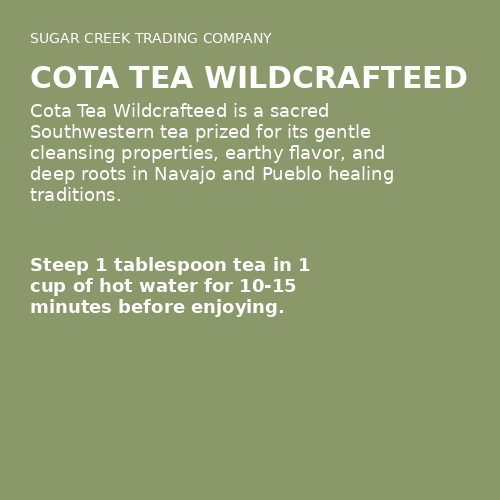
A sacred Southwestern tea prized for its gentle cleansing properties, earthy flavor, and deep roots in Navajo and Pueblo healing traditions.
BOTANICAL IDENTIFICATION
Scientific Name: Thelesperma megapotamicum (Spreng.) Kuntze
Common Names: Cota Tea, Navajo Tea, Hopi Tea, Indian Tea, Greenthread, Colorado Greenthread
Family: Asteraceae (Daisy family)
Cota is a slender, wiry perennial or biennial herb that typically grows 12 to 30 inches tall. Its stems are smooth and thread-like, branching near the top, with finely divided, almost needle-like opposite leaves. Small, daisy-like flower heads appear in summer, sometimes with yellow ray florets but often lacking them entirely, giving the plant an understated, minimalist appearance.
Native to the arid and semi-arid regions of the American Southwest, Great Plains, and northern Mexico, Cota thrives in sandy soils, dry grasslands, mesa tops, and open pinyon-juniper woodlands at elevations from 4,000 to 8,000 feet. It is drought-tolerant and well adapted to full sun and poor, well-drained soils.
CULTURAL AND HISTORICAL USE
Cota Tea holds a place of deep cultural significance among the Navajo (Dine), Hopi, Pueblo, and other Indigenous peoples of the American Southwest. For centuries, the dried stems and leaves have been brewed into a golden-amber tea consumed daily as a beverage, ceremonial drink, and gentle medicine. Among the Navajo, Cota is considered a cleansing and restorative plant, used to support digestion, ease stomach discomfort, and promote general wellness. It was commonly offered to guests as a sign of hospitality and is still served at gatherings and ceremonies today.
Pueblo peoples, including the Hopi and Zuni, have used Cota tea as a kidney and urinary tract tonic, a mild diuretic, and a remedy for colds and general malaise. The tea was also applied externally as a wash for skin irritations. Spanish colonists in New Mexico adopted the beverage from Indigenous communities, and it became a staple household tea throughout the region, sometimes called "te de cota" or simply "cota."
Unlike many medicinal herbs that are taken only when ill, Cota occupies a unique role as an everyday wellness beverage comparable to how green tea functions in East Asian cultures. Its mild, pleasant flavor, absence of caffeine, and gentle action on the body made it a practical daily drink long before the modern wellness movement rediscovered it.
KEY BIOACTIVE COMPOUNDS & BENEFITS
| Compound/Class | Location in Plant | Human Benefit | Role in Plant |
|---|---|---|---|
| Flavonoids (luteolin, apigenin derivatives) | Leaves, stems, flowers | Anti-inflammatory and antioxidant support; may help calm digestive irritation | UV protection and defense against herbivory |
| Phenolic acids | Aerial parts | Antioxidant activity; support cellular health | Antimicrobial defense and stress response |
| Tannins (mild) | Stems and leaves | Gentle astringent action on mucous membranes; supports digestive tone | Deterrent to herbivores and pathogens |
| Essential oil traces | Aerial parts | Contribute to the tea's characteristic earthy, slightly sweet aroma; mild calming effect | Pollinator attraction and pest deterrence |
Together, these compounds create a mild but synergistic profile that supports gentle detoxification, digestive ease, and antioxidant protection. The relatively low concentration of active constituents is part of what makes Cota safe and suitable as an everyday beverage rather than a potent acute remedy.
HOW IT WORKS IN THE BODY
Cota Tea operates as a gentle, broad-spectrum tonic rather than a targeted therapeutic agent, working through several complementary pathways.
Digestive Support and Comfort:
The mild tannins and flavonoids in Cota help tone the mucous membranes of the gastrointestinal tract, easing mild stomach discomfort, bloating, and irregularity. Its gentle astringency can help normalize loose stools without causing constipation, while its anti-inflammatory flavonoids soothe irritated gut tissue.
Kidney and Urinary Support:
Traditionally used as a mild diuretic, Cota encourages gentle fluid movement through the kidneys and urinary tract. This action supports the body's natural detoxification processes and may help reduce fluid retention. The phenolic compounds provide antioxidant protection to renal tissues.
Antioxidant and Anti-Inflammatory Activity:
The flavonoid content, particularly luteolin and apigenin derivatives, helps neutralize free radicals and modulate low-grade inflammatory pathways. Over time, regular consumption may contribute to reduced oxidative stress and improved overall cellular resilience.
DOSE GUIDELINES
| Preparation Type | Typical Dose | Purpose |
|---|---|---|
| Hot infusion (tea) | 1-2 tablespoons dried herb per 8 oz water, steep 10-15 minutes | Daily wellness beverage, digestive support |
| Strong decoction | 2-3 tablespoons per 12 oz water, simmer 15-20 minutes | Kidney and urinary support, stronger digestive action |
| Cold infusion (sun tea) | 2-3 tablespoons per quart of water, steep 4-8 hours in sun or at room temperature | Refreshing daily beverage, mild tonic |
Cota Tea is traditionally consumed as a daily beverage and can be enjoyed freely throughout the day. It has no caffeine and a very gentle action, making it suitable for long-term, regular use. The flavor deepens with longer steeping times and can be enhanced with honey or a squeeze of lemon.
PREPARATION AND USES
The most traditional preparation is a simple hot infusion. Place dried Cota stems and leaves in a pot or cup, pour boiling water over them, and let steep for 10 to 15 minutes. The resulting tea is a warm golden-amber color with an earthy, slightly sweet, mildly herbaceous flavor that many people find immediately appealing. For a stronger brew, simmer the herb gently in water for 15 to 20 minutes as a decoction. Cota also makes an excellent sun tea: fill a jar with water and dried herb, set it in sunlight for several hours, then strain and chill.
Beyond drinking, Cota tea has been used as a gentle skin wash for minor irritations and as a hair rinse. The tea can be combined with other Southwestern herbs like oregano de la sierra or yerba mansa for more targeted blends. It pairs well with honey, mint, or citrus peel for flavor variations.
OPTIMAL CONTEXT FOR USE
Cota Tea is especially well-suited for individuals experiencing:
Mild digestive discomfort, bloating, or irregular digestion who want a gentle daily tea rather than a strong medicinal intervention
A desire to replace caffeinated beverages with a naturally caffeine-free, flavorful herbal tea that has genuine wellness benefits
Mild fluid retention or a wish to support kidney and urinary tract health through gentle, ongoing hydration and diuretic action
Interest in traditional Indigenous American herbalism and culturally significant plant medicines of the Southwest
General wellness maintenance and antioxidant support as part of a daily routine
Cota works beautifully as a foundational daily beverage and can be combined with dietary adjustments, adequate hydration, and other gentle herbs for a holistic wellness approach.
SUSTAINABILITY AND ETHICAL HARVESTING
Cota is a wildcrafted herb, meaning it is harvested from wild populations rather than cultivated farms. This product is wildcrafted, reflecting its traditional gathering methods. In its native range across the American Southwest and Great Plains, Thelesperma megapotamicum is generally abundant and not considered threatened. However, as commercial demand increases, responsible wildcrafting practices become essential: harvesting should leave the root system intact, take no more than a small fraction of any local population, and avoid areas of cultural or ecological sensitivity.
Supporting wildcrafted Cota from ethical sources helps maintain the plant's wild populations and honors the Indigenous traditions that have sustained its use for centuries. Where possible, cultivation is encouraged to reduce pressure on wild stands, and several small farms in the Southwest have begun growing Cota commercially.
SAFETY AND CAUTIONS
Cota Tea is considered very safe and has a long history of daily consumption across multiple cultures with no significant adverse effects reported.
Individuals with known allergies to plants in the Asteraceae (daisy) family should exercise caution, as cross-reactivity is possible, particularly for those sensitive to ragweed, chamomile, or echinacea.
Due to its mild diuretic properties, those on prescription diuretics or blood pressure medications should consult a healthcare provider before adding Cota Tea to their routine.
There is insufficient safety data on Cota Tea during pregnancy and nursing. While it has been consumed traditionally by pregnant women in some communities, those who are pregnant or breastfeeding should consult a qualified healthcare professional.
REFERENCES
Dunmire, W.W. & Tierney, G.D. Wild Plants and Native Peoples of the Four Corners. Museum of New Mexico Press, 1997.
Moore, Michael. Medicinal Plants of the Mountain West. Museum of New Mexico Press, 2003.
Moerman, D.E. Native American Ethnobotany. Timber Press, 1998.
FINAL NOTE
Cota Tea is one of North America's great underappreciated herbal beverages -- a plant that has sustained Indigenous communities of the Southwest for centuries as both a daily drink and a gentle medicine. Its mild, earthy flavor, caffeine-free nature, and broad safety profile make it an ideal everyday tea for anyone seeking a grounding, nourishing alternative to conventional beverages. In a world saturated with exotic superfoods, Cota quietly reminds us that some of the most valuable plant allies grow close to home.
Share