Sugar Creek Trading Company
Devil's Claw Root
Devil's Claw Root
Impossible de charger la disponibilité du service de retrait
HARPAGOPHYTUM PROCUMBENS
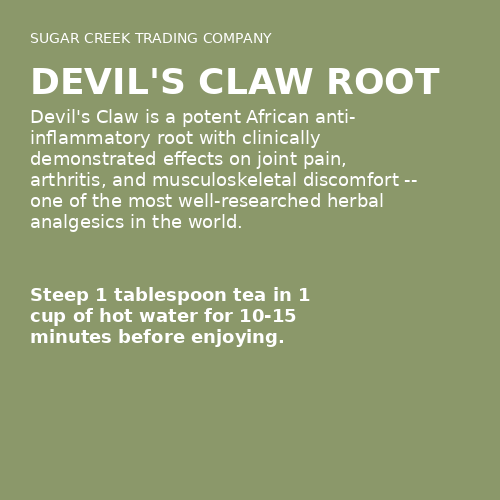
A potent African anti-inflammatory root with clinically demonstrated effects on joint pain, arthritis, and musculoskeletal discomfort -- one of the most well-researched herbal analgesics in the world.
BOTANICAL IDENTIFICATION
Scientific Name: Harpagophytum procumbens (Burch.) DC. ex Meisn.
Common Names: Devil's Claw, Grapple Plant, Wood Spider, Sengaparile (Tswana), Duiwelsklou (Afrikaans), Harpago
Family: Pedaliaceae (Sesame family)
Devil's claw is a sprawling, tuberous perennial herb native to the arid savannas and sandy soils of southern Africa. The plant produces prostrate, trailing stems that spread along the ground, bearing deeply lobed, grayish-green leaves and striking tubular flowers that range from violet to reddish-purple. The most distinctive feature is the fruit: a woody, claw-shaped capsule armed with long, curved hooks or "grapples" that attach to the hooves and fur of passing animals for seed dispersal -- and give the plant both its common and Latin names (Harpagophytum means "hook plant"). The medicinally active parts are the secondary storage tubers, thick lateral roots that branch off the primary taproot and serve as nutrient and water reserves in the plant's harsh desert habitat.
Devil's claw grows wild in the Kalahari Desert and surrounding regions of Namibia, Botswana, South Africa, Angola, Zambia, and Zimbabwe. It favors deep, sandy soils in open savanna and semi-arid grasslands, typically at elevations between 500 and 1,500 meters. The plant is drought-adapted and survives through its extensive underground tuber system, which allows it to endure prolonged dry seasons.
CULTURAL AND HISTORICAL USE
Devil's claw has been used by the San (Bushmen) and Khoi peoples of the Kalahari Desert for centuries, possibly millennia, as a treatment for pain, fever, digestive complaints, and difficult childbirth. The San traditionally prepare a decoction of the secondary tubers for rheumatic pain, back pain, and general inflammation. It is also used topically as a poultice for sores, boils, and wounds. Among the Bantu-speaking peoples of southern Africa, devil's claw is employed for blood diseases, fever, and as a bitter tonic to stimulate appetite and digestion.
European awareness of devil's claw began in the early 20th century when a German farmer named G.H. Mehnert observed its use by indigenous Namibian healers and sent samples to Germany for investigation. By the 1950s and 1960s, German and French researchers had begun pharmacological studies, and devil's claw quickly entered the European phytotherapy market. It became one of the most widely prescribed herbal remedies in Germany and France for osteoarthritis, low back pain, and musculoskeletal inflammation. The German Commission E approved its use for loss of appetite, dyspeptic complaints, and degenerative disorders of the musculoskeletal system.
Today, devil's claw is among the most extensively studied herbal anti-inflammatories in the world, with over 40 clinical trials and hundreds of pharmacological studies supporting its use. It is registered as a traditional herbal medicine by the European Medicines Agency and is included in the pharmacopeias of Germany, France, and the United Kingdom. The global demand for devil's claw, particularly from Europe, has made it the most economically important medicinal plant exported from southern Africa.
KEY BIOACTIVE COMPOUNDS & BENEFITS
| Compound/Class | Location in Plant | Human Benefit | Role in Plant |
|---|---|---|---|
| Harpagoside (iridoid glycoside) | Secondary tubers (highest concentration) | Primary anti-inflammatory and analgesic compound; inhibits COX-2 and pro-inflammatory cytokines; clinically demonstrated pain reduction | Bitter defense compound deterring herbivory |
| Harpagide and procumbide (iridoid glycosides) | Secondary tubers | Synergistic anti-inflammatory and antioxidant activity; contribute to the root's overall analgesic profile | Additional chemical defense and stress-response compounds |
| Phenylpropanoid glycosides (acteoside/verbascoside) | Secondary tubers | Potent antioxidant activity; anti-inflammatory; neuroprotective potential | UV protection and antimicrobial defense |
| Flavonoids (kaempferol, luteolin) | Tubers and aerial parts | Antioxidant protection; vascular support; complement the anti-inflammatory action of iridoids | UV screening and pollinator attraction |
| Bitter principles (various) | Tubers | Stimulate appetite and digestive secretions; support healthy gastric function | Herbivore deterrent compounds |
Devil's claw's clinical efficacy is driven primarily by harpagoside, one of the most potent naturally occurring iridoid glycosides known. However, research consistently shows that whole-root extracts outperform isolated harpagoside, indicating that the full spectrum of iridoids, phenylpropanoids, and flavonoids work synergistically to produce the plant's remarkable anti-inflammatory and analgesic effects. This is a textbook example of the herbal principle that the whole is greater than the sum of its parts.
HOW IT WORKS IN THE BODY
Devil's claw root exerts its effects primarily through multi-pathway anti-inflammatory action, with secondary benefits for digestion and antioxidant defense.
Anti-inflammatory Action (Multiple Pathways):
Harpagoside and related iridoids inhibit the arachidonic acid cascade at multiple points. They suppress cyclooxygenase-2 (COX-2) expression, reducing prostaglandin synthesis, which is the same mechanism targeted by non-steroidal anti-inflammatory drugs (NSAIDs) such as ibuprofen. Additionally, devil's claw compounds inhibit the nuclear transcription factor NF-kB, a master regulator of inflammatory gene expression, reducing the production of pro-inflammatory cytokines including TNF-alpha, IL-1-beta, and IL-6. This multi-target approach provides broad anti-inflammatory action without the single-point receptor blockade that causes the gastrointestinal side effects common to pharmaceutical NSAIDs.
Pain Modulation (Analgesic Effect):
Multiple randomized controlled trials have demonstrated that devil's claw root extract, standardized to harpagoside content, reduces pain scores in osteoarthritis and chronic low back pain comparably to conventional NSAID therapy. A landmark study by Chrubasik et al. (1999) found that devil's claw extract containing 50 mg harpagoside daily was as effective as 12.5 mg per day of rofecoxib (Vioxx) for low back pain over a 6-week period. The analgesic effect is believed to result from both the anti-inflammatory action (reducing pain-generating inflammation at the tissue level) and a possible central modulation of pain perception, though the latter mechanism requires further study.
Joint and Cartilage Protection:
In vitro research suggests that devil's claw compounds may inhibit matrix metalloproteinases (MMPs), the enzymes responsible for breaking down cartilage and connective tissue in arthritic joints. By reducing both inflammation and enzymatic cartilage destruction, devil's claw may slow the progression of degenerative joint disease, though this protective effect requires long-term clinical confirmation.
Digestive Stimulation:
The intensely bitter taste of devil's claw root stimulates appetite and digestive secretions through the bitter taste reflex. This is the plant's original medicinal use among the San people, and the German Commission E's first approved indication for devil's claw is actually for loss of appetite and dyspeptic complaints, with musculoskeletal use as a secondary indication.
DOSE GUIDELINES
| Preparation Type | Typical Dose | Purpose |
|---|---|---|
| Decoction (simmered tea) | 1-2 teaspoons dried root per cup, simmered 15-20 minutes; 2-3 cups daily | Anti-inflammatory and pain support; digestive stimulation |
| Standardized extract (capsules/tablets) | 600-1200 mg extract (standardized to 50-100 mg harpagoside daily), in divided doses | Clinically studied dose for osteoarthritis and low back pain |
| Tincture (1:5, 25% ethanol) | 1-3 mL, three times daily | Convenient liquid form for pain, inflammation, and digestive support |
| Powdered root (capsules) | 1-3 grams daily, in divided doses | Whole-root supplementation for general anti-inflammatory and digestive benefits |
Devil's claw is most effective when used consistently over a period of 4 to 12 weeks. Clinical trials typically evaluate outcomes at 4, 8, and 12 weeks, with benefits accumulating over time. It is not intended as an acute, fast-acting painkiller comparable to pharmaceutical analgesics, but rather as a sustained anti-inflammatory tonic that gradually reduces the underlying inflammatory processes driving chronic pain. Some individuals report noticeable improvement within the first 1 to 2 weeks.
PREPARATION AND USES
Devil's claw root is extremely hard and woody when dried and requires decoction (simmering) for effective extraction. Place 1 to 2 teaspoons of dried, chopped root in a pot with 2 cups of cold water, bring to a boil, then reduce heat and simmer gently for 15 to 20 minutes. Strain and drink. The tea is intensely bitter -- among the most bitter herbal teas available -- which is both a marker of its potency and its original use as a digestive bitter. The bitterness can be modulated with a small amount of honey, licorice root, or ginger, though many herbalists recommend experiencing the full bitterness for maximum digestive benefit.
For pain management, standardized extracts in capsule or tablet form are the most commonly used preparation in clinical practice, as they allow precise dosing of harpagoside and have the strongest evidence base. The tincture provides a convenient middle ground between tea and capsules. Devil's claw root combines well with other anti-inflammatory herbs such as turmeric, boswellia (frankincense), white willow bark, and meadowsweet in comprehensive joint-support formulas. For digestive applications, it pairs well with gentian root, artichoke leaf, and ginger.
OPTIMAL CONTEXT FOR USE
This herb is especially well-suited for individuals experiencing:
Osteoarthritis, particularly of the knee, hip, or spine, where chronic pain and stiffness reduce quality of life
Chronic low back pain, especially when related to degenerative changes or muscular tension with an inflammatory component
General musculoskeletal pain, tendinitis, or sports-related inflammation where a natural anti-inflammatory alternative or complement to NSAIDs is desired
Poor appetite or sluggish digestion, where a powerful bitter tonic is needed to stimulate the entire digestive cascade
A desire to reduce dependence on pharmaceutical pain medications, particularly NSAIDs, which carry risks of gastrointestinal, cardiovascular, and renal side effects with long-term use
Devil's claw works best as part of a comprehensive approach to musculoskeletal health that includes appropriate movement, stretching, anti-inflammatory nutrition, and complementary therapies such as massage or acupuncture.
SUSTAINABILITY AND ETHICAL HARVESTING
Devil's claw is a critically important sustainability concern in the herbal industry. The vast majority of commercial devil's claw is wild-harvested from the Kalahari Desert and surrounding regions, primarily in Namibia and Botswana. Harvesting involves digging up the secondary tubers while leaving the primary taproot intact to allow regeneration. When done properly, this method is sustainable and the plant recovers over 2 to 3 years. However, destructive harvesting practices -- including removal of the entire root system -- have led to population declines in some heavily harvested areas.
Devil's claw is listed under CITES Appendix II monitoring in several range countries, and Namibia has implemented a system of registered harvesting permits and export controls. Cultivation efforts are underway in southern Africa and other arid regions, though cultivated material currently represents a small fraction of the global supply. Ethical sourcing is essential: buyers should look for suppliers who work with community-based harvesting programs that provide fair compensation to indigenous harvesters and enforce sustainable collection practices. Sugar Creek Trading Company is committed to sourcing devil's claw root from suppliers who participate in responsible harvesting programs and support the livelihoods of the rural southern African communities that depend on this important resource.
SAFETY AND CAUTIONS
Devil's claw root is generally well tolerated in clinical trials, with adverse effects comparable to placebo in most studies. However, several important considerations apply.
Gastrointestinal sensitivity: The intense bitterness of devil's claw can cause nausea, stomach pain, or diarrhea in some individuals, particularly at higher doses or on an empty stomach. Starting with a lower dose and taking it with food can minimize digestive discomfort.
Gallstones and bile duct disorders: Devil's claw stimulates bile production and gallbladder contraction. It should be avoided by individuals with gallstones, bile duct obstruction, or acute gallbladder inflammation unless under professional supervision.
Peptic ulcers: Due to its stimulation of gastric acid secretion, devil's claw is traditionally contraindicated in active peptic or duodenal ulcers.
Drug interactions: Devil's claw may interact with anticoagulant and antiplatelet medications (warfarin, aspirin, clopidogrel) due to potential effects on blood clotting. It may also interact with diabetes medications (potential hypoglycemic effect), heart medications (possible effects on heart rate and blood pressure), and drugs metabolized by cytochrome P450 enzymes. Consult a healthcare provider before combining with prescription medications.
Pregnancy and nursing: Devil's claw is contraindicated during pregnancy due to traditional reports of oxytocic (uterine-stimulating) activity. It should be avoided during lactation as well, unless specifically recommended by a qualified practitioner.
REFERENCES
Chrubasik, S., et al. (1999). "Effectiveness of Harpagophytum procumbens in treatment of acute low back pain." Phytomedicine, 6(1), 1-6.
Gagnier, J.J., et al. (2004). "Harpagophytum procumbens for osteoarthritis and low back pain: A systematic review." BMC Complementary and Alternative Medicine, 4(1), 13.
Mncwangi, N., et al. (2012). "Devil's claw -- A review of the ethnobotany, phytochemistry and biological activity of Harpagophytum procumbens." Journal of Ethnopharmacology, 143(3), 755-771.
European Medicines Agency. (2016). "European Union Herbal Monograph on Harpagophytum procumbens DC. and/or Harpagophytum zeyheri Decne., radix." EMA/HMPC/627057/2015.
Grant, L., et al. (2007). "A review of the biological and potential therapeutic actions of Harpagophytum procumbens." Phytochemistry Reviews, 6(1), 199-208.
FINAL NOTE
Devil's claw root stands at the intersection of ancient indigenous knowledge and modern clinical evidence -- a rare medicinal plant whose traditional use for pain and inflammation has been validated by rigorous scientific inquiry. Its multi-pathway anti-inflammatory action offers a genuine natural alternative for the millions who live with chronic joint and back pain, and its clinical evidence base rivals or exceeds that of most herbal medicines in the world. When sourced ethically and used with respect for both its power and its origins in the Kalahari, devil's claw root is one of the most valuable tools in the herbalist's repertoire for restoring comfort, mobility, and quality of life.
Share