Sugar Creek Trading Company
Earl Grey Black Tea
Earl Grey Black Tea
Impossible de charger la disponibilité du service de retrait
CAMELLIA SINENSIS
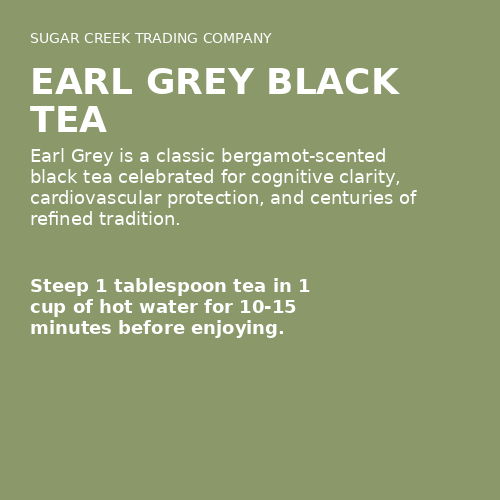
A classic bergamot-scented black tea celebrated for cognitive clarity, cardiovascular protection, and centuries of refined tradition.
BOTANICAL IDENTIFICATION
Scientific Name: Camellia sinensis (L.) Kuntze, scented with oil of Citrus bergamia Risso
Common Names: Earl Grey Tea, Bergamot Tea, Grey Tea, English Tea
Family: Theaceae (Tea family); bergamot from Rutaceae (Citrus family)
Camellia sinensis is an evergreen shrub or small tree that can reach 10 to 15 meters in the wild but is typically maintained at 1 to 1.5 meters in cultivation for ease of harvesting. It produces dark green, glossy, elliptical leaves with serrated margins, and small, fragrant white flowers with prominent yellow stamens. The young leaves and leaf buds are the primary harvest material, with flavor and chemical profile varying dramatically based on processing method, terroir, and cultivar.
Earl Grey is a flavored black tea in which fully oxidized Camellia sinensis leaves are scented or sprayed with oil extracted from the rind of the bergamot orange (Citrus bergamia), a citrus fruit cultivated almost exclusively in the Calabria region of southern Italy. The combination of robust, malty black tea with the bright, floral-citrus character of bergamot oil creates one of the most recognized and beloved tea blends in the world.
CULTURAL AND HISTORICAL USE
The origins of Earl Grey tea are steeped in legend and debate, but the blend is traditionally attributed to Charles Grey, the 2nd Earl Grey and British Prime Minister from 1830 to 1834. One popular account holds that the recipe was a gift from a Chinese mandarin in gratitude for the rescue of his son, though this story is likely apocryphal. What is certain is that by the mid-19th century, bergamot-flavored black tea had become a fixture of British aristocratic tea culture, and by the early 20th century it had spread to become one of the most popular tea blends worldwide.
The tea plant itself, Camellia sinensis, has a history of use stretching back nearly 5,000 years in China, where it was first consumed as a medicinal beverage before evolving into one of the world's great cultural traditions. In Traditional Chinese Medicine, tea is classified as bitter and cooling, used to clear heat, resolve dampness, aid digestion, and sharpen the mind. The addition of bergamot oil brings its own medicinal lineage: in Italian folk medicine, bergamot has been used for centuries to calm the nerves, support digestion, and treat fevers. Bergamot essential oil became a defining ingredient in Eau de Cologne and remains a cornerstone of European aromatherapy.
In modern practice, Earl Grey occupies a unique space as both a daily pleasure beverage and a genuinely bioactive functional tea. Its combination of black tea polyphenols, L-theanine, caffeine, and bergamot-derived compounds offers a layered pharmacological profile that supports cognitive performance, cardiovascular health, and mood stability, making it far more than just an elegant cup of tea.
KEY BIOACTIVE COMPOUNDS & BENEFITS
| Compound/Class | Location in Plant | Human Benefit | Role in Plant |
|---|---|---|---|
| Theaflavins and thearubigins | Formed during oxidation of tea leaves | Cardiovascular protection, LDL cholesterol reduction, antioxidant activity | Oxidation products of catechins; contribute to black tea's color and astringency |
| L-Theanine | Tea leaves (especially young leaves) | Promotes calm focus, reduces anxiety, modulates alpha brain wave activity | Amino acid unique to Camellia sinensis; involved in nitrogen metabolism and stress tolerance |
| Caffeine (theine) | Tea leaves and buds | Central nervous system stimulation, enhanced alertness, improved physical performance | Insecticidal defense compound; deters herbivorous insects |
| Bergamot polyphenols (bergamottin, neoeriocitrin, naringin, neohesperidin) | Bergamot rind oil | Lipid-lowering effects, blood sugar regulation, anti-inflammatory and neuroprotective activity | UV protection and antimicrobial defense in citrus rind |
| Linalool and linalyl acetate (from bergamot oil) | Bergamot essential oil | Anxiolytic and calming effects via olfactory and systemic pathways | Volatile terpenes that attract pollinators and deter pests |
The distinctive value of Earl Grey lies in the synergy between black tea and bergamot compounds. While black tea alone delivers significant cardiovascular and cognitive benefits through its polyphenols and L-theanine-caffeine interplay, the addition of bergamot oil introduces a complementary set of citrus flavonoids with documented lipid-modulating and mood-stabilizing properties. This makes Earl Grey functionally richer than either component alone.
HOW IT WORKS IN THE BODY
Earl Grey tea delivers its effects through multiple converging pathways, blending the neurostimulatory and cardioprotective actions of black tea with the metabolic and anxiolytic contributions of bergamot.
Cognitive Performance and Mood:
The combination of L-theanine and caffeine in black tea is one of the most well-studied natural nootropic pairings. Caffeine blocks adenosine receptors to increase alertness, while L-theanine promotes alpha brain wave production and modulates GABA, serotonin, and dopamine pathways. The result is a state of calm, focused attention without the jittery overstimulation associated with coffee. Bergamot's linalool further supports this effect through anxiolytic activity, reducing cortisol response and promoting parasympathetic nervous system tone.
Cardiovascular and Lipid Health:
Theaflavins in black tea have been shown to inhibit cholesterol absorption in the intestine and reduce LDL oxidation, a key step in atherosclerotic plaque formation. Bergamot polyphenols, particularly the flavanone glycosides naringin and neohesperidin, have demonstrated statin-like activity in clinical studies, inhibiting HMG-CoA reductase and reducing circulating triglycerides and LDL cholesterol while increasing HDL levels. This dual action makes Earl Grey a particularly heart-friendly daily beverage.
Metabolic and Blood Sugar Regulation:
Both black tea polyphenols and bergamot flavonoids independently support healthy blood glucose management. Black tea improves insulin sensitivity and slows carbohydrate absorption through alpha-amylase and alpha-glucosidase inhibition. Bergamot polyphenols activate AMPK (adenosine monophosphate-activated protein kinase), a master metabolic regulator that enhances glucose uptake and fatty acid oxidation.
Digestive Support:
Black tea tannins (thearubigins) have a mild astringent, tonifying effect on the gastrointestinal mucosa, while bergamot oil has traditionally been used as a carminative to ease bloating, gas, and digestive discomfort. Together, they support efficient digestion, particularly after meals.
DOSE GUIDELINES
| Preparation Type | Typical Dose | Purpose |
|---|---|---|
| Hot infusion (loose leaf) | 2-3 g steeped in 240 mL (8 oz) water at 95-100°C for 3-5 minutes | Standard daily beverage for cognitive and cardiovascular support |
| Multiple daily cups | 2-4 cups per day | Sustained cognitive focus, cumulative cardiovascular benefits |
| Cold brew | 4-5 g steeped in 500 mL cold water for 8-12 hours (refrigerated) | Smoother, lower-tannin preparation with retained polyphenol content |
| Concentrated brew for cooking | 6-8 g per 240 mL, steeped 5-7 minutes | Use as a base for Earl Grey lattes, baking, or syrups |
Earl Grey is well-suited for daily use, with most research supporting 3 to 4 cups per day as an optimal range for cardiovascular and cognitive benefits. Because it contains caffeine (typically 40-70 mg per cup), sensitive individuals may wish to limit afternoon and evening consumption. The bergamot component is present in small but bioactive amounts in a standard cup, with cumulative benefits emerging from regular daily intake rather than single large doses.
PREPARATION AND USES
For the best cup, use freshly boiled water that has been allowed to cool for 30 seconds to about 95 degrees Celsius. Steep 2 to 3 grams of loose-leaf Earl Grey (roughly one heaping teaspoon) for 3 to 5 minutes, adjusting steeping time to taste. Shorter steeps yield a lighter, more bergamot-forward cup, while longer steeps bring out deeper malty and tannic notes from the black tea base. Earl Grey takes well to a splash of milk, which softens the tannins, or a thin slice of lemon, which brightens the citrus character. A touch of honey or raw sugar complements the floral bergamot without overpowering it.
Beyond the teacup, Earl Grey is remarkably versatile in the kitchen. It can be used to infuse cream for Earl Grey panna cotta, custard, or ice cream. The tea makes an elegant poaching liquid for pears or stone fruit. Earl Grey simple syrup (strong brew reduced with sugar) adds sophisticated citrus-floral notes to cocktails, sparkling water, and lemonade. Cold-brewed Earl Grey produces a smooth, less astringent concentrate ideal for iced tea or as a base for tea lattes with frothed milk and a drizzle of vanilla or lavender honey.
OPTIMAL CONTEXT FOR USE
Earl Grey black tea is especially well-suited for individuals experiencing:
The need for sustained mental focus and productivity without the anxiety or crash associated with high-caffeine beverages
Cardiovascular risk factors including elevated LDL cholesterol, triglycerides, or borderline blood pressure concerns
Metabolic sluggishness or blood sugar instability where gentle daily support through dietary polyphenols is appropriate
Afternoon energy dips or mild mood fluctuations that benefit from L-theanine's calming, focus-enhancing properties
A desire to transition from coffee to a more balanced stimulant with fewer side effects and a gentler adrenal impact
Earl Grey fits naturally into a balanced daily wellness routine. It pairs beautifully with mindful morning rituals, focused work sessions, or as a calming afternoon interlude. For enhanced cardiovascular benefit, consistent daily intake over weeks and months is more effective than occasional use.
SUSTAINABILITY AND ETHICAL HARVESTING
Tea cultivation is one of the world's most extensive agricultural systems, employing millions of workers across Asia and Africa. Sustainability concerns in the tea industry center on fair labor practices, pesticide use, soil degradation from monoculture, and deforestation for new plantations. Certified organic, Rainforest Alliance, and Fair Trade sourcing standards help address these issues by promoting shade-grown cultivation, chemical-free farming, and equitable wages.
Bergamot production is concentrated in a small geographic area of Calabria, Italy, where the unique microclimate produces the world's highest-quality bergamot oil. This regional specificity creates both a strength (terroir-driven quality) and a vulnerability (climate sensitivity, limited production area). Sustainable bergamot farming involves traditional grove management, hand harvesting, and cold-press extraction of the essential oil. Sugar Creek Trading Company sources Earl Grey tea with attention to leaf quality, natural bergamot oil flavoring (rather than synthetic additives), and responsible supply chain practices.
SAFETY AND CAUTIONS
Earl Grey is generally considered safe for daily consumption by adults and has a centuries-long history as one of the world's most popular beverages.
Caffeine content (approximately 40-70 mg per cup) may cause insomnia, restlessness, or increased heart rate in caffeine-sensitive individuals. Pregnant and nursing women are generally advised to limit caffeine intake to 200 mg per day or less.
Bergamot oil contains bergamottin, a furanocoumarin that can inhibit cytochrome P450 3A4 enzymes. While the amount in a cup of tea is small, individuals taking medications metabolized by CYP3A4 (statins, calcium channel blockers, certain immunosuppressants) should be aware of potential interactions with very high consumption.
Excessive consumption (more than 6-8 cups daily over prolonged periods) has been associated in rare case reports with muscle cramps, likely due to bergamot oil's effect on potassium channels. This is extremely uncommon at normal intake levels.
Tea tannins can reduce iron absorption from plant-based foods. Individuals with iron-deficiency anemia may wish to drink tea between meals rather than with meals to minimize this effect.
REFERENCES
Mollace, V., Sacco, I., Janda, E., et al. "Hypolipemic and Hypoglycaemic Activity of Bergamot Polyphenols: From Animal Models to Human Studies." Fitoterapia, 2011; 82(3): 309-316.
Nobre, A.C., Rao, A., & Owen, G.N. "L-Theanine, a Natural Constituent in Tea, and Its Effect on Mental State." Asia Pacific Journal of Clinical Nutrition, 2008; 17(S1): 167-168.
Huxley, R.R., & Neil, H.A.W. "The Relation Between Dietary Flavonol Intake and Coronary Heart Disease Mortality: A Meta-Analysis of Prospective Cohort Studies." European Journal of Clinical Nutrition, 2003; 57(8): 904-908.
Navarra, M., Mannucci, C., Delbò, M., & Calapai, G. "Citrus bergamia Essential Oil: From Basic Research to Clinical Application." Frontiers in Pharmacology, 2015; 6: 36.
FINAL NOTE
Earl Grey is a testament to the idea that a daily ritual can also be a daily medicine. The marriage of robust black tea polyphenols with bergamot's unique citrus flavonoids creates a beverage that supports heart health, sharpens the mind, and steadies the mood, all while delivering one of the most elegant and satisfying flavor profiles in the world of tea. For those who believe that wellness should also be a pleasure, Earl Grey makes the case effortlessly.
Share