Sugar Creek Trading Company
Galangal Root
Galangal Root
Impossible de charger la disponibilité du service de retrait
ALPINIA GALANGA
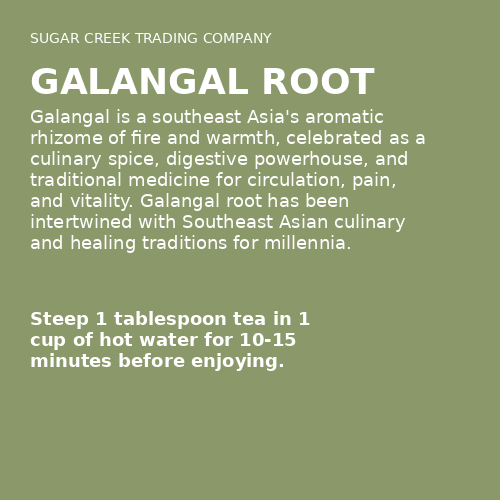
Southeast Asia's aromatic rhizome of fire and warmth, celebrated as a culinary spice, digestive powerhouse, and traditional medicine for circulation, pain, and vitality.
BOTANICAL IDENTIFICATION
Scientific Name: Alpinia galanga (L.) Willd.
Common Names: Greater Galangal, Galangal Root, Thai Galangal, Kha (Thai), Laos Root, Blue Ginger, Siamese Ginger, Lengkuas (Malay/Indonesian), Kulanjan (Hindi)
Family: Zingiberaceae (Ginger family)
Alpinia galanga is a robust, rhizomatous perennial herb that grows 1.5 to 2.5 meters tall, forming dense clumps of erect, cane-like stems sheathed in long, lance-shaped, dark green leaves that can reach 30 to 60 cm in length. The plant produces terminal racemes of striking greenish-white flowers with dark red veining on the lip, followed by round, orange-red capsular fruits. The prized rhizome is thick, knotty, and cylindrical with a pale yellowish to reddish-brown exterior and a dense, fibrous, cream-colored interior marked by distinctive concentric rings when sliced.
Native to the tropical forests and lowlands of Indonesia, particularly Java, and widely distributed across Southeast Asia including Thailand, Malaysia, Vietnam, Cambodia, and southern China, galangal thrives in warm, humid, tropical climates with well-drained, humus-rich soils and partial shade to full sun. It is extensively cultivated throughout Southeast Asia as both a culinary and medicinal crop, with Indonesia and Thailand being the primary commercial producers.
CULTURAL AND HISTORICAL USE
Galangal root has been intertwined with Southeast Asian culinary and healing traditions for millennia. In Thai cuisine, it is one of the essential aromatics of the kitchen, indispensable in soups like Tom Kha Gai (coconut chicken soup) and Tom Yum, in curry pastes, and in countless stir-fries and marinades. In Indonesian cuisine, lengkuas is fundamental to rendang, soto, and a vast array of sambals and spice pastes. Unlike ginger, which it superficially resembles, galangal has a sharper, more resinous, almost piney-citrus character with a distinct peppery bite that sets it apart in the flavor profile of Southeast Asian cooking.
Medicinally, galangal holds a venerable place in multiple Asian healing systems. In Ayurveda, Kulanjan is classified as a warming, pungent herb that kindles Agni (digestive fire), reduces Kapha and Vata doshas, and is prescribed for indigestion, nausea, respiratory congestion, and rheumatic pain. In Traditional Chinese Medicine, Gao Liang Jiang (lesser galangal, Alpinia officinarum, which is closely related) warms the Middle Jiao, dispels Cold, and stops pain, particularly for stomach cold with vomiting and hiccups. In the Unani medical system, Khulanjan is used as an aphrodisiac, digestive aid, and remedy for oral diseases.
Galangal's reach extended far beyond Asia along medieval trade routes. The German abbess and mystic Hildegard von Bingen (1098-1179) championed galangal as "the spice of life," prescribing it for heart conditions, digestive ailments, and foul breath, making it one of the few Asian spices to receive detailed attention in medieval European herbal medicine. Arab traders brought galangal to the Mediterranean world, where it became a valued ingredient in medieval European cookery and apothecary practice before gradually falling from Western use as other spices became more available. Its continued importance in Southeast Asian cuisine and medicine represents an unbroken tradition stretching back thousands of years.
KEY BIOACTIVE COMPOUNDS & BENEFITS
| Compound/Class | Location in Plant | Human Benefit | Role in Plant |
|---|---|---|---|
| 1'-Acetoxychavicol acetate (ACA) | Rhizome | Potent anti-inflammatory, anticancer research interest, antimicrobial, antifungal | Phenylpropanoid defense compound against pathogens and herbivores |
| Galangin (flavonol) | Rhizome | Antioxidant, anti-inflammatory, antimicrobial, hepatoprotective | UV protection and pathogen defense |
| Essential oils (1,8-cineole/eucalyptol, alpha-pinene, beta-pinene, camphor, eugenol) | Rhizome and leaves | Digestive stimulant, carminative, respiratory decongestant, analgesic | Volatile deterrents against herbivores and insects |
| Gingerols and galanolactone | Rhizome | Anti-nausea (5-HT3 receptor antagonism), warming circulatory stimulation | Pungent defense compounds shared with the ginger family |
| Diarylheptanoids | Rhizome | Antioxidant, anti-inflammatory, hepatoprotective activity | Phenolic defense metabolites |
Galangal's phytochemical profile is dominated by 1'-acetoxychavicol acetate (ACA), a unique phenylpropanoid that distinguishes it from ginger and turmeric and accounts for much of its distinctive sharp, camphoraceous flavor and its potent bioactivity. Galangin, the signature flavonol, provides broad-spectrum antioxidant and antimicrobial protection. The rich essential oil complement, featuring eucalyptol and pinene alongside warming compounds like eugenol, creates the aromatic complexity prized in cooking and the digestive and respiratory benefits valued in traditional medicine. Together, these compounds produce a warming, stimulating, antimicrobial, and anti-inflammatory botanical profile.
HOW IT WORKS IN THE BODY
Galangal acts primarily as a warming stimulant and anti-inflammatory agent, with its effects concentrated in the digestive, circulatory, and immune systems.
Digestive Stimulation and Carminative Action:
Galangal's pungent compounds and essential oils stimulate the production of saliva, gastric acid, and bile, promoting more efficient digestion and nutrient absorption. Its carminative properties help relax smooth muscle in the gastrointestinal tract, relieving gas, bloating, and cramping. The 5-HT3 receptor antagonism of galanolactone provides an anti-nausea mechanism similar to that of ginger, making galangal relevant for motion sickness and general nausea. In Ayurvedic terms, it powerfully kindles Agni, the digestive fire, making it a choice herb for cold, sluggish digestion.
Anti-Inflammatory and Analgesic Activity:
ACA inhibits NF-kB activation and suppresses the expression of pro-inflammatory enzymes COX-2 and iNOS, reducing inflammation through the same master regulatory pathway targeted by many pharmaceutical anti-inflammatories. Galangin complements this by scavenging reactive oxygen species and inhibiting the release of inflammatory mediators from immune cells. Together, these compounds provide a dual anti-inflammatory mechanism, addressing both the signaling and oxidative components of chronic inflammation. Traditional use for joint pain, muscle aches, and headache aligns with these pharmacological findings.
Circulatory Warming and Vitality:
As a warming aromatic spice, galangal stimulates peripheral circulation, promotes blood flow to extremities, and generates a sensation of internal warmth. This makes it particularly valuable in cold climates or for individuals with constitutionally cold patterns. The circulatory stimulation also enhances the delivery of other herbs and nutrients when galangal is used in formulas, a principle recognized in both Ayurvedic and TCM compounding.
Antimicrobial and Immune Support:
ACA and galangin have demonstrated broad-spectrum antimicrobial activity against bacteria (including MRSA strains in vitro), fungi (particularly Candida species), and certain parasites. These properties support galangal's traditional use for food preservation, oral hygiene, and resistance to gastrointestinal infections. The immune-supportive action extends beyond direct antimicrobial effects to include modulation of macrophage and natural killer cell activity.
DOSE GUIDELINES
| Preparation Type | Typical Dose | Purpose |
|---|---|---|
| Decoction (dried rhizome slices) | 3-9 g simmered for 15-25 minutes | Digestive warming, anti-inflammatory, and circulatory support |
| Powdered rhizome | 1-3 g daily, in capsules, warm water, or food | Daily digestive tonic and general warming spice |
| Tincture (1:5, 60% ethanol) | 2-4 mL, 2-3 times daily | Concentrated extract for digestive and anti-inflammatory support |
| Culinary use | 5-15 g fresh equivalent in cooking | Food-as-medicine integration for daily warming and digestive benefit |
Galangal can be used both acutely, for immediate digestive relief or warming, and as a longer-term tonic for circulatory and inflammatory support. Its warming nature makes it best suited for individuals with cold constitutions or conditions characterized by cold stagnation. Those with excess heat patterns, acid reflux, or inflammatory gastritis should use it in moderation. As with all warming spices, starting with a lower dose and adjusting based on individual response is advisable.
PREPARATION AND USES
Dried galangal root can be simmered as a decoction for a pungent, warming tea with a complex, spicy-citrus-piney flavor that is more resinous and sharper than ginger tea. The dried slices are also excellent added to soup stocks, broths, and curries, where they infuse liquid with their characteristic flavor over long cooking times. In Thai and Indonesian cooking, dried galangal is a standard pantry ingredient used when fresh rhizome is unavailable, and it is essential for authentic curry paste preparation.
Powdered galangal root can be encapsulated for therapeutic use, blended into golden milk and chai-style beverages, mixed into smoothies, or used as a culinary spice in rubs, marinades, and spice blends. It pairs exceptionally well with coconut milk, lemongrass, lime, chili, and turmeric. For topical application, galangal-infused oil (made by steeping crushed dried root in warm carrier oil) is traditionally used for massaging sore joints and muscles, particularly in Thai traditional massage practice. A galangal mouth rinse, made by steeping the root in warm water, is a traditional remedy for oral infections and bad breath. The root can also be tinctured in high-proof alcohol for a potent, shelf-stable extract.
OPTIMAL CONTEXT FOR USE
Galangal root is especially well-suited for individuals experiencing:
Sluggish digestion, poor appetite, bloating, nausea, or a pattern of cold, weak digestive function
Poor peripheral circulation, cold hands and feet, or a constitutionally cold constitution seeking warming support
Chronic joint or muscle pain, particularly when worsened by cold and damp conditions
Frequent mild infections or desire for daily antimicrobial and immune-supportive dietary supplementation
Interest in authentic Southeast Asian culinary traditions and food-as-medicine approaches to daily health
Galangal combines beautifully with other warming, anti-inflammatory botanicals. In culinary medicine, it is naturally paired with Turmeric, Ginger, Lemongrass, and Black Pepper. In Ayurvedic practice, it complements other Agni-kindling herbs like Long Pepper (Pippali), Cinnamon, and Cardamom. In TCM, it is traditionally paired with other Middle Jiao warmers.
SUSTAINABILITY AND ETHICAL HARVESTING
Greater galangal (Alpinia galanga) is an extensively cultivated crop throughout Southeast Asia, with Indonesia and Thailand as the major producers. As a tropical rhizomatous perennial, it is propagated vegetatively by dividing rhizome segments, grows rapidly in tropical conditions, and can be harvested repeatedly from established plantings. This makes it one of the more sustainably produced tropical spice crops, with minimal wild harvesting pressure on natural populations.
The plant's adaptability to a range of tropical growing conditions, including agroforestry systems where it can be grown under the canopy of fruit and timber trees, further supports its sustainability. Galangal cultivation provides important income for smallholder farmers across Southeast Asia, and fair-trade sourcing supports these communities. Sugar Creek Trading Company sources galangal root with attention to quality, authenticity, and responsible supply chain practices that support the farming communities who cultivate this ancient spice.
SAFETY AND CAUTIONS
Galangal root has a long history of safe culinary and medicinal use and is generally well-tolerated at standard doses.
Due to its strongly warming nature, galangal may aggravate conditions characterized by excess heat, including acid reflux, gastric ulcers, and hot-type inflammatory conditions. Individuals with these concerns should use galangal in moderation or under practitioner guidance.
May enhance the effects of blood-thinning medications due to mild antiplatelet activity. Consult a healthcare provider if taking anticoagulants (warfarin, heparin) or antiplatelet drugs.
Pregnant individuals should use galangal in culinary amounts only and consult a healthcare provider before using therapeutic doses. While it has a long history of culinary use during pregnancy in Southeast Asia, concentrated supplemental doses have not been adequately studied.
Individuals with allergies to ginger or other Zingiberaceae family members should exercise caution, as cross-reactivity is possible.
High doses may cause mild gastrointestinal irritation in sensitive individuals. Start with lower doses and increase as tolerated.
REFERENCES
Matsuda, H., Pongpiriyadacha, Y., Morikawa, T., et al. "Protective Effects of Phenylpropanoids and Terpenoids from Alpinia galanga on Ethanol-Induced Gastric Mucosal Lesions." Bioorganic & Medicinal Chemistry, 2003; 11(5): 709-715.
Oonmetta-aree, J., Suzuki, T., Gasaluck, P., & Eumkeb, G. "Antimicrobial Properties and Action of Galangal (Alpinia galanga Linn.) on Staphylococcus aureus." LWT - Food Science and Technology, 2006; 39(10): 1214-1220.
Chouni, A., & Paul, S. "A Review on Phytochemical and Pharmacological Potential of Alpinia galanga." Pharmacognosy Journal, 2018; 10(1): 09-15.
Bensky, D., Clavey, S., & Stoger, E. Chinese Herbal Medicine: Materia Medica, 3rd Ed. Eastland Press, 2004.
FINAL NOTE
Galangal root is a masterful example of the inseparability of food and medicine in Southeast Asian tradition. Where ginger offers gentle warmth, galangal brings a sharper, more penetrating fire, a spice that cuts through cold stagnation in the body as decisively as it transforms a simple coconut broth into something extraordinary. Its unique phytochemistry, anchored by the potent compound ACA, gives it an anti-inflammatory and antimicrobial profile distinct from its more famous Zingiberaceae relatives. For those seeking a warming, stimulating botanical that bridges the kitchen and the apothecary, galangal root is an essential and deeply satisfying ally.
Share