Sugar Creek Trading Company
Horehound Herb
Horehound Herb
Impossible de charger la disponibilité du service de retrait
MARRUBIUM VULGARE
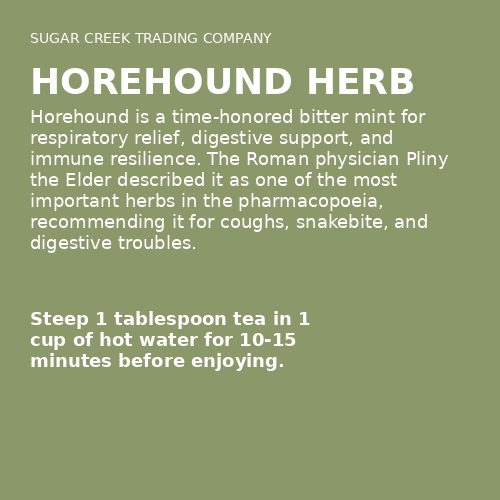
A time-honored bitter mint for respiratory relief, digestive support, and immune resilience.
BOTANICAL IDENTIFICATION
Scientific Name: Marrubium vulgare L.
Common Names: Horehound, White Horehound, Common Horehound, Marrube Blanc, Houndsbane
Family: Lamiaceae (Mint family)
Horehound is a perennial herbaceous plant growing 30 to 60 cm tall, with square, woolly stems characteristic of the mint family. Its leaves are opposite, round to ovate, deeply wrinkled with a crinkled texture, and covered in dense white hairs that give the plant a distinctive silvery-green appearance. Small white flowers form in dense whorls at the leaf axils, each bearing a hooked calyx that readily attaches to fur and clothing for seed dispersal.
Native to Europe, North Africa, and western Asia, horehound has naturalized across much of North and South America, Australia, and temperate regions worldwide. It thrives in dry, disturbed soils, roadsides, pastures, and waste ground, tolerating poor conditions and full sun with remarkable tenacity.
CULTURAL AND HISTORICAL USE
Horehound is one of the oldest recorded medicinal plants in Western herbalism, with references stretching back to ancient Egypt, where it was called "Seed of Horus" and used as a remedy for respiratory ailments and poison antidote. The Roman physician Pliny the Elder described it as one of the most important herbs in the pharmacopoeia, recommending it for coughs, snakebite, and digestive troubles. In Jewish tradition, horehound is considered by many scholars to be one of the five bitter herbs eaten during Passover.
Throughout medieval Europe, horehound was a staple of monastery gardens and folk medicine cabinets. It was widely prepared as a syrup, tea, or lozenge for coughs, bronchitis, and sore throats. Horehound candy became a beloved confection in England and colonial America, a tradition that persists in parts of the American South and Appalachia to this day. Early American settlers carried horehound westward as one of their essential medicinal herbs.
In European folk medicine, horehound was also valued as a bitter digestive tonic, a febrifuge, and a vermifuge. It appeared in the United States Pharmacopoeia from 1820 through 1900 and remained in the National Formulary until 1960. The German Commission E approved horehound for loss of appetite and dyspeptic complaints, and the European Medicines Agency recognizes its traditional use for coughs and colds.
KEY BIOACTIVE COMPOUNDS & BENEFITS
| Compound/Class | Location in Plant | Human Benefit | Role in Plant |
|---|---|---|---|
| Marrubiin (diterpene lactone) | Leaves and flowering tops | Expectorant, choleretic, and bitter digestive stimulant; the primary active constituent responsible for respiratory and digestive effects | Herbivore deterrent due to intensely bitter taste |
| Marrubenol (diterpene) | Aerial parts | Supports cardiovascular function; may help normalize heart rhythm and blood pressure | Secondary metabolite for chemical defense |
| Flavonoids (apigenin, luteolin, quercetin) | Leaves and stems | Anti-inflammatory, antioxidant, and mild antispasmodic properties | UV protection and pollinator attraction |
| Phenolic acids (caffeic acid, chlorogenic acid) | Leaves | Antioxidant support, free radical scavenging, hepatoprotective activity | Pathogen resistance and structural integrity |
| Volatile oils and tannins | Leaves and stems | Mild antimicrobial activity; astringent action soothes irritated mucous membranes | Antimicrobial defense and tissue protection |
Together, these compounds make horehound a multifaceted herb that bridges the respiratory and digestive systems. Marrubiin is the standout compound, delivering both the intensely bitter flavor that stimulates digestive secretions and the expectorant action that loosens mucus in the airways. The flavonoids and phenolic acids add a layer of antioxidant and anti-inflammatory protection that complements the primary actions.
HOW IT WORKS IN THE BODY
Horehound acts primarily through two interconnected pathways: stimulating secretory activity in the respiratory tract and activating bitter receptors throughout the digestive system.
Respiratory Support and Expectorant Action:
Marrubiin stimulates the secretion of thin, watery mucus in the bronchial passages, making it easier to expel thick, congested phlegm. This reflex expectorant mechanism works partly through irritation of the gastric mucosa, which triggers a vagal reflex that increases bronchial secretion. The result is productive coughing that clears the airways rather than the dry, unproductive coughing that accompanies many upper respiratory infections.
Digestive Stimulation and Bile Flow:
As one of the most intensely bitter herbs in the Western materia medica, horehound powerfully activates bitter taste receptors on the tongue and throughout the gastrointestinal tract. This triggers a cascade of digestive secretions including saliva, gastric acid, bile, and pancreatic enzymes. The choleretic effect (increased bile production and flow) supports fat digestion and gentle liver detoxification.
Anti-inflammatory and Antioxidant Activity:
The flavonoid and phenolic acid content provides systemic antioxidant protection, reducing oxidative stress in inflamed tissues. Apigenin and luteolin modulate inflammatory pathways, helping to calm irritated mucous membranes in both the respiratory and digestive tracts.
DOSE GUIDELINES
| Preparation Type | Typical Dose | Purpose |
|---|---|---|
| Herbal tea (infusion) | 1-2 teaspoons dried herb per cup, steep 10-15 minutes, 3 times daily | Coughs, congestion, digestive support |
| Tincture (1:5, 45% ethanol) | 2-4 mL, 3 times daily | Concentrated respiratory and digestive support |
| Syrup | 1-2 tablespoons as needed | Cough relief, especially for children (over 4 years) and those sensitive to bitterness |
| Capsules (powdered herb) | 400-600 mg, 2-3 times daily | General bitter tonic and respiratory support without the taste |
Horehound is best used at the onset of respiratory symptoms and continued for the duration of the illness. For digestive support, take 15-30 minutes before meals to stimulate secretions. Due to its intense bitterness, many people prefer it sweetened in syrups or taken in capsule form, though herbalists note that the bitter taste itself is part of the therapeutic mechanism for digestive applications.
PREPARATION AND USES
The most traditional preparation is a simple infusion: pour boiling water over 1-2 teaspoons of dried horehound herb, cover, and steep for 10-15 minutes. Strain and sweeten with honey if desired. For a horehound cough syrup, make a strong decoction by simmering a generous handful of the herb in two cups of water for 20 minutes, strain, and dissolve an equal volume of honey into the warm liquid. This syrup keeps refrigerated for several weeks and provides soothing relief for coughs and sore throats.
Horehound candy is made by cooking the strong tea down with sugar to the hard crack stage, then pouring into molds. Tinctures are prepared by macerating the dried herb in 45% alcohol for 4-6 weeks. Horehound also combines well with other respiratory herbs such as elecampane, thyme, mullein, and marshmallow root in tea blends. For digestive use, it pairs effectively with chamomile, peppermint, or gentian in bitter formulas.
OPTIMAL CONTEXT FOR USE
Horehound is especially well-suited for individuals experiencing:
Productive or congested coughs with thick, stubborn mucus that is difficult to expel
Upper respiratory infections, bronchitis, and seasonal colds with chest congestion
Poor appetite, sluggish digestion, bloating, or insufficient bile flow
Chronic low-grade respiratory issues in smokers or those exposed to environmental irritants
A need for a reliable, gentle bitter tonic to support overall digestive function
Horehound works well as part of a broader respiratory or digestive protocol and combines effectively with demulcent herbs like marshmallow root to balance its drying action, or with warming herbs like ginger to enhance circulation to congested tissues.
SUSTAINABILITY AND ETHICAL HARVESTING
Horehound is an abundant, easily cultivated plant with no conservation concerns. It is considered an invasive weed in many parts of the world, including Australia and parts of the western United States, where it colonizes disturbed land and overgrazed pastures. The commercial supply is primarily cultivated or harvested from naturalized populations, making it one of the most sustainably available medicinal herbs.
Home cultivation is straightforward: horehound grows readily from seed or root division in poor to average, well-drained soil and full sun. It is drought-tolerant once established and requires little care. Harvesting the aerial parts during early flowering preserves the highest concentration of marrubiin.
SAFETY AND CAUTIONS
Horehound is generally considered safe when used in traditional doses and has a long history of food and medicinal use without significant adverse effects.
Individuals with active peptic ulcers or gastroesophageal reflux should use caution, as the bitter stimulation of gastric acid may aggravate these conditions.
Horehound may interact with antihypertensive medications, antiarrhythmic drugs, and diabetes medications due to its potential effects on blood pressure, heart rhythm, and blood sugar levels.
Pregnant women should avoid horehound in medicinal doses, as it has traditional use as an emmenagogue and uterine stimulant. Occasional use in food-level amounts (such as horehound candy) is generally not a concern.
Large doses may cause nausea, vomiting, or diarrhea due to the strong bitter action. Start with lower doses and increase as tolerated.
REFERENCES
European Medicines Agency. (2013). Assessment report on Marrubium vulgare L., herba. EMA/HMPC/604272/2012.
Blumenthal, M., et al. (1998). The Complete German Commission E Monographs: Therapeutic Guide to Herbal Medicines. American Botanical Council.
Lodhi, S., et al. (2017). "Marrubium vulgare L.: A phytochemical and pharmacological overview." Journal of Intercultural Ethnopharmacology, 6(4), 429-452.
FINAL NOTE
Horehound is a humble but remarkably effective herb that has earned its place in the medicine chest for millennia. Where modern cough remedies often suppress the cough reflex, horehound works with the body's natural mechanisms to clear congestion and restore comfortable breathing. Its dual affinity for the lungs and the gut makes it a versatile ally during cold season and beyond, embodying the kind of straightforward, no-nonsense healing that defines the best of traditional Western herbalism.
Share