Sugar Creek Trading Company
Horny Goat Weed
Horny Goat Weed
Impossible de charger la disponibilité du service de retrait
EPIMEDIUM SPP.
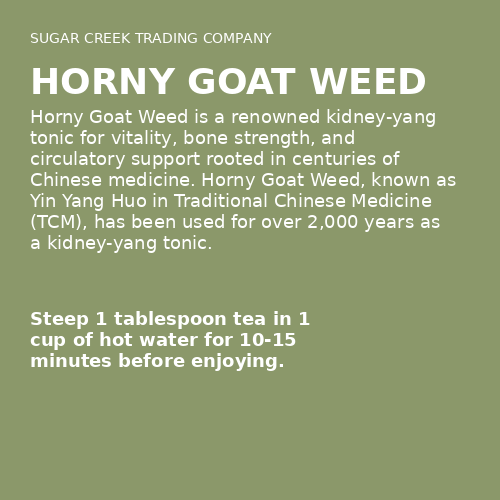
A renowned kidney-yang tonic for vitality, bone strength, and circulatory support rooted in centuries of Chinese medicine.
BOTANICAL IDENTIFICATION
Scientific Name: Epimedium brevicornu Maxim., E. sagittatum (Sieb. & Zucc.) Maxim., E. pubescens Maxim., E. koreanum Nakai, and related species
Common Names: Horny Goat Weed, Epimedium, Barrenwort, Bishop's Hat, Fairy Wings, Rowdy Lamb Herb
Family: Berberidaceae (Barberry family)
Epimedium species are low-growing, herbaceous perennials reaching 20 to 50 cm in height, forming clumping colonies via creeping rhizomes. The leaves are compound, typically with heart-shaped leaflets that emerge with a bronze or coppery tint in spring before maturing to green. Delicate, spurred flowers appear in spring in shades of yellow, white, pink, lavender, or red depending on the species, giving rise to the ornamental name "Bishop's Hat."
Native to China, Korea, Japan, and parts of the Mediterranean, the medicinal species are primarily found across temperate and subtropical forests of eastern Asia. They prefer moist, shaded woodland conditions with humus-rich soil and are widely cultivated both as ornamental ground covers and for medicinal harvest.
CULTURAL AND HISTORICAL USE
Horny Goat Weed, known as Yin Yang Huo in Traditional Chinese Medicine (TCM), has been used for over 2,000 years as a kidney-yang tonic. According to legend, a Chinese goat herder noticed his flock became unusually amorous after grazing on the plant, hence the colorful common name. In TCM, it is classified as warm in nature and acrid and sweet in flavor, entering the Kidney and Liver meridians. Its primary indications include kidney yang deficiency manifesting as impotence, infertility, fatigue, cold limbs, frequent urination, and weakness of the lower back and knees.
The herb first appeared in the Shennong Bencao Jing (Divine Farmer's Materia Medica), one of the oldest Chinese herbal texts, and has been featured in every major Chinese pharmacopoeia since. Classical formulations often combine Yin Yang Huo with other kidney-yang tonics such as Du Zhong (Eucommia bark), Rou Cong Rong (Cistanche), and Xu Duan (Dipsacus root) to create balanced warming formulas.
Beyond reproductive and vitality uses, TCM practitioners have historically prescribed Epimedium for wind-damp bi syndrome (joint pain and stiffness), numbness and weakness in the limbs, and to strengthen bones and sinews. The herb also has a tradition of use for forgetfulness and poor memory associated with kidney essence decline. In recent decades, Epimedium has gained worldwide popularity as a natural supplement for sexual health and has become one of the most recognized Chinese herbs in Western markets.
KEY BIOACTIVE COMPOUNDS & BENEFITS
| Compound/Class | Location in Plant | Human Benefit | Role in Plant |
|---|---|---|---|
| Icariin (prenylated flavonol glycoside) | Leaves | Primary active compound; supports circulatory function, bone density, and sexual health through PDE5 inhibition and nitric oxide modulation | UV protection and antifungal defense |
| Icariside II (Baohuoside I) | Leaves | Active metabolite of icariin with enhanced bioavailability; neuroprotective, anti-inflammatory, and osteogenic properties | Secondary metabolite defense |
| Epimedin A, B, C (flavonoid glycosides) | Leaves and stems | Synergistic support for cardiovascular, immune, and skeletal health | Broad-spectrum chemical defense |
| Flavonoids (quercetin, kaempferol) | Aerial parts | Antioxidant, anti-inflammatory, and vascular-protective effects | UV screening and pollinator signaling |
| Phytosterols and polysaccharides | Leaves and rhizomes | Immune modulation, cholesterol management, and adaptogenic support | Cell membrane integrity and energy storage |
The pharmacological profile of Epimedium centers on its prenylated flavonoids, with icariin as the flagship compound. These molecules are structurally unique among plant flavonoids due to their prenyl side chains, which enhance their ability to cross cell membranes and interact with enzymes involved in vascular tone, bone metabolism, and hormonal signaling. The collective action of these compounds positions Epimedium as a versatile tonic that supports multiple organ systems simultaneously.
HOW IT WORKS IN THE BODY
Epimedium exerts its effects through several well-studied mechanisms that align closely with its traditional TCM applications of warming the kidney yang and strengthening bone and sinew.
Circulatory and Sexual Health:
Icariin acts as a mild, natural phosphodiesterase type 5 (PDE5) inhibitor, the same enzyme pathway targeted by pharmaceutical erectile dysfunction drugs. By inhibiting PDE5, icariin supports the nitric oxide-cGMP signaling pathway, promoting smooth muscle relaxation and improved blood flow. Additionally, some research suggests icariin may support healthy testosterone metabolism by modulating the activity of enzymes involved in hormone production.
Bone Health and Osteogenesis:
Icariin and icariside II have demonstrated significant osteogenic (bone-building) activity in research settings. They promote the proliferation and differentiation of osteoblasts (bone-forming cells) while inhibiting osteoclast (bone-resorbing cell) activity. This dual action supports bone mineral density and may be particularly relevant for age-related bone loss.
Neuroprotective and Anti-inflammatory Activity:
The prenylated flavonoids in Epimedium cross the blood-brain barrier and exhibit neuroprotective properties, including antioxidant defense against neuronal oxidative stress and modulation of inflammatory cytokines. These actions support cognitive function and may help protect neural tissue from age-related decline.
Immune and Adaptogenic Support:
Epimedium polysaccharides and flavonoids modulate immune function, enhancing the activity of natural killer cells and macrophages while helping regulate overactive immune responses. This adaptogenic quality helps the body maintain balance under physical and emotional stress.
DOSE GUIDELINES
| Preparation Type | Typical Dose | Purpose |
|---|---|---|
| Herbal tea (decoction) | 3-9 grams dried leaf simmered in 2-3 cups water for 15-20 minutes, 1-2 times daily | General tonic, kidney-yang support, joint comfort |
| Tincture (1:5, 40-50% ethanol) | 3-5 mL, 2-3 times daily | Concentrated tonic and circulatory support |
| Capsules (powdered herb) | 500-1,000 mg, 2-3 times daily | Standardized supplementation for bone and vascular health |
| Standardized extract (icariin) | 200-400 mg extract standardized to 10-20% icariin, daily | Targeted support for sexual health and bone density |
Epimedium is traditionally used as a long-term tonic rather than a quick-acting remedy. In TCM, it is typically taken in cycles of several weeks to months as part of a balanced formula. Effects on vitality and energy are often noticed within 2-4 weeks of consistent use. As a warming herb, it is best balanced with yin-nourishing herbs in individuals prone to heat signs or dryness.
PREPARATION AND USES
In TCM, Epimedium leaves are most commonly prepared as a decoction, simmered with other formula ingredients for 15-20 minutes. The traditional processing method involves stir-frying the dried leaves with sheep fat (yang-enhancing preparation) to intensify the warming, kidney-tonifying properties. In Western practice, the dried leaf is commonly taken as a tea, tincture, or in capsule form. A simple tea can be made by simmering 3-9 grams of dried leaf in water for 15-20 minutes and straining.
For tincture preparation, macerate the dried leaves in 40-50% alcohol for 4-6 weeks. Epimedium combines well in formulas with ashwagandha, maca, tribulus, or tongkat ali for vitality support, or with nettle root and saw palmetto for prostate and hormonal health. In bone-support formulas, it pairs effectively with horsetail, nettle leaf, and red clover. The herb can also be added to soups and broths in the traditional Chinese culinary-medicine style.
OPTIMAL CONTEXT FOR USE
Horny Goat Weed is especially well-suited for individuals experiencing:
Low libido, sexual fatigue, or erectile difficulties, particularly those associated with aging or stress
General fatigue, low energy, cold extremities, and signs of kidney-yang deficiency in TCM terms
Age-related concerns about bone density, joint stiffness, or musculoskeletal weakness
Mild circulatory insufficiency or a desire to support cardiovascular health through natural means
Cognitive sluggishness, poor memory, or a need for neuroprotective support alongside vitality enhancement
For best results, Epimedium is ideally incorporated into a holistic approach that includes regular exercise, adequate rest, stress management, and a nutrient-dense diet. It works synergistically with other adaptogenic and tonic herbs as part of a comprehensive wellness protocol.
SUSTAINABILITY AND ETHICAL HARVESTING
Several Epimedium species used in commerce are wild-harvested in China, and increasing global demand has placed pressure on some native populations. While the genus is not currently listed under CITES, habitat loss and overharvesting are recognized concerns for certain species in their native range. Cultivated sources are increasingly available and preferred for both quality consistency and ecological sustainability.
Ethical sourcing means choosing suppliers who prioritize cultivated material or who work with communities practicing sustainable wildcrafting rotations. Many ornamental Epimedium cultivars are widely grown in gardens worldwide, and expanding cultivation for medicinal purposes is both feasible and encouraged. Supporting farms that invest in sustainable Epimedium cultivation helps reduce pressure on wild populations.
SAFETY AND CAUTIONS
Epimedium is generally well tolerated at traditional doses and has a long history of safe use in Chinese medicine. However, the following cautions should be observed:
Individuals taking blood-thinning medications (warfarin, aspirin, etc.) should exercise caution, as Epimedium may have mild anticoagulant effects and could potentiate bleeding risk.
Those on medications for blood pressure, heart conditions, or erectile dysfunction should consult a healthcare provider before use, as Epimedium may interact with PDE5 inhibitors, nitrates, and antihypertensives.
Pregnant and nursing women should avoid Epimedium due to its hormonal activity and warming nature.
Individuals with yin deficiency heat signs (night sweats, hot flashes, dry mouth, irritability) should use Epimedium cautiously or in balanced formulas, as its warming nature may exacerbate these conditions.
Excessive doses may cause dizziness, dry mouth, nosebleed, or heart palpitations. Adhere to recommended dosages.
REFERENCES
Ma, H., et al. (2011). "The genus Epimedium: An ethnopharmacological and phytochemical review." Journal of Ethnopharmacology, 134(3), 519-541.
Zhang, D., et al. (2015). "Icariin: A potential molecule for the treatment of osteoporosis." Pharmacology & Therapeutics, 150, 107-120.
Chinese Pharmacopoeia Commission. (2020). Pharmacopoeia of the People's Republic of China, Volume I. China Medical Science Press.
FINAL NOTE
Horny Goat Weed is far more than the suggestive name implies. Backed by over two millennia of clinical use in Chinese medicine and a growing body of modern pharmacological research, Epimedium stands as a sophisticated tonic herb that nourishes the deep reserves of vitality while supporting bone, brain, and cardiovascular health. It is a cornerstone of kidney-yang tonification and a testament to the depth of traditional herbal knowledge.
Share