Sugar Creek Trading Company
Jiaogulan Herb
Jiaogulan Herb
Impossible de charger la disponibilité du service de retrait
GYNOSTEMMA PENTAPHYLLUM
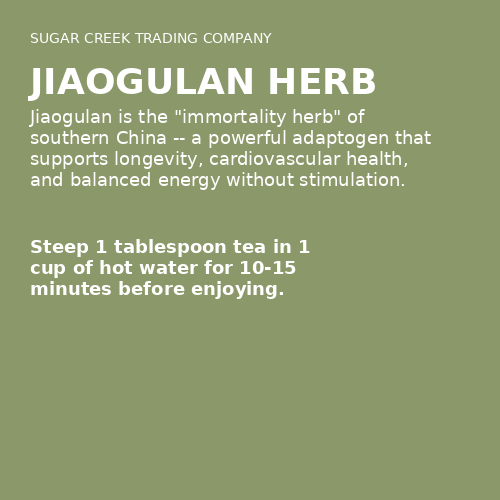
The "immortality herb" of southern China -- a powerful adaptogen that supports longevity, cardiovascular health, and balanced energy without stimulation.
BOTANICAL IDENTIFICATION
Scientific Name: Gynostemma pentaphyllum (Thunb.) Makino
Common Names: Jiaogulan, Gynostemma, Southern Ginseng, Cheap Ginseng, Five-Leaf Ginseng, Miracle Grass, Immortality Herb, Xiancao, Amachazuru
Family: Cucurbitaceae (Gourd/Cucumber family)
Jiaogulan is a climbing, herbaceous perennial vine that can grow 8 to 12 meters long when supported. It produces palmately compound leaves with five (sometimes three or seven) serrated, ovate leaflets arranged in a star-like pattern. The plant is dioecious, bearing small, inconspicuous greenish-white flowers on separate male and female plants, followed by small, dark green to black berries.
Native to the mountainous regions of southern China, northern Vietnam, Japan, and Korea, jiaogulan thrives in shaded, humid forest margins and ravines at elevations of 300 to 3,200 meters. It prefers rich, moist soil with partial shade and is remarkably cold-hardy for a subtropical vine, tolerating brief freezes down to about 15 F.
CULTURAL AND HISTORICAL USE
Jiaogulan's story is unique among major medicinal herbs in that its rise to prominence is relatively recent, driven by a remarkable convergence of folk tradition and modern scientific discovery. While it appears in the 15th-century Ming Dynasty text "Materia Medica for Famine" (Jiuhuang Bencao) by Zhu Xiao as a food plant consumed during times of scarcity, it was not part of the classical Traditional Chinese Medicine pharmacopoeia. Its medicinal use was primarily a folk tradition in the mountainous Guizhou province of southern China, where local people drank it daily as a tea and called it xiancao -- "the immortality herb."
The pivotal moment came in the 1970s when a Japanese researcher, Dr. Masahiro Nagai, discovered that jiaogulan contained saponins (gypenosides) remarkably similar to the ginsenosides found in Panax ginseng, despite the two plants being completely unrelated. This discovery, combined with a 1970s Chinese census finding that villages in Guizhou where jiaogulan tea was consumed daily had significantly higher rates of centenarians than surrounding areas, ignited an explosion of scientific research. By the 1990s, jiaogulan was being called "southern ginseng" and had become one of the most studied adaptogenic herbs in Chinese pharmacological research.
In Japan, jiaogulan (amachazuru, meaning "sweet tea vine") gained popularity as a health tea in the 1980s and was widely studied for its effects on cholesterol, blood sugar, and immune function. In Thailand, it was approved for clinical use and is included in the national pharmacopoeia. Today, jiaogulan is one of the most popular daily health teas across East and Southeast Asia, valued as a caffeine-free, adaptogenic alternative to green tea.
KEY BIOACTIVE COMPOUNDS & BENEFITS
| Compound/Class | Location in Plant | Human Benefit | Role in Plant |
|---|---|---|---|
| Gypenosides (saponins, 170+ identified) | Leaves, stems | Adaptogenic, cardioprotective, lipid-lowering, antioxidant, and immune-modulating activity | Bitter defense compounds deterring herbivores |
| Polysaccharides | Leaves, stems | Immune stimulation, gut microbiome support, blood sugar regulation | Energy storage and structural support |
| Flavonoids (quercetin, rutin, ombuin) | Leaves | Antioxidant, anti-inflammatory, and vascular-protective effects | UV protection and pollinator signaling |
| Carotenoids and chlorophyll | Leaves | Additional antioxidant support, cellular protection | Photosynthesis and photoprotection |
| Trace minerals (selenium, zinc, manganese) | Whole plant | Cofactors for antioxidant enzymes (SOD, glutathione peroxidase) | Essential enzymatic functions in plant metabolism |
Jiaogulan's extraordinary breadth of activity stems from its gypenoside content -- the richest saponin profile of any known plant, with over 170 unique dammarane-type saponins identified so far. Several of these are structurally identical to ginsenosides Rb1, Rb3, Rd, and F2 from Panax ginseng, which explains the overlapping adaptogenic effects. However, jiaogulan's greater diversity of saponins may give it a broader and more bidirectionally balancing range of action than ginseng itself.
HOW IT WORKS IN THE BODY
Jiaogulan acts as a true adaptogen, modulating multiple physiological systems toward homeostasis rather than pushing them in a single direction.
Cardiovascular and Lipid Metabolism:
Gypenosides stimulate the release of nitric oxide from the vascular endothelium, promoting vasodilation and healthy blood pressure. They inhibit platelet aggregation, reducing the risk of abnormal clotting. Multiple clinical studies demonstrate that jiaogulan lowers total cholesterol and LDL while raising HDL, likely through activation of AMPK (AMP-activated protein kinase), the same metabolic master switch activated by exercise and caloric restriction.
Adaptogenic Stress Response:
Jiaogulan modulates the hypothalamic-pituitary-adrenal (HPA) axis, helping normalize cortisol output under both high-stress and low-energy conditions. Its bidirectional activity -- calming when overstimulated, energizing when depleted -- is the hallmark of a true adaptogen. This is mediated in part by gypenosides' interaction with corticosteroid receptors and their ability to regulate both excitatory and inhibitory neurotransmitter pathways.
Antioxidant Defense (Endogenous Upregulation):
Rather than simply acting as a direct antioxidant, jiaogulan stimulates the body's own antioxidant enzyme systems. It upregulates superoxide dismutase (SOD), catalase, and glutathione peroxidase, providing deep, systemic protection against oxidative damage. This endogenous upregulation is considered far more effective than exogenous antioxidant supplementation alone.
Blood Sugar and Metabolic Support:
AMPK activation by gypenosides enhances glucose uptake into cells, improves insulin sensitivity, and promotes fatty acid oxidation. Clinical trials in type 2 diabetic patients have shown significant improvements in fasting blood sugar and HbA1c after 12 weeks of jiaogulan tea consumption.
DOSE GUIDELINES
| Preparation Type | Typical Dose | Purpose |
|---|---|---|
| Leaf Tea (infusion) | 1-2 teaspoons dried herb per 8 oz hot water, steep 5-10 minutes; 2-3 cups daily | Daily adaptogenic support, cardiovascular health, general wellness |
| Powder | 1-3 grams daily, mixed into smoothies, water, or food | Concentrated adaptogenic and metabolic support |
| Tincture (1:5) | 3-5 mL, 2-3 times daily | Convenient adaptogenic dosing, stress support |
| Standardized extract | Per manufacturer label (typically 225-450 mg standardized to gypenosides) | Targeted cardiovascular, blood sugar, or lipid support |
Jiaogulan is a long-term tonic herb meant for daily use over months and years. Its effects build gradually, with cardiovascular and metabolic benefits typically becoming measurable after 8 to 12 weeks of consistent use. The tea is naturally caffeine-free and mildly sweet, making it an excellent all-day beverage. The leaves can be re-steeped 3 to 4 times before flavor diminishes.
PREPARATION AND USES
The simplest and most traditional preparation is a hot water infusion of the dried leaves. Use water just below boiling (190-200 F), steep for 5 to 10 minutes, and enjoy plain. The flavor is mildly sweet with a faint, pleasant bitterness -- much gentler than most medicinal herbs. The leaves can be re-steeped multiple times throughout the day, and many users report that the second and third steepings taste even better than the first as the sweetness intensifies.
Jiaogulan also makes an excellent cold brew: steep 2 to 3 teaspoons in a jar of cool water overnight in the refrigerator for a refreshing, subtly sweet adaptogenic iced tea. The dried herb can be powdered and added to smoothies, oatmeal, or energy balls. It blends well with other adaptogens such as astragalus, reishi, or eleuthero for comprehensive tonic formulas. Because jiaogulan is caffeine-free and non-stimulating, it can be consumed at any time of day, including before bed.
OPTIMAL CONTEXT FOR USE
Jiaogulan is especially well-suited for individuals experiencing:
Elevated cholesterol, triglycerides, or blood pressure who want natural support alongside (not replacing) conventional care
Chronic stress, fatigue, or burnout who need adaptogenic support without the stimulation of caffeine or the heating quality of Panax ginseng
Blood sugar management challenges, including prediabetes or type 2 diabetes, as a complementary daily tea
A desire for a safe, gentle, daily longevity tonic that supports overall metabolic health and antioxidant defense
Athletes or physically active individuals seeking improved endurance, recovery, and cardiovascular efficiency
Jiaogulan combines exceptionally well with hawthorn berry for cardiovascular support, with reishi mushroom for immune and longevity benefits, or with tulsi (holy basil) for a caffeine-free adaptogenic tea blend.
SUSTAINABILITY AND ETHICAL HARVESTING
Jiaogulan is not considered threatened in the wild and is extensively cultivated across southern China, Thailand, Vietnam, and Japan. It grows rapidly, produces abundant leaf material, and can be harvested multiple times per growing season, making it one of the most sustainable and renewable medicinal herbs available. Cultivation is straightforward and does not require deforestation, heavy irrigation, or chemical inputs, as the plant naturally resists most pests.
The primary sustainability consideration is ensuring fair labor practices and clean growing conditions in the regions where it is commercially produced. Organic certification and direct-trade sourcing from small farms support both environmental and social sustainability. Because only the leaves and stems are harvested (not the roots), the plant survives harvest and continues producing, further enhancing its renewable profile.
SAFETY AND CAUTIONS
Jiaogulan has an excellent safety profile and is consumed daily as a food-grade tea by millions of people across Asia. It is considered generally safe for long-term use.
Individuals on blood-thinning medications (warfarin, aspirin, etc.) should exercise caution, as jiaogulan may have mild antiplatelet effects that could potentiate bleeding risk.
Those taking medications for diabetes or blood pressure should monitor levels carefully, as jiaogulan may enhance the effects of these medications, potentially requiring dose adjustment.
Pregnant and nursing women should avoid jiaogulan due to insufficient safety data in these populations.
Rare mild side effects may include nausea or increased bowel movements when starting use, which typically resolve within a few days as the body adjusts.
REFERENCES
Razmovski-Naumovski, V., et al. (2005). "Chemistry and pharmacology of Gynostemma pentaphyllum." Phytochemistry Reviews, 4(2-3), 197-219.
Huyen, V.T., et al. (2010). "Gynostemma pentaphyllum tea improves insulin sensitivity in type 2 diabetic patients." Journal of Nutrition and Metabolism, 2010, Article ID 351820.
Li, L., et al. (2016). "A review on pharmacological activities and utilization technologies of Gynostemma pentaphyllum." Journal of Functional Foods, 21, 468-479.
FINAL NOTE
Jiaogulan represents one of the best-kept secrets in the adaptogenic herb world -- a caffeine-free, gentle-tasting daily tea with a body of clinical evidence that rivals or exceeds many more famous herbs. Its ability to simultaneously support cardiovascular health, blood sugar balance, antioxidant defense, and stress resilience makes it a remarkably efficient addition to any wellness routine. The fact that entire villages of daily jiaogulan drinkers have some of the highest concentrations of centenarians in the world is not proof, but it is a compelling invitation to explore what this unassuming vine has to offer.
Share