Sugar Creek Trading Company
Kelp
Kelp
Impossible de charger la disponibilité du service de retrait
ASCOPHYLLUM NODOSUM / LAMINARIA SPP.
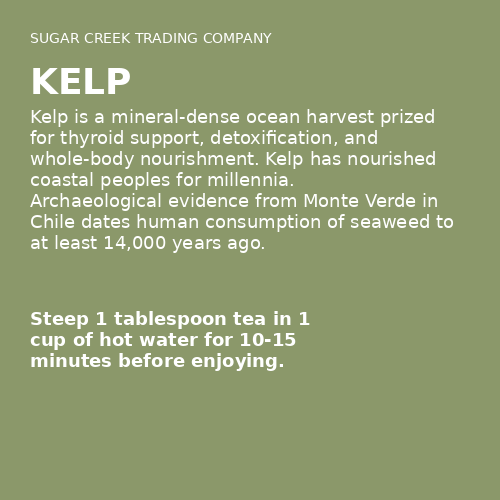
A mineral-dense ocean harvest prized for thyroid support, detoxification, and whole-body nourishment.
BOTANICAL IDENTIFICATION
Scientific Name: Ascophyllum nodosum (L.) Le Jolis; Laminaria digitata (Huds.) J.V. Lamour.; Laminaria hyperborea (Gunnerus) Foslie
Common Names: Kelp, Rockweed, Knotted Wrack, Norwegian Kelp, Bladderwrack (related), Oarweed, Tangle, Sea Belt, Kombu (Japanese relatives)
Family: Fucaceae (Ascophyllum); Laminariaceae (Laminaria)
Kelp is not a single species but a commercial term encompassing several large brown macroalgae. Ascophyllum nodosum forms long, olive-green to dark brown fronds with distinctive egg-shaped air bladders spaced along unbranched straps that can reach two meters in length. Laminaria species grow as broad, leathery blades arising from a stout stipe and holdfast, sometimes exceeding three meters. Both genera anchor themselves to rocky substrates in the intertidal and subtidal zones of cold, nutrient-rich waters.
These seaweeds thrive along the North Atlantic coastlines of Norway, Iceland, Scotland, Ireland, Atlantic Canada, and New England, as well as the Pacific coasts of British Columbia and Alaska for related species. They require cold water temperatures (typically 4-15 degrees Celsius), strong currents, and clean, unpolluted seas to form the dense kelp beds that provide critical habitat for marine ecosystems.
CULTURAL AND HISTORICAL USE
Kelp has nourished coastal peoples for millennia. Archaeological evidence from Monte Verde in Chile dates human consumption of seaweed to at least 14,000 years ago. In the British Isles, kelp was burned to produce soda ash for glass and soap manufacture from the 17th century onward, providing a crucial livelihood for Scottish Highland communities after the Clearances. Irish and Scottish coastal populations consumed kelp as a famine food and daily vegetable, incorporating it into broths, breads, and fertilizer for their fields. The word "kelp" itself likely derives from the Middle English "culpe," referring to the calcined ash of seaweed.
In East Asian medicine and cuisine, closely related species hold an even more prominent position. Traditional Chinese Medicine classifies Laminaria (known as Kun Bu) as salty and cold, entering the liver, stomach, and kidney meridians, and prescribes it to soften hardness and dissipate nodules, particularly for goiter and scrofula. Japanese and Korean culinary traditions have used kombu (Laminaria japonica) for centuries as the basis of dashi broth, exploiting its naturally high glutamate content, which Kikunae Ikeda isolated in 1908 to discover umami, the fifth basic taste.
Western herbalism recognized kelp's thyroid-supporting properties as early as the 18th century. In 1750, British physician Dr. Bernard Russell published his success treating goiter with burnt sponge and kelp ash, decades before iodine was formally discovered by Bernard Courtois in 1811. By the 19th century, kelp tablets had become a standard remedy in American Eclectic medicine for hypothyroidism, obesity associated with thyroid insufficiency, and glandular swellings. Folk practitioners along the Atlantic seaboard also applied kelp poultices to arthritic joints and used kelp baths for rheumatic complaints.
KEY BIOACTIVE COMPOUNDS & BENEFITS
| Compound/Class | Location in Plant | Human Benefit | Role in Plant |
|---|---|---|---|
| Iodine (organic) | Throughout the thallus, concentrated in cortical cells | Essential for thyroid hormone synthesis (T3/T4); supports metabolic rate and cognitive function | Serves as an antioxidant defense against reactive oxygen species in seawater |
| Alginic acid (alginate) | Cell wall structural polysaccharide | Binds heavy metals and radioactive isotopes in the GI tract; supports gut barrier integrity | Provides flexible structural support against wave action and desiccation |
| Fucoidan | Intercellular mucilage | Anti-inflammatory, immunomodulatory, and anticoagulant activity; studied for anti-tumor potential | Protects against desiccation at low tide and deters microbial colonization |
| Laminarin | Intracellular storage carbohydrate | Prebiotic fiber supporting beneficial gut bacteria; may modulate blood glucose response | Energy reserve for periods of low light availability |
| Fucoxanthin | Chloroplasts | Carotenoid antioxidant studied for anti-obesity and anti-diabetic effects; supports thermogenesis in adipose tissue | Accessory photosynthetic pigment capturing blue-green light in deep water |
Together, these compounds create a synergistic nutritional and therapeutic profile. Kelp delivers over 60 trace minerals and elements in bioavailable form, including calcium, magnesium, potassium, iron, zinc, and vanadium. The combination of alginate's detoxifying capacity, fucoidan's immune-modulating power, and the broad-spectrum mineral content makes kelp one of the most nutritionally complete single-source supplements available in the plant kingdom.
HOW IT WORKS IN THE BODY
Kelp acts through multiple physiological pathways, primarily centered on mineral replenishment, endocrine support, and gastrointestinal function.
Thyroid and Metabolic Support:
The organic iodine in kelp is absorbed in the small intestine and actively transported to the thyroid gland via the sodium-iodide symporter (NIS). There it is incorporated into thyroglobulin and used to synthesize thyroxine (T4) and triiodothyronine (T3), the master hormones governing basal metabolic rate, oxygen consumption, protein synthesis, and thermogenesis. Adequate iodine status is essential for energy production, weight regulation, and cognitive clarity. Kelp provides iodine in a food-matrix context with co-occurring selenium and tyrosine precursors, which may enhance its physiological utilization compared to isolated potassium iodide supplements.
Detoxification and Heavy Metal Binding:
Alginic acid forms a gel in the gastrointestinal tract that selectively binds heavy metals such as lead, mercury, cadmium, and strontium-90 through ion exchange, preventing their absorption across the intestinal mucosa. Research conducted following the Chernobyl disaster demonstrated that sodium alginate significantly reduced radiostrontium absorption in human subjects. This chelation occurs without depleting essential minerals when kelp is taken as a whole food, because its own mineral content compensates for any incidental binding.
Immune Modulation and Inflammation:
Fucoidan activates natural killer (NK) cells and macrophages while simultaneously suppressing excessive inflammatory signaling through inhibition of NF-kB and COX-2 pathways. Studies published in Marine Drugs have demonstrated that fucoidan from Ascophyllum nodosum can modulate dendritic cell maturation, suggesting a balancing rather than purely stimulatory effect on immune function. This makes kelp potentially useful as a long-term tonic rather than an acute immune stimulant.
Gut Health and Prebiotic Activity:
Laminarin and alginate serve as fermentable fibers for colonic bacteria, particularly stimulating the growth of Bifidobacterium and Lactobacillus species. The resulting short-chain fatty acid production (butyrate, propionate, acetate) nourishes colonocytes, strengthens the gut barrier, and contributes to systemic anti-inflammatory effects.
DOSE GUIDELINES
| Preparation Type | Typical Dose | Purpose |
|---|---|---|
| Dried kelp powder | 1-3 grams daily (approx. 1/2 to 1 teaspoon) | General mineral supplementation, thyroid support |
| Kelp capsules | 500-1000 mg, 1-3 times daily | Standardized iodine intake, convenient dosing |
| Decoction (simmered tea) | 1-2 teaspoons dried kelp in 2 cups water, simmered 15-20 minutes | Mineral extraction, digestive support |
| Culinary use | Add freely to soups, beans, grains, and broths | Nutritional enrichment, flavor enhancement (umami) |
Kelp is best used as a long-term daily tonic rather than a short-term acute remedy. Start with a low dose and increase gradually, especially if thyroid function is a concern. Because iodine content varies significantly between species and harvests (ranging from 500 to over 8,000 mcg per gram), it is prudent to use kelp from a consistent, tested source and avoid exceeding 1,100 mcg of iodine daily, the tolerable upper intake level established by the National Institutes of Health.
PREPARATION AND USES
Dried kelp powder blends easily into smoothies, juices, and soups. A half-teaspoon stirred into morning broth or miso provides a mineral-rich start to the day. For a more traditional preparation, simmer one to two teaspoons of dried kelp pieces in water for 15-20 minutes to make a mineral-rich decoction; strain and drink warm, optionally with lemon or ginger. Kelp powder can also be encapsulated at home for those who prefer not to taste the ocean flavor.
In the kitchen, kelp transforms ordinary dishes. Add a strip of dried kelp to beans while cooking to improve digestibility and reduce flatulence (the glutamic acid helps break down complex proteins). Sprinkle kelp powder over salads, popcorn, or roasted vegetables as a mineral-rich seasoning. Kelp also makes an excellent base for homemade seaweed salt: blend equal parts dried kelp powder and sea salt for a nutrient-dense condiment. For topical use, kelp powder mixed with water or aloe vera gel creates a remineralizing face mask or poultice for tired, aching joints.
OPTIMAL CONTEXT FOR USE
This herb is especially well-suited for individuals experiencing:
Sluggish thyroid function, low energy, cold intolerance, or unexplained weight gain associated with iodine insufficiency
Mineral depletion from poor diet, chronic stress, heavy exercise, or depleted agricultural soils
Concern about environmental toxin exposure, including heavy metals, radioactive isotopes, or industrial pollutants
Digestive sluggishness, poor gut microbiome diversity, or desire for gentle prebiotic support
Hair, skin, and nail brittleness or slow growth linked to trace mineral deficiency
Kelp pairs well with other thyroid-supportive herbs such as ashwagandha and bladderwrack, and with mineral-rich allies like nettle leaf and oat straw for comprehensive nutritional rebuilding.
SUSTAINABILITY AND ETHICAL HARVESTING
Wild kelp beds are ecologically vital, serving as nurseries for fish, habitat for invertebrates, and significant carbon sinks. Responsible harvesting involves cutting fronds above the meristematic growth zone so the plant can regenerate, and rotating harvest areas to prevent overexploitation. In Norway, Iceland, and Atlantic Canada, commercial kelp harvesting is regulated by government agencies that set quotas and monitor stock health. Increasingly, kelp is also cultivated on offshore longlines, a practice that requires no freshwater, fertilizer, or arable land, and actually improves local water quality by absorbing excess nitrogen and carbon dioxide.
When sourcing kelp, prioritize suppliers who harvest from clean, tested waters far from industrial outflows and who provide certificates of analysis for heavy metal content, particularly arsenic, which can accumulate in seaweed. Organic certification and third-party testing add additional assurance of purity.
SAFETY AND CAUTIONS
Kelp is generally recognized as safe when consumed in food-level amounts. However, several important considerations apply:
Thyroid sensitivity: Excessive iodine intake can paradoxically suppress or overstimulate thyroid function. Individuals with Hashimoto's thyroiditis, Graves' disease, or other autoimmune thyroid conditions should consult a healthcare provider before using kelp supplements. The Wolff-Chaikoff effect (temporary inhibition of thyroid hormone synthesis at very high iodine loads) is a real physiological concern.
Heavy metal contamination: Seaweeds bioaccumulate minerals from their environment, including arsenic, cadmium, and lead. Always source kelp from reputable suppliers who test for contaminants. Hijiki seaweed, in particular, is known for high inorganic arsenic and should not be confused with kelp.
Anticoagulant interactions: Fucoidan has mild blood-thinning properties. Those taking warfarin, heparin, or other anticoagulant medications should use kelp cautiously and inform their prescribing physician.
Pregnancy and nursing: While moderate dietary kelp is likely safe during pregnancy, concentrated kelp supplements delivering high iodine doses should be used only under professional guidance, as excessive iodine can affect fetal thyroid development.
REFERENCES
Holdt, S.L. and Kraan, S. "Bioactive compounds in seaweed: functional food applications and legislation." Journal of Applied Phycology, 23(3): 543-597, 2011.
Fitton, J.H. "Therapies from fucoidan; multifunctional marine polymers." Marine Drugs, 9(10): 1731-1760, 2011.
Teas, J. et al. "Dietary seaweed and mammary carcinogenesis in rats." Cancer Research, 44(7): 2758-2761, 1984.
Zava, T.T. and Zava, D.T. "Assessment of Japanese iodine intake based on seaweed consumption in Japan." Thyroid Research, 4: 14, 2011.
Brownlee, I.A. et al. "Alginate as a source of dietary fiber." Critical Reviews in Food Science and Nutrition, 45(6): 497-510, 2005.
FINAL NOTE
Kelp is the ocean's gift to the mineral-starved modern body. In a world where agricultural soils are increasingly depleted of trace elements, this ancient organism offers a direct pipeline to the concentrated mineral wealth of the sea. Whether used as a daily nutritional supplement, a culinary staple, or a targeted thyroid tonic, kelp reminds us that some of the most powerful medicines grow not in gardens but beneath the waves.
Share