Sugar Creek Trading Company
Knot Grass Herb
Knot Grass Herb
Impossible de charger la disponibilité du service de retrait
POLYGONUM AVICULARE
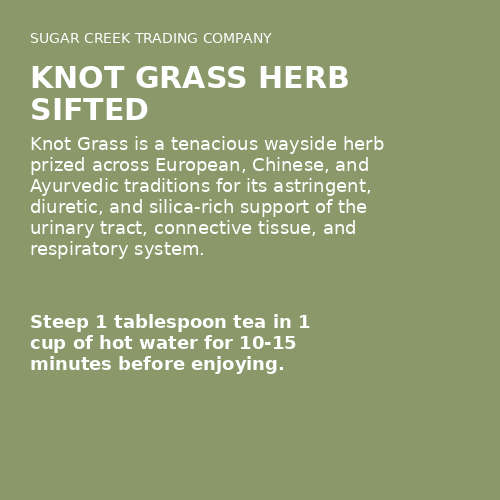
A tenacious wayside herb prized across European, Chinese, and Ayurvedic traditions for its astringent, diuretic, and silica-rich support of the urinary tract, connective tissue, and respiratory system.
BOTANICAL IDENTIFICATION
Scientific Name: Polygonum aviculare L.
Common Names: Knotgrass, Knot Grass, Prostrate Knotweed, Birdweed, Pigweed, Lowgrass, Centinode, Ninety-Knot, Bian Xu (Chinese)
Family: Polygonaceae (Buckwheat family)
Knotgrass is an annual or short-lived perennial herb with wiry, much-branched prostrate to ascending stems that radiate outward from a central taproot, forming dense mats up to one meter across. The stems are distinctly jointed at each node, sheathed by silvery, translucent stipules called ochreae, a hallmark feature of the Polygonaceae. Leaves are small, lance-shaped to elliptical, blue-green, and alternate along the stem. The tiny flowers, borne in axillary clusters of one to five, are greenish-white to pink and appear from late spring through autumn, followed by small, three-angled achene fruits that are a favored food of ground-feeding birds.
Polygonum aviculare is one of the most cosmopolitan plants on Earth, thriving on every continent except Antarctica. It colonizes disturbed ground, pavement cracks, footpaths, field margins, and waste areas from sea level to alpine elevations. It tolerates compacted soil, drought, and heavy foot traffic, which is part of why it has been trampled underfoot and overlooked by the general public despite being one of the most widely used medicinal herbs in world pharmacopoeias.
CULTURAL AND HISTORICAL USE
Knotgrass has been employed in European herbal medicine since at least the time of Dioscorides (first century CE), who recorded it in De Materia Medica as a remedy for spitting blood, dysentery, and excessive menstruation. The great English herbalist Nicholas Culpeper, writing in the seventeenth century, praised knotgrass for its cooling, astringent nature and recommended it for wounds, nosebleeds, and kidney stones. Throughout the medieval and early modern periods, knotgrass was a standard apothecary herb across Britain, France, Germany, and Scandinavia, used primarily as a hemostatic, urinary tonic, and vulnerary. Shakespeare referenced it in A Midsummer Night's Dream, where it was invoked as an herb that could stunt growth, a folk belief rooted in its low, creeping habit.
In Traditional Chinese Medicine, knotgrass is known as Bian Xu and holds an established place in the Chinese Pharmacopoeia. It is classified as bitter and slightly cold, entering the Bladder meridian. TCM practitioners use it to promote urination, expel dampness, kill parasites, and relieve itching. It is a key ingredient in Ba Zheng San (Eight Herb Powder for Rectification), one of the most commonly prescribed formulas for urinary tract infections, painful urination, and bladder stones. Bian Xu is also applied externally for eczema, dermatitis, and parasitic skin conditions.
Across Eastern European folk medicine traditions, particularly in Russia, Poland, and the Balkans, knotgrass tea has long been a household remedy for kidney gravel, bladder inflammation, and chronic coughs. Its silica content made it valued for strengthening hair and nails, and poultices of the fresh herb were applied to wounds, sprains, and varicose veins. In Ayurvedic and Unani traditions, the plant was used for similar urinary and astringent purposes, demonstrating a remarkable convergence of therapeutic application across unrelated medical systems.
KEY BIOACTIVE COMPOUNDS & BENEFITS
| Compound/Class | Location in Plant | Human Benefit | Role in Plant |
|---|---|---|---|
| Flavonoids (avicularin, quercitrin, quercetin, kaempferol, myricetin) | Aerial parts (leaves, stems, flowers) | Anti-inflammatory, antioxidant, capillary-strengthening, diuretic | UV protection and defense signaling |
| Silicic acid (soluble silica) | Aerial parts, concentrated in stems | Supports connective tissue integrity, hair, nails, bones, and arterial walls | Structural reinforcement of cell walls |
| Tannins (ellagic acid, gallic acid derivatives) | Whole herb | Astringent, hemostatic, antimicrobial; tightens and tones mucous membranes | Herbivore deterrent and antifungal defense |
| Phenolic acids (caffeic acid, chlorogenic acid, gallic acid) | Leaves and stems | Antioxidant, hepatoprotective, anti-inflammatory | Pathogen defense and oxidative stress management |
| Mucilage and polysaccharides | Leaves | Soothing to mucous membranes; mild expectorant activity | Water retention in leaf tissue |
The therapeutic profile of knotgrass emerges from the interplay between its astringent tannins, which tighten and protect irritated tissues, and its flavonoid-silica complex, which strengthens the structural matrix of connective tissue from the inside out. This dual action makes it particularly effective for conditions where tissue tone has been lost, whether in the urinary tract, the blood vessels, or the respiratory mucosa. The high avicularin content is especially noteworthy, as this flavonoid glycoside has demonstrated specific affinity for the urinary system in pharmacological studies.
HOW IT WORKS IN THE BODY
Knotgrass exerts its effects through several complementary mechanisms that center on tissue toning, fluid regulation, and mineral delivery.
Urinary Tract Support and Diuretic Action:
The flavonoids avicularin and quercitrin, combined with the herb's soluble silica and potassium content, produce a mild but reliable diuretic effect that increases urine volume without depleting electrolytes aggressively. This flushing action helps prevent crystallization of mineral salts in the kidneys and bladder, which is the basis for knotgrass's traditional use against gravel and stones. The tannins simultaneously tone the urinary mucosa, reducing inflammation and making the tissue less hospitable to bacterial adhesion, a mechanism that parallels (on a milder scale) the anti-adhesion properties of cranberry.
Connective Tissue and Silica Metabolism:
Knotgrass is one of the richest herbal sources of bioavailable silicic acid, the water-soluble form of silicon that the body can actually absorb and utilize. Silicon is an essential trace element for the cross-linking of collagen and elastin, the structural proteins that maintain the integrity of skin, hair, nails, blood vessels, tendons, and bone matrix. Regular intake of silica-rich herbs like knotgrass supports the body's ongoing tissue repair processes, particularly relevant for aging individuals or those recovering from injury.
Astringent and Hemostatic Effects:
The tannin content of knotgrass causes local vasoconstriction and protein precipitation on contact with mucous membranes and open wounds. This tightening effect reduces bleeding, slows excessive secretion, and creates a protective barrier over inflamed tissue. These properties underlie the herb's traditional use for heavy menstrual bleeding, nosebleeds, hemorrhoids, and diarrhea.
Respiratory Support:
The combination of mucilage (which soothes irritated airways) and astringent tannins (which reduce excessive mucus production) gives knotgrass a balanced action on the respiratory tract. It is neither purely drying nor purely moistening, making it useful for chronic bronchitis and coughs where tissue tone has been lost but the membranes are also inflamed.
DOSE GUIDELINES
| Preparation Type | Typical Dose | Purpose |
|---|---|---|
| Herbal infusion (tea) | 2-3 teaspoons of dried herb per cup of boiling water, steeped 10-15 minutes; 2-3 cups daily | Urinary tract support, kidney gravel prevention, general diuretic tonic |
| Tincture (1:5, 40% ethanol) | 2-4 mL, three times daily | Concentrated extract for urinary and astringent support |
| Powdered herb in capsules | 1-3 grams daily, divided into two doses | Silica supplementation, connective tissue support |
| External compress or wash | Strong decoction (4 tablespoons per liter, simmered 10 minutes), applied topically | Wounds, hemorrhoids, varicose veins, skin irritation |
Knotgrass is best used as a gentle, sustained tonic over several weeks to months, particularly when the goal is connective tissue support or chronic urinary maintenance. For acute urinary discomfort, it can be combined with other urinary herbs and used more intensively for 7 to 14 days. Its mild flavor makes it easy to drink as a daily tea.
PREPARATION AND USES
This sifted cut of knotgrass herb is ideal for making herbal infusions and blending into tea formulas. To prepare a simple tea, place two to three teaspoons of the dried herb in a cup, pour boiling water over it, cover, and steep for ten to fifteen minutes. The resulting infusion is mild, slightly astringent, and faintly grassy in flavor. For a stronger therapeutic preparation, simmer the herb gently for five to ten minutes as a light decoction, which will extract more of the tannins and silica. Knotgrass blends well with other urinary herbs such as corn silk, pellitory of the wall, and horsetail, and with demulcent herbs like marshmallow root to balance its astringency.
For topical use, a strong decoction can be used as a wound wash, a compress for varicose veins, or a sitz bath for hemorrhoids. The herb can also be ground finer and encapsulated for those who prefer not to drink tea. For tincture preparation, macerate in 40% alcohol at a 1:5 ratio for four to six weeks. Knotgrass is sometimes included in hair rinse formulas alongside nettle and horsetail, leveraging its silica content to promote hair strength and shine.
OPTIMAL CONTEXT FOR USE
Knotgrass herb is especially well-suited for individuals experiencing:
Recurrent urinary tract discomfort, cystitis, or a history of kidney gravel or bladder stones, where a gentle daily flushing herb can support prevention alongside adequate hydration
Weak connective tissue manifesting as brittle nails, thinning hair, slow wound healing, or loss of skin elasticity, where long-term silica support is desired
Heavy menstrual bleeding or other conditions involving tissue laxity and excessive fluid loss, where an astringent tonic can help restore tone
Chronic bronchial conditions with loss of mucosal tone, where the combination of soothing mucilage and tissue-tightening tannins offers balanced respiratory support
Hemorrhoids or varicose veins, used both internally as a tea and externally as a compress or sitz bath to strengthen venous walls
Knotgrass combines synergistically with horsetail for enhanced silica delivery, with corn silk and marshmallow root for urinary soothing, and with yarrow or shepherd's purse for hemostatic support.
SUSTAINABILITY AND ETHICAL HARVESTING
Polygonum aviculare is one of the most abundant and resilient wild plants on the planet, classified as a common weed in most regions where it grows. It thrives in disturbed habitats, requires no cultivation inputs, and regenerates prolifically from its prolific seed production, with individual plants capable of producing several thousand seeds per season. There are no conservation concerns whatsoever with this species. It is not listed by CITES, IUCN, or any regional endangered species registry.
Commercial knotgrass is sourced from both wild harvest and cultivated production, primarily in Eastern Europe, China, and parts of Central Asia. Wild-harvested material is typically collected from clean field margins and meadows away from roadsides and industrial areas. The plant's weedy nature means that harvesting it actually mimics the disturbance ecology it has evolved to exploit, making it one of the most inherently sustainable herbs in commerce.
SAFETY AND CAUTIONS
Knotgrass is generally regarded as safe and has a long history of food and medicinal use across multiple cultures. The following precautions should be noted:
Due to its diuretic properties, individuals taking prescription diuretics or medications for hypertension should consult a healthcare provider before using knotgrass to avoid additive effects on fluid balance.
The astringent tannins may reduce absorption of certain medications if taken simultaneously. Separate knotgrass tea from pharmaceutical drugs by at least one to two hours.
Pregnant women should avoid therapeutic doses of knotgrass, as uterine-stimulating effects have been reported in traditional literature. Occasional dietary use is not a concern, but sustained medicinal doses should be avoided during pregnancy.
Individuals with kidney disease should consult a practitioner before using any diuretic herb, including knotgrass, to ensure it is appropriate for their specific condition.
REFERENCES
Granica, S., Kluge, H., Horn, G., Matkowski, A., & Kiss, A.K. (2015). "The phytochemical investigation of Polygonum aviculare L. herba and its biological activities." Phytochemistry Letters, 11, 336-341.
Hsu, C.Y. (2006). "Antioxidant activity of extract from Polygonum aviculare L." Biological Research, 39(2), 281-288.
European Medicines Agency (EMA). (2014). "Assessment report on Polygonum aviculare L., herba." Committee on Herbal Medicinal Products (HMPC). EMA/HMPC/572846/2009.
FINAL NOTE
Knotgrass is the kind of herb that rewards patience and consistency rather than dramatic, immediate effect. It works quietly, day by day, toning the urinary passages, delivering bioavailable silica to rebuild connective tissue, and tightening membranes that have lost their resilience. It is a plant that has thrived for millennia by being unbreakable, pushing through pavement and shrugging off drought, and it offers that same tenacity to the body when used with knowledge and respect. In a world fixated on exotic superfoods, knotgrass is a reminder that some of the most reliable medicines grow right under our feet.
Share