Sugar Creek Trading Company
Kombu Sun Pacific Seaweed Pieces
Kombu Sun Pacific Seaweed Pieces
Impossible de charger la disponibilité du service de retrait
SACCHARINA JAPONICA
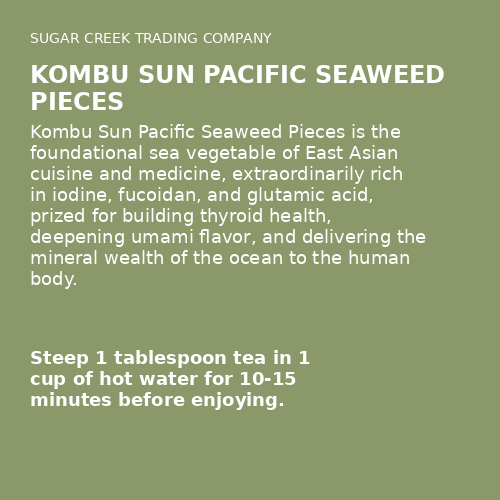
The foundational sea vegetable of East Asian cuisine and medicine, extraordinarily rich in iodine, fucoidan, and glutamic acid, prized for building thyroid health, deepening umami flavor, and delivering the mineral wealth of the ocean to the human body.
BOTANICAL IDENTIFICATION
Scientific Name: Saccharina japonica (J.E.Areschoug) C.E.Lane, C.Mayes, Druehl & G.W.Saunders (formerly Laminaria japonica)
Common Names: Kombu, Konbu, Dashima (Korean), Haidai (Chinese), Kelp, Sea Tangle
Family: Laminariaceae (Kelp family); Division: Ochrophyta (Brown algae)
Saccharina japonica is a large brown macroalga (seaweed) that forms thick, leathery, olive-brown to dark brown blades that can reach 2 to 5 meters in length and 20 to 35 centimeters in width. The blade surface is smooth to slightly wrinkled, with a prominent midrib running along its center and wavy, ruffled margins. It attaches to rocky substrates via a branching holdfast and rises through the water column on a short, flexible stipe. When dried, the blades become dark green to black and develop a characteristic white powder on their surface, which is a natural coating of mannitol and glutamic acid salts, the source of kombu's renowned umami flavor.
This kelp species is native to the cold, nutrient-rich waters of the northwest Pacific Ocean, including the coasts of northern Japan (Hokkaido), Korea, and northern China (particularly the Shandong and Liaoning coastlines). It thrives in water temperatures between 5 and 20 degrees Celsius, at depths of 2 to 30 meters, in areas with strong currents that provide a constant flow of nutrients. Today, Saccharina japonica is one of the most extensively cultivated marine organisms in the world, with China producing over 8 million metric tons of wet weight annually, primarily through longline rope cultivation in coastal waters.
CULTURAL AND HISTORICAL USE
Kombu has been central to Japanese food culture for over 1,500 years. The earliest written references appear in the Heian period (794-1185 CE), when kombu from the northern island of Hokkaido, harvested by the Ainu people, was transported southward to the imperial capital of Kyoto via the Kitamaebune trade route, one of Japan's most important historical shipping lanes. By the Edo period (1603-1868), kombu had become essential to the Japanese culinary identity, forming the base of dashi, the foundational stock upon which virtually all Japanese cuisine is built. The combination of kombu and katsuobushi (dried bonito flakes) creates the archetypal dashi that underlies miso soup, noodle broths, simmered dishes, and sauces. It was a Japanese chemist, Kikunae Ikeda, who in 1908 isolated glutamic acid from kombu and identified umami as a distinct fifth taste, a discovery that transformed food science worldwide.
In Traditional Chinese Medicine, kombu (known as Haidai or Kunbu) has been used for over a thousand years to soften hardness, resolve phlegm, and promote urination. It is classified as salty and cold, entering the Liver, Stomach, and Kidney meridians. TCM practitioners prescribe it for goiter and thyroid nodules (a use directly linked to its iodine content), lymphatic swellings, edema, and phlegm accumulation. The classic formula Kunbu Wan (Kelp Pill) has been used since the Song Dynasty for thyroid disorders. In Korean traditional medicine and cuisine, dashima serves identical culinary and medicinal roles, and is a fundamental ingredient in stock-making, soup bases, and banchan (side dishes).
Beyond East Asia, seaweed consumption has deep roots in coastal communities worldwide. In the British Isles, various kelp species were consumed in coastal Scotland, Wales, and Ireland for centuries, and kelp ash was a critical source of iodine and soda for the glass and soap industries in the eighteenth and nineteenth centuries. The modern Western discovery of kombu's health benefits has driven rapidly growing demand, and it is now widely used in macrobiotic cooking, plant-based cuisine, and as a dietary supplement for thyroid support and mineral supplementation.
KEY BIOACTIVE COMPOUNDS & BENEFITS
| Compound/Class | Location in Plant | Human Benefit | Role in Plant |
|---|---|---|---|
| Iodine (1,500-8,000+ mcg per gram dry weight) | Throughout the blade tissue | Essential for thyroid hormone synthesis (T3 and T4); supports metabolism, neurodevelopment, and reproductive health | Antioxidant defense; halide metabolism in seawater |
| Fucoidan (sulfated polysaccharide) | Cell wall and intercellular matrix | Immunomodulatory, anti-inflammatory, anticoagulant, antiviral, and emerging anticancer research | Structural integrity and desiccation protection at low tide |
| Alginate (alginic acid) | Cell wall | Binds heavy metals and radioactive isotopes in the GI tract; prebiotic fiber supporting gut microbiome | Structural polysaccharide providing flexibility in wave action |
| Glutamic acid and mannitol | Blade surface and intracellular fluid | Natural umami flavor; mannitol acts as a mild osmotic diuretic and sweetener | Osmoregulation in saltwater environment |
| Fucoxanthin (carotenoid pigment) | Chloroplasts throughout the blade | Antioxidant, anti-obesity (promotes fat oxidation), anti-inflammatory | Accessory photosynthetic pigment for harvesting light in deep water |
Kombu's therapeutic profile is dominated by two features: its extraordinary iodine concentration, which makes it the single most potent natural source of this essential trace element, and its fucoidan content, a sulfated polysaccharide that has generated intense research interest for its immunomodulatory and potential anticancer properties. The alginate fiber adds a third dimension by acting as a natural chelator in the digestive tract, binding heavy metals and supporting healthy gut ecology. Together, these compounds make kombu one of the most nutrient-dense foods available anywhere in the human diet.
HOW IT WORKS IN THE BODY
Kombu delivers its benefits through mineral replenishment, polysaccharide bioactivity, and unique marine compounds not found in terrestrial plants.
Thyroid Function and Iodine Metabolism:
Iodine is an indispensable building block of thyroid hormones thyroxine (T4) and triiodothyronine (T3), which regulate basal metabolic rate, body temperature, protein synthesis, and neurodevelopment. Iodine deficiency remains the most common preventable cause of intellectual disability worldwide and is associated with goiter, hypothyroidism, and impaired growth. Kombu provides iodine in quantities far exceeding any terrestrial food, making even small amounts effective for maintaining thyroid health. However, this potency demands respect: excessive iodine intake can paradoxically suppress thyroid function in susceptible individuals, which is why dosing awareness is important.
Immune Modulation via Fucoidan:
Fucoidan has been the subject of over 2,000 published studies examining its biological activities. It activates natural killer (NK) cells, enhances macrophage phagocytic activity, and modulates dendritic cell function, promoting a balanced immune response rather than simple immune stimulation. Research has also demonstrated antiviral activity against several enveloped viruses, including herpes simplex, and emerging studies are investigating fucoidan's ability to inhibit tumor angiogenesis and metastasis in several cancer models.
Heavy Metal Chelation and Gut Health:
Alginate, the structural polysaccharide that gives kombu its characteristic flexibility, has a well-documented ability to bind heavy metals (particularly lead, cadmium, and strontium) and radioactive isotopes in the gastrointestinal tract, facilitating their excretion before absorption. This property was notably leveraged after the Chernobyl disaster, when alginate-containing preparations were administered to affected populations. As a prebiotic fiber, alginate is fermented by beneficial gut bacteria into short-chain fatty acids that nourish the intestinal lining.
Cardiovascular and Metabolic Support:
Fucoidan's mild anticoagulant properties (structurally analogous to heparin) may support cardiovascular health by reducing platelet aggregation and promoting healthy blood viscosity. Fucoxanthin, the brown pigment carotenoid, has demonstrated anti-obesity effects in animal studies by activating uncoupling protein 1 (UCP1) in white adipose tissue, promoting thermogenesis and fat oxidation. Human studies are still preliminary but promising.
DOSE GUIDELINES
| Preparation Type | Typical Dose | Purpose |
|---|---|---|
| Culinary use (dashi, soups, beans) | A 3-5 cm piece (approximately 2-5 grams dried) per pot of stock or beans; remove after cooking | Mineral-rich flavor base; improved bean digestibility; daily iodine maintenance |
| Eaten as a side dish or condiment | 3-5 grams dried (rehydrated), a few times per week | Nutritional supplementation; thyroid support; fiber intake |
| Powdered kombu | 1/4 to 1/2 teaspoon (approximately 1-2 grams) added to soups, grains, or smoothies | Convenient mineral and umami boost; moderate iodine supplementation |
| Kombu tea (kobucha, not to be confused with kombucha) | 1-2 grams dried pieces steeped in hot water for 5-10 minutes; 1 cup daily | Gentle mineral tonic; digestive support |
Due to kombu's extremely high iodine content, moderation is important. The Japanese population, with centuries of dietary adaptation, consumes an estimated average of 1,000 to 3,000 mcg of iodine daily without widespread adverse effects, but individuals from low-iodine dietary backgrounds should introduce kombu gradually. The recommended daily allowance for iodine is 150 mcg for adults, with a tolerable upper intake level of 1,100 mcg. Even a small strip of kombu used in cooking can provide several hundred micrograms of iodine.
PREPARATION AND USES
These sun-dried Pacific kombu pieces are ready for immediate culinary and medicinal use. The most fundamental preparation is dashi: place a 10-centimeter strip of kombu in a pot of cold water (approximately one liter), bring slowly to just below boiling, then remove the kombu immediately before the water reaches a full boil. Boiling kombu releases excessive slime and bitter compounds, so gentle heating is key. The resulting clear, savory stock is the base for miso soup, noodle broths, simmered vegetables, and rice seasoning. For a stronger stock, soak the kombu in cold water for 30 minutes to several hours before heating.
One of the most practical everyday uses of kombu is adding a small piece to a pot of cooking beans or legumes. The alginate and glutamic acid in the seaweed help break down the oligosaccharides responsible for gas and bloating, resulting in more digestible, better-flavored beans. Simply drop a 5-centimeter strip into the pot at the start of cooking and remove before serving, or chop it finely and leave it in. Kombu can also be simmered with soy sauce, mirin, and sugar to make tsukudani, a savory-sweet condiment served over rice. Powdered kombu sprinkled over grains, salads, or popcorn provides a quick mineral boost and deep umami flavor. The pieces can also be rehydrated and sliced into salads, stir-fries, or wrapped around rice balls.
OPTIMAL CONTEXT FOR USE
Kombu seaweed is especially well-suited for individuals experiencing:
Iodine insufficiency or subclinical hypothyroidism, particularly those on plant-based or low-seafood diets who may not be obtaining adequate iodine from other dietary sources
Digestive discomfort from beans and legumes, where kombu's enzymatic and polysaccharide properties can significantly improve digestibility and reduce gas
Interest in natural immune support, where fucoidan research suggests benefits for immune surveillance, viral defense, and inflammatory modulation
Concerns about environmental heavy metal exposure, where alginate's chelating properties offer a dietary strategy for reducing intestinal absorption of lead, cadmium, and other contaminants
Mineral depletion from chronic stress, athletic training, or restrictive diets, where kombu provides a broad spectrum of ocean-derived trace minerals including iron, calcium, magnesium, potassium, and zinc
Kombu pairs naturally with shiitake mushroom and bonito flakes for traditional dashi, with wakame and miso for mineral-rich soups, and with astragalus and reishi in immune-support formulations.
SUSTAINABILITY AND ETHICAL HARVESTING
Saccharina japonica is overwhelmingly produced through aquaculture rather than wild harvest, making it one of the most sustainable food crops on Earth. Seaweed cultivation requires no arable land, no freshwater, no fertilizer, and no pesticides. The kelp absorbs dissolved carbon dioxide, nitrogen, and phosphorus from seawater as it grows, effectively acting as a bioremediator that improves water quality. Large-scale kombu farms in China, Japan, and Korea use longline rope systems suspended in coastal waters, where the kelp grows from spore to harvestable size in six to twelve months.
Sun-dried kombu, as offered here, represents the most traditional and energy-efficient processing method, relying on solar energy rather than mechanical dehydration. Wild kombu is still harvested sustainably in Hokkaido, Japan, where the Ainu and Japanese fishing communities have managed kelp forests for generations under regulated harvest quotas. Globally, kelp aquaculture is increasingly recognized as a climate-positive industry that sequesters carbon, provides marine habitat, and produces food with essentially zero environmental footprint compared to terrestrial agriculture.
SAFETY AND CAUTIONS
Kombu is a food-grade seaweed with centuries of safe dietary use. However, its exceptional iodine concentration requires awareness:
Kombu contains very high levels of iodine (1,500 to 8,000+ mcg per gram of dry weight). Excessive iodine intake can cause thyroid dysfunction, including both hyperthyroidism and paradoxical hypothyroidism (the Wolff-Chaikoff effect). Individuals with pre-existing thyroid conditions, particularly Hashimoto's thyroiditis or Graves' disease, should consult a healthcare provider before consuming kombu regularly.
Individuals taking thyroid medications (levothyroxine, methimazole, etc.) should be aware that significant dietary iodine changes can alter medication requirements. Introduce kombu gradually and inform your prescriber.
Seaweeds can accumulate heavy metals and arsenic from polluted waters. Source from reputable suppliers who test for contaminants, and favor products from clean Pacific waters.
Kombu's natural anticoagulant properties (from fucoidan) may interact with blood-thinning medications such as warfarin or heparin. Consult a healthcare provider if you are on anticoagulant therapy.
REFERENCES
Zava, T.T. & Zava, D.T. (2011). "Assessment of Japanese iodine intake based on seaweed consumption in Japan: A literature-based analysis." Thyroid Research, 4, 14.
Fitton, J.H., Stringer, D.N., & Karpiniec, S.S. (2015). "Therapies from fucoidan: An update." Marine Drugs, 13(9), 5920-5946.
Mouritsen, O.G. (2013). Seaweeds: Edible, Available, and Sustainable. University of Chicago Press. ISBN 978-0226044361.
FINAL NOTE
Kombu is not merely a health food supplement; it is a culinary cornerstone that has shaped an entire civilization's cuisine. The Japanese discovered, centuries before Western science caught up, that this humble sea vegetable held the key to a fundamental dimension of flavor, umami, and to a form of nourishment that only the ocean can provide. Its mineral density, fucoidan bioactivity, and chelating fiber make it one of the most functionally complete foods in existence. A single strip of kombu in a pot of soup or beans is a small act with outsized returns for both flavor and health.
Share