Sugar Creek Trading Company
Kudzu Root
Kudzu Root
Impossible de charger la disponibilité du service de retrait
PUERARIA LOBATA
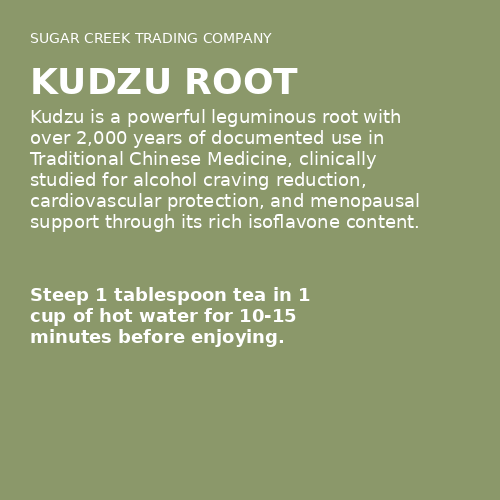
A powerful leguminous root with over 2,000 years of documented use in Traditional Chinese Medicine, clinically studied for alcohol craving reduction, cardiovascular protection, and menopausal support through its rich isoflavone content.
BOTANICAL IDENTIFICATION
Scientific Name: Pueraria montana var. lobata (Willd.) Maesen & S.M.Almeida ex Sanjappa & Predeep (syn. Pueraria lobata (Willd.) Ohwi)
Common Names: Kudzu, Kuzu, Japanese Arrowroot, Ge Gen (Chinese), Kakkon (Japanese), Chilk (Korean)
Family: Fabaceae (Legume family)
Kudzu is a vigorous, semi-woody perennial climbing vine that can extend 20 to 30 meters in a single growing season, covering trees, structures, and entire hillsides with its dense, trifoliate foliage. Each leaf is composed of three large, broadly ovate leaflets, 8 to 20 centimeters long, with the terminal leaflet often three-lobed. The stems are hairy, tough, and rope-like, capable of rooting at nodes to produce new plants. Flowers are fragrant, reddish-purple, grape-scented, and borne in upright racemes during late summer. The root, the primary medicinal and commercial part, is a massive, tuberous taproot that can grow to over two meters in length and weigh 180 kilograms or more in mature plants, storing enormous reserves of starch and bioactive isoflavones.
Pueraria lobata is native to East and Southeast Asia, occurring naturally in China, Japan, Korea, and parts of the Pacific Islands. It was introduced to the United States in 1876 at the Philadelphia Centennial Exposition as an ornamental and later promoted extensively by the Soil Conservation Service in the 1930s and 1940s for erosion control. In the warm, humid climate of the American Southeast, kudzu found ideal growing conditions and no natural controls, becoming one of the most notorious invasive species in North America, now covering an estimated 3 million hectares. In its native Asian range, kudzu is kept in ecological balance by natural herbivores, insects, and traditional harvest practices.
CULTURAL AND HISTORICAL USE
Kudzu root, known as Ge Gen in Chinese, is one of the oldest and most important herbs in Traditional Chinese Medicine, first recorded in the Shennong Ben Cao Jing (Divine Farmer's Classic of Materia Medica), compiled approximately 200 CE. It is classified as sweet, acrid, and cool, entering the Spleen and Stomach meridians. The classic formula Ge Gen Tang (Kudzu Root Decoction), recorded in Zhang Zhongjing's Shang Han Lun (Treatise on Cold Damage, circa 220 CE), remains one of the most commonly prescribed formulas in East Asian medicine today, used for the early stages of colds and flu with stiff neck and upper back tension. Ge Gen is also a key ingredient in Ge Gen Qin Lian Tang, prescribed for diarrhea with fever, and in numerous formulas for hypertension, diabetes, and alcohol intoxication.
In Japan, kudzu root starch (kuzu) has been prized for over a thousand years as both a food and medicine. The laborious process of extracting pure kudzu starch from the massive roots, involving repeated washing, settling, and drying, yields a premium thickening agent used in traditional Japanese confections (wagashi), savory sauces, and the medicinal porridge called kuzuyu, which is given to those recovering from illness, colds, or digestive upset. The finest kuzu, from Yoshino in Nara Prefecture, is considered a luxury ingredient and has been produced by the same family workshops for generations. In Korean medicine, kudzu root (chilk) is similarly used for fever, headache, and alcohol-related symptoms.
The use of kudzu for alcohol-related problems has deep historical roots. The Ben Cao Gang Mu (Comperta of Materia Medica, 1596) by Li Shizhen specifically recommends Ge Gen flower and root for "overcoming alcohol intoxication and stopping excessive drinking." This traditional application has attracted significant modern scientific interest, leading to clinical trials at Harvard Medical School and other institutions investigating kudzu's isoflavones as a potential intervention for alcohol use disorders. The convergence of ancient traditional knowledge with modern clinical research is one of the most compelling stories in ethnopharmacology.
KEY BIOACTIVE COMPOUNDS & BENEFITS
| Compound/Class | Location in Plant | Human Benefit | Role in Plant |
|---|---|---|---|
| Puerarin (8-C-glucoside of daidzein) | Root (highest concentration) | Vasodilatory, cardioprotective, neuroprotective; increases cerebral and coronary blood flow; modulates alcohol metabolism | UV-protective flavonoid and nodulation signaling molecule |
| Daidzein and daidzin | Root and flowers | Phytoestrogen; supports menopausal symptoms, bone density; inhibits aldehyde dehydrogenase (ALDH-2) linked to alcohol craving reduction | Antimicrobial defense and rhizobial symbiosis signaling |
| Genistein | Root | Antioxidant, anti-inflammatory, anticancer research; tyrosine kinase inhibition | Isoflavone defense compound and nitrogen-fixation signal |
| Pueraria polysaccharides and starch | Root | Prebiotic fiber; hepatoprotective; blood sugar modulation | Energy storage for overwintering and regrowth |
| Puerosides and kudzusaponins (triterpenoid saponins) | Root | Anti-inflammatory, hepatoprotective, hypoglycemic | Antimicrobial and antiherbivore defense |
Puerarin is the signature compound of kudzu root and one of the most intensively studied single phytochemicals in Chinese herbal medicine, with thousands of published papers examining its pharmacology. It is unique among isoflavones in being a C-glycoside, meaning the sugar molecule is bonded directly to the carbon backbone rather than through an oxygen bridge. This structural feature gives puerarin greater metabolic stability and different pharmacokinetic properties compared to other soy isoflavones, contributing to its distinct cardiovascular and neurological activities.
HOW IT WORKS IN THE BODY
Kudzu root exerts its effects through multiple pharmacological mechanisms, centered on isoflavone-mediated vascular relaxation, enzyme modulation, and phytoestrogenic activity.
Cardiovascular and Cerebrovascular Protection:
Puerarin is a potent vasodilator that relaxes smooth muscle in blood vessel walls through multiple mechanisms, including beta-adrenergic receptor activation, calcium channel blocking, and nitric oxide pathway stimulation. In Chinese hospitals, injectable puerarin has been used for decades as an approved treatment for angina pectoris and acute myocardial infarction. Oral consumption of kudzu root delivers puerarin at lower but sustained levels that support healthy blood pressure, improve microcirculation, and increase blood flow to the heart and brain. This vasodilatory effect is also the mechanism behind kudzu's traditional use for relieving neck stiffness and headaches, symptoms that often involve vascular constriction in the upper body.
Alcohol Craving and Consumption Reduction:
Landmark clinical trials conducted at McLean Hospital (Harvard Medical School) by Dr. Scott Lukas and colleagues demonstrated that kudzu root extract significantly reduced beer consumption in heavy drinkers in a controlled laboratory setting. The proposed mechanism involves daidzin and daidzein's inhibition of mitochondrial aldehyde dehydrogenase (ALDH-2) and alcohol dehydrogenase (ADH), enzymes central to alcohol metabolism. By slowing alcohol metabolism, kudzu may increase the peak blood alcohol level reached per drink, producing a sense of satiety sooner. Additional evidence suggests that puerarin may modulate dopaminergic reward pathways in the brain, reducing the reinforcing effects of alcohol.
Phytoestrogenic Activity and Menopausal Support:
The isoflavones daidzein and genistein are well-characterized phytoestrogens that bind selectively to estrogen receptor beta (ER-beta), producing mild estrogenic effects in tissues where estrogen is deficient while potentially blocking stronger estrogenic stimulation in tissues where it is excessive. This selective action underlies kudzu's traditional and modern use for menopausal hot flashes, bone density support, and hormonal balance. Clinical studies in Asian and European populations have demonstrated reductions in hot flash frequency and severity with isoflavone supplementation.
Anti-inflammatory and Antioxidant Activity:
Puerarin and the other kudzu isoflavones inhibit NF-kB signaling, reduce proinflammatory cytokine production (TNF-alpha, IL-6), and scavenge reactive oxygen species. These properties contribute to the herb's protective effects on the liver, brain, and cardiovascular system, and underlie its traditional use in fever and inflammatory conditions.
DOSE GUIDELINES
| Preparation Type | Typical Dose | Purpose |
|---|---|---|
| Decoction (traditional TCM method) | 9-15 grams of dried root simmered in 2-3 cups of water for 20-30 minutes; drink throughout the day | Classic Ge Gen preparation for colds, stiff neck, fever, or alcohol-related symptoms |
| Powdered root in capsules | 1.5-3 grams daily, divided into two or three doses | General cardiovascular support, menopausal symptom relief, or alcohol moderation |
| Tincture (1:3, 50% ethanol) | 3-5 mL, two to three times daily | Convenient liquid format for sustained isoflavone delivery |
| Kudzu starch (kuzu) in porridge or thickened drinks | 1-2 tablespoons dissolved in warm water or broth | Gentle digestive support; convalescence; traditional Japanese kuzuyu |
Kudzu root is suitable for both acute and long-term use. For early-stage colds and flu, higher doses over a short period (3-5 days) are traditional. For cardiovascular support, menopausal symptoms, or alcohol craving management, sustained use over weeks to months at moderate doses is typical. The decoction method extracts the full spectrum of compounds most effectively, as puerarin is water-soluble and heat-stable.
PREPARATION AND USES
Dried kudzu root pieces are best prepared as a traditional decoction. Place 9 to 15 grams of the root in a pot with approximately 600 mL of water, bring to a boil, then reduce heat and simmer for 20 to 30 minutes until the volume has reduced by about one-third. Strain and drink warm, dividing the decoction into two or three servings throughout the day. This is the standard method used in TCM practice and extracts the highest concentration of puerarin and other isoflavones. For a milder preparation, the root can be steeped in hot water as an infusion, though a decoction yields significantly higher active compound levels.
Kudzu root powder can be stirred into smoothies, mixed into oatmeal, or encapsulated for convenient daily use. In the Japanese tradition, pure kudzu starch (a refined product) is dissolved in warm water with umeboshi plum paste, grated ginger, and a touch of soy sauce to make kuzuyu, a soothing, easily digestible drink for illness recovery. Kudzu root is commonly combined in TCM formulas with ephedra, cinnamon twig, and peony root (Ge Gen Tang) for wind-cold patterns, or with scutellaria and coptis (Ge Gen Qin Lian Tang) for diarrhea with heat signs. For alcohol moderation, it is sometimes combined with milk thistle and schisandra for comprehensive liver support.
OPTIMAL CONTEXT FOR USE
Kudzu root is especially well-suited for individuals experiencing:
Desire to reduce alcohol consumption, where clinical evidence supports kudzu's ability to decrease the number of drinks consumed per session and reduce binge-drinking frequency
Early-stage colds and flu with neck stiffness, upper back tension, and headache, the classic Ge Gen Tang presentation that has been treated with kudzu for two millennia
Cardiovascular concerns including hypertension, poor circulation, or angina, where puerarin's vasodilatory and cardioprotective properties provide meaningful support
Menopausal symptoms, particularly hot flashes and night sweats, where the phytoestrogenic isoflavones offer a plant-based approach to hormonal comfort
Blood sugar management challenges, where preliminary research and traditional use suggest kudzu may support glucose metabolism and insulin sensitivity
Kudzu root combines well with cinnamon twig and white peony for cold and flu formulas, with hawthorn berry and dan shen for cardiovascular support, and with red clover and black cohosh for menopausal protocols.
SUSTAINABILITY AND ETHICAL HARVESTING
In its native range across East Asia, kudzu is both cultivated and wild-harvested. The plant's extraordinary growth rate and nitrogen-fixing root system make it an inherently renewable resource that requires minimal agricultural inputs. Chinese and Japanese producers have cultivated kudzu for food and medicine for centuries, and sustainable harvest practices are well established. In Japan, premium kuzu root harvesting in the mountains of Yoshino follows centuries-old traditions that ensure root regeneration.
In the southeastern United States, kudzu is classified as an invasive species and harvesting it is actively encouraged as a management strategy. Any kudzu root sourced from North America represents a net ecological benefit, as removing this aggressive vine allows native plant communities to recover. This makes American-harvested kudzu one of the rare cases where wild harvest is not only sustainable but environmentally restorative. The irony of a plant that is simultaneously a treasured medicine in Asia and a reviled invader in North America underscores the importance of ecological context in plant management.
SAFETY AND CAUTIONS
Kudzu root has a strong safety profile supported by centuries of dietary and medicinal use and modern clinical trials. The following precautions should be observed:
The isoflavones in kudzu have phytoestrogenic activity. Individuals with hormone-sensitive conditions (estrogen receptor-positive breast cancer, endometriosis, uterine fibroids) should consult a healthcare provider before use.
Kudzu may potentiate the effects of blood-thinning medications (warfarin, aspirin) and antidiabetic drugs (metformin, insulin) by enhancing their pharmacological activity. Monitor blood sugar and clotting parameters if combining.
Pregnant and nursing women should avoid therapeutic doses of kudzu due to its phytoestrogenic properties and limited safety data in these populations.
Individuals taking methotrexate or other medications metabolized by liver cytochrome P450 enzymes should be aware that kudzu isoflavones may alter drug metabolism. Consult a prescriber before combining.
While kudzu may help reduce alcohol consumption, it is not a substitute for professional treatment of alcohol use disorder. Individuals with serious alcohol dependency should seek qualified medical support.
REFERENCES
Lukas, S.E., Penetar, D., Berko, J., Vicens, L., Palmer, C., Mallya, G., Macklin, E.A., & Lee, D.Y. (2005). "An extract of the Chinese herbal root kudzu reduces alcohol drinking by heavy drinkers in a naturalistic setting." Alcoholism: Clinical and Experimental Research, 29(5), 756-762.
Zhou, Y.X., Zhang, H., & Peng, C. (2014). "Puerarin: A review of pharmacological effects." Phytotherapy Research, 28(7), 961-975.
Keung, W.M. & Vallee, B.L. (1998). "Kudzu root: An ancient Chinese source of modern antidipsotropic agents." Phytochemistry, 47(4), 499-506.
FINAL NOTE
Kudzu root is a plant of extraordinary contradictions: an invasive menace in the American South, yet a cornerstone of healing in the pharmacies of Beijing and Tokyo. Its isoflavone chemistry, anchored by the unique compound puerarin, gives it a pharmacological sophistication that has been validated by both two millennia of clinical observation and modern randomized controlled trials. Whether used to ease the grip of alcohol, open constricted blood vessels, or soothe the transition of menopause, kudzu root delivers the kind of deep, systemic support that only a plant with a massive, starch-laden taproot and thousands of years of evolutionary refinement can provide.
Share