Sugar Creek Trading Company
Linden Leaf And Flower
Linden Leaf And Flower
Impossible de charger la disponibilité du service de retrait
TILIA EUROPAEA / TILIA CORDATA
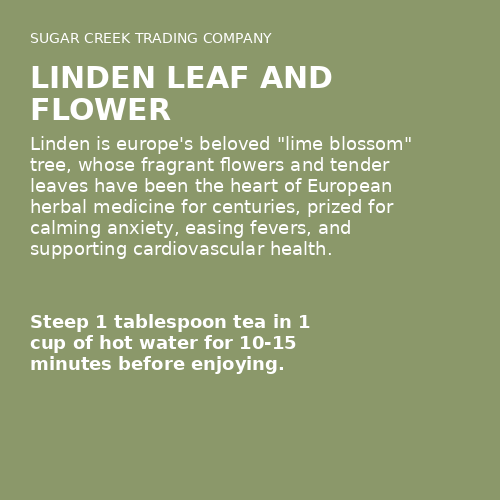
Europe's beloved "lime blossom" tree, whose fragrant flowers and tender leaves have been the heart of European herbal medicine for centuries, prized for calming anxiety, easing fevers, and supporting cardiovascular health.
BOTANICAL IDENTIFICATION
Scientific Name: Tilia europaea L. (hybrid of T. cordata and T. platyphyllos); Tilia cordata Mill. (Small-leaved Linden)
Common Names: Linden, Lime Blossom, Lime Tree, Basswood, Tilia, Tilleul (French), Lindenbluten (German), Tilo (Spanish)
Family: Malvaceae (Mallow family; formerly Tiliaceae)
Linden trees are large, long-lived deciduous trees that can reach 20 to 40 meters in height and live for several hundred years, with some ancient specimens in Europe estimated at over a thousand years old. The leaves are heart-shaped (cordate), 4 to 10 centimeters across, with serrated margins, dark green above and paler beneath, often with tufts of fine hair in the vein axils on the underside. The flowers are the medicinally prized part: small, pale yellow to cream-colored, five-petaled, intensely fragrant blossoms that hang in clusters of 4 to 10 from a distinctive wing-shaped bract (a modified leaf) that later aids in wind dispersal of the small, round, hard fruits. A linden tree in full bloom fills the surrounding air with a sweet, honey-like perfume that attracts clouds of bees, making it one of the most important honey trees in Europe.
Tilia cordata (small-leaved linden) is native throughout Europe from Britain to the Ural Mountains, while Tilia platyphyllos (large-leaved linden) ranges across central and southern Europe. Tilia europaea is their naturally occurring hybrid, common in cultivation and city plantings. All three are used medicinally and are considered interchangeable in commerce. Linden trees grow in temperate forests, along riverbanks, and in rich, moist soils, and have been planted along streets, in parks, and in town squares across Europe for centuries as both shade trees and cultural landmarks.
CULTURAL AND HISTORICAL USE
The linden tree holds an exceptionally deep place in European culture and medicine. In Germanic mythology, the linden was sacred to Freya, goddess of love and fertility, and linden trees served as gathering places for village councils, courts, and celebrations throughout the medieval period. The famous "Dorflinde" (village linden) was the social and spiritual center of countless German, Austrian, and Swiss communities for centuries. In Slavic tradition, the linden (lipa) was so culturally important that it gave its name to months in several calendars, to cities (Leipzig derives from the Slavic word for linden), and remains a national symbol of the Czech Republic, Slovakia, and Slovenia.
Medicinally, linden flower tea (tilleul) has been one of the most widely consumed herbal remedages in European folk medicine since at least the medieval period. Hildegard von Bingen (1098-1179) wrote of its use, and it has been a fixture in European pharmacopoeias for centuries. In France, tilleul remains the most popular herbal tea in the country, consumed after meals and before bed as a gentle digestive and sleep aid. French hospitals historically served linden flower tea to patients as a calming, restorative beverage. The German Commission E, one of the most rigorous herbal regulatory bodies, approved linden flower for use as a diaphoretic (fever-reducing sweat therapy) and for catarrhs of the respiratory tract.
In traditional European herbalism, linden flower tea was the first-line home remedy for colds and fevers, particularly in children. The method was to drink several cups of hot linden tea, climb into bed under heavy blankets, and "sweat out" the illness. This diaphoretic approach has a physiological basis: the flavonoids and volatile oils in linden promote peripheral vasodilation and sweating, which helps the body regulate fever and accelerate immune clearance of infections. Beyond fever management, European herbalists prescribed linden for nervous tension, heart palpitations, high blood pressure, digestive spasms, and as a general relaxant for people who carry stress in their bodies as muscle tension and restlessness.
KEY BIOACTIVE COMPOUNDS & BENEFITS
| Compound/Class | Location in Plant | Human Benefit | Role in Plant |
|---|---|---|---|
| Flavonoids (quercetin, kaempferol, tiliroside, rutin) | Flowers and leaves | Antioxidant, anti-inflammatory, antispasmodic, vasoprotective; support healthy blood pressure | UV protection and pollinator signaling |
| Volatile oils (farnesol, geraniol, linalool, eugenol) | Flowers (0.02-0.1%) | Anxiolytic, mildly sedative, diaphoretic, antimicrobial | Pollinator attraction and antimicrobial defense |
| Mucilage polysaccharides (arabinogalactans) | Flowers, leaves, and bract | Demulcent; soothe irritated mucous membranes in throat, stomach, and respiratory tract | Water retention and tissue hydration |
| Phenolic acids (chlorogenic acid, caffeic acid, p-coumaric acid) | Flowers and leaves | Antioxidant, hepatoprotective, and mild hypotensive | Defense against microbial attack and oxidative stress |
| Proanthocyanidins (tannins) | Leaves and flowers | Astringent, anti-diarrheal, and vascular-toning properties | Herbivore deterrent and wound-sealing |
The therapeutic character of linden is defined by the synergy between its calming volatile oils, its tissue-soothing mucilage, and its vascular-protective flavonoids. This three-part chemistry creates a medicine that simultaneously relaxes the nervous system, soothes irritated mucosal surfaces, and supports healthy circulation, a combination that few other single herbs can match. The inclusion of both leaf and flower in this preparation ensures the full spectrum of both volatile and non-volatile compounds is represented.
HOW IT WORKS IN THE BODY
Linden leaf and flower exerts its effects through several interconnected mechanisms that center on relaxation, vascular health, and mucosal protection.
Nervous System Relaxation and Anxiolytic Action:
The volatile oil components farnesol and linalool have well-documented anxiolytic properties, acting on GABA receptors and the limbic system to reduce nervous excitability. The flavonoid fraction, particularly quercetin and kaempferol, further supports this calming effect through mild sedative and antispasmodic activity. Clinical observations and traditional use consistently describe linden as a gentle nervine that eases anxiety, reduces restlessness, and promotes natural sleep without morning grogginess. Importantly, linden's calming action extends to the cardiovascular system, helping to reduce stress-related heart palpitations and nervous tachycardia.
Cardiovascular and Vascular Support:
Linden flavonoids, especially rutin and tiliroside, strengthen capillary walls, reduce vascular permeability, and promote healthy endothelial function. The herb's antispasmodic action extends to vascular smooth muscle, producing mild vasodilation that can help lower blood pressure. Historically, European physicians noted that linden was particularly effective for hypertension that was worsened by stress and anxiety, a connection now understood through the herb's combined neurological and vascular mechanisms. The antioxidant phenolic acids further protect blood vessel walls from oxidative damage.
Diaphoretic and Fever Management:
When consumed as a hot tea, linden promotes peripheral vasodilation and sweating, which supports the body's natural fever-management mechanisms. This is not fever suppression but fever regulation: by opening the peripheral circulation and inducing perspiration, the body can more efficiently dissipate excess heat while maintaining the beneficial immune-stimulating effects of moderate fever. The volatile oils and flavonoids work together in this process, with the heat of the tea itself contributing to the diaphoretic effect.
Respiratory and Digestive Demulcent Action:
The mucilage polysaccharides in linden create a protective, soothing film over irritated mucous membranes in the throat, upper respiratory tract, and stomach. This demulcent action relieves dry coughs, sore throats, and mild gastric irritation. Combined with the antispasmodic effects of the flavonoids, linden tea can calm both respiratory and digestive spasms, making it useful for coughs accompanied by stomach upset, a common pattern in viral infections.
DOSE GUIDELINES
| Preparation Type | Typical Dose | Purpose |
|---|---|---|
| Hot infusion (tea) | 2-3 teaspoons dried flower and leaf per cup of boiling water, steeped covered 10-15 minutes; 2-4 cups daily | Relaxation, cardiovascular support, general wellness |
| Diaphoretic infusion (fever tea) | 1 tablespoon per cup, steeped 15 minutes, drunk as hot as tolerable; 3-5 cups in rapid succession | Acute fever management and cold/flu support (traditional sweat therapy) |
| Tincture (1:5, 40% ethanol) | 2-4 mL, two to three times daily | Anxiety, nervous tension, heart palpitations |
| Combined with elderflower and peppermint | Equal parts of each, 1-2 teaspoons of blend per cup | Classic European cold and flu formula |
Linden is a gentle herb suitable for daily use as a wellness tea, and its effects build pleasantly with regular consumption. For acute fever support, the traditional approach of drinking several cups of very hot tea in succession and then resting under warm blankets remains highly effective. For anxiety and sleep, evening consumption of one to two strong cups is typically sufficient. The tea is safe for children at reduced doses (half the adult amount) and is one of the most traditional children's fever remedies in European herbalism.
PREPARATION AND USES
Linden leaf and flower is ideally prepared as a covered hot infusion. Place two to three teaspoons of the dried herb in a cup or teapot, pour freshly boiled water over it, and cover tightly to prevent the volatile oils from escaping with the steam. Steep for 10 to 15 minutes, then strain and drink. The resulting tea is a pale golden-green color with a delicate, sweet, honey-like aroma and a mild, pleasant flavor with subtle floral and slightly mucilaginous character. Most people find it immediately appealing, and it requires no sweetener, though honey is a traditional and complementary addition.
Linden is an outstanding blending herb. The classic European cold and flu combination is equal parts linden flower, elderflower, and peppermint, brewed as a hot tea and consumed at the first sign of symptoms. For a relaxation blend, combine linden with chamomile and lavender. For cardiovascular support, combine with hawthorn leaf and flower and motherwort. For a children's calming tea, blend with chamomile and catnip. Linden can also be prepared as a tincture by macerating the dried flowers and leaves in 40% ethanol at a 1:5 ratio for 4 to 6 weeks. For topical use, a strong linden infusion makes a soothing facial compress for irritated skin and a calming addition to bath water.
OPTIMAL CONTEXT FOR USE
Linden leaf and flower is especially well-suited for individuals experiencing:
Anxiety, nervous tension, and restlessness, particularly when accompanied by heart palpitations, racing thoughts, or a general inability to relax and let go at the end of the day
Mild to moderate hypertension, especially the type worsened by stress, where gentle vasodilation and nervous system calming can support blood pressure reduction alongside other lifestyle measures
Colds, fevers, and upper respiratory infections, where the traditional European diaphoretic approach (hot linden tea plus bed rest) can support the body's natural immune and fever response
Insomnia and sleep difficulty, particularly trouble falling asleep due to an overactive mind, where a gentle, non-sedating nervine is preferred over stronger sleep herbs
Digestive discomfort with a nervous component, such as stress-related stomach upset, nervous indigestion, or spasmodic abdominal pain
Linden pairs beautifully with hawthorn for cardiovascular support, with valerian and passionflower for deeper sleep assistance, with elderflower for comprehensive cold and flu treatment, and with chamomile for gentle everyday relaxation.
SUSTAINABILITY AND ETHICAL HARVESTING
Linden flowers and leaves are harvested from large, mature trees that are abundant across Europe and increasingly common in North American landscapes. The harvest is non-destructive: flowers and attached leaves are picked or clipped from the branches during the brief flowering window (typically one to two weeks in early to mid-summer), and the tree continues to grow and produce indefinitely. Many European linden trees are centuries-old municipal or village trees that have been continuously harvested for generations without any negative impact on the tree's health or longevity.
Commercial linden flower production is centered in Bulgaria, Poland, Romania, Albania, and other parts of Eastern Europe, where wild collection from abundant native stands and planted trees is the primary sourcing method. Cultivated orchard production also exists. Tilia species are not threatened or endangered; they are among the most commonly planted urban and landscape trees in the Northern Hemisphere. The brief annual harvest window and the non-destructive collection method make linden one of the most inherently sustainable herbs in the European herbal tradition.
SAFETY AND CAUTIONS
Linden leaf and flower is one of the safest herbs in the European pharmacopoeia and is approved for use in adults and children by the German Commission E and the European Medicines Agency. The following minor precautions should be noted:
Individuals with known allergies to Tilia species or other members of the Malvaceae family should exercise caution. Allergic reactions are rare but possible.
Very rare cases of contact dermatitis have been reported from handling fresh linden flowers. Dried preparations do not typically cause this issue.
Due to its mild hypotensive effects, individuals already taking blood pressure medications should monitor their blood pressure when adding linden to their routine and consult a healthcare provider.
Linden may mildly potentiate the effects of sedative medications and other calming herbs. Exercise appropriate caution when combining with prescription sedatives or anxiolytics.
There are no known contraindications during pregnancy or breastfeeding at normal tea consumption levels, and linden has a long history of use in European folk medicine for pregnant and nursing women. However, as with all herbs, pregnant women should consult a qualified practitioner before therapeutic-dose use.
REFERENCES
Aguirre-Hernandez, E., Martinez, A.L., Gonzalez-Trujano, M.E., Moreno, J., Vibrans, H., & Soto-Hernandez, M. (2007). "Pharmacological evaluation of the anxiolytic and sedative effects of Tilia americana L. var. mexicana in mice." Journal of Ethnopharmacology, 109(1), 140-145.
Herrera-Ruiz, M., Roman-Ramos, R., Zamilpa, A., Tortoriello, J., & Jimenez-Ferrer, J.E. (2008). "Flavonoids from Tilia americana with anxiolytic activity in plus-maze test." Journal of Ethnopharmacology, 118(2), 312-317.
European Medicines Agency. (2012). "Assessment report on Tilia cordata Miller, Tilia platyphyllos Scop., Tilia x vulgaris Heyne or their mixtures, flos." EMA/HMPC/337067/2011.
FINAL NOTE
Linden is the gentle giant of European herbalism: a towering tree that yields one of the mildest, most universally tolerated, and most pleasantly flavored medicines in the botanical world. Its ability to simultaneously calm the nerves, protect the heart, soothe the mucous membranes, and support the body's fever response makes it a true whole-system healer. When a French grandmother brews tilleul for a feverish grandchild or a restless sleeper, she is drawing on a thousand years of unbroken clinical wisdom that modern pharmacology has only begun to validate.
Share