Sugar Creek Trading Company
Luna Night Cota Herbal Tea
Luna Night Cota Herbal Tea
Impossible de charger la disponibilité du service de retrait
LUNA NIGHT COTA HERBAL TEA
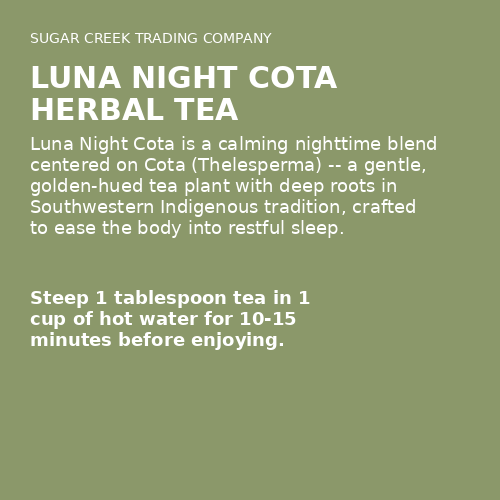
A calming nighttime blend centered on Cota (Thelesperma) -- a gentle, golden-hued tea plant with deep roots in Southwestern Indigenous tradition, crafted to ease the body into restful sleep.
BOTANICAL IDENTIFICATION
Blend Name: Luna Night Cota Herbal Tea
Primary Botanical: Thelesperma megapotamicum (Spreng.) Kuntze, syn. Thelesperma filifolium
Common Names for Cota: Cota, Navajo Tea, Hopi Tea, Greenthread, Indian Tea, Cota Tea
Family: Asteraceae (Daisy/Composite family)
Cota, the heart of this nighttime blend, is a slender, wiry perennial or biennial native to the arid grasslands and mesas of the American Southwest and Great Plains. The plant grows 30 to 60 centimeters tall with finely dissected, thread-like leaves that give it an almost feathery appearance. Small, daisy-like flower heads -- often lacking ray florets, appearing as golden-brown buttons -- bloom from late spring through summer. The entire aerial portion of the plant produces a naturally sweet, golden-amber tea with a smooth, mellow flavor reminiscent of mild chamomile with earthy, slightly honeyed undertones.
Thelesperma species thrive in dry, sandy, and rocky soils at elevations ranging from 1,200 to 2,400 meters across New Mexico, Arizona, Colorado, and into northern Mexico. They are drought-tolerant plants perfectly adapted to the high desert environment, often found growing alongside sagebrush, juniper, and pinon pine.
CULTURAL AND HISTORICAL USE
Cota holds a place of deep cultural importance among the Indigenous peoples of the American Southwest that few herbs can rival. For the Navajo (Dine), Hopi, Pueblo, and other Southwestern nations, Cota tea is not merely a beverage -- it is a staple of daily life, ceremony, and medicine that has been consumed for centuries. Among the Navajo, it is traditionally called "Dine tea" and is served at gatherings, ceremonies, and meals. The Hopi have cultivated and harvested Cota for generations, using it as a nourishing daily drink and a gentle medicine for stomach upset, kidney support, and general well-being.
Unlike many herbs that entered the Western pharmacopoeia through European channels, Cota's medicinal tradition is almost entirely rooted in Indigenous Southwest knowledge. Spanish colonists in New Mexico adopted Cota tea from Pueblo communities during the 17th and 18th centuries, and it became a fixture of New Mexican folk medicine under the name "te de cota." It was valued as a soothing drink for digestive complaints, as a mild diuretic, and as a calming evening beverage. The tradition of drinking Cota tea in the evening to settle the stomach and promote relaxation has persisted in New Mexican households -- both Indigenous and Hispanic -- for hundreds of years.
The Luna Night Cota blend draws directly from this tradition, combining Cota's naturally calming and mildly sweet profile with complementary nighttime herbs selected to deepen relaxation, ease nervous tension, and support the body's transition into restorative sleep. This is a blend designed for the liminal hours -- the quiet space between the activity of the day and the stillness of the night.
KEY BIOACTIVE COMPOUNDS & BENEFITS
| Compound/Class | Source in Blend | Human Benefit | Role in Plant |
|---|---|---|---|
| Flavonoids (luteolin, apigenin derivatives) | Cota (Thelesperma) | Mild anxiolytic and calming effect; antioxidant protection; supports relaxation without sedation | UV protection and pollinator attraction |
| Phenolic acids (chlorogenic acid, caffeic acid) | Cota and complementary herbs | Anti-inflammatory and antioxidant activity; gentle digestive support | Antimicrobial defense compounds |
| Volatile terpenoids | Aromatic herbs in blend | Calming aroma that supports parasympathetic activation; mild spasmolytic action on digestive smooth muscle | Herbivore deterrence and pollinator signaling |
| Sesquiterpene lactones (low levels) | Cota (as Asteraceae member) | Mild anti-inflammatory and digestive bitter activity | Defense against insect herbivory |
| Polysaccharides | Cota stems and flowers | Soothing demulcent quality in the tea; gentle on the stomach lining | Water retention and structural support in arid conditions |
The therapeutic character of this blend is defined by gentle, cumulative action rather than any single potent compound. Cota's flavonoid profile -- particularly its apigenin-type compounds -- contributes a mild calming quality similar to chamomile but with a smoother, less bitter flavor profile. The complementary nighttime herbs in the blend are selected to enhance these relaxing properties, creating a synergistic formula that works through multiple gentle pathways to promote restfulness.
HOW IT WORKS IN THE BODY
Luna Night Cota Herbal Tea supports the body's natural transition from wakefulness to sleep through several complementary mechanisms.
Nervous System Relaxation:
The flavonoid compounds in Cota, particularly apigenin-type derivatives, interact with GABA-A receptors in the central nervous system, promoting mild anxiolytic and calming effects without heavy sedation. This is the same receptor system targeted by chamomile's well-studied apigenin content, and it helps quiet the overactive mental chatter that often prevents sleep onset. The effect is gentle -- a gradual unwinding rather than a pharmacological knock-out.
Digestive Soothing and Evening Settling:
One of the most common barriers to restful sleep is unresolved digestive tension from the evening meal. Cota has been traditionally used to settle the stomach, and its mild bitter and carminative properties support healthy digestion. The warm tea itself acts as a physical cue for the body to begin its evening wind-down, and the smooth, naturally sweet flavor of Cota makes it a genuinely pleasant ritual rather than a medicinal chore.
Parasympathetic Activation:
The act of preparing and sipping warm herbal tea activates the parasympathetic nervous system -- the "rest and digest" branch of the autonomic nervous system. Combined with the aromatic volatile compounds in the blend, which are inhaled with each sip, this creates a multi-sensory relaxation experience. The warmth, aroma, and flavor work together to signal safety and rest to the body.
Gentle Diuretic and Detoxification Support:
Cota has traditional use as a mild diuretic and kidney-supportive herb. In the context of an evening tea, this gentle action helps the body process and release fluid and metabolic byproducts accumulated during the day, contributing to a sense of lightness and ease before sleep.
DOSE GUIDELINES
| Preparation Type | Typical Dose | Purpose |
|---|---|---|
| Evening tea (standard) | 1-2 tablespoons of blend per 8 oz hot water, steeped 7-10 minutes | Nightly relaxation and sleep support |
| Stronger infusion | 2-3 tablespoons per 8 oz, steeped 15-20 minutes (covered) | Deeper calming effect on restless or high-stress nights |
| Iced evening tea | Brew double strength and pour over ice | Warm-weather alternative; same calming properties |
For best results, drink Luna Night Cota Tea 30 to 60 minutes before your intended bedtime. Allow yourself to sit quietly while drinking it -- this is not a tea to gulp while scrolling through your phone. The ritual of the tea is part of the medicine. Consistent nightly use over one to two weeks often produces the best cumulative results, as the body begins to associate the tea with the onset of sleep.
PREPARATION AND USES
Bring fresh, filtered water to a full boil, then pour it over 1 to 2 tablespoons of Luna Night Cota blend in a mug or teapot. Cover the vessel to retain the volatile aromatic compounds and steep for 7 to 10 minutes. The resulting tea should be a warm golden-amber color with a smooth, mildly sweet, and earthy aroma. Cota is one of the few herbal teas that is naturally pleasant without any sweetener, but a small amount of honey can be added if desired.
This blend is also excellent when prepared as a larger pot to share in the evening with family or guests -- a practice that mirrors the traditional Navajo and Pueblo custom of serving Cota tea communally. For a more concentrated nighttime infusion on particularly restless nights, increase the steeping time to 15 to 20 minutes and keep the vessel covered throughout. The tea can also be cooled and enjoyed as an iced beverage during warm months, though the warming quality of a hot cup is generally preferred for sleep support.
OPTIMAL CONTEXT FOR USE
Luna Night Cota Herbal Tea is especially well-suited for individuals experiencing:
Difficulty winding down in the evening, particularly after mentally stimulating or stressful days
Mild to moderate sleep onset difficulty -- lying awake with racing thoughts or an inability to "turn off" the mind
Evening digestive discomfort, bloating, or heaviness that interferes with comfortable rest
A desire to establish a calming nighttime ritual that does not involve screens, alcohol, or pharmaceutical sleep aids
General nervous tension, restlessness, or the low-level anxiety that often accumulates over the course of a demanding day
This blend pairs well with other sleep-supportive practices such as dimming lights in the evening, gentle stretching, journaling, or quiet reading. It is designed to complement -- not replace -- good sleep hygiene.
SUSTAINABILITY AND ETHICAL HARVESTING
Thelesperma species are widespread and abundant across the American Southwest and Great Plains, and they are not threatened or endangered. Wild Cota grows prolifically in dry grasslands and can be sustainably wildcrafted by harvesting the aerial portions during flowering season while leaving root systems intact to regenerate. However, given the deep cultural significance of Cota to Navajo, Hopi, and Pueblo communities, ethical sourcing is paramount. Wild harvesting should never occur on tribal lands without explicit permission, and commercial use of Cota should ideally support Indigenous harvesters and communities.
Cota can be cultivated from seed in well-drained, sandy soil with full sun and minimal irrigation, making it an excellent candidate for sustainable cultivation in arid and semi-arid regions. Supporting Indigenous-owned Cota harvesting operations and acknowledging the cultural origins of this tea tradition is an essential part of ethical engagement with this plant.
SAFETY AND CAUTIONS
Luna Night Cota Herbal Tea is a gentle, food-grade herbal blend with an excellent safety profile suitable for most adults.
Asteraceae sensitivity: Cota is a member of the Asteraceae (daisy) family. Individuals with known allergies to ragweed, chamomile, echinacea, or other composites should exercise caution and try a small amount first.
Pregnancy and nursing: While Cota has a long history of safe traditional use as a daily beverage, pregnant and nursing individuals should consult a qualified healthcare provider before using any herbal blend regularly, as comprehensive safety data specific to pregnancy is limited.
Mild diuretic effect: The gentle diuretic action of Cota may lead to increased urination. If nighttime bathroom trips are already a concern, consider drinking the tea earlier in the evening (90 minutes or more before bed).
Medication interactions: No significant drug interactions are documented for Cota tea at normal beverage doses, but individuals taking sedative medications, sleep aids, or anti-anxiety drugs should consult their healthcare provider, as additive calming effects are possible.
REFERENCES
Dunmire, W.W. & Tierney, G.D. (1995). Wild Plants of the Pueblo Province: Exploring Ancient and Enduring Uses. Santa Fe: Museum of New Mexico Press.
Moerman, D.E. (1998). Native American Ethnobotany. Portland: Timber Press. Entries on Thelesperma spp.
Moore, M. (1989). Medicinal Plants of the Desert and Canyon West. Santa Fe: Museum of New Mexico Press.
Slattery, B.E., Reshetiloff, K. & Zwicker, S.M. (2003). Native Plants for Wildlife Habitat and Conservation Landscaping: Chesapeake Bay Watershed. U.S. Fish and Wildlife Service.
Srivastava, J.K., Shankar, E. & Gupta, S. (2010). "Chamomile: A herbal medicine of the past with a bright future." Molecular Medicine Reports, 3(6), 895-901. [For apigenin/flavonoid mechanism context.]
FINAL NOTE
Luna Night Cota Herbal Tea carries forward a tradition of evening tea drinking that Southwestern peoples have practiced for centuries -- the simple, powerful act of sitting down with a warm cup as the day ends and the stars emerge. Cota is not a knockout sedative; it is a gentle, steady companion that helps the body remember how to rest. In a culture saturated with stimulants and screens, a cup of golden Cota tea in the quiet hours before sleep is both ancient medicine and modern antidote, and this blend honors that tradition with care.
Share