Sugar Creek Trading Company
Lungwort Lichen
Lungwort Lichen
Impossible de charger la disponibilité du service de retrait
LOBARIA PULMONARIA
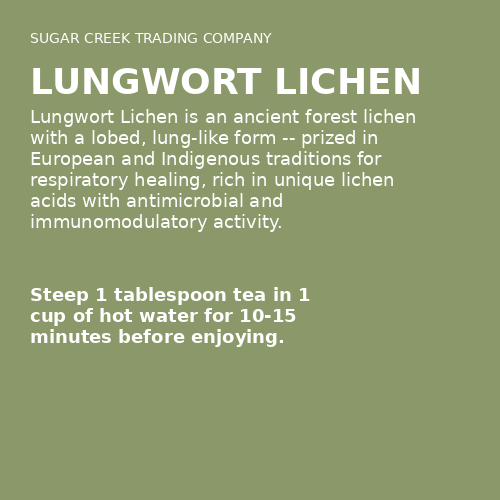
An ancient forest lichen with a lobed, lung-like form -- prized in European and Indigenous traditions for respiratory healing, rich in unique lichen acids with antimicrobial and immunomodulatory activity.
BOTANICAL IDENTIFICATION
Scientific Name: Lobaria pulmonaria (L.) Hoffm.
Common Names: Lungwort Lichen, Tree Lungwort, Lung Lichen, Oak Lungs, Lung Moss, Sticta (historical pharmacopoeia name), Lappen (Scandinavian)
Family: Lobariaceae (within the kingdom Fungi; lichenized ascomycete)
Note: This is a lichen, not a plant. It should not be confused with Lungwort Herb (Pulmonaria officinalis), which is a flowering plant in the Boraginaceae family. Though they share a common name and traditional respiratory uses, they are entirely different organisms.
Lobaria pulmonaria is a large, conspicuous foliose lichen that grows on the bark of deciduous trees -- particularly oak, beech, ash, and maple -- in old-growth and mature forests. The thallus (body) is broadly lobed, 7 to 30 centimeters or more across, with a distinctly ridged and pitted upper surface that closely resembles lung tissue, complete with a network of ridges that evoke the bronchial tree. The upper surface is bright green when wet (due to the photosynthetic algal partner, Dictyochloropsis reticulata) and olive-brown to gray-green when dry. The lower surface is paler with a tomentose (fuzzy) texture and a network of raised veins. The thallus also harbors cyanobacteria (Nostoc) in internal cephalodia, making Lobaria pulmonaria a tripartite lichen -- a symbiosis of fungus, green alga, and cyanobacterium.
This lichen is found across the Northern Hemisphere in oceanic and humid temperate forests, from the Pacific Northwest and Appalachian Mountains of North America to the Atlantic coasts of Europe, Scandinavia, the British Isles, and into eastern Asia. It is an epiphyte that requires clean air, high humidity, and old trees with textured bark, making it an important bioindicator species for forest health and air quality.
CULTURAL AND HISTORICAL USE
Like the herb that shares its common name, lungwort lichen owes its medicinal reputation partly to the Doctrine of Signatures -- the belief that the lung-like appearance of its lobed, ridged thallus indicated its usefulness for pulmonary conditions. However, the use of Lobaria pulmonaria in respiratory medicine predates the formal articulation of the Doctrine of Signatures and is rooted in empirical observation across multiple cultures.
In medieval European medicine, Lobaria pulmonaria was widely used for lung diseases, particularly tuberculosis (then called "consumption"), chronic coughs, and asthma. The lichen was known in apothecary practice as "Pulmonaria arborea" or simply "Sticta" and was included in the London Pharmacopoeia. Monasteries across Germany, Austria, and Switzerland cultivated knowledge of this lichen and prescribed it in teas, decoctions, and powdered form for chest complaints. The 16th-century herbalist Pierandrea Mattioli recommended it for "ulcers of the lungs," and it appeared in various European pharmacopoeias through the 18th century.
In Scandinavia, Lobaria pulmonaria had both medicinal and economic significance. Norwegian and Swedish folk medicine employed it for respiratory ailments and as a wound-healing poultice. It was also historically used in Scandinavian brewing as a bittering and preserving agent before hops became widely available -- a practice that speaks to its antimicrobial properties. In parts of Norway, it was known as "lungelav" (lung lichen) and was boiled into decoctions for stubborn coughs.
Among Indigenous peoples of the Pacific Northwest, including the Nlaka'pamux (Thompson), Okanagan, and other Salish peoples, Lobaria pulmonaria was used medicinally for respiratory infections and as a poultice for wounds and skin conditions. The Nlaka'pamux reportedly chewed the lichen or prepared a tea for coughs and lung complaints. In homeopathic medicine, the related Sticta pulmonaria (now Lobaria pulmonaria) remains a remedy for catarrhal conditions with frontal headache and dry, racking coughs.
KEY BIOACTIVE COMPOUNDS & BENEFITS
| Compound/Class | Location in Lichen | Human Benefit | Role in Lichen |
|---|---|---|---|
| Stictic acid (depsidone) | Medulla (inner layer of thallus) | Antimicrobial activity against respiratory pathogens including Gram-positive bacteria; anti-inflammatory; antioxidant | UV screening; antimicrobial defense; allelopathic deterrent |
| Norstictic acid (depsidone) | Medulla | Antimicrobial; cytotoxic to certain abnormal cell lines; antioxidant | Chemical defense against microbial colonization and competing organisms |
| Constictic acid and related depsidones | Medulla | Contributes to the overall antimicrobial and anti-inflammatory profile of the lichen | Chemical defense system |
| Polysaccharides (lichenin, isolichenin) | Throughout thallus | Demulcent and immunomodulatory; soothe irritated mucous membranes; stimulate immune cell activity | Structural integrity; water absorption and retention |
| Usnic acid (trace amounts) | Cortex (outer layer) | Broad-spectrum antimicrobial, particularly against Staphylococcus and Streptococcus species; anti-inflammatory | UV protection; antimicrobial defense of the lichen surface |
Lichen biochemistry is fundamentally different from plant biochemistry. Lichens produce a class of compounds -- lichen acids (depsides, depsidones, and dibenzofurans) -- that are found nowhere else in nature. These compounds evolved over hundreds of millions of years as chemical defenses in a symbiotic organism that cannot flee from predators, pathogens, or UV radiation. Stictic acid and its related depsidones are the signature compounds of Lobaria pulmonaria, and they demonstrate consistent antimicrobial activity against common respiratory pathogens in laboratory studies. The combination of these unique lichen acids with immunomodulatory polysaccharides gives lungwort lichen a therapeutic profile that no plant can exactly replicate.
HOW IT WORKS IN THE BODY
Lobaria pulmonaria supports respiratory health through mechanisms that reflect its unique biochemistry as a lichen rather than a plant.
Antimicrobial Activity in the Respiratory Tract:
The depsidone compounds in lungwort lichen -- particularly stictic acid and norstictic acid -- demonstrate significant antimicrobial activity against Gram-positive bacteria, including Staphylococcus aureus, Streptococcus pneumoniae, and Bacillus subtilis. These are among the most common bacterial pathogens involved in respiratory infections, sinusitis, and pneumonia. The mechanism of action appears to involve disruption of bacterial cell membrane integrity and interference with bacterial enzyme systems. Unlike broad-spectrum antibiotics, lichen acids tend to target specific pathogenic organisms while having less impact on beneficial microbiota, though more research is needed in this area.
Immunomodulatory and Immune-Stimulating Action:
The polysaccharides in Lobaria pulmonaria -- particularly the beta-glucan-type compounds lichenin and isolichenin -- stimulate immune cell activity, including macrophage activation and natural killer cell function. This immunomodulatory effect primes the body's own defenses against respiratory infection rather than directly killing pathogens. In traditional use, this manifests as improved resistance to recurrent colds and chest infections when lungwort lichen is used regularly over time. Research on beta-glucans from related lichen species (including Cetraria islandica, Iceland moss) has confirmed significant immunostimulatory effects, and the polysaccharides in Lobaria are structurally similar.
Demulcent and Mucosal Protection:
Like Iceland moss, lungwort lichen contains substantial mucilaginous polysaccharides that, when extracted into water, produce a soothing, gel-like consistency that coats and protects irritated respiratory mucous membranes. This demulcent action reduces the sensitivity of cough receptors and shields raw, inflamed tissue from further irritation. The effect is particularly valuable for dry, hacking coughs and sore throats associated with upper respiratory infections.
Anti-Inflammatory and Antioxidant Protection:
Stictic acid and related depsidones demonstrate anti-inflammatory effects through inhibition of cyclooxygenase (COX) and lipoxygenase (LOX) pathways, reducing the production of inflammatory prostaglandins and leukotrienes in respiratory tissue. The antioxidant capacity of these compounds also protects lung tissue from oxidative damage caused by infection, pollution, or chronic inflammation. This is particularly relevant for individuals recovering from respiratory illness, where inflammatory damage to alveolar tissue can persist long after the infectious agent has been cleared.
DOSE GUIDELINES
| Preparation Type | Typical Dose | Purpose |
|---|---|---|
| Dried lichen decoction | 2-4 g simmered gently in 2 cups water for 15-20 minutes, strained; drink 1-2 cups daily | Respiratory support, cough, bronchial infection |
| Tincture (1:5 in 40-50% alcohol) | 2-4 mL, 3 times daily | Convenient dosing for ongoing respiratory and immune support |
| Powdered lichen in capsules | 500-1000 mg, 2-3 times daily | Immune support, long-term respiratory health |
Lungwort lichen is best used as a sustained course over several weeks for chronic respiratory conditions and immune support. For acute respiratory infections, it can be combined with more directly expectorant herbs and used intensively for 7 to 14 days. Decoction (simmering) is the preferred extraction method, as the tougher structure of lichen requires more vigorous extraction than delicate plant leaves.
PREPARATION AND USES
Unlike tender herbs that yield their properties to a simple hot-water infusion, lichens generally require decoction -- gentle simmering -- to fully extract their medicinal compounds. To prepare a lungwort lichen decoction, add 2 to 4 grams of dried, crumbled lichen to approximately 500 mL (2 cups) of cold water, bring slowly to a gentle simmer, and maintain for 15 to 20 minutes. Strain and drink warm. The resulting liquid will have a slightly mucilaginous texture, a faint earthy-mushroom aroma, and a mildly bitter flavor from the lichen acids. Honey pairs well with the earthy taste and provides additional throat-soothing properties.
Lungwort lichen can also be prepared as a tincture by macerating the dried lichen in 40 to 50 percent alcohol for 4 to 6 weeks. The tincture is convenient for travel or for those who find the decoction process inconvenient, though the water-soluble polysaccharides are less completely extracted in an alcohol medium. A dual extraction -- combining a water decoction with an alcohol tincture -- captures both the water-soluble polysaccharides and the alcohol-soluble lichen acids for the most complete preparation. Lungwort lichen combines well in respiratory formulas with mullein, elecampane, thyme, and marshmallow, and in immune-support formulas with reishi, astragalus, and elderberry.
OPTIMAL CONTEXT FOR USE
Lungwort lichen is especially well-suited for individuals experiencing:
Chronic or recurring respiratory infections -- bronchitis, sinusitis, or chest colds that return frequently, suggesting an underlying immune weakness in the respiratory mucosa
Persistent coughs following respiratory illness, particularly dry, hacking coughs that linger after the acute infection has passed
A need for respiratory-specific immune support during cold and flu season or in environments with high pathogen exposure
Recovery from severe respiratory infections where antimicrobial, anti-inflammatory, and tissue-protective actions are all needed simultaneously
Interest in lichen medicine and its unique biochemistry -- for individuals who have worked with plant-based respiratory herbs and want to add a fundamentally different class of organism to their protocol
Lungwort lichen is best understood as a slow, deep-acting respiratory ally rather than a fast-acting acute remedy. It works best when taken consistently over weeks to months, building immune resilience and reducing the frequency and severity of respiratory episodes over time.
SUSTAINABILITY AND ETHICAL HARVESTING
Sustainability is the most important consideration with Lobaria pulmonaria, and it requires careful attention. This lichen grows extremely slowly -- often only 1 to 5 millimeters per year in radial expansion -- and large specimens may be decades or even centuries old. It depends on old-growth and mature forest conditions: clean air, high humidity, and old trees with rough bark. Lobaria pulmonaria has declined dramatically across much of Europe due to air pollution (it is extremely sensitive to sulfur dioxide), deforestation, and habitat loss. It is legally protected in several European countries, including the United Kingdom, where it is listed under Schedule 8 of the Wildlife and Countryside Act. In Scandinavia, populations have declined by an estimated 30 to 50 percent over the past century.
In North America, Lobaria pulmonaria remains relatively widespread in the Pacific Northwest, Appalachian Mountains, and other areas of mature temperate forest, but it is absent from regions with poor air quality or heavily managed forests. Wild harvesting should be conducted with extreme restraint -- never taking more than a small portion of any individual thallus, never removing entire specimens, and never harvesting from areas where the lichen is uncommon. Fallen branches bearing lungwort lichen are the most sustainable collection source. Given the conservation sensitivity of this species, sourcing from reputable suppliers who can verify sustainable and legal harvesting practices is strongly recommended. Supporting efforts to protect old-growth forests is the single most important thing anyone can do for the long-term availability of this remarkable organism.
SAFETY AND CAUTIONS
Lungwort lichen has a long history of traditional use with few reported adverse effects, but several considerations apply.
Bitter lichen acids and digestive sensitivity: The depsidone compounds (stictic acid, norstictic acid) are mildly bitter and can cause stomach upset in sensitive individuals, especially when taken on an empty stomach or in large doses. Start with smaller amounts and take with food if needed.
Usnic acid caution: While Lobaria pulmonaria contains only trace amounts of usnic acid (far less than Usnea species), it is worth noting that high-dose usnic acid supplements have been associated with liver toxicity in isolated cases. At the doses present in lungwort lichen preparations, this is not a meaningful concern, but individuals with liver disease should exercise standard caution with any lichen product.
Pregnancy and nursing: There is insufficient safety data for use of Lobaria pulmonaria during pregnancy and breastfeeding. Avoid use during these periods as a precaution.
Medication interactions: No significant drug interactions are documented, but the antimicrobial properties of lichen acids may theoretically interact with antibiotic therapy. Consult a healthcare provider if you are taking prescription antimicrobials.
Identification: Ensure correct identification. Lobaria pulmonaria has a distinctive appearance, but lichens can be challenging to identify without experience. Purchase from a reputable herbal supplier rather than attempting to wildcraft unless you are confident in your identification skills.
REFERENCES
Rankovic, B. (ed.) (2015). Lichen Secondary Metabolites: Bioactive Properties and Pharmaceutical Potential. Cham: Springer International Publishing.
Shrestha, G. & St. Clair, L.L. (2013). "Antimicrobial activity of extracts from two lichens Ramalina menziesii and Usnea lapponica." Bulletin of the California Lichen Society, 20(1), 5-10. [For broader lichen antimicrobial context.]
Scheidegger, C. (1995). "Early development of transplanted isidioid soredia of Lobaria pulmonaria in an endangered population." The Lichenologist, 27(5), 361-374.
Ingolfsdottir, K. (2002). "Usnic acid." Phytochemistry, 61(7), 729-736.
Turner, N.J. (1998). Plant Technology of First Peoples in British Columbia. Vancouver: UBC Press. References to Lobaria pulmonaria use among Salish peoples.
FINAL NOTE
Lobaria pulmonaria is not a plant but something far more ancient and strange -- a tripartite symbiosis of fungus, alga, and cyanobacterium that has been colonizing the bark of old-growth trees since long before flowering plants existed. Its biochemistry produces compounds found nowhere else in the living world, and its traditional respiratory uses span from Norse folk medicine to Pacific Northwest Indigenous healing to European monastic pharmacies. To use lungwort lichen is to engage with a fundamentally different branch of the tree of life, one that offers antimicrobial, immunomodulatory, and tissue-protective benefits that complement rather than duplicate what plants provide. It is also a reminder that the most potent medicines often come from the most fragile ecosystems, and that preserving old forests is, in a very real sense, preserving our pharmacy.
Share