Sugar Creek Trading Company
Madder Root
Madder Root
Impossible de charger la disponibilité du service de retrait
RUBIA TINCTORUM
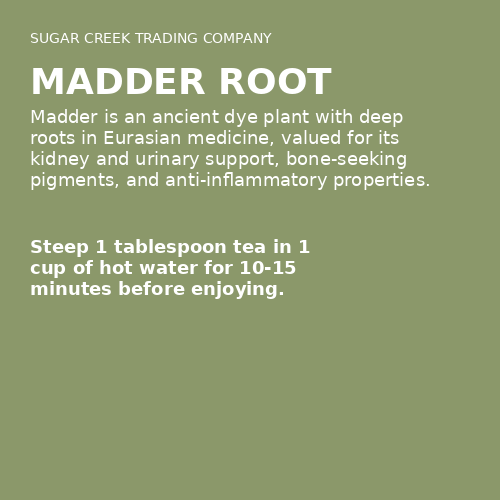
An ancient dye plant with deep roots in Eurasian medicine, valued for its kidney and urinary support, bone-seeking pigments, and anti-inflammatory properties.
BOTANICAL IDENTIFICATION
Scientific Name: Rubia tinctorum L.
Common Names: Madder Root, Common Madder, Dyer's Madder, Turkey Red, Krapp, Garance, Rubia, Manjistha (sometimes applied to R. cordifolia)
Family: Rubiaceae (Bedstraw/Coffee family)
Rubia tinctorum is a scrambling, herbaceous perennial with angular, prickly stems that can extend 60 to 120 cm in length, climbing over neighboring vegetation using recurved hooks along the stem edges and leaf midribs. The whorled leaves are arranged in groups of four to six, lanceolate to ovate, 5 to 10 cm long, with rough margins and a prominent midvein. Small, star-shaped, yellowish-green flowers appear in loose cymes from June through August, developing into small, fleshy, dark red to blackish berries approximately 4 to 6 mm in diameter.
Native to southeastern Europe, western and central Asia, and parts of North Africa, Rubia tinctorum thrives in warm, well-drained, calcareous soils and full to partial sun. It was extensively cultivated throughout Europe, the Middle East, and India for centuries as a primary source of red dye. The thick, cylindrical, reddish-brown roots can reach considerable depth and are harvested from plants at least three years old, when anthraquinone pigment concentrations are highest.
CULTURAL AND HISTORICAL USE
Madder root is one of the most historically significant plants in human civilization, with a documented history of use spanning over 5,000 years. Fragments of madder-dyed textiles have been recovered from the Indus Valley civilization (circa 3000 BCE), from Egyptian tombs of the pharaonic period, and from Bronze Age archaeological sites across Europe. The red pigment alizarin, extracted from madder root, was the foundation of the textile dyeing industry across the ancient and medieval world. Turkish Red, a complex dyeing process using madder root with alum and oil mordants, produced a vivid, wash-fast scarlet that was the most prized textile color in Europe and the Ottoman Empire for centuries. The French military's iconic red trousers, worn until 1915, were dyed with madder root from the garanciere fields of Provence.
Beyond its role as a dyestuff, madder root has a substantial medicinal history. Dioscorides recorded its use in De Materia Medica (circa 70 CE) for promoting urination, bringing on menstruation, and dissolving kidney and bladder stones. Pliny the Elder described similar applications. In the Unani (Greco-Arabic) medical tradition, madder root (known as "Runas" or "Fuwa") was prescribed as a diuretic, emmenagogue, and treatment for jaundice, splenic enlargement, and sciatica. Persian physicians including Avicenna (Ibn Sina) referenced it in the Canon of Medicine for kidney stone dissolution and urinary complaints. In Ayurvedic medicine, the closely related species Rubia cordifolia (Manjistha) is one of the most important blood-purifying herbs, and the two species share overlapping chemistry and applications.
European folk medicine traditions in Germany, France, and the Balkans used madder root decoctions for kidney stones, amenorrhea, rickets, and anemia. The observation that madder root stains bones red when consumed by animals, first documented by the English surgeon John Belchier in 1736, became a foundational experiment in understanding bone growth and remodeling, as it demonstrated that new bone is continuously deposited. This bone-seeking property of madder's anthraquinones would later prove relevant to understanding both the plant's medicinal actions and its safety profile.
KEY BIOACTIVE COMPOUNDS & BENEFITS
| Compound/Class | Location in Plant | Human Benefit | Role in Plant |
|---|---|---|---|
| Alizarin and purpurin (anthraquinones) | Root cortex and periderm | Anti-inflammatory activity, kidney stone inhibition, antimicrobial effects | Defense pigments against microbial pathogens and herbivory |
| Ruberythric acid (alizarin primeveroside) | Root parenchyma | Antispasmodic action on urinary tract smooth muscle, diuretic effects | Glycosylated storage form of alizarin for controlled release |
| Lucidin and lucidin primeveroside | Root tissue | Under investigation; genotoxicity concerns limit therapeutic application | Secondary metabolite in anthraquinone biosynthesis pathway |
| Mollugin | Root | Anti-inflammatory, antitumor activity in preclinical models | Naphthoquinone defense compound |
| Rubiadins and munjistin | Root bark and cortex | Hepatoprotective, antioxidant, antimicrobial activity | Antifungal and antibacterial defense metabolites |
The anthraquinone glycosides, particularly ruberythric acid, are considered the primary therapeutic agents in madder root. They are responsible for its antispasmodic, stone-dissolving, and diuretic effects in the urinary tract. Alizarin and purpurin provide anti-inflammatory and antimicrobial activity. However, the presence of lucidin, which has shown genotoxic potential in laboratory assays, is a significant safety consideration that has shaped modern regulatory approaches to this plant and distinguishes it from many other herbal medicines.
HOW IT WORKS IN THE BODY
Madder root's pharmacological actions center on the urinary system, with additional effects on inflammation, microbial defense, and smooth muscle tone.
Kidney and Urinary Tract Support:
Ruberythric acid and its aglycone alizarin exert antispasmodic effects on the smooth muscle of the ureters, bladder, and renal pelvis, relaxing the urinary tract and facilitating passage of small stones and gravel. The anthraquinones also alter the surface chemistry of calcium oxalate and calcium phosphate crystals, inhibiting crystal aggregation and growth. This mechanism is thought to underlie the traditional use of madder root for kidney stone prevention and treatment. European phytotherapy has used standardized madder root extracts (Rubia tinctorum extract tablets, marketed as "Cyston" components and similar formulations in Eastern Europe) for urolithiasis management.
Anti-inflammatory and Analgesic Activity:
Alizarin and purpurin inhibit cyclooxygenase-2 (COX-2) and lipoxygenase (LOX) pathways, reducing prostaglandin and leukotriene synthesis. Mollugin has shown significant inhibition of NF-kB signaling in preclinical models, a master inflammatory pathway. These mechanisms support the traditional use of madder root for pain associated with kidney stones, urinary tract inflammation, and rheumatic complaints.
Antimicrobial Defense:
Multiple anthraquinones from madder root demonstrate activity against gram-positive bacteria, including Staphylococcus aureus and Streptococcus species, and against Candida albicans. Alizarin in particular has shown the ability to disrupt bacterial biofilm formation, which is relevant to chronic urinary tract infections where biofilm-producing organisms are involved.
Bone Affinity (Pharmacokinetic Note):
Madder's anthraquinones have a well-documented affinity for calcium-rich tissues. When consumed, alizarin and its metabolites bind to calcium in newly formed bone, cartilage, and teeth, producing a visible red staining. This property, first observed in the 18th century, confirms that madder compounds are systemically absorbed and distributed to mineralized tissues. While this is pharmacologically interesting, it also underscores the importance of using madder root in appropriate doses and durations.
DOSE GUIDELINES
| Preparation Type | Typical Dose | Purpose |
|---|---|---|
| Decoction (dried root) | 1-3 g simmered in 250 mL water for 15-20 minutes, 1-2 times daily | Traditional urinary tract and kidney stone support |
| Powdered root | 0.5-1.5 g daily in divided doses | Mild diuretic and urinary antispasmodic use |
| Tincture (1:5, 45% ethanol) | 1-2 mL, 2-3 times daily | Convenient preparation for short-term urinary support |
Madder root is traditionally used for defined periods rather than as a long-term daily tonic. Most traditional protocols recommend use for 2 to 4 weeks at a time, with breaks between courses. Due to the presence of lucidin and related compounds with genotoxic potential, extended continuous use is not recommended. This is a plant best employed with clear therapeutic intent under informed guidance rather than as a casual daily beverage.
PREPARATION AND USES
The dried root is most commonly prepared as a decoction, simmering 1 to 3 grams of cut or powdered root in water for 15 to 20 minutes. The resulting liquid will be distinctly reddish-orange, reflecting the extraction of anthraquinone pigments. The taste is mildly bitter and earthy. In European phytotherapy, madder root was frequently combined with other urinary herbs such as hydrangea root, gravel root (Eupatorium purpureum), and corn silk to create kidney stone formulas. In Unani medicine, it was often combined with fennel seed and rock salt in diuretic preparations.
Beyond internal medicine, madder root has significant applications as a natural dye. The root produces shades ranging from soft pink to deep crimson depending on the mordant used (alum, tin, iron, or chrome), the pH of the dye bath, and the fiber being dyed. It is one of the most lightfast and washfast natural dyes known and remains a staple of natural dyeing practice. For crafters and textile artists, madder root is an essential material. The powdered root can also be used to make natural pigments for art applications, producing the historic pigment known as Rose Madder or Madder Lake.
OPTIMAL CONTEXT FOR USE
Madder root is especially well-suited for individuals experiencing:
Kidney stones or urinary gravel, particularly calcium-based stones, where smooth muscle relaxation and crystal aggregation inhibition may support passage and prevention
Recurrent urinary tract discomfort or chronic low-grade urinary inflammation, as part of a broader herbal protocol
Interest in natural dyeing, textile arts, or historical pigment-making, where madder root is an essential and irreplaceable material
Traditional Unani, European, or folk medicine protocols for kidney, spleen, or liver support under practitioner guidance
Madder root works best as part of a targeted protocol rather than a standalone remedy. For urinary concerns, it combines well with marshmallow root (to soothe inflamed mucosa), hydrangea root (for stone dissolution support), and corn silk (for gentle diuresis). Always ensure adequate hydration when using madder root for kidney or urinary support.
SUSTAINABILITY AND ETHICAL HARVESTING
Rubia tinctorum was historically one of the most widely cultivated plants in Europe and the Near East, with major production centers in the Netherlands, France, Turkey, and the Levant. The collapse of the madder industry following the synthesis of alizarin from coal tar by Graebe and Liebermann in 1868 devastated farming regions but also eliminated agricultural pressure on the species. Today, madder root is cultivated on a smaller scale for the natural dye industry, herbal medicine trade, and historical reenactment markets.
Wild populations of Rubia tinctorum are not considered threatened, and the species is common across its native range in southern Europe and western Asia. Cultivated sources are preferred for both quality and ethical reasons, as they provide consistent anthraquinone content and avoid any impact on wild plant communities. Sugar Creek Trading Company sources madder root from cultivated supply chains with attention to quality and responsible agricultural practices.
SAFETY AND CAUTIONS
Madder root requires more careful attention to safety than many herbal medicines due to specific compounds in its chemical profile. Users should be informed of the following considerations.
Lucidin, a naturally occurring anthraquinone in madder root, has demonstrated mutagenic and genotoxic activity in Ames test and other in vitro assays. The European Medicines Agency (EMA) has flagged this as a safety concern, and some European countries have restricted or removed madder root preparations from the market. Long-term continuous use is not recommended.
Madder root will cause red-orange discoloration of urine, sweat, and breast milk. This is a harmless cosmetic effect of the anthraquinone pigments but can be alarming if unexpected. It is not a sign of bleeding.
Contraindicated during pregnancy due to traditional reports of emmenagogue and uterine-stimulant activity. Nursing mothers should avoid use due to anthraquinone excretion in breast milk.
Individuals with kidney disease or active urinary obstruction should use madder root only under professional supervision. While it may support passage of small stones, it is not a substitute for medical management of significant urolithiasis.
Should not be used concurrently with pharmaceutical diuretics or anticoagulants without medical consultation.
REFERENCES
Derksen, G.C.H. & van Beek, T.A. "Rubia tinctorum L." In: Studies in Natural Products Chemistry, Vol. 26. Elsevier, 2002: 629-684.
Blumenthal, M., Goldberg, A., & Brinckmann, J. (Eds.). Herbal Medicine: Expanded Commission E Monographs. American Botanical Council, 2000.
Westendorf, J., Pfau, W., & Schulte, A. "Carcinogenicity and DNA Adduct Formation Observed in ACI Rats After Long-Term Treatment with Madder Root, Rubia tinctorum L." Carcinogenesis, 1998; 19(12): 2163-2168.
Grieve, M. A Modern Herbal. Dover Publications, 1971 (reprint of 1931 edition). Entry on Madder.
FINAL NOTE
Madder root is a plant of extraordinary historical depth, one that colored the robes of pharaohs, the uniforms of Napoleonic soldiers, and the pages of every major ancient pharmacopoeia from Dioscorides to Avicenna. As a medicine, it occupies a specific and valuable niche in urinary tract support, where its antispasmodic and stone-inhibiting properties have been recognized for millennia. As a dye, it remains unmatched in its depth of color and fastness among natural sources. It demands respect and informed use, but for those who understand its properties and limitations, madder root connects the user to one of the oldest and most enduring relationships between humans and the plant kingdom.
Share