Sugar Creek Trading Company
Muira Puama Bark
Muira Puama Bark
Impossible de charger la disponibilité du service de retrait
PTYCHOPETALUM OLACOIDES
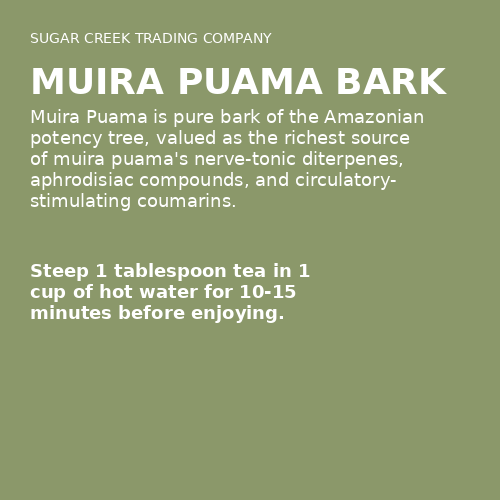
Pure bark of the Amazonian potency tree, valued as the richest source of muira puama's nerve-tonic diterpenes, aphrodisiac compounds, and circulatory-stimulating coumarins.
BOTANICAL IDENTIFICATION
Scientific Name: Ptychopetalum olacoides Benth.
Common Names: Muira Puama Bark, Marapuama Bark, Potency Wood Bark, Casca de Marapuama
Family: Olacaceae
Ptychopetalum olacoides is a small Amazonian tree or large shrub reaching 5 to 15 meters in height, with a slender trunk covered in smooth, grayish-brown bark that becomes slightly fissured with age. The bark itself is the focus of this product: when harvested, it appears as thin, fibrous strips or curled quills, pale brown to grayish on the outer surface and lighter tan on the inner surface, with a faintly resinous, woody aroma and a slightly bitter, aromatic taste. The tree produces small, white, jasmine-scented flowers in short axillary clusters, and its leaves are alternate, oblong, and glossy dark green.
This species is endemic to the lowland terra firme (non-flooded) forests of the Amazon River basin, growing primarily in the Brazilian states of Para, Amazonas, and Maranhao. It prefers well-drained, acidic, sandy soils of the forest understory, where it receives dappled light through the canopy. The bark is traditionally harvested from both trunk and branches, and skilled harvesters take care to remove strips without girdling the tree, allowing recovery and continued growth.
CULTURAL AND HISTORICAL USE
The bark of muira puama has been the most highly prized plant part in Amazonian traditional medicine for generations. Indigenous peoples of the Amazon, including the Tupi and related groups, developed specific preparations using the bark for conditions involving nervous weakness, physical exhaustion, sexual dysfunction, and rheumatic pain. The bark was typically prepared as a long-simmered decoction or macerated in cachaca (sugarcane spirit) to create potent tonic preparations called garrafadas. These bottled tonics became a fixture of Brazilian popular medicine, sold in markets throughout the Amazon and eventually in herbal pharmacies across Brazil, where muira puama bark remains one of the most commonly purchased plant medicines.
European pharmacologists first encountered muira puama bark in the late 1800s, when specimens were sent from Brazil to herbaria and pharmacological laboratories in France, Germany, and England. The bark entered the Brazilian Pharmacopoeia as a recognized medicinal plant, classified as a neuromuscular tonic and aphrodisiac. French researchers showed particular interest, and the bark was included in several European herbal formulations for nervous asthenia and impotence during the early 20th century. Dr. Jacques Waynberg's clinical studies at the Institute of Sexology in Paris during the 1990s, which demonstrated significant improvements in libido and erectile function, specifically used bark-derived preparations.
The distinction between muira puama bark and the whole root-and-bark material is meaningful in traditional practice. Brazilian herbalists often consider the bark to be the more concentrated and potent form, containing a higher density of the aromatic and resinous compounds responsible for the plant's nerve-tonic and aphrodisiac effects. The bark's thin profile also makes it well-suited to decoction and tincture preparation, where surface area exposure maximizes extraction efficiency. In the hierarchy of Amazonian tonics, muira puama bark stands alongside guarana, catuaba, and suma as one of the great revitalizing medicines of the rainforest tradition.
KEY BIOACTIVE COMPOUNDS & BENEFITS
| Compound/Class | Location in Plant | Human Benefit | Role in Plant |
|---|---|---|---|
| Clerodane diterpenes (ptychonal and related compounds) | Concentrated in bark | Neuroprotective, neurostimulant; enhance acetylcholine signaling and nerve conduction | Antifeedant defense against insects and herbivores |
| Long-chain fatty acid esters (lupeol esters, behenic acid) | Bark and root bark | Lipid-soluble tonic compounds; may modulate steroid receptor activity | Wax and cuticle components; energy storage |
| Phytosterols (beta-sitosterol, stigmasterol) | Bark | Anti-inflammatory, mild hormonal modulation, prostate-supportive | Membrane structural components |
| Coumarins and coumarin glycosides | Bark | Vasodilatory, antispasmodic; enhance peripheral and pelvic blood flow | UV-protective and allelopathic defense |
| Volatile terpenoids (alpha-pinene, beta-caryophyllene, alpha-humulene) | Bark resin | Anti-inflammatory (CB2 agonism), mild analgesic, aromatic stimulant | Resin-based wound sealing and insect deterrence |
The bark of muira puama concentrates the plant's most pharmacologically active compounds in a thin, high-surface-area matrix of fibers and resinous tissue. The clerodane diterpenes are especially significant: this class of compounds is relatively uncommon in the plant kingdom and gives muira puama a neurochemical profile distinct from other adaptogenic or aphrodisiac herbs. Combined with the vasodilatory coumarins and anti-inflammatory terpenoids, the bark delivers a coordinated action on nervous tissue, blood vessels, and hormonal pathways simultaneously.
HOW IT WORKS IN THE BODY
Muira puama bark acts through several interconnected mechanisms that center on nervous system restoration, vascular optimization, and neuroendocrine support.
Acetylcholinesterase Inhibition and Cognitive Enhancement:
Research from the Federal University of Rio Grande do Sul demonstrated that muira puama bark extract inhibits acetylcholinesterase (AChE), the enzyme responsible for breaking down the neurotransmitter acetylcholine at nerve synapses. By slowing acetylcholine degradation, the bark enhances cholinergic signaling throughout the brain and peripheral nervous system, supporting memory formation, learning, attention, and neuromuscular coordination. This mechanism is shared with pharmaceutical cognitive enhancers like donepezil, though muira puama acts more gently and with a broader range of complementary actions. Studies in aged mice showed improved memory retrieval performance with muira puama administration.
Vasodilation and Erectile Physiology:
The coumarin compounds in muira puama bark promote vasodilation by enhancing nitric oxide availability and relaxing vascular smooth muscle, particularly in the peripheral and pelvic vasculature. This increased blood flow to genital tissue, combined with enhanced nerve sensitivity from the diterpene fraction, creates the physiological conditions for improved erectile response in men and increased genital sensation in women. Unlike pharmaceutical vasodilators, this action develops gradually with consistent use rather than producing acute on-demand effects.
Neuromuscular Tonic Action:
Traditional classification of muira puama bark as a "nerve tonic" aligns with modern evidence showing its effects on both central and peripheral nervous tissue. The combination of enhanced cholinergic transmission, neuroprotective antioxidant activity, and improved nerve blood supply creates a restorative action on fatigued or weakened neuromuscular pathways. This is the mechanism underlying its traditional use for tremor, weakness, and the general "nerve exhaustion" that indigenous healers recognized as a distinct syndrome.
Adaptogenic and Anti-stress Properties:
Studies by Piato and colleagues have demonstrated antidepressant-like and anxiolytic-like effects of muira puama bark extract in animal models, mediated through modulation of monoamine neurotransmitter systems (serotonin and dopamine pathways) and possibly through effects on the HPA stress axis. This positions the bark as a nervine adaptogen that helps the nervous system recover its baseline resilience after periods of depletion, rather than simply masking symptoms of fatigue.
DOSE GUIDELINES
| Preparation Type | Typical Dose | Purpose |
|---|---|---|
| Decoction (bark) | 1-2 tablespoons bark per 2 cups water, simmered 15-20 minutes; 1-2 cups daily | Traditional Amazonian preparation for nerve tonic and vitality restoration |
| Tincture (1:5, 50-60% ethanol) | 3-5 mL, two to three times daily | Optimal extraction of lipophilic diterpenes and coumarins; sexual and cognitive support |
| Powdered bark in capsules | 1-2.5 grams daily, divided into two doses | Convenient supplementation for sustained daily tonic use |
Muira puama bark is a cumulative tonic herb that delivers its most meaningful benefits with sustained use over two to eight weeks. Because many of the key bioactive compounds, particularly the diterpenes and fatty acid esters, are lipophilic, alcohol-based tinctures and alcohol-macerated garrafadas achieve more complete extraction than water decoctions alone. However, the traditional decoction method remains effective and is the most accessible preparation for most users. Morning and midday dosing is generally preferred due to the bark's mildly stimulating character.
PREPARATION AND USES
The dried muira puama bark offered here consists of thin, fibrous bark strips ideal for decoction and tincture preparation. To prepare a traditional decoction, place 1 to 2 tablespoons of bark in a pot with 2 cups of cold water, bring to a gentle boil, then reduce heat and simmer for 15 to 20 minutes. Strain and drink warm or at room temperature. The resulting tea is pale amber with a woody, mildly bitter, slightly aromatic flavor that most people find pleasant and easy to drink. For a more potent preparation, simmer for 30 minutes or longer, which extracts more of the resinous compounds.
Tincture preparation yields the most complete extraction of muira puama bark's full phytochemical profile. Macerate the dried bark in 50 to 60 percent alcohol (vodka or grain alcohol diluted appropriately) at a 1:5 weight-to-volume ratio for 6 to 8 weeks, shaking the jar every day or two. The resulting tincture is a rich amber liquid with a warm, resinous flavor. In the traditional Brazilian garrafada method, the bark is macerated in red wine with other tonic herbs such as catuaba bark, guarana seeds, and damiana leaf for 2 to 4 weeks, creating a flavorful and effective compound tonic. Muira puama bark combines exceptionally well with ginkgo biloba leaf for cerebrovascular support, with maca root for hormonal vitality, and with ashwagandha for comprehensive adaptogenic formulas.
OPTIMAL CONTEXT FOR USE
Muira puama bark is especially well-suited for individuals experiencing:
Decreased libido, erectile difficulty, or diminished sexual sensation in either men or women, particularly when these changes are associated with nervous exhaustion, stress, or aging rather than acute hormonal pathology
Mental fatigue, poor concentration, or age-related cognitive decline, where gentle cholinergic enhancement and improved cerebral circulation can support memory and processing speed
Neuromuscular weakness, poor coordination, or the "nerve exhaustion" pattern characterized by fatigue that is nervous rather than muscular in origin
Recovery from prolonged illness, chronic stress, or burnout, where deep nervous system restoration is needed rather than simple stimulation
Mild depressive states or loss of motivation, particularly when accompanied by physical fatigue and reduced interest in activities that were once enjoyable
Muira puama bark works synergistically with catuaba bark in the classic Amazonian vitality formula, with ginkgo biloba for enhanced cognitive and vascular support, and with tribulus terrestris for male reproductive health protocols.
SUSTAINABILITY AND ETHICAL HARVESTING
The sustainability of muira puama bark harvest is an important consideration that deserves informed attention from consumers. As a slow-growing Amazonian understory tree that does not readily adapt to plantation cultivation, Ptychopetalum olacoides depends on intact rainforest habitat for its continued existence. All commercial muira puama bark is wild-harvested by traditional forest communities in the Brazilian Amazon, primarily through extractivist practices that are designed to be sustainable when practiced correctly.
Responsible bark harvesting involves removing strips from the trunk and branches without girdling (fully encircling) the tree, which would kill it. Skilled harvesters limit the amount of bark taken from any individual tree and allow recovery periods of several years between harvests. However, as international demand has grown, overharvesting pressure has increased in some areas. Buyers and suppliers committed to sustainability should prioritize sourcing from community-managed forest reserves where harvest levels are monitored, and ideally from projects that provide economic incentives for forest conservation. Every purchase of sustainably harvested muira puama bark is a small vote for the economic viability of standing Amazon rainforest.
SAFETY AND CAUTIONS
Muira puama bark has a long history of traditional use and is generally regarded as safe at recommended herbal doses. No serious adverse effects have been reported in clinical trials or traditional practice. The following precautions should be observed:
Pregnant and nursing women should avoid muira puama bark due to insufficient safety data in these populations and the theoretical possibility of hormonal or uterotonic effects.
Individuals taking anticoagulant or antiplatelet medications (warfarin, aspirin, clopidogrel) should consult a healthcare provider before using muira puama bark, as its coumarin content may contribute additive blood-thinning effects.
Those using pharmaceutical erectile dysfunction medications (sildenafil, tadalafil, vardenafil) should exercise caution and consult a practitioner, as the combined vasodilatory effects may produce excessive blood pressure reduction.
Muira puama bark's mildly stimulating properties may interfere with sleep in sensitive individuals. Taking the last dose no later than mid-afternoon is advisable if this is a concern.
As with any herbal supplement, individuals taking prescription medications of any kind should inform their healthcare provider, as the full spectrum of potential herb-drug interactions has not been exhaustively characterized.
REFERENCES
Siqueira, I.R., Fochesatto, C., da Silva, A.L., Nunes, D.S., Battastini, A.M., Netto, C.A., & Elisabetsky, E. (2003). "Ptychopetalum olacoides, a traditional Amazonian 'nerve tonic,' possesses anticholinesterase activity." Pharmacology Biochemistry and Behavior, 75(3), 645-650.
da Silva, A.L., Piato, A.L., Bardini, S., Netto, C.A., Nunes, D.S., & Elisabetsky, E. (2004). "Memory retrieval improvement by Ptychopetalum olacoides in young and aging mice." Journal of Ethnopharmacology, 95(2-3), 199-203.
Piato, A.L., Rizon, L.P., Martins, B.S., Nunes, D.S., & Elisabetsky, E. (2009). "Antidepressant profile of Ptychopetalum olacoides Bentham (Marapuama) in mice." Phytomedicine, 16(4), 356-362.
Waynberg, J. (1990). "Aphrodisiacs: Contributions to the clinical validation of the traditional use of Ptychopetalum guyanna." Presented at the First International Congress on Ethnopharmacology, Strasbourg, France.
FINAL NOTE
Muira puama bark is the concentrated expression of one of the Amazon's most respected medicinal trees, delivering the plant's full nerve-tonic, aphrodisiac, and cognitive-enhancing chemistry in its most potent natural form. Where many herbs address either the body or the mind, muira puama bark works at their intersection, restoring the nervous system's capacity to feel, respond, and sustain. Its centuries of use by Amazonian peoples and its growing validation by modern neuropharmacology reflect a plant that genuinely delivers on its legendary reputation. Pure dried bark ensures the highest concentration of the lipophilic diterpenes and resinous compounds that define this extraordinary botanical.
Share