Sugar Creek Trading Company
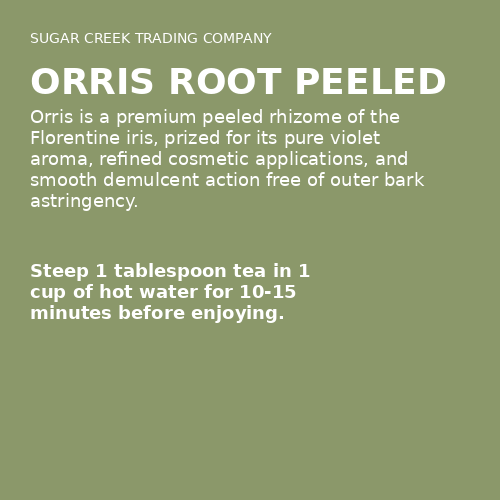
Orris Root (peeled)
Orris Root (peeled)
Impossible de charger la disponibilité du service de retrait
IRIS GERMANICA / IRIS PALLIDA
Ancient aromatic rhizome treasured for its violet-like fragrance, gentle digestive support, and centuries of use in perfumery, medicine, and spiritual practice.
BOTANICAL IDENTIFICATION
Scientific Name: Iris germanica L. / Iris pallida Lam.
Common Names: Orris root, iris root, Florentine iris, Queen Elizabeth root, love drawing root
Family: Iridaceae (Iris family)
Iris germanica and Iris pallida are stately perennial herbs growing 60 to 120 centimeters tall, producing sword-shaped, blue-green leaves arranged in flat fans from a thick, fleshy rhizome. The flowers are large and showy, typically deep purple-blue in I. germanica and pale lavender-blue in I. pallida, each displaying the characteristic three upright standards and three drooping falls of the iris genus. The rhizomes, which are the commercially valuable portion, are thick, knotted, and pale when freshly cut, developing their prized violet aroma only after an extended drying and aging period of two to five years.
Both species are native to the Mediterranean region, with I. pallida originating in the Dalmatian coast and I. germanica having a broader Southern European range. The finest orris root has been cultivated for centuries in the hills surrounding Florence, Italy, particularly in the regions of Chianti and San Polo. This product contains the whole, unpeeled rhizome, retaining the full complement of outer bark compounds alongside the fragrant inner tissue.
CULTURAL AND HISTORICAL USE
Orris root holds one of the longest documented histories of any aromatic botanical, stretching back over four thousand years. The ancient Egyptians valued the rhizome as both a medicine and a perfume ingredient, and it appears in medicinal formularies from the Ebers Papyrus (circa 1550 BCE). Greek physicians including Theophrastus and Dioscorides described orris root preparations for coughs, digestive complaints, and dropsy. Dioscorides specifically recommended it for inducing sleep, easing congestion, and treating skin conditions when applied as a poultice.
In medieval Europe, orris root became an essential ingredient in pomanders and sachets used to perfume clothing and repel moths. It was a key fixative in early perfumery, valued for its ability to anchor and extend other fragrances. The Florentine guild of perfumers built an entire trade economy around orris cultivation, and the fleur-de-lis symbol of Florence is believed to represent the iris flower rather than the lily. In the herbalism of Nicholas Culpeper and John Gerard, orris root was prescribed for bronchial congestion, water retention, and as a teething aid for infants, a practice that continued into the nineteenth century.
In African American folk magic and Hoodoo traditions, orris root is known as "Queen Elizabeth root" and is used in love-drawing sachets, attraction powders, and spiritual baths. This spiritual association with love and attraction has roots in the ancient Greek connection between the iris flower and the goddess Iris, messenger of the heavens and personification of the rainbow.
KEY BIOACTIVE COMPOUNDS & BENEFITS
| Compound/Class | Location in Plant | Human Benefit | Role in Plant |
|---|---|---|---|
| Irones (alpha-, beta-, gamma-isomers) | Rhizome (develops during aging) | Aromatherapeutic calming effects; respiratory soothing | Produced during oxidative aging of iridal triterpenoids |
| Iridal triterpenoids (iridals, irigermanal) | Rhizome cortex and interior | Anti-inflammatory and mild antimicrobial activity | Chemical defense against herbivores and pathogens |
| Isoflavones (irigenin, iridin, tectorigenin) | Rhizome tissue | Antioxidant activity; mild estrogenic and anti-inflammatory effects | UV protection and signaling |
| Myristic acid | Rhizome oil | Contributes to the fixative quality in perfumery; emollient for skin | Energy storage and membrane composition |
| Starch and mucilage | Rhizome parenchyma | Soothing demulcent action on mucous membranes; digestive comfort | Energy reserve and water retention |
The signature aroma of orris root is attributable almost entirely to the irones, which are not present in the fresh rhizome but develop through the slow enzymatic and oxidative degradation of iridal triterpenoids during the multi-year drying process. This transformation is why aged orris root commands significantly higher prices and possesses a richer, more refined violet-like scent than freshly harvested material.
HOW IT WORKS IN THE BODY
Orris root exerts its effects through a combination of mucilaginous soothing action, aromatic volatile activity, and isoflavone-mediated biochemical modulation.
Respiratory and Mucosal Soothing:
The mucilage and starch content of orris root creates a demulcent coating on irritated mucous membranes of the throat and upper respiratory tract. This physical barrier reduces irritation from dry coughs and sore throats. The volatile irones provide mild expectorant properties, helping to loosen congestion when orris root is used in steams or infusions.
Digestive Support:
Orris root has a long history as a gentle digestive aid. The mucilage soothes inflamed gastrointestinal tissue, while the bitter triterpenoid compounds stimulate digestive secretions. This dual action makes it useful for both irritated and sluggish digestion. Traditional European herbalism classifies it as a mild stomachic and carminative.
Isoflavone Activity:
The isoflavones in orris root, particularly tectorigenin and irigenin, have demonstrated antioxidant and anti-inflammatory properties in laboratory studies. Tectorigenin has shown the ability to inhibit COX-2 and reduce NF-kB activation in cell culture models. These isoflavones also exhibit mild phytoestrogenic activity, which may contribute to the traditional use of orris root in formulations for hormonal balance.
Aromatherapeutic Action:
When inhaled, the irone compounds interact with olfactory receptors and have been associated with calming, mood-elevating effects. In aromatherapy, orris root absolute is considered grounding and emotionally stabilizing, used to ease anxiety and promote a sense of comfort.
DOSE GUIDELINES
| Preparation Type | Typical Dose | Purpose |
|---|---|---|
| Decoction (simmered tea) | 1 to 2 teaspoons of chopped root per cup, simmered 15 to 20 minutes | Digestive support, respiratory soothing |
| Powdered root | 0.5 to 2 grams daily | Digestive tonic; added to herbal blends and tooth powders |
| Tincture (1:5, 50% ethanol) | 1 to 3 mL, up to three times daily | Concentrated digestive and respiratory support |
| Sachet or potpourri | As desired externally | Aromatic fixative; calming scent for linens and rooms |
Orris root is most commonly used in small quantities as a supportive ingredient in herbal blends rather than as a standalone remedy. Its fixative properties make it valuable for anchoring the aromas of other herbs in tea blends, sachets, and incense. When used medicinally, start with lower doses to assess individual tolerance, as the root can cause mild nausea in sensitive individuals if taken in excess.
PREPARATION AND USES
To prepare a decoction, add one to two teaspoons of chopped or coarsely ground orris root to two cups of cold water, bring slowly to a gentle boil, then reduce heat and simmer covered for 15 to 20 minutes. Strain and drink warm, optionally sweetened with honey. This preparation addresses coughs, sore throats, and digestive discomfort. Orris root pairs well with licorice root, marshmallow root, and fennel in respiratory and digestive tea formulas.
In cosmetic and perfumery applications, powdered orris root serves as a natural dry shampoo, a body powder, and the premier botanical fixative for potpourri and perfume blends. Its ability to absorb and slowly release fragrance compounds makes it indispensable in traditional perfumery. Powdered orris root can also be added to homemade tooth powders and mouthwash preparations, continuing a practice documented since ancient Roman times. For sachets and drawer fresheners, combine orris root powder with lavender, rose petals, and a few drops of essential oil for a long-lasting aromatic blend.
OPTIMAL CONTEXT FOR USE
This herb is especially well-suited for individuals experiencing:
Dry, irritating coughs and sore throats where a gentle, mucilaginous soothing agent is preferred
Mild digestive discomfort including bloating, sluggish digestion, or gastric irritation
Interest in natural perfumery and cosmetics, where orris root serves as an irreplaceable aromatic fixative
Aromatherapy and emotional wellness practices seeking a grounding, violet-scented botanical
Spiritual and folk practices incorporating traditional love-drawing and attraction formulations
Orris root blends beautifully with lavender, rose, sandalwood, vetiver, and frankincense in aromatic preparations, and with marshmallow root, licorice, and fennel in medicinal formulations.
SUSTAINABILITY AND ETHICAL HARVESTING
Iris germanica and Iris pallida are not endangered and are widely cultivated ornamental and commercial crops. The primary sustainability consideration with orris root is the extraordinarily long production cycle: rhizomes must grow for three years before harvest, then dry and age for an additional two to five years before they develop their full aromatic potential. This means that high-quality orris root represents a minimum five-year investment from planting to market, making it one of the most labor- and time-intensive botanical products in the world.
The traditional growing regions around Florence, Italy, and in Morocco and China remain the primary commercial sources. Supporting growers who maintain traditional cultivation methods and fair labor practices helps preserve both the quality of the product and the livelihoods of farming communities that have tended these crops for generations.
SAFETY AND CAUTIONS
Orris root is generally well tolerated when used in typical doses and traditional preparations.
Allergic sensitivity: Orris root is a known sensitizer and can cause contact dermatitis in susceptible individuals. Those with known fragrance allergies should patch-test before topical use. Orris root is listed among regulated fragrance allergens in the European Union.
Gastrointestinal effects: Excessive internal doses may cause nausea, vomiting, or diarrhea. Adhere to recommended doses and start low to assess personal tolerance.
Pregnancy and nursing: Due to the presence of mildly estrogenic isoflavones and insufficient safety data, orris root is not recommended for internal use during pregnancy or breastfeeding.
Teething use discontinued: The historical practice of giving infants orris root to chew during teething has been abandoned due to choking hazard and potential allergic reactions. This use is no longer recommended.
REFERENCES
Orris Root Monograph. American Herbal Products Association Botanical Safety Handbook, 2nd ed., CRC Press, 2013.
Roger, B., and Waterman, P. G. "The chemistry and biological activity of the Iridaceae." Biochemical Systematics and Ecology, 11(3), 1983, pp. 261-272.
Bonfils, J. P., et al. "Isoflavone content and estrogenic activity of orris root extracts." Planta Medica, 61(5), 1995, pp. 465-467.
Kukula-Koch, W., et al. "Iridals and other triterpenoids from Iris species and their biological activities." Phytochemistry Reviews, 14(1), 2015, pp. 51-71.
FINAL NOTE
Orris root is one of the botanical world's most patient offerings. Its true character reveals itself only after years of slow transformation, as harsh, earthy rhizomes gradually develop the exquisite violet fragrance that has captivated perfumers and herbalists for millennia. Whether used to anchor a perfume blend, soothe a scratchy throat, or add depth to a potpourri, orris root brings a quiet, refined elegance that reflects the unhurried artistry of traditional plant craft.
Share