Sugar Creek Trading Company
Peppermint Leaf
Peppermint Leaf
Impossible de charger la disponibilité du service de retrait
Mentha × piperita — Peppermint Leaf
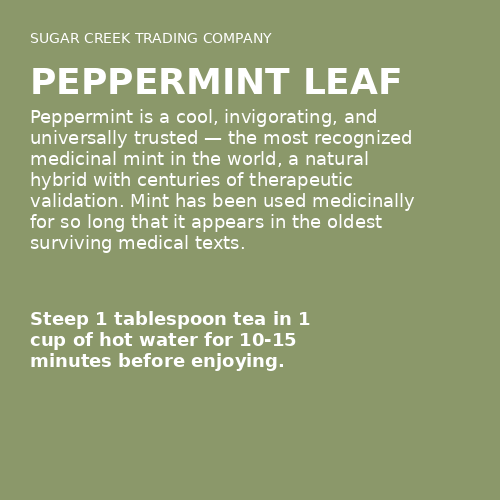
Cool, invigorating, and universally trusted — the most recognized medicinal mint in the world, a natural hybrid with centuries of therapeutic validation.
Botanical Identification
- Species: Mentha × piperita L. (a natural hybrid of Mentha aquatica [watermint] and Mentha spicata [spearmint])
- Family: Lamiaceae (mint family)
- Common Names: Peppermint, Brandy Mint, Lamb Mint, Balm Mint
- Part Used: Dried aerial parts, primarily leaves; harvested at or just before flowering when essential oil content peaks
- Origin: Believed to have originated naturally in Europe; now cultivated worldwide, with major production in the United States (Pacific Northwest, Midwest), India, and Mediterranean regions
- Distinguishing Features: Square stems with a purple-red tinge, opposite leaves with serrated margins, and a strong cooling menthol aroma that immediately distinguishes it from spearmint (which is sweeter and lower in menthol)
Cultural and Historical Use
Mint has been used medicinally for so long that it appears in the oldest surviving medical texts. Dried mint leaves were found in Egyptian tombs dating to approximately 1000 BCE. The Ebers Papyrus (c. 1550 BCE) references mint for calming digestive complaints. Greek and Roman physicians, including Pliny the Elder and Dioscorides, prescribed mint for everything from hiccups to scorpion stings, and Roman tables were rubbed with fresh mint before feasting to stimulate appetite.
However, the specific hybrid Mentha × piperita was not formally recognized until 1696, when English botanist John Ray described it as a distinct plant growing wild near Hertfordshire. By the eighteenth century, peppermint had become a cornerstone of European herbal medicine and was listed in the London Pharmacopoeia. Peppermint water, peppermint spirit, and peppermint oil became standard dispensary preparations for colic, nausea, and flatulence.
In American folk medicine, peppermint tea has been the go-to home remedy for upset stomachs, headaches, colds, and restless nerves for over two centuries. The Eclectic physicians of the nineteenth century prescribed it extensively and considered it one of the safest and most reliable herbs available. Today, peppermint remains one of the most widely consumed herbal teas on earth and one of the most thoroughly researched medicinal plants in the Western pharmacopoeia.
Key Bioactive Compounds
| Compound | Concentration (approx.) | Primary Activity |
|---|---|---|
| Menthol | 30–55% of essential oil (oil content 1–3% in dried leaf) | Antispasmodic, cooling analgesic, decongestant, TRPM8 agonist |
| Menthone | 14–32% of essential oil | Antimicrobial, choleretic (bile-stimulating), aromatic |
| Menthyl acetate | 3–10% of essential oil | Aromatic, contributes to the sweet, smooth top note |
| 1,8-Cineole (eucalyptol) | 3–7% of essential oil | Expectorant, anti-inflammatory, bronchodilator |
| Rosmarinic acid | Significant (water-soluble polyphenol) | Antioxidant, anti-inflammatory, antiallergic |
| Luteolin, eriocitrin, hesperidin | Present as flavonoid glycosides | Antioxidant, anti-inflammatory, vasoprotective |
Peppermint leaf delivers its benefits through two complementary pathways: the volatile essential oil fraction (menthol, menthone, and associated terpenes), which is responsible for the cooling sensation and antispasmodic effects, and the water-soluble polyphenol fraction (rosmarinic acid, flavonoids), which provides antioxidant and anti-inflammatory support. A cup of peppermint tea extracts primarily the water-soluble compounds, while preparations using the essential oil concentrate the volatile fraction.
How It Works in the Body
Menthol's signature cooling sensation occurs through direct activation of the TRPM8 cold receptor — the same receptor that detects actual drops in temperature. This is not just a sensory trick; TRPM8 activation triggers real physiological responses, including relaxation of smooth muscle tissue in the gastrointestinal tract, bronchial passages, and blood vessels.
The antispasmodic effect on the GI tract is peppermint's most clinically validated action. Menthol blocks calcium ion channels in intestinal smooth muscle cells, preventing the sustained muscle contraction that causes cramping, bloating, and the visceral pain of irritable bowel syndrome (IBS). Multiple randomized controlled trials and meta-analyses have confirmed that enteric-coated peppermint oil capsules significantly reduce IBS symptom severity compared to placebo, with a number needed to treat (NNT) of approximately 3 — making it one of the most effective interventions for IBS available.
Rosmarinic acid, extracted efficiently in hot water infusions, inhibits complement activation and histamine release from mast cells, which underlies peppermint's traditional use for seasonal allergies and mild allergic rhinitis. It also scavenges free radicals and protects against oxidative stress in laboratory studies.
Inhalation of peppermint aroma has demonstrated measurable effects on cognitive performance and alertness in human trials, likely through a combination of menthol's stimulatory effect on the trigeminal nerve and its influence on neurotransmitter activity.
Dose Guidelines
| Form | Suggested Amount | Notes |
|---|---|---|
| Dried leaf tea (infusion) | 1–2 tablespoons per 8 oz boiling water, steep 7–15 minutes covered | Cover while steeping to prevent volatile oil loss to evaporation; drink 1–3 cups daily |
| Tincture (1:5, 45% ethanol) | 2–4 mL (40–80 drops), up to three times daily | Take in a small amount of water before or after meals |
| Enteric-coated peppermint oil capsules (for IBS) | 0.2–0.4 mL per capsule, 1–3 times daily | Take 30–60 minutes before meals; enteric coating prevents gastric release and heartburn |
| Inhalation (for congestion or alertness) | Inhale steam from fresh infusion or 2–3 drops essential oil in hot water | Breathe deeply for 5–10 minutes; keep eyes closed to avoid irritation |
Preparation and Uses
- Simple peppermint tea: The single most common preparation — steep dried leaves covered in boiling water for 7 to 15 minutes. Drink after meals for digestive support, or anytime for refreshment and mild alertness
- Digestive blend: Combine peppermint leaf with chamomile, fennel seed, and ginger root for a comprehensive after-meal tea that addresses cramping, bloating, and nausea simultaneously
- Cold and flu tea: Blend peppermint with elderflower, yarrow, and linden for a traditional diaphoretic (sweat-inducing) tea taken at the onset of colds and fevers
- Headache compress: Brew a strong peppermint infusion, soak a cloth, and apply to the forehead and temples for tension headache relief
- Culinary herb: Add dried peppermint to tabbouleh, lamb dishes, yogurt sauces, chocolate desserts, and fruit salads
- Bath herb: Add a generous handful of dried peppermint to a muslin bag and hang under the hot tap for a cooling, invigorating herbal bath that soothes sore muscles
- Iced peppermint tea: Brew double-strength, cool, and serve over ice — one of the most refreshing summer beverages possible
Optimal Context for Use
- After meals, to support digestion, reduce bloating, and ease cramping — this is peppermint's most established and evidence-supported role
- For IBS management — peppermint (especially as enteric-coated oil) has strong clinical evidence for reducing abdominal pain, bloating, and bowel irregularity
- During colds and respiratory congestion — the combination of menthol's decongestant action and eucalyptol's expectorant properties makes peppermint a natural choice
- For tension headaches — both ingested as tea and applied topically, peppermint has shown efficacy comparable to acetaminophen in clinical studies
- When mental clarity and focus are needed — peppermint aroma is one of the few scents with replicated evidence for improving cognitive performance and alertness
- As a daily wellness tea — safe, pleasant, caffeine-free, and mildly therapeutic, peppermint is suitable for long-term daily use by most adults
Sustainability and Ethical Harvesting
Peppermint is a vigorous, spreading perennial that is one of the easiest herbs to cultivate. It thrives in moist, temperate conditions and propagates readily by runners (stolons), often requiring containment rather than encouragement. This makes it an inherently low-impact crop — it requires minimal inputs, suppresses weeds through its dense growth habit, and can be harvested multiple times per growing season.
The United States, particularly Oregon, Washington, and the Midwest, produces some of the world's highest quality peppermint. Indian production has grown significantly and supplies much of the global market for both dried leaf and essential oil. When purchasing, seek out organically grown peppermint, as conventional mint production can involve herbicides and fungicides, especially in large-scale operations. The plant itself rarely needs pesticides due to its naturally high essential oil content, which deters most insects.
Safety and Cautions
- Generally recognized as safe (GRAS) — peppermint tea is one of the safest herbal preparations available and is suitable for most adults with daily use
- Gastroesophageal reflux (GERD): Peppermint relaxes the lower esophageal sphincter, which can worsen acid reflux in susceptible individuals. If you have GERD or chronic heartburn, use cautiously or opt for enteric-coated capsules that bypass the stomach
- Gallbladder disease: Peppermint stimulates bile flow (choleretic effect). Individuals with gallstones or bile duct obstruction should consult a healthcare provider before using therapeutic doses
- Infants and young children: Do not apply peppermint essential oil near the face or nose of infants or children under age 3 — menthol can cause reflex apnea (breathing cessation) and laryngospasm in very young children. Mild peppermint tea is generally considered safe for children over age 2 in small amounts
- Pregnancy: Peppermint tea in moderate amounts (1–2 cups daily) is generally considered safe during pregnancy and is a common nausea remedy. However, concentrated peppermint oil should be avoided in medicinal doses during pregnancy without professional guidance
- May reduce the effectiveness of iron supplements if taken simultaneously — separate by at least 2 hours
- Peppermint may interact with cyclosporine and other drugs metabolized by CYP3A4, though the effect is generally mild at tea-drinking doses
References
- McKay, D.L., and J.B. Blumberg. "A Review of the Bioactivity and Potential Health Benefits of Peppermint Tea (Mentha piperita L.)." Phytotherapy Research, vol. 20, no. 8, 2006, pp. 619–633.
- Alammar, N., et al. "The Impact of Peppermint Oil on the Irritable Bowel Syndrome: A Meta-Analysis of the Pooled Clinical Data." BMC Complementary and Alternative Medicine, vol. 19, no. 1, 2019, p. 21.
- Göbel, H., et al. "Effectiveness of Oleum Menthae Piperitae and Paracetamol in Therapy of Headache of the Tension Type." Nervenarzt, vol. 67, no. 8, 1996, pp. 672–681.
- Moss, M., et al. "Modulation of Cognitive Performance and Mood by Aromas of Peppermint and Ylang-Ylang." International Journal of Neuroscience, vol. 118, no. 1, 2008, pp. 59–77.
- Kligler, B., and S. Chaudhary. "Peppermint Oil." American Family Physician, vol. 75, no. 7, 2007, pp. 1027–1030.
- Blumenthal, M., et al. The Complete German Commission E Monographs: Therapeutic Guide to Herbal Medicines. American Botanical Council, 1998.
Final Note: Peppermint leaf is one of those rare herbs where traditional wisdom and modern clinical evidence align almost perfectly. Thousands of years of use for digestive complaints, headaches, and colds are now backed by rigorous trials confirming its efficacy — particularly for IBS, tension headaches, and cognitive performance. It is safe, effective, pleasant to drink, and belongs in every herbal medicine cabinet. This product is sold as a culinary herb and botanical specimen. It is not intended to diagnose, treat, cure, or prevent any disease. Consult a qualified healthcare practitioner before using any herb therapeutically.
Share