Sugar Creek Trading Company
Purple Coneflower Root
Purple Coneflower Root
Impossible de charger la disponibilité du service de retrait
Echinacea purpurea
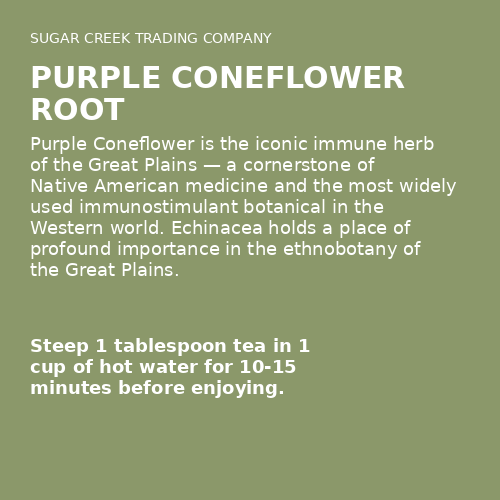
The iconic immune herb of the Great Plains — a cornerstone of Native American medicine and the most widely used immunostimulant botanical in the Western world.
Botanical Identification
Common Names: Purple Coneflower, Echinacea, Eastern Purple Coneflower, Hedgehog Coneflower, Snakeroot
Latin Name: Echinacea purpurea (L.) Moench
Family: Asteraceae (Daisy/Composite family)
Part Used: Root (primary; also aerial parts in some preparations)
Origin: Native to eastern and central North America, ranging from the Great Plains states eastward through the Ohio Valley. The plant grows naturally in open prairies, dry meadows, and along roadsides and woodland edges from Texas north to Michigan and eastward to Virginia. Now extensively cultivated across North America, Europe (particularly Germany), and parts of Asia for the herbal supplement industry.
Description: Echinacea purpurea is a robust, clump-forming perennial reaching 60 to 120 cm in height. It bears distinctive flower heads with drooping, purplish-pink ray florets surrounding a prominent, spiny, dome-shaped central cone (the genus name derives from the Greek echinos, meaning "hedgehog" or "sea urchin," referring to this prickly seed head). The leaves are broad, lanceolate, and rough-textured with prominent veins. The root system is fibrous and branching — in contrast to the thick taproot of E. angustifolia — and is harvested after 2 to 3 years of growth. Fresh root has a distinctive tingling, tongue-numbing sensation when chewed, which is a reliable indicator of potency due to the presence of alkylamides.
Cultural and Historical Use
Echinacea holds a place of profound importance in the ethnobotany of the Great Plains. The Cheyenne, Lakota, Comanche, Pawnee, and other Plains nations used multiple Echinacea species as perhaps their most versatile medicinal plant. The root was chewed for toothaches and sore throats, applied as a poultice to wounds, burns, insect bites, and snakebites, and prepared as a decoction for colds, coughs, and infections. The Lakota called it icahpe hu and considered it their primary remedy for infections and pain. The Cheyenne used it for sore mouths, gums, and as a general ceremonial purification herb. European settlers in the Great Plains quickly adopted echinacea from Indigenous knowledge. By the 1880s, a Nebraska physician and patent-medicine entrepreneur named H.C.F. Meyer began marketing "Meyer's Blood Purifier," an echinacea-based preparation that brought the plant to wider attention. The Eclectic physicians of the late 19th and early 20th centuries — particularly John Uri Lloyd and John King — championed echinacea as a premier antimicrobial and immune tonic, making it one of the most prescribed herbs in American medicine by 1900. When the Eclectics faded from practice, knowledge of echinacea was carried to Europe, particularly Germany, where it became the foundation of modern phytomedicine research. Today, echinacea is the single best-selling herbal supplement in the United States and one of the most studied medicinal plants in the world.
Key Bioactive Compounds
| Compound | Concentration | Function |
|---|---|---|
| Alkylamides (isobutylamides) | ~0.01-0.04% in root (highly bioactive) | Immunomodulation via CB2 cannabinoid receptor agonism; anti-inflammatory; responsible for tongue-tingling sensation |
| Cichoric acid | ~1.2-3.1% in root | Antioxidant; inhibits hyaluronidase (preventing pathogen spread through connective tissue); antiviral |
| Polysaccharides (arabinogalactans, fucogalactoxyloglucans) | Significant in water extracts | Macrophage activation; increased phagocytic activity; cytokine stimulation |
| Echinacoside (caffeic acid glycoside) | Present primarily in E. angustifolia, minor in E. purpurea | Antibacterial; antioxidant; mild anti-inflammatory |
| Glycoproteins | Present in fresh juice preparations | Immune cell activation and cytokine modulation |
| Volatile oils (borneol, germacranolides) | Trace amounts | Antimicrobial; anti-inflammatory |
| Cynarin | Minor constituent | Hepatoprotective; choleretic (promotes bile flow) |
How It Works in the Body
Echinacea's immune-modulating activity operates through several distinct but complementary mechanisms, making it far more than a simple "immune booster." The alkylamides are now understood to be the primary bioactive compounds responsible for systemic immunomodulation. These lipophilic molecules are rapidly absorbed through the oral mucosa and gut lining, achieving measurable blood levels within minutes of ingestion. They bind to CB2 cannabinoid receptors on immune cells — the same receptor system that regulates immune cell trafficking and inflammatory responses — where they act as agonists, stimulating innate immune function. This CB2 activity increases macrophage phagocytic activity (the engulfing and destruction of pathogens) and modulates the production of pro-inflammatory cytokines such as TNF-alpha and interleukins IL-1, IL-6, and IL-10. Crucially, echinacea does not simply "stimulate" the immune system in a unidirectional way. At the onset of infection, it upregulates the innate immune response; in states of chronic inflammation, the alkylamides' CB2 activity can actually downregulate excessive inflammatory signaling. The polysaccharides, particularly arabinogalactans, activate macrophages through a separate pathway involving toll-like receptor 4 (TLR4), complementing the alkylamide-CB2 axis. Cichoric acid inhibits hyaluronidase, an enzyme that many bacteria produce to break down connective tissue and spread through the body, effectively containing infections at their site of entry. Together, these mechanisms explain echinacea's traditional reputation as a first-response herb for acute infections, most effective when taken at the very earliest signs of illness.
Dose Guidelines
| Preparation | Amount | Frequency |
|---|---|---|
| Dried root decoction | 1 - 2 teaspoons root simmered in 1 cup water for 15 minutes | 3 - 4 cups daily at onset of illness; 1 - 2 cups for maintenance |
| Tincture (1:5, 50% alcohol) | 2 - 4 mL (40-80 drops) | Every 2 - 3 hours at acute onset; 3 times daily for prevention |
| Capsule (dried root powder) | 500 - 1,000 mg | 3 times daily |
| Fresh-pressed juice (Echinacin-type) | 6 - 9 mL daily | Divided into 3 doses |
| Acute protocol (loading dose) | Double the standard dose for the first 24 - 48 hours | Then reduce to standard dose for 7 - 10 days |
Timing is critical: Clinical evidence consistently shows that echinacea is most effective when taken at the very first signs of illness — the initial scratch in the throat, the first sneeze, the beginning of body aches. Starting echinacea 24 to 48 hours into an illness yields significantly diminished results.
Preparation and Uses
- Root Decoction: Because the root contains tough, fibrous material, a simmered decoction (rather than a simple infusion) is necessary to fully extract the active compounds. Simmer 1 to 2 teaspoons of cut root in 8 to 10 ounces of water for 10 to 15 minutes, covered. Strain and drink warm. The tea has an earthy, slightly sweet flavor with a characteristic tongue-tingling finish.
- Tincture: Alcohol-based tinctures are the most efficient delivery method for echinacea's lipophilic alkylamides. A quality tincture should produce a noticeable tingling or numbing sensation on the tongue within 30 seconds — this is the primary field test for potency. Hold the tincture in the mouth for 15 to 30 seconds before swallowing to maximize buccal absorption.
- Capsules: Dried root powder in capsules is convenient for maintenance use but may deliver less immediate immune activation than tinctures or decoctions, as the alkylamides bypass the oral mucosa.
- Throat Spray: Diluted tincture used as a throat spray delivers active compounds directly to the pharyngeal mucosa, the most common site of initial viral colonization.
- Topical Poultice: Following the Indigenous tradition, a paste of powdered root mixed with a small amount of water can be applied to minor wounds, insect bites, or skin infections to promote healing and prevent infection.
- Combination Formula: Echinacea root pairs powerfully with elderberry (Sambucus nigra) for antiviral support, with goldenseal (Hydrastis canadensis) for upper respiratory infections, or with astragalus (Astragalus membranaceus) for deep immune building during recovery.
Optimal Context for Use
- At the very first signs of cold or flu — this is echinacea's primary indication and strongest evidence base.
- Short-term acute immune support during active upper respiratory infections (7 to 14 day courses).
- Recurrent infections — individuals who experience frequent colds or upper respiratory infections may benefit from intermittent preventive courses (10 days on, 3 to 4 days off).
- Wound healing and skin infections — topical application, following traditional use.
- As part of a broader immune-support protocol during cold and flu season, alongside adequate sleep, vitamin D, zinc, and stress management.
- For travelers exposed to crowded, enclosed environments (air travel, conferences) where pathogen exposure is elevated.
Sustainability and Ethical Harvesting
Echinacea purpurea is the most commercially cultivated species in the genus and carries the lowest conservation concern. Unlike E. angustifolia and E. pallida, which have been severely overharvested from wild prairie populations, E. purpurea adapts readily to cultivation and is now farm-grown at commercial scale in the United States, Canada, and Europe. However, the broader context matters: wild prairie ecosystems throughout the Great Plains have been reduced to less than 4% of their original extent, and all wild Echinacea populations face habitat loss. Supporting cultivated sources of E. purpurea reduces pressure on wild stands and related species. The plant is also an outstanding garden perennial that supports native pollinators — particularly bumblebees and butterflies — and its spiny seed heads provide winter food for goldfinches and other seed-eating birds. Growing echinacea in home gardens simultaneously produces medicine, supports biodiversity, and contributes to prairie ecosystem awareness.
Safety and Cautions
- Autoimmune Conditions: Due to its immunostimulating properties, echinacea has traditionally been cautioned against in autoimmune diseases (lupus, rheumatoid arthritis, multiple sclerosis). However, emerging research on echinacea's immunomodulatory (rather than purely stimulatory) effects via CB2 receptors suggests this concern may be overstated. Nonetheless, individuals with autoimmune conditions should consult their healthcare provider before use.
- Asteraceae Allergy: Individuals with known allergies to plants in the daisy family (ragweed, chamomile, chrysanthemum, marigold) may experience allergic reactions to echinacea. Discontinue immediately if rash, itching, or respiratory symptoms occur.
- Immunosuppressive Medications: Echinacea may theoretically counteract immunosuppressive drugs used after organ transplantation or for autoimmune disease. Concurrent use is contraindicated.
- Duration of Use: The German Commission E originally recommended limiting continuous echinacea use to 8 weeks, based on theoretical (not clinical) concerns about immune overstimulation. More recent evidence suggests this restriction may be unnecessarily conservative, but intermittent use remains the most common recommendation.
- Pregnancy: A large prospective cohort study found no increased risk of birth defects or adverse outcomes with echinacea use during the first trimester. However, use during pregnancy should still be discussed with a healthcare provider.
- Children: Generally considered safe for children over 2 years old at reduced doses. Avoid in infants under 1 year.
- Hepatotoxicity: Extremely rare; a few case reports exist. Individuals with liver disease should use with caution.
References
- Barrett, B. "Medicinal properties of Echinacea: A critical review." Phytomedicine, 10(1), 2003.
- Woelkart, K., et al. "Bioavailability and pharmacokinetics of alkamides from Echinacea preparations." Planta Medica, 71(7), 2005.
- Raduner, S., et al. "Alkylamides from Echinacea are a new class of cannabinomimetics: CB2 receptor-dependent and -independent immunomodulatory effects." Journal of Biological Chemistry, 281(20), 2006.
- Shah, S.A., et al. "Evaluation of echinacea for the prevention and treatment of the common cold: A meta-analysis." The Lancet Infectious Diseases, 7(7), 2007.
- Moerman, D.E. Native American Ethnobotany. Timber Press, 1998.
- Foster, S. "Echinacea: Nature's Immune Enhancer." Healing Arts Press, 1991.
- Goel, V., et al. "Efficacy of a standardized echinacea preparation for treating the common cold." Journal of Clinical Pharmacy and Therapeutics, 29(1), 2004.
Final Note
Purple coneflower root is not intended to diagnose, treat, cure, or prevent any disease. It is a traditional botanical immune support with substantial clinical research backing its use for upper respiratory infections. Echinacea works best as an acute-phase intervention — taken at the very first signs of illness and maintained for 7 to 14 days — rather than as a year-round daily supplement. Its centuries of use by the Indigenous peoples of the Great Plains represent one of the most important contributions of Native American medicine to the modern world. Quality matters enormously with echinacea: always verify potency by the tongue-tingling test (for tinctures) and source from reputable, identity-verified suppliers.
Share