Sugar Creek Trading Company
Quassia Wood
Quassia Wood
Impossible de charger la disponibilité du service de retrait
Quassia amara — Quassia Wood
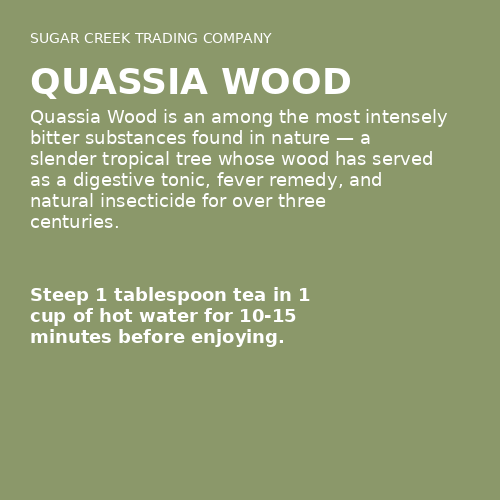
Among the most intensely bitter substances found in nature — a slender tropical tree whose wood has served as a digestive tonic, fever remedy, and natural insecticide for over three centuries.
Botanical Identification
Species: Quassia amara L.
Family: Simaroubaceae
Common Names: Quassia, bitterwood, amargo, Surinam quassia, bitter ash, hombre grande
Parts Used: Heartwood and stem wood (sold as whole pieces, shavings, or chips)
Native Range: Tropical regions of Central and South America, from southern Mexico through Brazil; also found in the Caribbean. Naturalized in parts of tropical Africa and Southeast Asia.
Appearance: Whole quassia wood pieces are typically pale yellowish-white to cream, with a fine, straight grain. The wood is lightweight and has virtually no aroma — but its taste is extraordinarily, memorably bitter.
Cultural and Historical Use
Quassia takes its name from Graman Quassi, an enslaved man in 18th-century Suriname who gained renown as a healer and shared knowledge of the tree's medicinal properties with European colonists. The Dutch brought samples to Europe in the 1750s, where the wood quickly became prized in pharmacies as a bitter tonic and febrifuge.
Throughout Central and South America, quassia wood has a deep history of use against intestinal parasites, digestive weakness, and malarial fevers. In Costa Rica and Panama, the wood is still commonly sold in markets as hombre grande — "big man" — a reference to its reputation as a vitality tonic. Traditional preparations involve simply soaking wood pieces in cold water overnight, producing a profoundly bitter liquid that stimulates appetite and digestion.
Beyond medicine, quassia found commercial use as a natural insecticide, a bittering agent in beverages (it was once used in brewing as a hop substitute), and even as a material for carved drinking cups — the bitterness would leach into any liquid poured inside.
Key Bioactive Compounds
| Compound Class | Key Representatives | Primary Activity |
|---|---|---|
| Quassinoids (bitter triterpenes) | Quassin, neoquassin, 18-hydroxyquassin | Responsible for extreme bitterness; stimulate digestive secretions, demonstrate antiparasitic and antitumor activity in vitro |
| Beta-carbolines | 1-Vinyl-4,8-dimethoxy-beta-carboline | Potential sedative and smooth-muscle-relaxant properties |
| Alkaloids | Various indole alkaloids (trace amounts) | Contribute to antiparasitic profile |
| Squalene | Squalene | Antioxidant; minor constituent of the wood |
How It Works in the Body
The defining pharmacological action of quassia wood is its profound bitterness. Quassin is estimated to be 50 times more bitter than quinine, making it one of the most potent bitter substances known. When bitter compounds contact taste receptors on the tongue (T2R receptors), they trigger a vagal nerve reflex that stimulates secretion of saliva, hydrochloric acid, bile, and pancreatic enzymes. This "bitter reflex" is the foundation of quassia's digestive benefits — it primes the entire gastrointestinal tract for efficient digestion.
Beyond the bitter reflex, quassinoids demonstrate direct antiparasitic activity, particularly against intestinal nematodes and protozoa. Laboratory studies show quassin and neoquassin disrupting the metabolism and reproductive capacity of several parasite species. This dual action — digestive stimulation combined with antiparasitic effects — made quassia a logical choice for traditional healers dealing with parasitic infections that impaired appetite and nutrition.
Emerging research has also explored quassinoids for anticancer properties, with several showing cytotoxic activity against leukemia and solid tumor cell lines in vitro, though clinical applications remain distant.
Dose Guidelines
| Form | Typical Dose | Notes |
|---|---|---|
| Cold Infusion (whole wood) | 1–2 small wood pieces (roughly 2–4 grams) soaked in 1 cup cold water for 8–12 hours | Traditional method; cold water extracts bitterness effectively without heat |
| Hot Infusion / Decoction | 1–2 grams of shaved or chipped wood steeped in hot water for 10–15 minutes | Faster extraction; produces an intensely bitter tea — start with less if new to bitter herbs |
| Tincture (1:5, 40% ethanol) | 1–3 mL, taken 15–30 minutes before meals | Convenient; allows precise dosing of this very potent bitter |
| Powdered Wood (capsules) | 250–500 mg, one to three times daily before meals | Bypasses bitter taste receptors and may reduce the vagal bitter reflex — liquid forms are generally preferred for digestive purposes |
Preparation and Uses
- Cold Water Infusion: The classic method. Place a piece of quassia wood in a glass of cool water before bed. By morning, the water will be pale yellow and intensely bitter. Sip 15–30 minutes before meals. The same piece of wood can be reused multiple times until bitterness fades.
- Digestive Bitter Formula: Combine quassia tincture with gentian root and orange peel tinctures for a well-rounded digestive bitter blend.
- Antiparasitic Tea: A stronger decoction (4–6 grams simmered 15 minutes) has been used traditionally for intestinal worms, though this should be done under practitioner guidance.
- Natural Insecticide: A strong quassia decoction can be sprayed on garden plants as a non-toxic pesticide effective against aphids, caterpillars, and other soft-bodied insects. It is considered safe for beneficial insects like ladybugs and bees once dried.
- Beverage Bittering: Tiny amounts of quassia infusion can be added to homemade tonics, bitters, or non-alcoholic aperitifs for a clean, sharp bitterness.
Optimal Context for Use
- Poor appetite, sluggish digestion, or insufficient stomach acid production
- As a pre-meal digestive stimulant, especially for heavy or rich meals
- In traditional antiparasitic protocols (under practitioner guidance)
- As a base ingredient in homemade digestive bitter blends
- In organic gardening as a natural, non-toxic insecticide spray
Sustainability and Ethical Harvesting
Quassia amara is a relatively small, fast-growing understory tree that regenerates readily in its native tropical habitats. It is not currently listed as threatened or endangered. The tree is cultivated commercially in several countries, including Brazil, Suriname, and Indonesia, reducing pressure on wild populations. Compared to many medicinal trees, quassia is considered a lower-risk species from a conservation standpoint. Nevertheless, purchasing from suppliers who can verify cultivated or sustainably wildcrafted origins remains best practice.
Safety and Cautions
- Quassia is extremely bitter and high doses can cause nausea, vomiting, and stomach irritation — start with small amounts and increase gradually.
- Large or prolonged doses have been associated with potential irritation to the gastrointestinal mucosa; not recommended for those with active gastric ulcers or severe gastritis.
- Traditional use as a male anti-fertility agent has been documented in some regions — men actively trying to conceive may wish to avoid regular use until more data is available.
- Not recommended during pregnancy due to potential uterine-stimulating effects documented in animal studies.
- May potentiate the effects of anticoagulant medications; consult a healthcare provider if taking blood thinners.
- Avoid concurrent use with antacids or proton pump inhibitors, as quassia's mechanism relies on stimulating acid secretion.
References
- Caceres, A., et al. "Plants used in Guatemala for the treatment of gastrointestinal disorders." Journal of Ethnopharmacology, 30(1), 1990, pp. 55–73.
- Guo, Z., et al. "Quassinoids: chemistry and biology." Natural Product Reports, 22(5), 2005, pp. 580–600.
- Plantamura, L., et al. "Bitter taste receptors and their role in digestive physiology." Alimentary Pharmacology and Therapeutics, 2019.
- Raintree Nutrition. "Tropical Plant Database: Quassia amara." 2012.
- WHO. "WHO Monographs on Selected Medicinal Plants, Volume 2: Lignum Quassiae." World Health Organization, Geneva, 2002.
Final Note: Quassia wood is a masterclass in the therapeutic power of bitterness. In a culture that often avoids bitter flavors, this ancient remedy reminds us that the taste we reject may be exactly what our digestion needs most. A single piece of wood, a glass of water, and the patience to let it steep — sometimes the simplest preparations carry the deepest medicine. This product is sold as a botanical specimen for educational purposes. It is not intended to diagnose, treat, cure, or prevent any disease.
Share