Sugar Creek Trading Company
Red Root
Red Root
Impossible de charger la disponibilité du service de retrait
Ceanothus americanus
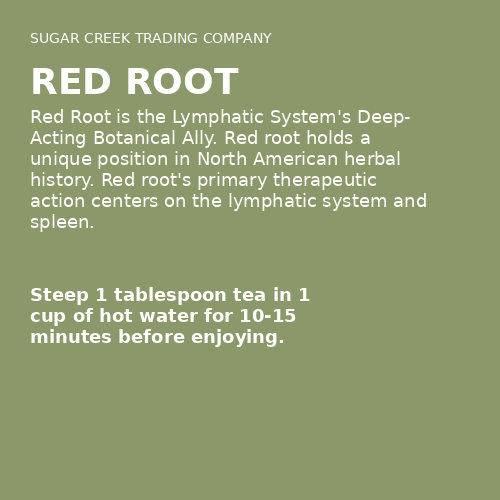
Red Root — The Lymphatic System's Deep-Acting Botanical Ally
Botanical Identification
Latin Name: Ceanothus americanus
Common Names: Red Root, New Jersey Tea, Wild Snowball, Mountain Sweet, Indian Tea
Family: Rhamnaceae (Buckthorn family)
Part Used: Root and root bark
Origin: Native to eastern and central North America, from southern Canada to the Gulf Coast
Description: Ceanothus americanus is a small, deciduous shrub growing 2 to 4 feet tall with clusters of small white flowers and ovate, finely serrated leaves. The roots are thick, woody, and distinctive for their deep reddish-brown to crimson interior — the characteristic that gives this plant its common name. The inner root bark yields a rich, dark-red extract when prepared. This plant should not be confused with red clover (Trifolium pratense), which is an entirely different species in a different family. Red root is one of the most important lymphatic herbs in the North American materia medica, prized specifically for its action on the spleen and lymphatic system.
Cultural and Historical Use
Red root holds a unique position in North American herbal history. During the American Revolution, the leaves of Ceanothus americanus were widely used as a substitute for imported black tea, earning it the enduring name "New Jersey Tea." But it is the root, not the leaf, that carries the greater medicinal significance.
Indigenous peoples of eastern North America used red root extensively. The Cherokee employed root decoctions for digestive complaints and as a wash for skin conditions. The Chippewa used it for colds and respiratory congestion. The Meskwaki used the root for bowel complaints. Multiple tribes recognized its ability to address swollen glands and stagnant conditions — observations that align precisely with its modern use as a lymphatic herb.
In the Eclectic medical tradition, red root was considered one of the premier remedies for splenic enlargement and lymphatic congestion. Eclectic physicians John Scudder and Finley Ellingwood documented its specific indications: boggy, enlarged spleen; swollen lymph nodes; and a sense of heaviness or fullness in the left hypochondrium. These physicians used it extensively for malarial splenomegaly, a common condition in 19th-century America.
Modern herbalists have revived red root as a cornerstone of lymphatic support protocols, recognizing it as one of the few herbs with a specific affinity for the spleen and deep lymphatic tissue.
Key Bioactive Compounds
| Compound Class | Key Constituents | Primary Activity |
|---|---|---|
| Condensed Tannins (Proanthocyanidins) | Ceanothane-type tannins, procyanidins | Astringent; tissue toning; anti-inflammatory |
| Triterpene Saponins | Ceanothic acid, ceanothenic acid | Lymphatic stimulation; expectorant |
| Alkaloids | Ceanothine (peptide alkaloid) | Hemostatic; circulatory support |
| Flavonoids | Myricetin, quercetin, fisetin | Antioxidant; anti-inflammatory; capillary strengthening |
| Phenolic Acids | Ellagic acid, gallic acid | Antioxidant; tissue protection |
| Resins | Complex resinous compounds | Astringent; local hemostatic |
How It Works in the Body
Red root's primary therapeutic action centers on the lymphatic system and spleen. The condensed tannins and triterpene saponins work synergistically to stimulate lymphatic circulation and reduce lymphatic congestion. The tannins tone and tighten lymphatic vessel walls, improving their contractile function, while the saponins appear to stimulate the movement of lymph through these vessels.
The herb has a pronounced affinity for the spleen, the body's largest lymphatic organ. The spleen filters blood, recycles old red blood cells, and serves as a reservoir for immune cells. When the spleen becomes congested or enlarged — whether from infection, chronic inflammation, or systemic stagnation — red root's astringent and stimulating compounds help restore normal splenic function. Eclectic physicians described this as "resolving" the spleen.
The alkaloid ceanothine contributes a hemostatic (blood-clotting) action, which supports the herb's traditional use for excessive bleeding and its role in interstitial tissue health. The flavonoids, particularly fisetin, provide anti-inflammatory protection to the vascular endothelium.
Red root also supports healthy blood viscosity and interstitial fluid balance. Herbalist Matthew Wood and others have described its ability to "thin" stagnant blood and interstitial fluids, improving the delivery of nutrients and the removal of waste at the tissue level. This is not a blood-thinning action in the pharmaceutical sense but rather a restoration of healthy fluid dynamics.
Dose Guidelines
| Preparation | Amount | Frequency |
|---|---|---|
| Decoction (simmered) | 1 tablespoon dried root per 2 cups water, simmered 15–20 minutes | 2–3 times daily |
| Tincture (1:5, 50–60% alcohol) | 1–3 mL (30–90 drops) | 3 times daily |
| Powdered root in capsules | 500–1,000 mg | 2–3 times daily |
Note: Because red root is a hard, woody root, decoction (simmering) rather than infusion (steeping) is necessary to properly extract its compounds. Tincture requires higher alcohol percentages (50–60%) for adequate extraction.
Preparation and Uses
- Decoction: Simmer 1 tablespoon of chopped or coarsely ground dried root in 2 cups of water for 15 to 20 minutes, covered. Strain and drink warm. The resulting tea is deeply astringent with a slightly bitter, earthy flavor.
- Tincture: Prepare using 50 to 60 percent alcohol at a 1:5 ratio. The higher alcohol content is necessary to extract the resinous and tannin-rich compounds from the woody root. Macerate for 6 to 8 weeks, shaking regularly.
- Lymphatic Formula Blends: Red root combines powerfully with cleavers (Galium aparine), calendula flower, and prickly ash bark for comprehensive lymphatic support. For splenic focus, pair with barberry root bark or fringe tree bark.
- Gargle: A strong decoction makes an excellent astringent gargle for sore throats, tonsillitis, and inflamed gums.
- Topical Astringent: The decoction can be applied externally as a wash for weeping skin conditions or minor wounds where astringent action is desired.
Optimal Context for Use
- Lymphatic congestion with swollen lymph nodes or a feeling of heaviness
- Splenic enlargement or dysfunction (under practitioner supervision)
- Chronic tonsillitis or pharyngitis with boggy, swollen tissues
- As part of a comprehensive lymphatic drainage protocol
- Recovery from mononucleosis or other infections that enlarge the spleen
- Chronic sinus congestion with thick, stagnant mucus
- Support for healthy blood and interstitial fluid dynamics
- Ovarian cysts and other conditions involving fluid-filled cystic formations (under practitioner guidance)
Sustainability and Ethical Harvesting
Ceanothus americanus grows as an understory shrub in open woodlands, prairies, and forest edges across eastern North America. While it is not currently listed as endangered, harvesting the root kills the individual plant, making sustainable wildcrafting practices essential. Ethical harvesters take only a portion of the root system from mature stands, leave the majority of plants unharvested, and avoid overharvesting in any single area. The plant's nitrogen-fixing root nodules contribute to soil fertility, another reason to harvest responsibly. We source from suppliers who practice sustainable wildcrafting and replanting to ensure long-term population stability.
Safety and Cautions
- Blood Clotting: Due to its hemostatic (pro-coagulant) properties, red root should be used with caution by individuals taking anticoagulant or antiplatelet medications. Consult a healthcare provider before combining with warfarin, heparin, aspirin, or other blood-thinning drugs.
- Pregnancy and Lactation: Safety during pregnancy and lactation has not been established. Avoid use unless directed by a qualified practitioner.
- Iron Absorption: The high tannin content may reduce non-heme iron absorption if taken with meals. Take between meals to avoid this effect.
- Splenic Conditions: While red root is traditionally used for splenic enlargement, any significant splenic pathology should be evaluated by a physician before self-treating with herbs.
- Surgery: Discontinue use at least two weeks before scheduled surgery due to potential effects on blood clotting.
- General: Red root is generally well tolerated at recommended doses. The most commonly reported side effect is mild gastrointestinal upset from the high tannin content, which can be mitigated by taking with food.
References
- Ellingwood, F. (1919). The American Materia Medica, Therapeutics and Pharmacognosy. Eclectic Medical Publications.
- Felter, H.W. & Lloyd, J.U. (1898). King's American Dispensatory. Ohio Valley Company.
- Buhner, S.H. (2012). Herbal Antivirals: Natural Remedies for Emerging and Resistant Viral Infections. Storey Publishing.
- Wood, M. (2008). The Earthwise Herbal: A Complete Guide to Old World Medicinal Plants. North Atlantic Books.
- Moerman, D.E. (1998). Native American Ethnobotany. Timber Press.
- Li, L., et al. (1997). "Peptide alkaloids from Ceanothus americanus." Phytochemistry, 45(4), 729-733.
- Hoffmann, D. (2003). Medical Herbalism: The Science and Practice of Herbal Medicine. Healing Arts Press.
Final Note
Red Root is one of the most important — and most underutilized — herbs in the North American materia medica. In a world of herbs that work on the liver, kidneys, or digestive tract, red root stands nearly alone in its specific, demonstrable affinity for the lymphatic system and spleen. It works where few other herbs reach: deep in the body's filtration and immune-surveillance network, restoring movement to stagnant fluids and tone to lax lymphatic tissues. For herbalists and health-seekers who understand that true detoxification requires a functioning lymphatic system, red root is not optional — it is foundational.
This information is for educational purposes only and is not intended to diagnose, treat, cure, or prevent any disease. Always consult a qualified healthcare professional before beginning any herbal regimen.
Share