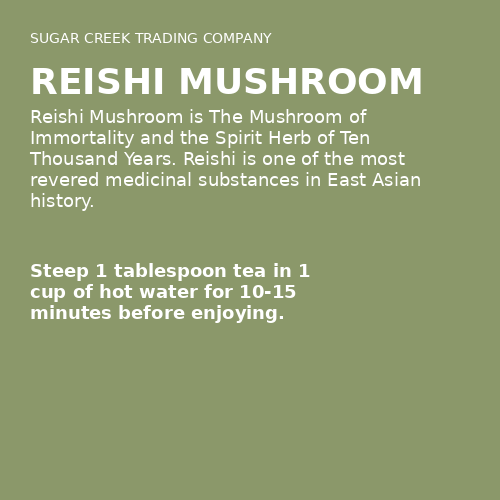
Sugar Creek Trading Company
Reishi Mushroom
Reishi Mushroom
Impossible de charger la disponibilité du service de retrait
Ganoderma lucidum
Ling Zhi — The Mushroom of Immortality and the Spirit Herb of Ten Thousand Years
Botanical Identification
- Species: Ganoderma lucidum (Curtis) P. Karst., and closely related species within the Ganoderma complex
- Family: Ganodermataceae (Polyporales)
- Common Names: Reishi (Japanese), Ling Zhi (Chinese, "spirit plant" or "divine mushroom"), Mushroom of Immortality, Yeongji (Korean)
- Part Used: Fruiting body (cap and stipe); spores are also used medicinally but require separate cracking/processing
- Origin: Found throughout temperate and subtropical forests across Asia, Europe, and the Americas. Most commercial supply is cultivated in China, Japan, and South Korea on hardwood logs or sawdust substrates.
- Appearance: Fan-shaped or kidney-shaped bracket fungus with a distinctive lacquered, glossy surface. Color ranges from reddish-brown to dark brown to nearly black. The underside is white to cream with fine pores (not gills). Texture is woody, tough, and not edible without processing.
- Taste and Energetics: Bitter flavor; neutral to slightly warm energy; enters the Heart, Lung, Liver, and Kidney meridians
Cultural and Historical Use
Reishi is one of the most revered medicinal substances in East Asian history. Its Chinese name, Ling Zhi, translates variously as "spirit mushroom," "divine fungus," or "herb of spiritual potency" — and for over two thousand years, it has been regarded not merely as medicine but as a symbol of good fortune, longevity, and spiritual attainment. It was first recorded in the Shennong Bencao Jing as a superior-grade herb — the highest classification, reserved for substances considered safe for prolonged use and capable of nurturing life itself.
In ancient China, wild Reishi was so rare and treasured that it was reserved for emperors and nobility. Taoist monks sought it in deep mountain forests as part of their quest for immortality, and it appears throughout Chinese art, literature, and architecture as an emblem of divine power and longevity. The famous Taoist text Baopuzi by Ge Hong (4th century CE) describes Reishi extensively, categorizing it by color into six types — red, black, blue-green, white, yellow, and purple — each associated with different organs and therapeutic properties.
In Japan, where it is known as Reishi (from rei meaning "spirit" and shi meaning "mushroom"), it has been integral to traditional Kampo medicine and folk healing. Japanese cultivation methods developed in the 1970s finally made this once-rare mushroom available to the wider public, sparking a global wave of research and commercial cultivation that continues to accelerate.
Key Bioactive Compounds
| Compound / Class | Concentration | Documented Activity |
|---|---|---|
| Beta-glucans (polysaccharides) | 25-50% of dried fruiting body | Immunomodulatory — activate macrophages, NK cells, dendritic cells; anti-tumor activity in preclinical studies |
| Ganoderic acids (triterpenoids) | Over 150 identified; 1-5% of dried weight | Hepatoprotective, anti-inflammatory, anti-histamine, cytotoxic to certain cancer cell lines, cholesterol-lowering |
| Ganodermanontriol & related sterols | Variable | Anti-tumor activity, particularly against breast and prostate cancer cell lines in vitro |
| Ganoderma polysaccharide peptides (GL-PP) | Variable | Antioxidant, immunostimulant, blood sugar-regulating |
| Adenosine and adenosine derivatives | Trace to moderate | Anti-platelet aggregation, muscle relaxation, sedative and calming effects |
| Germanium (organic) | Trace mineral | Oxygen utilization enhancement; antioxidant support (specific role debated) |
How It Works in the Body
Reishi's therapeutic power arises from the interplay between two major compound classes: polysaccharides (primarily beta-glucans) and triterpenoids (primarily ganoderic acids). These work through complementary but distinct mechanisms.
The beta-glucans function as biological response modifiers. They do not directly attack pathogens or abnormal cells; instead, they prime and modulate the immune system. They bind to receptors on macrophages, dendritic cells, and natural killer cells (particularly Dectin-1 and Complement Receptor 3), enhancing the body's surveillance and response capacity. This makes Reishi immunomodulatory rather than simply immunostimulatory — it can upregulate a suppressed immune system or help calm an overactive one, which is why it has been studied in both immune deficiency and autoimmune contexts.
The ganoderic acids, which are responsible for Reishi's characteristic bitter taste, operate more directly. They have demonstrated hepatoprotective effects (supporting liver detoxification pathways), anti-histamine activity (inhibiting histamine release from mast cells), and anti-inflammatory action through suppression of NF-kB and COX-2 pathways. Their ability to inhibit cholesterol synthesis via HMG-CoA reductase inhibition provides a mechanistic basis for Reishi's traditional association with cardiovascular health.
The adenosine compounds in Reishi contribute calming and sedative qualities, supporting its traditional use for calming the spirit (an shen), easing anxiety, and promoting restful sleep. This combination of immune support, liver protection, anti-inflammatory action, and nervous system calming gives Reishi its reputation as a broad, foundational tonic.
Dose Guidelines
| Preparation | Typical Dose | Frequency |
|---|---|---|
| Dried sliced fruiting body (decoction) | 3-15 g simmered in water for 1-2 hours | 1-2 times daily |
| Powdered fruiting body | 1.5-9 g | 1-3 times daily in tea or warm water |
| Hot water extract (standardized) | 1-2 g extract powder | 1-2 times daily |
| Tincture (dual extraction, 1:4) | 2-4 mL | 2-3 times daily |
| As tea (sliced pieces) | 5-10 g simmered 30-60 minutes | Sipped throughout the day |
Extraction note: Reishi's beta-glucans are water-soluble and require hot water extraction. The triterpenoids are poorly water-soluble and extract better in alcohol. For the fullest spectrum of compounds, a dual extraction (hot water + alcohol) or prolonged decoction is recommended.
Preparation and Uses
- Long decoction: The most traditional method. Simmer sliced Reishi in water for 1-2 hours. The tea is bitter and earthy. Can be sweetened with honey or combined with dates and goji berries to balance the flavor.
- Powder in beverages: Ground Reishi can be added to coffee, tea, smoothies, or hot chocolate. The bitter flavor pairs surprisingly well with cacao and coffee.
- Dual-extraction tincture: Combining hot water and alcohol extractions captures both the polysaccharides and the triterpenoids. This is considered the most comprehensive preparation method.
- Broth and soup: Reishi slices are commonly simmered into medicinal broths in Chinese and Japanese cuisine, often with chicken, astragalus, goji, and jujube dates.
- Capsules and tablets: Powdered fruiting body or standardized extracts are widely available in capsule form for convenience.
- Topical: Reishi extracts are increasingly used in skincare formulations for their anti-inflammatory and antioxidant properties.
Optimal Context for Use
- Long-term immune system support and modulation — for those seeking foundational resilience rather than acute immune stimulation
- Stress adaptation and nervous system calming — anxiety, restlessness, insomnia, and the traditional TCM concept of "disturbed Shen"
- Liver health and detoxification support, especially following exposure to environmental toxins or during recovery from illness
- Cardiovascular support — cholesterol regulation, blood pressure management, and circulation
- Adjunctive support during and after cancer treatment (under qualified medical supervision)
- Seasonal allergy management — the anti-histamine effects of ganoderic acids may help reduce allergic reactivity
- Longevity and healthy aging — consistent with its 2,000-year reputation as a life-extending tonic
Sustainability and Ethical Harvesting
Wild Reishi is relatively uncommon in nature, growing on decaying hardwood stumps and logs in deciduous and mixed forests. However, the vast majority of commercial Reishi is now cultivated, which has relieved pressure on wild populations. Cultivation methods range from log-grown (considered superior in quality, more closely mimicking wild conditions) to sawdust bag cultivation (more economically efficient but potentially lower in certain bioactive compounds).
When selecting Reishi, prioritize whole fruiting body products over mycelium-on-grain products. Mycelium grown on grain substrates may contain significant amounts of residual starch and lower concentrations of beta-glucans and triterpenoids compared to mature fruiting bodies. Look for products that specify beta-glucan and triterpenoid content and that have been tested for heavy metals and pesticide residues.
Supporting suppliers who use organic substrates and sustainable forestry-sourced hardwood logs helps maintain ecological responsibility in the mushroom cultivation industry.
Safety and Cautions
- Generally well-tolerated: Reishi has an excellent safety profile in most studies, with millennia of traditional use supporting its long-term safety. Side effects are uncommon at recommended doses.
- Digestive upset: Some individuals may experience dry mouth, mild stomach discomfort, nausea, or loose stools, particularly at higher doses or when starting use.
- Blood-thinning effects: Reishi may inhibit platelet aggregation. Use caution if taking anticoagulant or antiplatelet medications (warfarin, aspirin, clopidogrel). Discontinue at least two weeks before scheduled surgery.
- Blood pressure and blood sugar: May lower blood pressure and blood sugar. Monitor these levels if you take medications for hypertension or diabetes.
- Immunomodulation: Due to its immune-modulating effects, individuals taking immunosuppressant medications (transplant recipients, autoimmune patients on biologics) should consult their physician before use.
- Pregnancy and breastfeeding: Insufficient safety data. Consult a qualified practitioner before use during pregnancy or nursing.
- This product is sold as a botanical specimen and herbal supplement ingredient. These statements have not been evaluated by the FDA. This product is not intended to diagnose, treat, cure, or prevent any disease.
References
- Wachtel-Galor, S., et al. "Ganoderma lucidum (Lingzhi or Reishi): A Medicinal Mushroom." In: Herbal Medicine: Biomolecular and Clinical Aspects, 2nd Edition. CRC Press/Taylor & Francis, 2011.
- Boh, B., et al. "Ganoderma lucidum and its pharmaceutically active compounds." Biotechnology Annual Review, 2007; 13: 265-301.
- Cör, D., et al. "Antitumour, antimicrobial, antioxidant and antiacetylcholinesterase effect of Ganoderma lucidum terpenoids and polysaccharides." Molecules, 2018; 23(3): 649.
- Sanodiya, B.S., et al. "Ganoderma lucidum: A potent pharmacological macrofungus." Current Pharmaceutical Biotechnology, 2009; 10(8): 717-742.
- Ge Hong. Baopuzi Neipian (The Master Who Embraces Simplicity, Inner Chapters), c. 320 CE.
Final Note
Reishi is not a quick-fix herb. It is a slow, cumulative tonic that reveals its deepest benefits over weeks and months of consistent use. The ancients who called it the Mushroom of Immortality were not being literal — they were pointing to its capacity to support the body's foundational resilience, to calm the mind, to protect the liver, and to strengthen the immune system in a way that compounds over time. Start with a modest dose, be consistent, and give it the time it deserves. Of all the medicinal mushrooms now gaining recognition in the West, Reishi remains the most studied, the most storied, and the most worthy of its ancient reputation.
Share