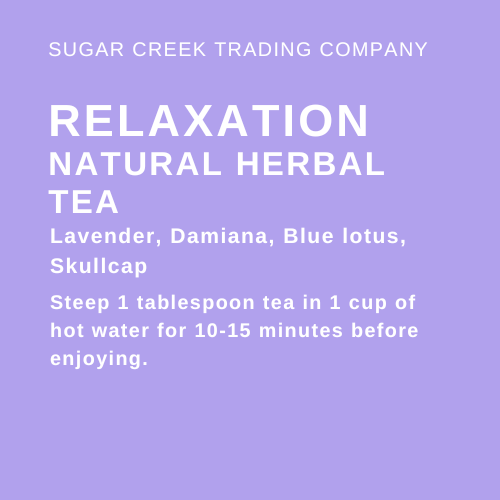
Sugar Creek Trading Company
Relaxation Blend
Relaxation Blend
Impossible de charger la disponibilité du service de retrait
Relaxation Blend
A potent herbal formula crafted to quiet the mind, ease tension, and restore deep calm.
Botanical Identification
Relaxation Blend is a multi-herb formula combining several of the most respected nervine and sedative botanicals in the Western and Ayurvedic traditions. Unlike a gentle relaxation tea meant for casual sipping, this blend is formulated at therapeutic strength for those who need meaningful relief from tension, restlessness, and overstimulation.
- Passionflower (Passiflora incarnata) — Family: Passifloraceae
- Valerian Root (Valeriana officinalis) — Family: Caprifoliaceae
- Skullcap (Scutellaria lateriflora) — Family: Lamiaceae
- Lemon Balm (Melissa officinalis) — Family: Lamiaceae
- Ashwagandha Root (Withania somnifera) — Family: Solanaceae
- Hops Strobiles (Humulus lupulus) — Family: Cannabaceae
Cultural and Historical Use
Each ingredient in this blend carries centuries of documented use for calming the nervous system. Passionflower was used by Indigenous peoples of the southeastern United States as a sedative poultice and tea long before European contact. Valerian root was prescribed by Hippocrates and Galen in ancient Greece and Rome for insomnia and nervous agitation. Skullcap earned the name "mad dog weed" in early American herbalism for its use in calming hysteria and nervous tension. Lemon balm has been cultivated in monastery gardens across Europe since the Middle Ages, where it was considered essential for "lifting the spirits." Ashwagandha has been a cornerstone of Ayurvedic medicine for over 3,000 years, classified as a rasayana (rejuvenative tonic). Hops, beyond their role in brewing, were historically stuffed into pillows to promote restful sleep — a practice attributed to King George III.
This blend draws on the synergy of these traditions: nervines that directly soothe the central nervous system paired with adaptogens that help regulate the stress response at its hormonal root.
Key Bioactive Compounds
| Compound | Source Herb | Primary Action |
|---|---|---|
| Chrysin | Passionflower | GABA-A receptor modulation; anxiolytic activity |
| Valerenic acid | Valerian Root | Inhibits GABA breakdown; promotes sedation |
| Baicalin | Skullcap | Anti-anxiety; neuroprotective flavonoid |
| Rosmarinic acid | Lemon Balm | GABA-transaminase inhibition; calming effect |
| Withanolides | Ashwagandha | Cortisol regulation; HPA axis modulation |
| 2-Methyl-3-buten-2-ol | Hops | Sedative metabolite; enhances sleep onset |
How It Works in the Body
This blend operates through multiple complementary pathways. The primary mechanism centers on the GABAergic system — the brain's chief inhibitory network responsible for reducing neuronal excitability. Passionflower, valerian, and skullcap each enhance GABA signaling through slightly different mechanisms: passionflower modulates GABA-A receptors directly, valerian inhibits the enzymatic breakdown of GABA, and skullcap provides flavonoids that bind to benzodiazepine receptor sites without the dependency risks of pharmaceutical agents.
Lemon balm contributes by inhibiting GABA-transaminase, the enzyme that degrades GABA, effectively raising available GABA levels in the synaptic cleft. Meanwhile, ashwagandha works upstream on the hypothalamic-pituitary-adrenal (HPA) axis, reducing cortisol output and normalizing the stress response over time. Hops contribute a sedative metabolite that forms during digestion, supporting sleep onset when the blend is taken in the evening.
The result is a formula that addresses both acute nervous tension and the underlying chronic stress patterns that perpetuate it.
Dose Guidelines
| Form | Amount | Frequency |
|---|---|---|
| Dried blend as tea | 1.5 to 2 teaspoons per 8 oz hot water, steeped 10-15 minutes covered | 1-3 times daily |
| Powdered blend (capsules) | 1,000-2,000 mg | 1-2 times daily |
| Tincture (if prepared) | 2-4 mL (40-80 drops) | Up to 3 times daily |
| Evening/sleep dose | 2 teaspoons brewed strong, 30-60 minutes before bed | Once nightly |
For best results during acute stress, use consistently for at least 2-4 weeks. The adaptogenic component (ashwagandha) requires sustained use to reach full effect.
Preparation and Uses
- Strong infusion: Use 1.5-2 teaspoons per cup. Pour just-boiled water over the blend, cover tightly, and steep for 10-15 minutes. The longer steep extracts deeper sedative compounds from valerian and hops. Strain and drink warm.
- Evening wind-down ritual: Brew a strong cup 30-60 minutes before bed. Pair with reduced screen exposure for enhanced effect.
- Daytime calm formula: Use a lighter dose (1 teaspoon) during the day for anxiety relief without heavy sedation. Skullcap and lemon balm provide calm focus at lower doses.
- Bath soak: Brew a quart of strong infusion and add to a warm bath for full-body relaxation.
- Tincture preparation: Combine the dried blend with 80-proof vodka at a 1:5 ratio in a sealed jar. Macerate for 4-6 weeks, shaking daily. Strain and bottle.
Optimal Context for Use
- Chronic stress, nervous tension, and difficulty unwinding after work
- Insomnia or restless sleep, particularly when caused by an overactive mind
- Periods of high emotional demand or life transitions
- Muscle tension associated with stress (especially jaw clenching, neck and shoulder tightness)
- Complementary support alongside meditation, breathwork, or therapy
- Recovery from overstimulation (excessive screen time, noise, social demands)
This blend is stronger and more targeted than a casual relaxation tea. It is designed for individuals who need therapeutic-grade calming support, not just a pleasant evening beverage.
Sustainability and Ethical Harvesting
All herbs in this blend are sourced from cultivated stocks. Passionflower, lemon balm, and hops are widely cultivated perennials that grow vigorously in temperate climates. Valerian is commercially farmed across Europe and North America. Skullcap should always be verified as true Scutellaria lateriflora, as adulteration with germander (Teucrium) has been historically documented — our supply chain maintains identity testing. Ashwagandha is cultivated extensively in India and increasingly in North American farms. None of the ingredients in this blend are threatened or wild-harvested from sensitive ecosystems.
Safety and Cautions
- Sedation: This blend can cause drowsiness, especially at higher doses or when combined with hops and valerian. Do not operate heavy machinery or drive until you know how it affects you.
- Drug interactions: May potentiate the effects of benzodiazepines, barbiturates, sleep medications, and alcohol. Consult a healthcare provider if you take any sedative or anxiolytic medication.
- Pregnancy and breastfeeding: Not recommended. Passionflower and ashwagandha have uterine-stimulating potential. Valerian and hops lack sufficient safety data for pregnancy.
- Nightshade sensitivity: Ashwagandha belongs to the Solanaceae family. Individuals with nightshade sensitivities should exercise caution.
- Thyroid conditions: Ashwagandha may increase thyroid hormone levels. Those with hyperthyroidism or on thyroid medication should consult their provider.
- Surgery: Discontinue use at least two weeks before scheduled surgery due to potential sedative interactions with anesthesia.
References
- Akhondzadeh, S., et al. (2001). "Passionflower in the treatment of generalized anxiety: a pilot double-blind randomized controlled trial." Journal of Clinical Pharmacy and Therapeutics, 26(5), 363-367.
- Bent, S., et al. (2006). "Valerian for sleep: a systematic review and meta-analysis." American Journal of Medicine, 119(12), 1005-1012.
- Brock, C., et al. (2014). "American Skullcap: a randomised, double-blind placebo-controlled crossover study." Alternative Medicine Review, 19(4), 372-378.
- Cases, J., et al. (2011). "Pilot trial of Melissa officinalis L. leaf extract in the treatment of volunteers suffering from mild-to-moderate anxiety disorders." Mediterranean Journal of Nutrition and Metabolism, 4(3), 211-218.
- Chandrasekhar, K., et al. (2012). "A prospective, randomized double-blind, placebo-controlled study of safety and efficacy of a high-concentration full-spectrum extract of ashwagandha root." Indian Journal of Psychological Medicine, 34(3), 255-262.
- Franco, L., et al. (2012). "Health benefits of methylbutenol from beer." PLoS ONE, 7(4), e34543.
Final Note
This Relaxation Blend is not a mild sipping tea — it is a purposefully formulated herbal compound designed to deliver real, measurable calming effects. The combination of fast-acting nervines with a sustained-release adaptogen creates both immediate relief and long-term resilience against chronic stress. Brew it strong, use it consistently, and give the formula time to work at its deeper levels. As with all herbal medicines, this product is not intended to diagnose, treat, cure, or prevent any disease. Consult a qualified healthcare practitioner before use if you have any medical conditions or are taking medications.
Share