Sugar Creek Trading Company
Rhodiola Root
Rhodiola Root
Impossible de charger la disponibilité du service de retrait
Rhodiola rosea
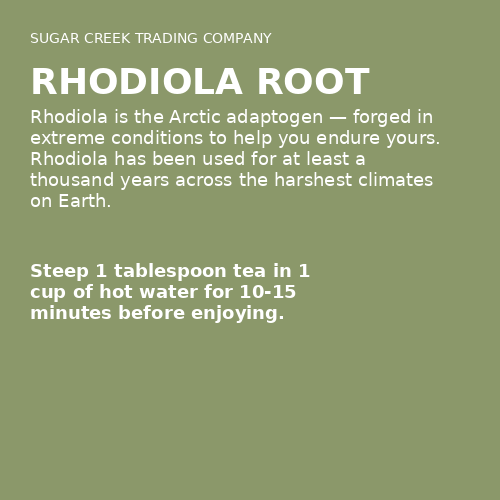
The Arctic adaptogen — forged in extreme conditions to help you endure yours.
Botanical Identification
Species: Rhodiola rosea L.
Family: Crassulaceae (Stonecrop family)
Common names: Rhodiola, Golden Root, Arctic Root, Rose Root, King's Crown, Roseroot
Part used: Root and rhizome
Native range: Arctic and subarctic regions of Europe, Asia, and North America — thriving in high-altitude mountain meadows, cliff faces, and tundra across Scandinavia, Siberia, Iceland, and the Altai Mountains. The plant is a succulent perennial growing 5-40 cm tall with thick, fleshy leaves and distinctive clusters of yellow flowers. The root, when cut, releases a characteristic rose-like fragrance — hence the species name rosea.
Cultural and Historical Use
Rhodiola has been used for at least a thousand years across the harshest climates on Earth. Viking warriors reportedly consumed rhodiola root to enhance physical stamina and mental resilience before voyages and battles. In Siberia, it was traditionally given to newly married couples to promote fertility and was considered so valuable that trade routes for rhodiola were closely guarded. The Sherpa people of the Himalayas have used it to cope with high-altitude conditions. Chinese emperors sent expeditions to Siberia specifically to procure "golden root."
Modern scientific interest in rhodiola began in the Soviet Union during the Cold War, where it was classified as a secret adaptogen for military personnel, Olympic athletes, cosmonauts, and political leaders. Soviet researchers published over 180 studies on rhodiola between the 1960s and 1990s, much of which remained inaccessible to the West until after the fall of the Soviet Union. It was formally classified as an adaptogen by Russian pharmacologist Dr. Nikolai Lazarev and further studied by Dr. Israel Brekhman, the father of adaptogen research. Today, rhodiola is one of the most clinically studied adaptogens in the world.
Key Bioactive Compounds
| Compound | Classification | Primary Action |
|---|---|---|
| Salidroside | Phenylpropanoid glycoside | Primary adaptogenic compound; neuroprotective; anti-fatigue |
| Rosavins (rosavin, rosin, rosarin) | Cinnamyl alcohol glycosides | Unique to R. rosea; mood-regulating; synergistic with salidroside |
| Tyrosol | Phenylethanoid | Antioxidant; cardioprotective; anti-fatigue |
| Rhodioflavonoside | Flavonoid glycoside | Antioxidant; anti-inflammatory |
| Gallic acid | Phenolic acid | Antioxidant; neuroprotective |
| Beta-sitosterol | Phytosterol | Anti-inflammatory; immune-modulating |
Standardized extracts typically contain a minimum of 3% rosavins and 1% salidroside, reflecting the natural ratio found in the root. Both compounds are considered necessary for full adaptogenic activity — products standardized to salidroside alone (often from other Rhodiola species) may not deliver the same benefits.
How It Works in the Body
Rhodiola's adaptogenic mechanism is among the best characterized of any medicinal plant. It operates primarily through modulation of the stress-response system at multiple levels. At the hormonal level, rhodiola regulates the hypothalamic-pituitary-adrenal (HPA) axis, preventing the excessive cortisol release that accompanies chronic stress while maintaining the body's ability to mount an appropriate acute stress response when needed.
At the cellular level, salidroside activates AMP-activated protein kinase (AMPK), a master regulator of cellular energy metabolism. This enhances mitochondrial function, increases ATP production, and improves the efficiency of oxygen utilization in tissues — explaining rhodiola's documented anti-fatigue effects. Salidroside also upregulates heat shock proteins (Hsp70), which protect cells from stress-induced damage.
In the brain, rhodiola influences monoamine neurotransmitters by inhibiting monoamine oxidase (MAO) and catechol-O-methyltransferase (COMT), the enzymes responsible for breaking down serotonin, dopamine, and norepinephrine. This results in enhanced mood, sharper focus, and improved cognitive performance under stress — without the jitteriness of stimulants. Rosavins appear to enhance serotonergic activity specifically, contributing to the mood-brightening effects that distinguish rhodiola from purely stimulating adaptogens.
Dose Guidelines
| Form | Amount | Frequency |
|---|---|---|
| Dried root as decoction | 1-2 teaspoons per 10 oz water, simmered 10-15 minutes | 1-2 times daily, morning and early afternoon |
| Powdered root (capsules) | 300-600 mg (standardized to 3% rosavins, 1% salidroside) | Once or twice daily |
| Tincture (1:5) | 2-3 mL (40-60 drops) | 1-2 times daily |
| Bulk dried root powder | 500-1,000 mg | 1-2 times daily |
Take rhodiola in the morning or early afternoon. Avoid evening doses, as its stimulating and focus-enhancing properties may interfere with sleep. Rhodiola follows a biphasic dose-response curve: lower doses tend to be stimulating and focus-enhancing, while very high doses can be sedating. Most people find their optimal dose in the 300-600 mg range of standardized extract.
Preparation and Uses
- Decoction: Because rhodiola is a dense, fibrous root, a standard infusion is insufficient. Simmer 1-2 teaspoons of dried, chopped root in 10 oz of water for 10-15 minutes with the lid on. Strain and drink. The taste is mildly astringent with rose-like floral notes and a slight bitterness.
- Powdered root in smoothies: Add 1/2 to 1 teaspoon of rhodiola powder to a morning smoothie with adaptogenic companions like maca, cacao, or reishi for a synergistic energy blend.
- Tincture preparation: Fill a jar one-third full with dried, chopped rhodiola root. Cover with 100-proof vodka (50% alcohol is ideal for extracting both water-soluble and alcohol-soluble compounds). Seal and macerate for 6-8 weeks, shaking regularly. Strain and bottle. Take 40-60 drops in water.
- Cycling protocol: Many herbalists recommend using rhodiola in cycles — 5 days on, 2 days off, or 3 weeks on, 1 week off — to maintain sensitivity to its effects and honor the adaptogenic principle of restoring balance rather than creating dependency.
- Pre-performance dose: A single dose of 300-600 mg taken 30-60 minutes before a demanding mental or physical task can acutely enhance performance, focus, and endurance.
Optimal Context for Use
- Chronic stress and burnout recovery — particularly for those who feel "wired but tired"
- Cognitive performance demands: exams, high-stakes work, creative projects
- Physical endurance and athletic performance, especially in endurance sports
- Mild to moderate depression, especially stress-related or seasonal
- Fatigue and low energy that does not respond to rest alone
- High-altitude adaptation and physical performance in demanding environments
- Shift work, jet lag, and disrupted circadian rhythms
- Complementary support during recovery from illness or prolonged physical demand
Sustainability and Ethical Harvesting
Wild rhodiola populations are under significant pressure in several regions due to commercial overharvesting. Rhodiola rosea is classified as endangered or vulnerable in parts of the United Kingdom, Russia, and several European countries. The plant grows slowly in harsh environments, and wild roots can take 5-7 years to reach harvestable maturity. For this reason, we prioritize rhodiola sourced from cultivated farms in Scandinavia, Canada, or the northern United States where sustainable agricultural practices are established. Consumers should always verify that their rhodiola comes from cultivated sources and is confirmed as true R. rosea, as adulteration with other Rhodiola species (particularly R. crenulata) is common in the global market.
Safety and Cautions
- Stimulating effects: Rhodiola can cause insomnia, restlessness, or agitation in sensitive individuals, particularly at higher doses or when taken late in the day. Start with a low dose and take in the morning.
- Bipolar disorder: Due to its monoamine-modulating effects, rhodiola should be used with caution by individuals with bipolar disorder, as it could theoretically trigger manic episodes.
- MAO and COMT inhibition: Rhodiola may interact with antidepressant medications, particularly MAOIs and SSRIs. Consult your healthcare provider before combining rhodiola with any psychiatric medication.
- Autoimmune conditions: As an immune modulator, rhodiola may not be appropriate for individuals with autoimmune diseases without practitioner guidance.
- Pregnancy and breastfeeding: Insufficient safety data. Avoid use during pregnancy and lactation unless directed by a qualified practitioner.
- Blood pressure: Rhodiola may lower blood pressure in some individuals. Those on antihypertensive medications should monitor accordingly.
- Surgery: Discontinue use at least two weeks before surgery due to potential effects on blood pressure and neurotransmitter levels.
References
- Panossian, A. & Wikman, G. (2010). "Effects of adaptogens on the central nervous system and the molecular mechanisms associated with their stress-protective activity." Pharmaceuticals, 3(1), 188-224.
- Darbinyan, V., et al. (2000). "Rhodiola rosea in stress-induced fatigue — a double-blind cross-over study." Phytomedicine, 7(5), 365-371.
- Olsson, E.M., et al. (2009). "A randomised, double-blind, placebo-controlled, parallel-group study of the standardised extract SHR-5 of the roots of Rhodiola rosea in the treatment of subjects with stress-related fatigue." Planta Medica, 75(2), 105-112.
- Mao, J.J., et al. (2015). "Rhodiola rosea versus sertraline for major depressive disorder: a randomized placebo-controlled trial." Phytomedicine, 22(3), 394-399.
- Ishaque, S., et al. (2012). "Rhodiola rosea L.: an herb with anti-stress, anti-aging, and immunostimulating properties for cancer chemoprevention." Current Pharmacology Reports, 1(6), 406-417.
- Amsterdam, J.D. & Panossian, A.G. (2016). "Rhodiola rosea L. as a putative botanical antidepressant." Phytomedicine, 23(7), 770-783.
Final Note
Rhodiola rosea stands as one of the most rigorously studied adaptogens available. Born in some of the most extreme environments on Earth, this root has been used for centuries to help humans meet their own extremes — whether physical, mental, or emotional. It does not simply mask fatigue or artificially stimulate the nervous system. Instead, it recalibrates the stress response, optimizes cellular energy production, and sharpens cognitive function from the ground up. Rhodiola is a root that earns its reputation every time it is studied. As with all herbal medicines, this product is not intended to diagnose, treat, cure, or prevent any disease. Consult a qualified healthcare practitioner before use if you have any medical conditions or are taking medications.
Share