Sugar Creek Trading Company
Rosemary
Rosemary
Impossible de charger la disponibilité du service de retrait
ROSMARINUS OFFICINALIS / SALVIA ROSMARINUS
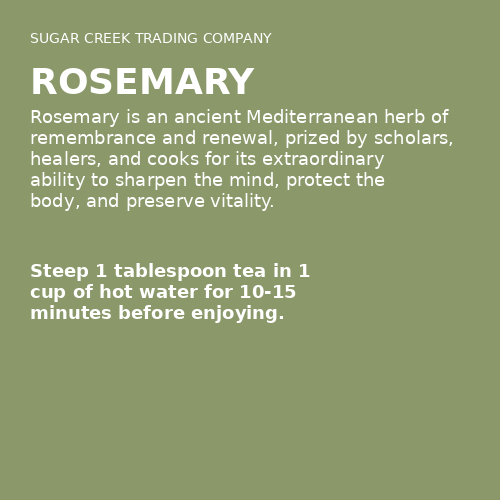
Ancient Mediterranean herb of remembrance and renewal, prized by scholars, healers, and cooks for its extraordinary ability to sharpen the mind, protect the body, and preserve vitality.
BOTANICAL IDENTIFICATION
Scientific Name: Salvia rosmarinus (Spenn.) (formerly Rosmarinus officinalis L.)
Common Names: Rosemary, dew of the sea, compass weed, old man, incensier, polar plant
Family: Lamiaceae (Mint family)
Rosemary is an aromatic, evergreen, woody perennial shrub native to the Mediterranean basin, where it thrives on dry, rocky limestone hillsides and coastal cliffs. In 2017, phylogenetic research led to the reclassification of the genus Rosmarinus into Salvia, making the current accepted name Salvia rosmarinus, though Rosmarinus officinalis remains widely used in herbal commerce and literature. The plant grows one to two meters tall with dense, needle-like leaves that are dark green above, silver-white beneath, and intensely aromatic when crushed. Small, two-lipped flowers ranging from pale blue to deep violet appear in axillary clusters, blooming nearly year-round in mild climates.
The leaves are the primary medicinal and culinary part. They are leathery, linear, 2 to 4 centimeters long, with strongly rolled-under margins that help reduce water loss in the plant's native arid habitat. This adaptation also concentrates the volatile essential oils in glandular trichomes on the leaf surface, making rosemary one of the most aromatically potent herbs in cultivation. The name rosmarinus derives from the Latin ros marinus, meaning "dew of the sea," reflecting its natural abundance on Mediterranean coastal bluffs where morning sea mist provides its primary moisture.
CULTURAL AND HISTORICAL USE
Rosemary has been intertwined with human culture for at least three thousand years, with a remarkably consistent association with memory, mental clarity, and fidelity that spans civilizations. Ancient Greek students wore garlands of rosemary while studying for examinations, believing the herb strengthened recall. This tradition gave rise to rosemary's enduring title as the "herb of remembrance," a role reinforced by Shakespeare's Ophelia when she declared, "There's rosemary, that's for remembrance."
In ancient Egypt, rosemary sprigs were placed in tombs as symbols of remembrance and preservation. Greek and Roman physicians including Dioscorides and Pliny prescribed rosemary for digestive weakness, liver complaints, headaches, and failing memory. Paracelsus, the influential Renaissance physician, valued rosemary oil for its ability to strengthen the entire body, particularly the brain and heart. One of the earliest distilled herbal products in European history, Hungary Water, was a rosemary-based preparation created around 1370, allegedly for Queen Elizabeth of Hungary, who claimed it restored her youth and beauty.
In European folk medicine, rosemary was burned as incense to purify sickrooms, ward off plague, and cleanse the air of infection. This practice was not mere superstition; modern research has confirmed that rosemary smoke contains antimicrobial volatile compounds capable of reducing airborne bacterial counts. During the Black Death, rosemary was a key ingredient in the aromatic vinegars and pomanders carried by physicians and plague survivors. It was also traditional to throw rosemary into graves, tuck it into bridal bouquets, and burn it at funerals, weaving the herb into every major life transition.
KEY BIOACTIVE COMPOUNDS & BENEFITS
| Compound/Class | Location in Plant | Human Benefit | Role in Plant |
|---|---|---|---|
| Rosmarinic acid | Leaves | Potent antioxidant, anti-inflammatory, antiallergic; protects neurons and liver | Antimicrobial defense and UV protection |
| Carnosic acid and carnosol (diterpenes) | Leaves | Neuroprotective; activates Nrf2 antioxidant pathway; anticancer research interest | Antioxidant protection against arid-climate oxidative stress |
| 1,8-Cineole (eucalyptol) | Essential oil | Cognitive enhancement; bronchodilator; respiratory support | Herbivore deterrent |
| Camphor and alpha-pinene | Essential oil | Circulatory stimulant; analgesic; mental alertness | Insect repellent and allelopathic compound |
| Ursolic acid (triterpene) | Leaf surface wax | Anti-inflammatory; supports muscle preservation and insulin sensitivity | Protective leaf coating against desiccation |
Rosemary's therapeutic profile is distinguished by the exceptional combination of rosmarinic acid and carnosic acid, two compounds that work through complementary but distinct antioxidant mechanisms. Rosmarinic acid is a water-soluble polyphenol that scavenges free radicals directly, while carnosic acid is a lipid-soluble diterpene that activates the body's own antioxidant defense system through the Nrf2 pathway. This dual mechanism provides both immediate and sustained antioxidant protection, a quality that has drawn significant attention from neuroscience researchers investigating Alzheimer's disease and age-related cognitive decline.
HOW IT WORKS IN THE BODY
Rosemary acts as a systemic stimulant and protector, with its most notable effects concentrated in the brain, liver, circulatory system, and digestive tract.
Cognitive Enhancement and Neuroprotection:
Rosemary's reputation as the herb of remembrance is now supported by substantial research. The volatile compound 1,8-cineole is absorbed through both inhalation and ingestion and has been detected in blood plasma following rosemary exposure. Studies at Northumbria University demonstrated that participants in a rosemary-scented room performed significantly better on memory and cognitive speed tasks, with blood levels of 1,8-cineole correlating directly with improved performance. Carnosic acid provides longer-term neuroprotection by activating the Nrf2 transcription factor, which upregulates the production of endogenous antioxidant enzymes such as glutathione, superoxide dismutase, and heme oxygenase-1 in brain tissue. This mechanism protects neurons from oxidative damage and has shown promise in animal models of Alzheimer's and Parkinson's disease.
Liver Protection and Detoxification:
Rosmarinic acid and carnosol both demonstrate significant hepatoprotective activity. They support Phase I and Phase II liver detoxification enzymes, enhance glutathione production in hepatocytes, and protect liver cells from damage by toxins, medications, and oxidative stress. This traditional use of rosemary as a liver herb is well validated by modern pharmacological research.
Circulatory Stimulation:
Rosemary is a warming, circulatory stimulant that improves blood flow to the periphery and the brain. The essential oil compounds camphor, alpha-pinene, and 1,8-cineole increase cardiac output and peripheral vasodilation when used in moderate doses. This circulatory-stimulating quality underlies its traditional use for cold extremities, low blood pressure, headaches of a congestive nature, and sluggish digestion.
Digestive Support:
As a bitter aromatic herb, rosemary stimulates the production of bile and gastric secretions, enhances intestinal motility, and relieves gas and bloating. The antimicrobial essential oil compounds also help maintain a healthy intestinal microbial balance. European herbal pharmacopeias have long approved rosemary for dyspeptic complaints.
DOSE GUIDELINES
| Preparation Type | Typical Dose | Purpose |
|---|---|---|
| Dried leaf infusion (tea) | 1 to 2 teaspoons per cup, steeped covered 10 to 15 minutes | Cognitive support, digestive stimulation, and daily tonic |
| Tincture (1:5, 45% alcohol) | 2 to 4 mL, 3 times daily | Concentrated circulatory and hepatic support |
| Essential oil (inhalation) | 3 to 5 drops in a diffuser or inhaled from cloth | Cognitive enhancement and mental alertness |
| Essential oil (topical, diluted) | 2 to 3% dilution in carrier oil | Muscle pain, scalp circulation, and joint relief |
| Culinary use | Fresh or dried leaves added freely to food | Daily antioxidant intake and digestive support |
Rosemary is potent and should be dosed with respect, particularly in concentrated extract or essential oil forms. The dried leaf tea and culinary use are the gentlest approaches and are appropriate for daily long-term use. For cognitive support, consistent daily intake over weeks to months is more effective than occasional large doses. Rosemary essential oil should never be taken internally without professional guidance and should always be diluted before topical application.
PREPARATION AND USES
A covered infusion of dried rosemary leaves produces a robust, aromatic, pine-like tea with a slightly bitter, warming character. Cover the cup or pot during steeping to prevent the volatile essential oils from escaping with the steam, as these compounds are central to the herb's cognitive and digestive benefits. The tea can be sweetened with honey and combines well with lemon, ginger, peppermint, or green tea.
For hair and scalp health, a strong rosemary infusion makes an excellent final rinse after shampooing, traditionally used to stimulate scalp circulation, strengthen hair follicles, and darken graying hair. Rosemary-infused oil, made by steeping dried leaves in olive or jojoba oil for four to six weeks, is used for scalp massage and as a base for muscle and joint liniments. In the kitchen, rosemary is one of the most versatile culinary herbs, enhancing roasted meats, potatoes, bread, olive oil, and Mediterranean dishes while simultaneously contributing its protective antioxidant compounds to the food. The herb's antioxidant potency is so significant that rosemary extract is approved as a food-grade preservative (E392) in the European Union for preventing lipid oxidation in oils and processed foods.
OPTIMAL CONTEXT FOR USE
This herb is especially well-suited for individuals experiencing:
Cognitive fog, poor memory, and difficulty concentrating, particularly age-related cognitive decline or study-related mental fatigue
Cold constitution and poor peripheral circulation manifesting as cold hands and feet, low blood pressure, or sluggish digestion
Liver congestion and sluggish detoxification from medication use, environmental toxin exposure, or dietary burden
Digestive weakness with bloating, gas, and slow gastric motility, especially when linked to inadequate bile flow
Hair thinning and scalp conditions where improved local circulation and antioxidant protection may support follicle health
Rosemary pairs powerfully with ginkgo for cognitive enhancement, with ginger for circulatory warming, with milk thistle for liver protection, and with lemon balm for a balanced nootropic blend that combines stimulation with calm focus.
SUSTAINABILITY AND ETHICAL HARVESTING
Salvia rosmarinus is an extremely abundant, widely cultivated plant that is in no way threatened or endangered. It is commercially grown across the Mediterranean, the Americas, and Australia, and thrives as a garden plant in most temperate and subtropical climates. Rosemary is a resilient, drought-tolerant, long-lived perennial that actually benefits from regular harvesting, which promotes bushier growth and higher essential oil production.
Wild rosemary populations in the Mediterranean are abundant and robust. The plant colonizes disturbed sites readily and is an important component of the maquis and garrigue shrubland ecosystems of southern Europe. Because rosemary is so easy to grow and so widely cultivated, there is minimal ecological concern associated with its harvest. The primary ethical consideration is ensuring fair labor practices and fair pricing for growers, particularly for essential oil production, which requires enormous quantities of plant material.
SAFETY AND CAUTIONS
Rosemary leaf used in culinary quantities and as a moderate-strength tea is extremely safe for the vast majority of adults. However, several cautions apply to concentrated forms.
Epilepsy and seizure disorders: Rosemary essential oil, particularly varieties high in camphor, may lower the seizure threshold. Individuals with epilepsy or a history of seizures should avoid rosemary essential oil and use the whole leaf herb with caution and in moderate doses.
Pregnancy: Culinary use of rosemary is safe during pregnancy. However, concentrated rosemary preparations (essential oil, high-dose tinctures, and standardized extracts) should be avoided during pregnancy due to potential emmenagogue and uterine-stimulating effects at high doses.
High blood pressure: While rosemary's circulatory-stimulating properties are beneficial for those with low blood pressure, individuals with significant hypertension should use rosemary in moderate culinary or tea quantities rather than high-dose supplemental forms.
Iron absorption: The tannins and polyphenols in rosemary can inhibit non-heme iron absorption if consumed in large quantities alongside iron-rich meals. This is a minor concern at typical doses.
Essential oil safety: Rosemary essential oil should never be ingested without professional supervision and must always be diluted before skin application. Keep away from the face of infants and young children.
REFERENCES
Moss, M., et al. "Aromas of rosemary and lavender essential oils differentially affect cognition and mood in healthy adults." International Journal of Neuroscience, 113(1), 2003, pp. 15-38.
Satoh, T., et al. "Carnosic acid, a catechol-type electrophilic compound, protects neurons both in vitro and in vivo through activation of the Keap1/Nrf2 pathway." Journal of Neurochemistry, 104(4), 2008, pp. 1116-1131.
Begum, A., et al. "An in-depth review on the medicinal flora Rosmarinus officinalis (Lamiaceae)." Acta Scientifica Pharmaceutical Sciences, 2(3), 2013, pp. 110-120.
Pengelly, A., et al. "Short-term study on the effects of rosemary on cognitive function in an elderly population." Journal of Medicinal Food, 15(1), 2012, pp. 10-17.
FINAL NOTE
Rosemary stands as living proof that the most powerful medicines are sometimes the ones growing quietly in the garden. For three thousand years, humans have reached for this pungent, resinous herb to sharpen their minds, warm their bodies, protect their livers, and honor their dead. Modern science has not only validated these ancient uses but has uncovered mechanisms of action, particularly the Nrf2-activating neuroprotective pathway of carnosic acid, that position rosemary at the frontier of neurodegenerative disease research. From the kitchen spice rack to the biochemistry laboratory, rosemary remains exactly what it has always been: an indispensable ally for the mind and body.
Share